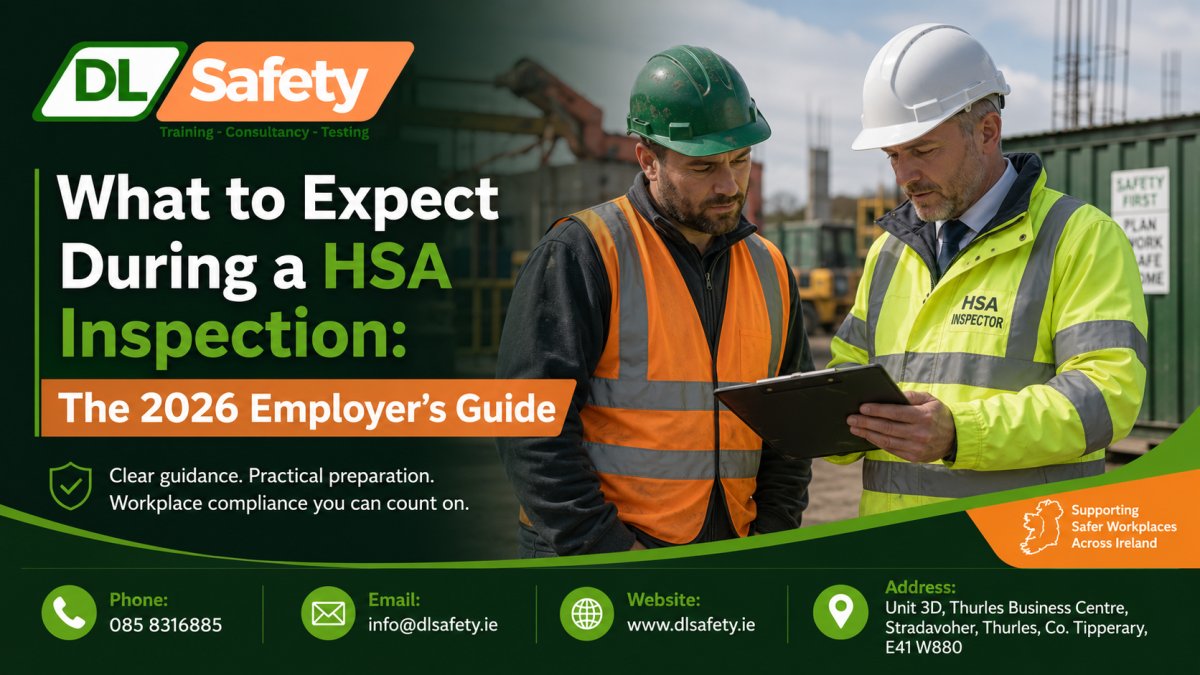
With 11,974 inspections conducted in 2025 and workplace fatalities reaching their highest level since 2007, the Health and Safety Authority is shifting from simple observation to rigorous enforcement. You likely feel a surge of anxiety at the thought of an unannounced visitor at your gate, particularly when you’re already struggling to find the time to organise complex safety paperwork. It’s a common fear that a single oversight could lead to heavy fines or even a site closure, but compliance doesn’t have to be a source of constant stress. By understanding exactly what to expect during a HSA inspection, you can move from a state of uncertainty to one of total confidence.
In this 2026 guide, we’ll demystify the inspection process by providing a clear timeline and a checklist of the statutory documents that inspectors now prioritise. Whether you need help with GA1 testing, safety statements, or monthly support, the team at DL Safety is here to help. You can reach us at www.dlsafety.ie, email info@dlsafety.ie, or call 085 8316885. Our office is located at Unit 3D Thurles Business Centre, Stradavoher, Thurles, County Tipperary, E41 W880. Let’s ensure your safety systems are robust enough to pass any scrutiny, allowing you to focus on running your business with genuine peace of mind.
Key Takeaways
- Understand the legal framework of a formal assessment to ensure your team remains compliant with the Safety, Health and Welfare at Work Act 2005.
- Learn why a signed, site-specific Safety Statement is the essential first step in demonstrating your commitment to workplace safety during an audit.
- Gain a clear roadmap of what to expect during a HSA inspection, including how an inspector bridges the gap between your paperwork and actual site practices.
- Identify the ‘Big Four’ high-risk hazards that inspectors prioritise to help you avoid common enforcement outcomes like Improvement or Prohibition Notices.
- Discover how Monthly Safety Support from DL Safety ensures you stay prepared; contact us at www.dlsafety.ie, info@dlsafety.ie, or 085 8316885, or visit us at Unit 3D Thurles Business Centre, Stradavoher, Thurles, County Tipperary, E41 W880.
Understanding the HSA Inspection Process in Ireland
A Health and Safety Authority (HSA) inspection is a formal assessment designed to verify that your workplace complies with the Safety, Health and Welfare at Work Act 2005. It isn’t merely a box-ticking exercise; it’s a rigorous check to ensure both employers and employees understand their statutory duties. In 2025, the HSA carried out 11,974 inspections and investigations, which was the highest number recorded since 2007. This surge signals a clear shift towards more frequent site visits, making it essential for you to understand exactly what to expect during a HSA inspection in 2026.
Visits aren’t always random. They often stem from planned sector campaigns, such as the 2026 focus on silica dust in construction or UV exposure for outdoor workers during the summer months. Other times, a visit follows a serious accident, a fatal incident, or even a public complaint. Under the law, inspectors possess significant powers to ensure compliance. They have the right of entry to any place of work at any reasonable time, the authority to take samples or photographs, and the power to interview personnel in private to get an honest account of site practices.
Unannounced vs. Planned Inspections
Most visits are unannounced, which allows the inspector to capture a true reflection of daily site behaviour. When an inspector arrives at your gate, greeting them with professional composure is vital. You should have a designated ‘competent person’ ready to escort them, ensuring that all safety documentation is organised and accessible. In 2026, national campaigns are specifically targeting high-risk activities like excavation safety and the management of lifting equipment. Being prepared at all times is the only way to avoid the anxiety that usually accompanies a surprise visit.
The Inspector’s Primary Objectives
The inspector’s first priority is identifying immediate, life-threatening hazards. This includes checking for unguarded edges, unstable trenches, or poorly managed traffic. Beyond physical risks, they’ll verify that your Safety Statement is a ‘living document’ that accurately reflects current site activities. They aren’t just looking at your folders; they’re assessing the actual behaviour and safety culture of your workforce. If your team can’t demonstrate they’ve read the Method Statements or understood the risks, even the most thorough paperwork won’t prevent an enforcement action.
At DL Safety, we help you bridge the gap between paperwork and practice through our Health & Safety Site Audits and Monthly Safety Support Packages. If you want to ensure your site is truly inspection-ready, you can reach us at www.dlsafety.ie, email info@dlsafety.ie, or call 085 8316885. Our team is based at Unit 3D Thurles Business Centre, Stradavoher, Thurles, County Tipperary, E41 W880, and we are dedicated to helping you maintain the highest safety standards.
Statutory Documentation: The Inspector’s First Port of Call
When an inspector arrives, the documentation review is typically the first stage of the process. They’ll almost always ask to see your Safety Statement before anything else. It’s vital that this document is signed and dated for 2026 to prove it has been reviewed recently. A common pitfall is presenting a generic, dusty folder that hasn’t been updated in years. Understanding the Role of the Health and Safety Authority helps clarify why they prioritise these records; they need to see that you’ve actively identified risks and put controls in place. Knowing what to expect during a HSA inspection means being ready to prove that your safety culture is active rather than just aspirational.
The inspector will scrutinise your Risk Assessments under Section 19 of the 2005 Act. These must be site-specific. Generic templates that don’t reflect the actual machinery or hazards present on your floor will likely trigger further investigation. In construction environments, the ‘Site Safety File’ is the cornerstone of your compliance. This file should include the Preliminary Safety and Health Plan and any relevant Method Statements (RAMS) for high-risk tasks. Inspectors are increasingly looking for “live data” and verifiable proof of employee engagement rather than just signatures on a page.
The Essential Documentation Checklist
To keep your site inspection-ready, you should maintain a central folder containing these high-priority items. Having them organised demonstrates professional competence and reduces the time an inspector needs to spend on-site. Learn more about creating a safety statement for a small business to ensure your paperwork meets these rigorous standards. Your checklist should include:
- A signed and dated 2026 Safety Statement.
- Site-specific Risk Assessments and Method Statements (RAMS) for current works.
- A comprehensive Training Matrix showing Safe Pass and CSCS cards.
- Specific competency certificates for machinery and equipment operators.
Statutory Testing and Certification
Beyond training records, the physical equipment on your site must have valid certification. This is where many businesses fail to meet the mark. You must have valid GA1 certificates for all lifting equipment, including slings, chains, and shackles. Portable electrical tools require up-to-date PAT testing records to ensure they’re safe for use. If you operate in the industrial or quarry sectors, brake testing reports for heavy vehicles are now a major focus area for 2026 campaigns. Our team at DL Safety provides comprehensive GA1 testing and site audits to help you stay ahead of these requirements. To fully understand your obligations around GA1 certification and inspection intervals, our guide on lifting equipment inspection training Ireland provides a clear breakdown of the statutory requirements for 2026. You can find us at Unit 3D Thurles Business Centre, Stradavoher, Thurles, County Tipperary, E41 W880, or contact us at info@dlsafety.ie or 085 8316885.
The Physical Site Walkthrough: Bridging Paperwork and Practice
Once the documentation review is complete, the inspector will step out onto the site to observe work in progress. This is often the most stressful part of the visit, but knowing exactly what to expect during a HSA inspection can help you maintain focus and composure. The inspector isn’t just looking at the machinery; they’re looking to see if the Method Statements you provided earlier are actually being followed by the crew on the ground. If your RAMS state that exclusion zones are in place for lifting operations, but the inspector sees workers walking freely under a suspended load, your paperwork loses its credibility immediately.
The inspector’s focus will invariably fall on ‘The Big Four’ high-risk areas: falls from height, falling objects, moving vehicles, and collapsing excavations. Given that workplace fatalities rose to 61 in 2025, these areas remain the top priorities for enforcement in 2026. They’ll also check the ‘human’ side of the site. Welfare facilities, such as clean toilets, drying rooms, and access to fresh drinking water, are statutory requirements that reflect your overall safety culture. Similarly, PPE compliance is about more than just wearing a hard hat; the inspector will check if the gear is in good condition and suitable for the specific task at hand. For those managing complex sites, you can discover 11 Bravo Security and their tactical guide to fire prevention and fire watch compliance.
Equipment Inspection and Maintenance
Inspectors will look for physical proof of maintenance and testing. They’ll check that all lifting gear is clearly colour-coded and that these colours match your current GA1 certificates. If an excavator or MEWP is in use, they may ask the operator for proof of training on the spot. One of the biggest red flags for any inspector is an improvised ‘home-made’ repair on equipment, such as a welded-on hook or a taped-up electrical cable. These improvised fixes suggest a lack of formal maintenance and can lead to immediate Prohibition Notices. Ensuring your team has completed proper lifting equipment inspection training in Ireland is one of the most effective ways to demonstrate competency and avoid this outcome.
Behavioural Safety and Supervision
The way your supervisors manage the site is under the microscope. An inspector will observe how they react to unsafe behaviour amongst the crew and may speak with your designated Safety Representative to gauge their level of involvement. Effective supervision is particularly critical when you are managing external teams or diverse trades. For more on this, see our guide on Managing Subcontractor Safety Compliance.
At DL Safety, we specialise in keeping businesses ‘inspection-ready’ through our Monthly Safety Support Packages and on-site audits. If you need assistance with GA1 testing or accident investigation, you can reach us at www.dlsafety.ie, email info@dlsafety.ie, or call 085 8316885. Our team is located at Unit 3D Thurles Business Centre, Stradavoher, Thurles, County Tipperary, E41 W880. We provide the expertise you need to ensure your physical site standards match your safety ambitions.
Enforcement Outcomes: From Advisory Reports to Prohibition Notices
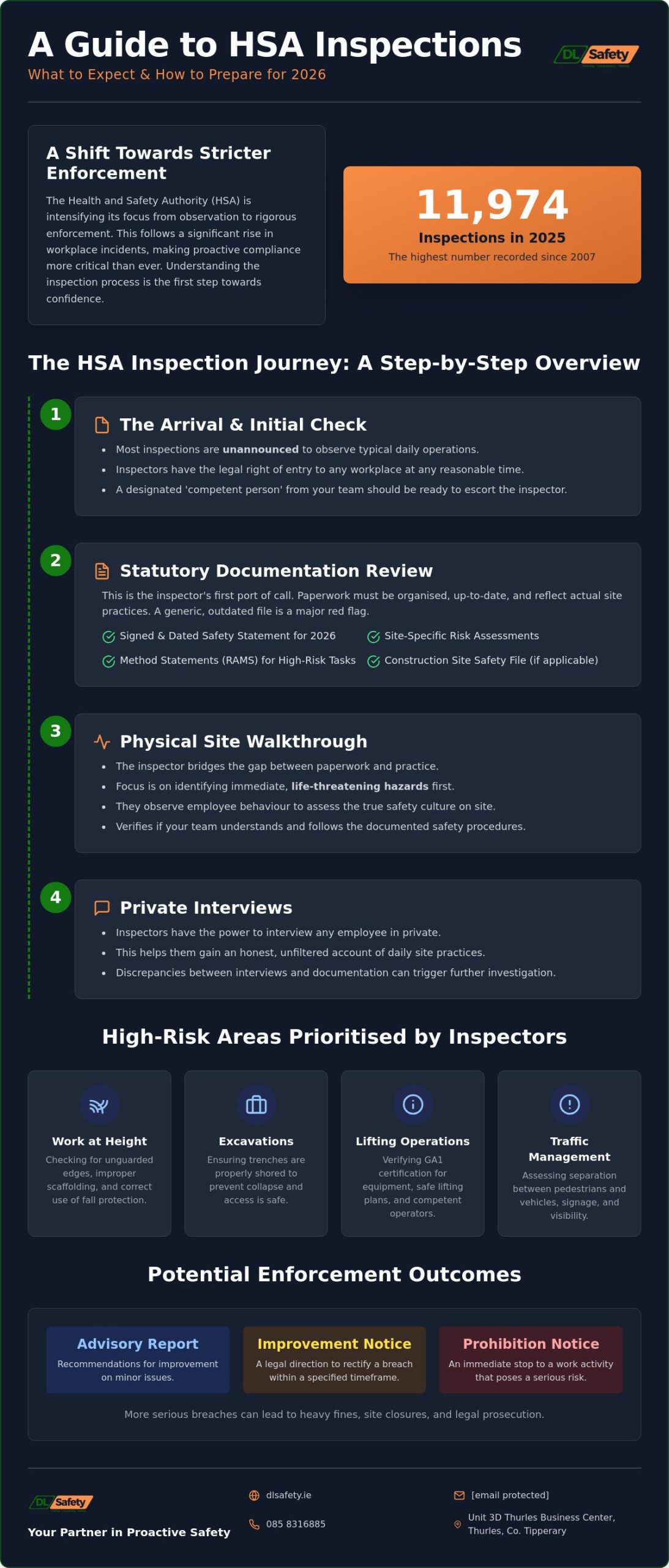
When the inspector concludes their walkthrough, the atmosphere often shifts from observation to formal feedback. Knowing what to expect during a HSA inspection outcome means being prepared for one of four primary results. The most frequent is a Report of Inspection. This written summary contains advisory ‘points for attention’ that you must address to prevent future escalations. Whilst these aren’t legal orders, they serve as a roadmap for the inspector’s next visit. If you ignore these suggestions, you’re essentially handing the inspector a reason to take formal action later.
More serious findings result in an Improvement Notice, which is a legal directive to fix a specific breach within a set window. If an inspector finds an immediate threat to life, such as an unshored trench or a worker on an unprotected roof, they’ll issue a Prohibition Notice. This halting order stops all work on that task or machine instantly until the danger is cleared. In 2025, the HSA issued 420 Prohibition Notices and 415 Improvement Notices. For the most severe breaches, the HSA pursues prosecution. Total fines in 2025 reached €2.468 million; 2026 has already seen significant penalties, including a €150,000 fine for Meade Potato Company Unlimited in February following a serious incident.
Responding to an Enforcement Notice
If you receive a notice, the clock starts ticking immediately. Ignoring HSA deadlines is a high-risk strategy that often leads to more severe penalties or even site closure. It’s vital to seek professional safety consultancy to ensure your remedial actions meet the required standard. Understanding what to expect during a HSA inspection follow-up is just as important as the initial visit. You might also need to know how to challenge a HSA Improvement Notice if you believe the findings are inaccurate or the timeframe is unreasonable.
Director’s Liability and Reputation
Under the 2005 Act, directors and managers can be held personally liable for systemic safety failures. This isn’t just about the company’s bank account; it’s about your personal record and the business’s reputation. Maintaining a clean HSA record is essential for your ability to tender for large-scale projects, particularly in the public sector. For a deeper look at your legal obligations, read our guide on Director’s Responsibilities for Health and Safety in Ireland. Once you understand those obligations, the next step is ensuring your leadership team can communicate performance effectively; our guide on presenting safety statistics to the board provides a repeatable 2026 reporting framework to help directors turn raw inspection data into actionable governance insight.
If you’ve recently had an inspection or want to prevent enforcement action, our Monthly Safety Support Packages provide the expert oversight you need to stay compliant. Our team at DL Safety is ready to support you. Contact us at www.dlsafety.ie, email info@dlsafety.ie, or call 085 8316885. You can also visit our office at Unit 3D Thurles Business Centre, Stradavoher, Thurles, County Tipperary, E41 W880. We’re here to help you turn a stressful inspection into a validation of your high standards.
Proactive Preparation: How Monthly Safety Support Eliminates Anxiety
Many businesses operate in a state of reactive “firefighting,” only scrambling to update folders when they hear a rumour that an inspector is in the area. This is a high-risk strategy that rarely pays off. When you truly understand what to expect during a HSA inspection, you realise that surface-level compliance is easy to spot. Inspectors are trained to look past the paperwork and identify whether safety is actually woven into your daily site behaviour. Waiting for a visit to fix your systems isn’t just stressful; it’s a gamble with your reputation and your team’s lives.
The transition from a reactive to a proactive safety culture is the single most effective way to eliminate inspection anxiety. By maintaining a constant state of readiness, an unannounced visit becomes a validation of your standards rather than a threat to your operations. Retaining a professional safety consultant provides you with a “big picture” perspective, allowing you to address long-term impacts rather than just immediate tasks. This approach reduces the administrative burden on your staff and ensures that your safety systems are always robust enough to pass scrutiny.
A similar commitment to quality and rigorous vetting is essential in other professional environments; for those in the scientific community, you can learn more about EuroLab Peptides and their guide on vetting suppliers for research-grade materials.
The DL Safety Monthly Support Package
Our Monthly Safety Support Packages are built on the principle of transparency and reliability. We don’t just hand you a folder and walk away; we become a dedicated partner in your success. Our team performs regular on-site audits that mimic HSA standards, catching behavioural issues or equipment faults before an inspector ever arrives at your gate. We also provide ongoing reviews of your Safety Statements and Risk Assessments to ensure they remain relevant to your current projects. Most importantly, you gain direct access to our expertise during an active HSA visit for immediate, professional advice.
Next Steps for Your Business
The first step toward total compliance is a thorough ‘gap analysis’ of your current safety files to identify where you might be vulnerable. It’s also the perfect time to organise your GA1 and PAT testing for 2026 to ensure all machinery and tools are fully certified. If you’re ready to move away from the stress of compliance, we invite you to book a consultation with the team at DL Safety to discuss a bespoke support package. You can visit us at www.dlsafety.ie, email info@dlsafety.ie, or call 085 8316885. Our office is located at Unit 3D Thurles Business Centre, Stradavoher, Thurles, County Tipperary, E41 W880. Let’s work together to make your next inspection a stress-free experience.
Build a Culture of Constant Inspection Readiness
Navigating the complexities of statutory compliance doesn’t have to be a source of constant stress for your leadership team. By ensuring your Safety Statement is a site-specific, living document and maintaining rigorous standards for GA1 testing, you’ve already mastered the most difficult part of what to expect during a HSA inspection. The goal isn’t just to avoid a Prohibition Notice; it’s to create a culture where safety is a natural part of every task, from excavation to the final walkthrough. This proactive approach protects your reputation and, more importantly, your people.
We are here to support you in maintaining these high standards through our specialist GA1 and brake testing services, as well as expert accident investigation support. To ensure your site is always ready for scrutiny, secure your business with a Monthly Safety Support Package from DL Safety. You can also reach us at info@dlsafety.ie or call 085 8316885. Our team is based at Unit 3D Thurles Business Center, Stradavoher, Thurles, County Tipperary, E41 W880. With the right partner by your side, you can face your next inspection with total confidence and professional pride.
Frequently Asked Questions
Do I have to let a HSA inspector onto my site if they arrive unannounced?
Yes, you are legally required to allow entry. Under the Safety, Health and Welfare at Work Act 2005, inspectors have the right to enter any workplace at any reasonable time. Obstructing an inspector is a criminal offence and can lead to immediate prosecution or a fine of up to €5,000 on summary conviction. It’s always best to cooperate fully and have a competent person ready to escort them.
What is the most common reason for a HSA inspector to issue a Prohibition Notice?
Immediate danger to life is the primary trigger, with work at height and unsafe excavations being the most frequent causes. In 2025, the HSA issued 420 Prohibition Notices for hazards like unprotected roof edges or a lack of shoring in deep trenches. If an inspector believes a task poses an imminent risk, they’ll stop the activity instantly until the hazard is fully resolved.
How long does a HSA inspection typically take on a construction site?
A typical inspection usually lasts between two and four hours, depending on the site’s size and complexity. The inspector will spend time reviewing your Safety Statement and GA1 certificates before conducting a physical walkthrough. Knowing what to expect during a HSA inspection helps you prepare your files in advance, which can significantly streamline the process and reduce unnecessary downtime for your crew.
Can a HSA inspector interview my employees without me being present?
Yes, inspectors have the legal authority to interview any personnel in private. This power ensures they can get an honest account of site practices and safety culture without influence from management. They may ask employees about their specific training, if they’ve read the Method Statements, or if they’ve ever been asked to perform a task they felt was unsafe or poorly managed.
What happens if I cannot meet the deadline on a HSA Improvement Notice?
Failing to meet a deadline is a serious breach that often leads to a Prohibition Notice or legal prosecution. If you realise you can’t comply within the set timeframe due to factors beyond your control, you must contact the inspector immediately to discuss an extension. Ignoring the deadline is never an option, as it demonstrates a lack of commitment to your statutory safety obligations.
Will the HSA fine me immediately during the inspection?
No, HSA inspectors don’t issue “on-the-spot” fines like traffic wardens. Instead, they issue enforcement notices or reports of inspection. Monetary penalties are typically decided in court following a successful prosecution. However, the costs associated with a Prohibition Notice, such as site downtime and urgent remedial work, can be far more expensive than a court-mandated fine, impacting your bottom line instantly.
How often does the HSA visit small businesses in Ireland?
The frequency of visits depends on your industry’s risk level and current HSA campaigns rather than your business size. High-risk sectors like construction and agriculture are prioritised for more frequent visits. With 11,974 inspections conducted in 2025, even small businesses should maintain a constant state of readiness, as unannounced visits are common during nationwide safety drives focusing on specific hazards.
What documents are most frequently missing during a HSA inspection?
Site-specific Risk Assessments and up-to-date GA1 certificates for lifting equipment are the most commonly missing items. Often, employers rely on generic templates that don’t reflect actual hazards. To ensure your files are complete, contact DL Safety at www.dlsafety.ie or 085 8316885. Our team at Unit 3D Thurles Business Centre, Stradavoher, Thurles, Tipperary, E41 W880, can help you prepare for exactly what to expect during a HSA inspection.