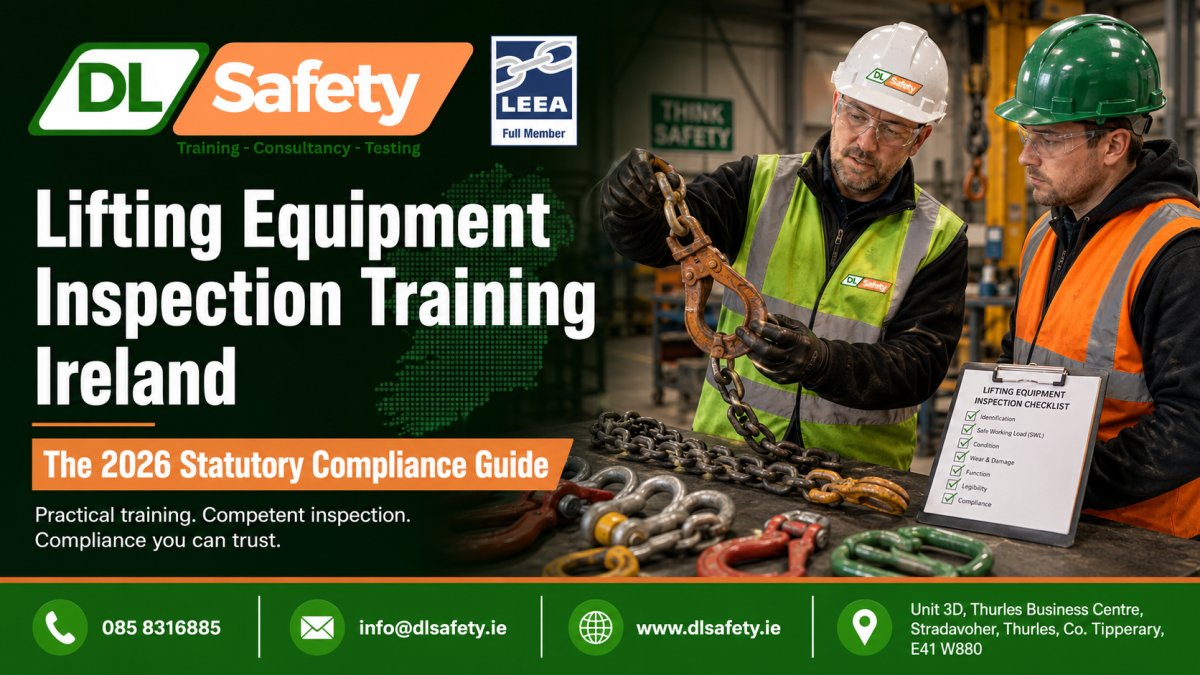
Imagine an HSA inspector walks onto your site tomorrow morning and asks for your latest GA1 certificates. If your heart sinks because you aren’t certain if that chain sling was due its six-month check, you aren’t alone. Many site managers across the country find the shift between six and twelve-month intervals confusing, particularly whilst trying to keep projects on schedule. Securing high-quality lifting equipment inspection training Ireland is no longer just a box-ticking exercise; it’s a vital safeguard against the rising rates of workplace incidents.
At DL Safety, we believe that compliance shouldn’t feel like a barrier to your progress. We’re here to help you master the complexities of GA1 certification and statutory lifting inspections so your site remains both safe and fully operational. This 2026 guide will provide a clear understanding of your legal obligations and show you how to reduce your reliance on external inspectors for minor checks. Whether you need bespoke training or equipment from our base at Unit 3D Thurles Business Center, Stradavoher, Thurles, County Tipperary, E41 W880, our goal is to support your team. For direct advice, you can reach us at 085 8316885, email info@dlsafety.ie, or visit www.dlsafety.ie to explore our safety support packages.
Key Takeaways
- Clarify the legal requirements for six-month versus twelve-month inspection intervals to ensure your gear always meets the 2007 General Application Regulations.
- Master the process of issuing GA1 Certificates of Thorough Examination and understand the exact criteria required to be deemed a “Competent Person” under Irish law.
- Identify the core curriculum needed for high-quality lifting equipment inspection training Ireland, from recognising metallurgy wear patterns to documenting defects accurately.
- Learn how to organise a robust on-site inspection regime that empowers your operators to conduct effective pre-use checks and maintain a statutory register.
- Discover how to simplify compliance by combining professional training with the expert guidance found in our Monthly Safety Support Packages available at www.dlsafety.ie.
Navigating Lifting Equipment Regulations and Safety Standards in Ireland
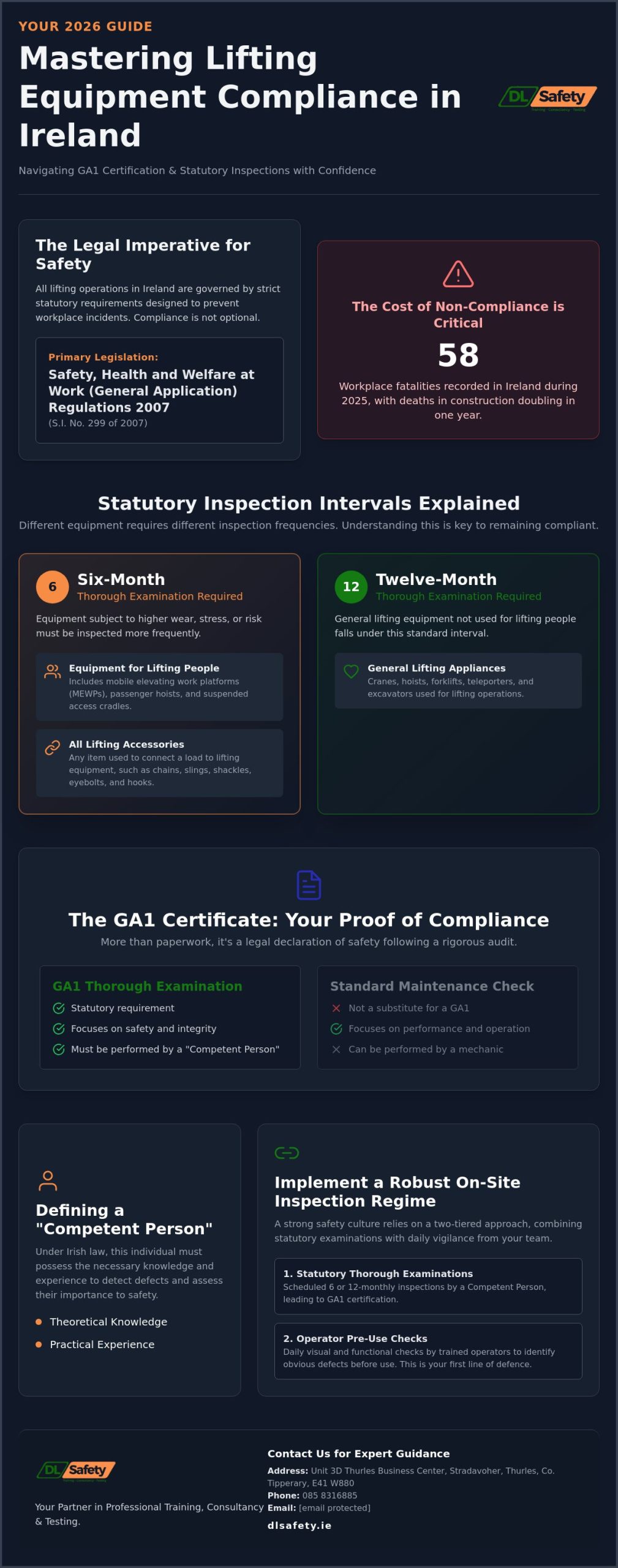
The Safety, Health and Welfare at Work (General Application) Regulations 2007 (S.I. No. 299 of 2007) serve as the backbone for all lifting operations across the Republic. These regulations aren’t merely suggestions; they’re rigid statutory requirements designed to keep workers safe in high-risk environments. For any site manager in the construction or industrial sectors, staying compliant is a full-time commitment. The Health and Safety Authority (HSA) maintains a proactive stance on enforcement, often conducting unannounced inspections to verify that every hoist, chain, and shackle is accounted for in a statutory register.
The stakes are incredibly high. In 2025, Ireland saw 58 workplace fatalities, with construction deaths doubling in a single year. Many of these incidents involve the incorrect use of lifting or height-safety equipment. Failing to meet these standards doesn’t just result in heavy HSA fines or site closures; it carries the weight of legal liability and the devastating risk of catastrophic mechanical failure. It’s why many firms now prioritise lifting equipment inspection training Ireland to ensure their teams can spot issues before they escalate.
Understanding the Legal Framework for Lifting Operations
Irish law distinguishes between general work equipment rules and the specific hazards of lifting. Whilst Part 2 of the 2007 Regulations covers the Provision and Use of Work Equipment, Part 4 focuses exclusively on lifting equipment. In 2026, Irish standards continue to align closely with international best practices like those found in the Lifting Operations and Lifting Equipment Regulations (LOLER).
Employers bear the ultimate responsibility for ensuring that all gear is maintained and that staff are competent. This means every piece of equipment must have a valid GA1 certificate, and every operator must understand how to spot a defect. Professional lifting equipment inspection training Ireland bridges the gap between basic operation and technical competency, ensuring that your business meets its duty of care.
The Importance of Certified Training for Site Safety
Experience is valuable, but “in-house” knowledge is rarely enough to satisfy an auditor or prevent an accident. Formal training provides the technical depth required to identify subtle signs of wear, such as hairline fractures or chain elongation, that an untrained eye might miss. Trained staff serve as your first line of defence. By implementing rigorous pre-use check protocols, you create a culture where safety is proactive rather than reactive. This reduces your reliance on external inspectors for minor daily checks and ensures that your team remains protected.
If you’re looking to strengthen your site’s safety culture, we’re here to help. At DL Safety, located at Unit 3D Thurles Business Center, Stradavoher, Thurles, County Tipperary, E41 W880, we provide the expertise needed to manage these risks. You can contact us at 085 8316885 or email info@dlsafety.ie. For more information on our support services, visit www.dlsafety.ie.
The GA1 Certificate of Thorough Examination: Essential Compliance
The GA1 certificate, or the Report of Thorough Examination, is the most critical document for any site using lifting gear. It isn’t just a piece of paper; it’s a statutory requirement that proves a detailed, technical inspection has been carried out by a qualified professional. Many site managers mistake a standard maintenance check or a manufacturer’s service for a GA1. Whilst regular maintenance keeps machines running, a thorough examination is a rigorous safety audit. This distinction is vital for remaining compliant with the Health and Safety Authority (HSA). A maintenance check focuses on performance, but a thorough examination focuses on integrity and safety.
Who is a “Competent Person” under Irish Law?
The law is very specific about who can sign off on these certificates. It isn’t enough to be a “handy” mechanic or an experienced operator. A competent person must possess the right blend of theoretical knowledge and practical experience to identify defects and assess their impact on safety. Crucially, this person must be impartial. They shouldn’t be the same individual responsible for the daily maintenance of the equipment they are inspecting. According to HSA guidelines, a competent person is someone who has the necessary theoretical knowledge and practical experience of the lifting equipment to be able to detect defects or weaknesses and to assess their importance in relation to the safety and continued use of the equipment. If your team lacks this internal expertise, investing in lifting equipment inspection training Ireland can help develop the necessary skills amongst your senior staff.
Statutory Intervals for Thorough Examinations
Precise timing is vital for maintaining GA1 compliance. If you miss an inspection window, your insurance may be voided and your site could face immediate closure. The intervals depend entirely on the type of equipment being used:
- 6-Month Intervals: This applies to all lifting accessories, such as slings, chains, and shackles, as well as any equipment used for lifting people.
- 12-Month Intervals: General lifting machinery, including cranes and telescopic handlers, typically require an annual examination.
- Immediate Examination: You must trigger an inspection if the equipment has been involved in an accident, undergone major repairs, or been out of use for a long period.
Managing these dates across a busy site is a challenge. At DL Safety, we help businesses stay on top of these requirements through our Monthly Safety Support Packages, ensuring you never miss a deadline. Our team is based at Unit 3D Thurles Business Center, Stradavoher, Thurles, County Tipperary, E41 W880. If you have questions about your specific fleet, call us at 085 8316885 or email info@dlsafety.ie for expert guidance.
Comparing Lifting Equipment Inspection Training Programmes
Selecting the right lifting equipment inspection training Ireland requires a clear understanding of your site’s specific inventory. It isn’t helpful to put a general plant operator through an advanced crane inspection course if they only ever handle chain slings and shackles. The ideal programme should offer a curriculum that moves beyond basic operation. A high-quality course covers metallurgy, identifying stress-induced wear patterns, and the precise methodology for reporting defects. Whilst online theory is excellent for understanding legislation, hands-on practical assessment remains the only way to ensure an inspector can physically identify a hairline crack or a stretched link in real-world conditions.
Training for Lifting Accessories vs. Machinery
Inspecting lifting accessories like slings, chains, and shackles requires a different set of skills compared to inspecting plant machinery. For accessories, the focus is often on high-frequency wear and environmental damage. Advanced training for complex lifting systems, such as tower cranes or telescopic handlers, involves understanding hydraulic integrity and structural stability. When selecting a course, ensure the certification is valid and recognised. You can learn more about how to verify a safety training certificate to protect your business from fraudulent providers.
The gold standard for these programmes often follows the guidelines set by the Lifting Equipment Engineers Association (LEEA). Their standards ensure that training isn’t just about passing a test but about gaining deep technical proficiency. This includes understanding how different materials react under load and how to document findings in a way that satisfies statutory GA1 requirements. This technical depth is what separates a basic check from a thorough examination that keeps your site compliant.
What to Look for in a Training Provider
A reliable training provider should offer more than just a classroom session. Look for trainers who have active field experience in performing GA1 testing. This ensures the advice they give is grounded in current site realities rather than just textbook theory. Post-training support is equally vital. Having a direct line to a technical expert can be the difference between a minor equipment query and a major safety incident. It’s often better to work with a provider that understands the “big picture” of site safety rather than a faceless training entity.
At DL Safety, we bridge this gap by providing bespoke training that is tailored to the exact equipment your team uses every day. Our experts don’t just teach safety; they live it through our daily testing services across Ireland. Based at Unit 3D Thurles Business Center, Stradavoher, Thurles, County Tipperary, E41 W880, we are ready to help you upskill your workforce. Reach out to us at 085 8316885 or email info@dlsafety.ie to discuss your training needs. You can also view our full range of services at www.dlsafety.ie.
Implementing an Effective On-site Inspection Regime
Establishing a robust safety culture on-site starts with the operator. It isn’t enough to have a GA1 certificate tucked away in a filing cabinet; the equipment must be fit for purpose every time it leaves the ground. A successful regime moves beyond the statutory six-month check and focuses on the daily behaviour of your team. When operators take ownership of their gear, they become the most effective tool in preventing accidents. This proactive approach ensures that minor issues are caught before they develop into expensive repairs or, worse, workplace injuries.
A vital part of this regime is knowing exactly when to pull a piece of equipment from service. You must establish clear rejection criteria that every staff member understands. For instance, if a lifting hook shows signs of a widened throat opening or if a wire rope has more than a handful of broken wires in a single lay, it must be quarantined immediately. Illegible identification tags are another non-negotiable rejection point. If you can’t verify the Safe Working Load (SWL) or the unique ID of a shackle, it shouldn’t be used. Whilst external audits are vital, the daily safety of your crew depends on the quality of lifting equipment inspection training Ireland provided to your on-site team.
The Daily Pre-use Check Workflow
Every operator should follow a structured visual inspection pattern before work begins. This involves checking for nicks, gouges, chemical damage, or heat discolouration on slings and chains. Reporting procedures must be simple; if a “near miss” or a defect is found, there should be a clear path to notify the site manager without fear of project delays. For more specific details on hardware, you can read our guide on the safe use of lifting shackles.
Statutory Record Keeping and the Safety File
Maintaining an organised statutory register of all lifting equipment is a legal requirement. This safety file must be easily accessible for HSA inspectors and should track the entire lifecycle of each asset. Digital management systems are increasingly popular as they allow for real-time updates and automated reminders for upcoming GA1 renewals. Knowing exactly when to discard a lifting chain is a key part of this record-keeping process, ensuring that your inventory only contains gear that is safe and compliant.
Managing these daily complexities shouldn’t fall solely on your shoulders. Our Monthly Safety Support Packages provide the structure and oversight needed to keep your site compliant without the administrative headache. If you’re based in the Tipperary area or across Ireland, visit us at Unit 3D Thurles Business Center, Stradavoher, Thurles, County Tipperary, E41 W880. You can also contact David and the team at 085 8316885 or email info@dlsafety.ie to discuss how we can support your on-site inspection regime.
Professional Training and Monthly Safety Support with DL Safety
Compliance isn’t a one-off event; it’s a continuous process that requires both skilled people and reliable equipment. Whilst many providers offer generic courses, DL Safety bridges the critical gap between classroom theory and daily site reality. We don’t just provide lifting equipment inspection training Ireland; we offer a partnership that ensures your statutory obligations are met month after month. By combining our training expertise with physical equipment supply and technical audits, we remove the friction from safety management and let you focus on your core operations.
Bespoke Training Solutions for Irish Industry
Every site has a unique fleet and its own set of challenges. A quarry in Tipperary faces different risks than a high-rise construction project in Dublin, which is why we tailor our course content to your specific equipment and site hazards. This ensures the training is directly relevant to your team’s daily tasks. Our on-site training options are designed to minimise disruption to your workflow, allowing your staff to learn in their own environment. For high-risk lifting scenarios, we integrate simulation training to build confidence and technical competence without the real-world danger of a lifting failure.
The DL Safety Advantage: Total Compliance Support
What sets us apart is our “big picture” approach to safety. Our Monthly Safety Support Packages are the ultimate solution for firms that want more than just a certificate. These packages provide consistent safety oversight through a retained consultancy model, giving you priority access to David and our team of experts. Whether you need a detailed accident investigation or a comprehensive health and safety site audit, we act as your proactive partner in problem-solving.
We also simplify your supply chain by providing direct access to the gear your team uses. Instead of dealing with multiple vendors, you can source high-quality lifting accessories directly from us, including:
- Lifting Slings: Durable webbing and round slings for various load types.
- Lifting Chains: Grade 80 and Grade 100 chains for heavy-duty applications.
- Lifting Shackles: D-shackles and bow shackles tested to Irish standards.
DL Safety is led by David, an experienced construction safety professional who understands the pressures of the Irish industrial sector. Our centre is located at Unit 3D Thurles Business Center, Stradavoher, Thurles, County Tipperary, E41 W880. To discuss your bespoke lifting equipment inspection training Ireland or to inquire about our support packages, contact us today at 085 8316885 or email info@dlsafety.ie. You can also explore our full range of safety statements and ISO preparation services at www.dlsafety.ie.
Securing Your Site’s Future through Proactive Safety Management
Compliance isn’t just about passing an inspection; it’s about building a culture where every lift is planned and every shackle is verified. By mastering the statutory requirements for GA1 certifications and empowering your team with high-quality lifting equipment inspection training Ireland, you protect your workforce and your business from the risks of mechanical failure and legal liability. You now understand how the distinction between six and twelve-month intervals is vital, but the real power lies in the daily vigilance of your operators and the maintenance of a robust safety file.
A truly safe site relies on the consistent application of these standards and the use of certified gear. Whether you’re managing a busy construction project or a complex industrial facility, having a trusted partner makes the path to compliance much clearer and less stressful. Our team is ready to support your long-term goals with expert GA1 testing and equipment supply from our base in Tipperary.
Contact DL Safety today to book your lifting equipment inspection training or discuss our Monthly Safety Support Packages. You can find us at Unit 3D Thurles Business Center, Stradavoher, Thurles, County Tipperary, E41 W880, reach us at 085 8316885, or email info@dlsafety.ie. Let’s work together to ensure your site remains a leader in safety and operational excellence.
Frequently Asked Questions
Is GA1 training mandatory for all construction workers in Ireland?
No, GA1 training isn’t mandatory for every general worker on a site. It is, however, essential for any staff member designated as a “Competent Person” responsible for performing thorough examinations and signing off on statutory reports. Whilst all operators need basic safety awareness, specific lifting equipment inspection training Ireland is required for those who must identify technical defects and ensure legal compliance.
How long is a GA1 certificate valid for under current Irish law?
The validity of a GA1 certificate depends entirely on the type of equipment and its application. Under the 2007 General Application Regulations, lifting accessories and any equipment used for lifting people require a thorough examination every 6 months. Most other lifting machinery, such as standard cranes or forklifts, requires a new certificate every 12 months.
Can an in-house employee perform a statutory thorough examination?
Yes, an in-house employee can perform these examinations if they meet the legal criteria for a “Competent Person.” They must possess the correct blend of theoretical knowledge and practical experience to detect defects. Crucially, they must remain impartial, which means they shouldn’t be the person responsible for the day-to-day maintenance of the gear they are inspecting.
What is the difference between LOLER and the Irish General Application Regulations?
LOLER (Lifting Operations and Lifting Equipment Regulations) is the statutory framework used in the United Kingdom. In Ireland, we follow the Safety, Health and Welfare at Work (General Application) Regulations 2007, specifically Part 4. Whilst the technical safety standards are very similar, the Irish regulations require the specific GA1 form for reporting thorough examinations.
What happens if a HSA inspector finds an expired GA1 certificate on my site?
Finding an expired certificate usually results in a Prohibition Notice, which stops the use of that equipment immediately. This can lead to significant project delays and heavy fines from the HSA. If an accident occurs involving equipment with an expired GA1, your insurance provider will likely refuse to cover the claim, leaving your business fully liable.
What lifting equipment requires a 6-monthly thorough examination?
All lifting accessories, including chains, slings, and shackles, must be examined every 6 months. Additionally, any equipment used for lifting persons, such as hoists, MEWPs, or cranes with man-baskets, falls under this stricter six-month requirement to ensure maximum safety for workers at height.
Does DL Safety provide on-site lifting equipment inspection training?
Yes, we specialise in bespoke, on-site lifting equipment inspection training Ireland that is tailored to the specific gear your team uses. Our experts travel from our centre at Unit 3D Thurles Business Center, Stradavoher, Thurles, County Tipperary, E41 W880, to provide hands-on instruction. You can reach us at 085 8316885, email info@dlsafety.ie, or visit www.dlsafety.ie to arrange a session.
Can I use a GA1 certificate from a different country in Ireland?
No, you generally can’t use a foreign inspection report to satisfy Irish statutory requirements. Any lifting equipment brought into Ireland must be examined by a competent person who issues a report that specifically complies with the 2007 Irish Regulations. It’s best to have an Irish GA1 performed before the equipment is put into service on any local site.