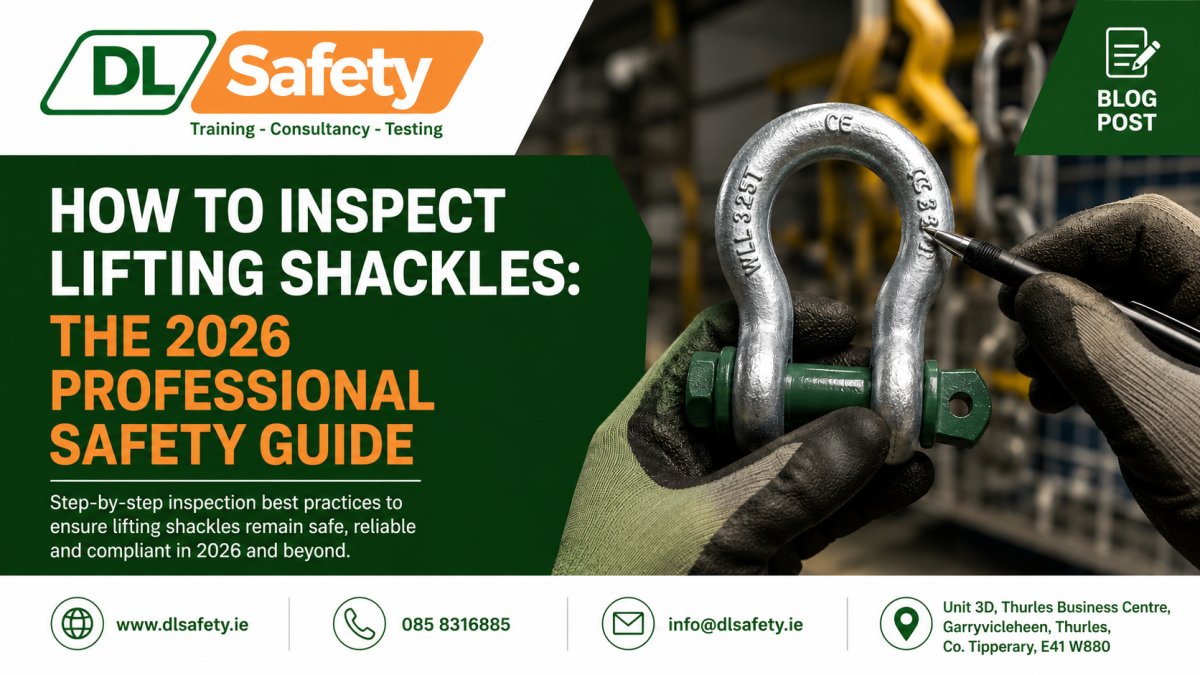
Professional shackle inspection is a three-dimensional process covering markings, geometry, and surface integrity; anything less is a safety gamble that puts lives and livelihoods at risk. Learning how to inspect lifting shackles correctly is about more than just ticking a box; it’s about the peace of mind that comes from knowing every pin and bow on your site is fit for purpose. We understand the pressure of an upcoming HSA inspection or the nagging doubt that arises when you spot a slight bend in a pin and wonder if it represents a critical failure waiting to happen.
This guide will show you exactly how to master the essential steps to identify unsafe gear and understand the specific wear patterns that demand immediate removal from service. You’ll gain a clear, repeatable checklist to ensure site safety, regulatory compliance, and equipment longevity. We’ll walk you through the latest 2026 rejection criteria, including heat damage and 10% dimension reductions, turning uncertainty into professional confidence. For expert GA1 testing or high-quality lifting equipment, visit us at www.dlsafety.ie or reach our team at Unit 3D Thurles Business Centre, Stradavoher, Thurles, County Tipperary, E41 W880. You can also contact us directly at info@dlsafety.ie or call 085 8316885.
Key Takeaways
- Learn to distinguish between daily pre-use checks and statutory thorough examinations to maintain continuous site safety and regulatory compliance.
- Master the professional methodology for how to inspect lifting shackles, focusing on cleaning techniques that reveal hidden surface defects and structural nicks.
- Understand the critical “10% Rule” and other non-negotiable rejection criteria that signal when a shackle must be immediately discarded to prevent equipment failure.
- Ensure your operations meet Irish statutory requirements by mastering the role of GA1 Certificates and the necessity of six-monthly professional assessments.
- Access expert support from DL Safety (www.dlsafety.ie) at Unit 3D Thurles Business Centre, Stradavoher, Thurles, County Tipperary, E41 W880; contact info@dlsafety.ie or call 085 8316885 for professional GA1 testing.
Understanding Lifting Shackle Inspection Fundamentals
A professional shackle inspection is a methodical review of three core elements: the shackle body, the pin, and the identifying markings. When you are learning how to inspect lifting shackles, you must treat each component as a potential point of failure. The body must be checked for deformation; the pin must be inspected for thread integrity; and the markings must be legible to ensure the Working Load Limit (WLL) isn’t exceeded. Skipping any of these steps creates a safety gamble that your site simply cannot afford.
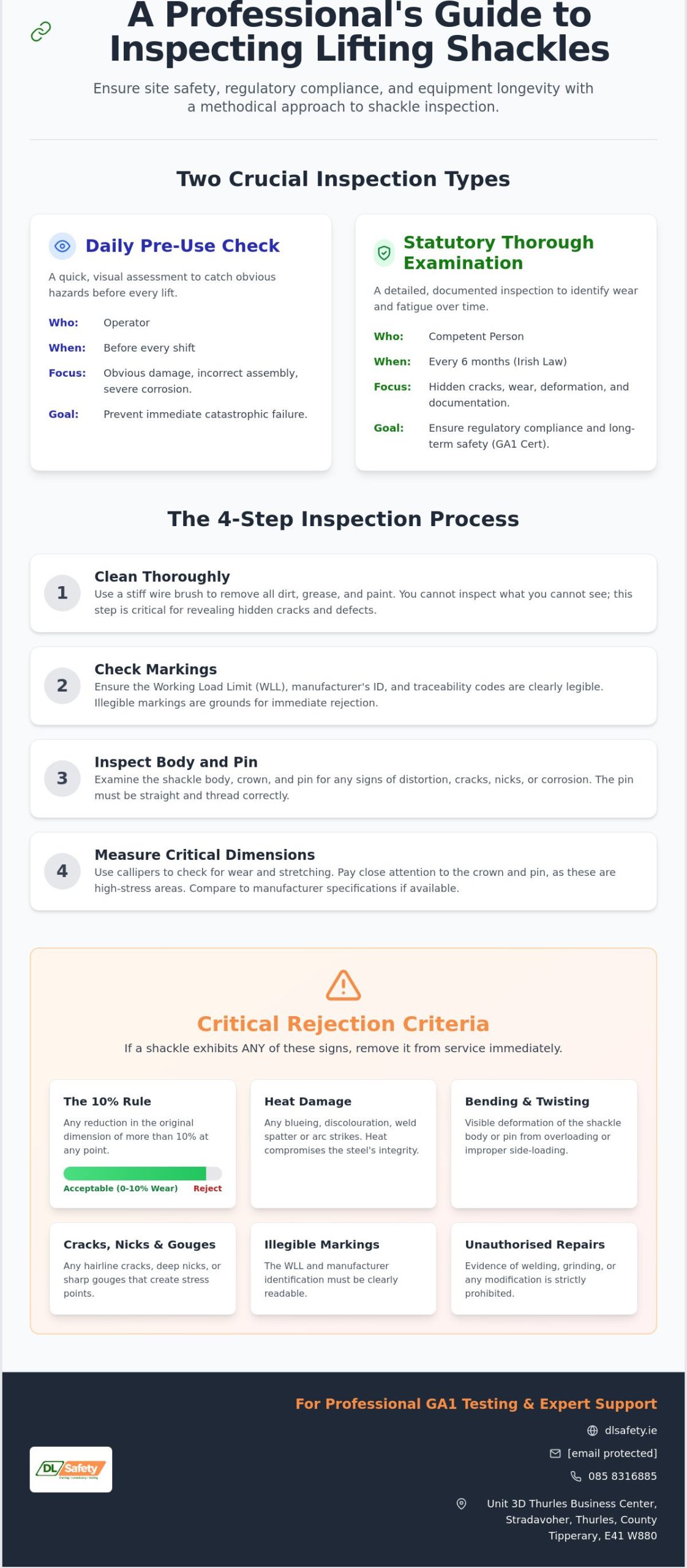
There is a clear distinction between a daily pre-use check and a statutory thorough examination. The pre-use check is a visual assessment performed by the operator before every shift to catch obvious damage. In contrast, a thorough examination is a detailed, documented inspection carried out by a competent person, such as the team at DL Safety, usually every six months under Irish safety regulations. This formal process ensures that hidden fatigue or wear hasn’t compromised the equipment’s integrity over time.
Shackles are amongst the most vulnerable components in any lifting assembly because they often act as the primary connection point between the load and the hoist. Understanding Lifting Shackle Fundamentals helps in choosing the right gear for the job. Bow shackles, with their rounded “omega” shape, allow for multi-leg sling attachments and better handle side-loading. Dee shackles are designed for straight-line tension and can fail if subjected to the same centre-loading stresses as a bow shackle.
The Importance of Pre-Use Checks
Riggers must perform a visual assessment before every single lift. This isn’t just a formality; it’s a life-saving habit. You are looking for immediate hazards like a pin that isn’t fully seated or severe surface corrosion that could hide deeper cracks. Mastering how to inspect lifting shackles at this basic level prevents catastrophic site accidents by identifying gear that has been compromised by previous near-miss events or improper storage. If you don’t trust the gear, don’t use it.
Organising Your Inspection Kit
Accurate assessment requires the right tools. You’ll need callipers to measure for wear or “stretching” and a stiff wire brush to remove grit and grease from the threads. Good lighting is essential; you can’t spot a hairline crack in a dimly lit warehouse. We recommend using a digital safety app or a dedicated logbook to record your findings consistently. If you need help setting up a robust system or require professional GA1 testing, contact us at Unit 3D Thurles Business Centre, Stradavoher, Thurles, County Tipperary, E41 W880. You can reach our team at info@dlsafety.ie or call 085 8316885 to ensure your operations remain fully compliant.
Step-by-Step Guide to Physical Shackle Inspection
Before you begin your assessment, you must clean the shackle thoroughly. Dirt, grease, and old paint can easily hide hairline cracks or surface defects that might lead to a failure under load. Use a stiff wire brush to clear the metal surface until you can see the base material clearly. This preparation is the foundation of how to inspect lifting shackles effectively. You cannot judge what you cannot see. Taking five minutes to clean a component could prevent a lifetime of regret on a busy site.
Once the metal is clear, examine the body for nicks, gouges, and signs of ‘stretching’ or deformation. Pay close attention to the crown for ‘necking down’, which is a visible thinning of the metal that indicates the shackle has been severely overloaded. If you notice any discolouration or blueing of the metal, this is a clear sign of heat damage. Such damage significantly alters the metallurgical properties of the steel, making it brittle and unsafe. Also, look for weld spatters or evidence of unauthorised ‘on-site’ repairs. These are strictly prohibited under OSHA Shackle Regulations and Irish safety standards alike.
Inspecting the Shackle Body and Crown
The crown of the shackle takes the brunt of the load. Look for any flattening of the circular cross-section, as this suggests the WLL has been exceeded. If the shackle appears wider at the mouth than it was when new, it’s likely been subjected to side-loading beyond its design capacity. We often see this when people use Dee shackles for multi-leg lifts where a bow shackle was required. If you find your gear is failing these checks, it might be time to refresh your inventory with certified equipment from a trusted supplier.
Evaluating the Pin and Threads
The pin is the most critical moving part in the assembly. Ensure the pin is the correct match for the shackle body; never substitute a lost pin with a standard bolt. Bolts aren’t designed to handle the specific shear forces involved in lifting. The pin should rotate freely by hand but must lock securely when fully tightened. Check the threads on both the pin and the shackle body for stripping or ‘galling’, where friction has caused the metal to tear and smear. Stripped threads can lead to the pin popping out under tension, which is a leading cause of dropped loads.
For professional guidance on site safety or to arrange on-site inspections, visit us at Unit 3D Thurles Business Centre, Stradavoher, Thurles, County Tipperary, E41 W880. You can also email info@dlsafety.ie or call 085 8316885 to speak with our advisors about maintaining your lifting gear.
Critical Rejection Criteria: When to Discard a Shackle
A professional approach to site safety requires more than just a quick glance; it demands a clear understanding of technical rejection thresholds. When you are mastering how to inspect lifting shackles, the “10% Rule” is your most vital benchmark. If any cross-section of the shackle body or pin shows wear exceeding 10% of its original dimension, the item is scrap. This isn’t just a recommendation; it’s a safety-critical limit. Any reduction beyond this point compromises the structural integrity of the steel, making it impossible to guarantee the rated capacity under tension.
Visible cracks or linear indications are also non-negotiable. If you spot even a hairline fracture during your visual check or whilst performing Non-Destructive Testing (NDT), remove the shackle from service immediately. We suggest using a professional Shackle Inspection Checklist to ensure no detail is missed during your assessment. Identification is equally important. If the Working Load Limit (WLL) or the unique ID number has worn away or become illegible, the shackle is effectively anonymous. You can’t safely lift a load if you can’t verify the capacity of the hardware.
Identifying Permanent Deformation
Deformation is a sign of past trauma. If the “jaw” opening has increased by more than 5% of its original width, the shackle has been stretched by an overload. You can check this by comparing the unit against manufacturer data or a new reference shackle. A bent pin is an automatic fail. Don’t ever try to straighten a pin in a vice; the metal’s internal structure is already damaged. This type of twisting is common when Dee shackles are subjected to side-loading, a task they aren’t designed to handle.
Corrosion and Surface Integrity
Distinguishing between harmless surface “tea staining” and dangerous pitting is a skill that comes with experience. Light oxidation can often be brushed away, but deep pockmarks that bite into the metal are a different story. If a shackle has been acid-etched or is heavily rusted, it belongs in the bin. This level of scrutiny ensures your site stays compliant and your team stays safe. It’s the same rigorous methodology we explain in our guide on when to discard a lifting chain.
If you’re unsure about the state of your gear, our team at DL Safety provides professional GA1 testing and thorough examinations to keep you compliant. Visit us at Unit 3D Thurles Business Centre, Stradavoher, Thurles, County Tipperary, E41 W880, or browse our range of certified replacement gear at www.dlsafety.ie. You can reach us at info@dlsafety.ie or call 085 8316885 for expert advice on your lifting equipment.
Statutory Requirements and the Role of GA1 Certification
In Ireland, the Health and Safety Authority (HSA) is very clear about the management of lifting gear. Whilst your daily visual checks are a foundational part of how to inspect lifting shackles, they don’t replace the statutory requirement for a thorough examination. Every six months, all lifting accessories, including shackles, slings, and chains, must be inspected by a competent person. This isn’t just a best practice; it’s a legal mandate under the Safety, Health and Welfare at Work (General Application) Regulations. If you’re using gear that hasn’t been certified within the last half-year, you’re operating outside the law.
What is a GA1 Certificate?
The GA1 Certificate is the primary document used to prove that your equipment has been professionally assessed. It acts as a formal record that a competent person has verified the structural integrity of the item. This form must include specific data, such as the unique identification number of the shackle, its Working Load Limit (WLL), and the date of the last examination. Just as you should know how to verify a safety training certificate, you must also be able to confirm the validity of your GA1 forms. A competent person isn’t just anyone with a toolkit; they must have the practical and theoretical knowledge to detect defects and assess their importance in relation to safety.
Preparing for a Professional Audit
Organising a lifting register is the best way to ensure no component misses its inspection window. This register should be a live document that tracks every shackle and sling on your site. When you’re developing a critical lift plan, the first thing an inspector will look for is the corresponding GA1 certification for every piece of rigging mentioned. Understanding how to inspect lifting shackles to a statutory standard is essential for any site manager or safety officer. Using uncertified gear can lead to immediate site shutdowns, heavy fines, and significant personal liability if an accident occurs. Investing in lifting equipment inspection training Ireland is one of the most effective ways to reduce your reliance on external inspectors and build in-house competency that keeps your site ahead of regulatory requirements.
Proactive management isn’t just about safety; it’s about protecting your business from the stress of a sudden HSA audit. Our team at DL Safety specialises in providing these thorough examinations, ensuring your lifting operations remain seamless and compliant. We don’t just provide a piece of paper; we provide the reassurance that your gear is fit for purpose. For professional GA1 testing and safety support, visit us at www.dlsafety.ie or stop by our office at Unit 3D Thurles Business Centre, Stradavoher, Thurles, County Tipperary, E41 W880. You can reach us at info@dlsafety.ie or call 085 8316885 to book your next inspection.
Managing Lifting Safety with DL Safety Support
Whilst knowing how to inspect lifting shackles is a critical skill for any operator, the broader challenge of maintaining site-wide compliance requires a more strategic approach. We believe that safety shouldn’t be a source of stress or a barrier to productivity. That’s why we’ve designed our Monthly Safety Support Packages to act as a dedicated resource for your business. We handle the scheduling, the documentation, and the rigorous checks, allowing you to focus on the job at hand with the confidence that your legal obligations are fully met. It’s a pragmatic solution for businesses that want to move beyond reactive safety warnings to a proactive, disciplined culture.
Sometimes, an inspection reveals that gear simply isn’t fit for purpose and must be retired immediately. When that happens, you need a reliable partner who can provide high-quality, fully certified replacements without delay. We supply a comprehensive range of lifting shackles and accessories that meet the most exacting standards, ensuring you don’t have to compromise on quality. For businesses that source hardware internationally, The Inspection Company provides quality control and factory audit services to ensure that products meet safety standards before they are shipped. In the unfortunate event that a lifting incident does occur, our expert accident investigation services provide a transparent and honest analysis. We look at the “big picture” to identify root causes, providing you with the insights needed to prevent future failures and protect your team.
Professional GA1 Testing and Inspection
Our approach to thorough examinations is methodical and grounded in years of industry expertise. We don’t just provide a certificate; we provide peace of mind through expert oversight and detailed reporting that demystifies complex regulatory requirements. Our on-site GA1 testing services are specifically designed to keep your lifting operations running smoothly by minimising downtime. We bring the expertise to your location, ensuring every shackle and sling is scrutinised in its working environment. If you’re ready to professionalise your lifting gear management, contact us at info@dlsafety.ie or call 085 8316885 to arrange a site visit from one of our advisors.
Contact and Compliance Details
We pride ourselves on being a personable and accessible partner for our clients across Ireland. You can visit our centre at Unit 3D Thurles Business Centre, Stradavoher, Thurles, County Tipperary, E41 W880, to discuss your specific safety needs. We encourage you to explore our full range of services, including bespoke training and health and safety site audits, at www.dlsafety.ie. Whether you need to source new lifting equipment or require a comprehensive safety audit to prepare for an inspection, our team is ready to help. Request a quote today and take the first step towards a simpler, more reliable approach to site compliance.
Elevating Your Site Safety Standards
Maintaining a safe lifting environment requires a blend of daily vigilance and professional oversight. By mastering how to inspect lifting shackles, you’ve taken a significant step toward protecting your team and ensuring your equipment lasts for years to come. Remember that the 10% rule for wear and the 5% threshold for jaw deformation are non-negotiable standards for any site aiming for excellence. Combining these operator checks with statutory six-monthly GA1 examinations ensures that your operations remain fully compliant with Irish safety regulations whilst preventing costly downtime.
We’re here to support you in navigating these requirements with ease and transparency. Whether you need expert safety consultancy, high-quality replacement hardware, or HSA-compliant testing, our team is ready to assist. You can reach us at info@dlsafety.ie or call 085 8316885 to discuss your specific needs. Visit our centre at Unit 3D Thurles Business Center, Stradavoher, Thurles, County Tipperary, E41 W880, to see how we can help you build a more resilient safety culture.
Book Your GA1 Lifting Equipment Inspection with DL Safety
Your commitment to high standards today is the best insurance for a safer, more productive tomorrow.
Whether you are securing a worksite or coordinating a major celebration, professional expertise is key to a successful outcome; to ensure your next event is handled with the same level of care, you can learn more about Stevie Dee Wedding DJ.
Frequently Asked Questions
How often should lifting shackles be inspected by a competent person?
In Ireland, lifting shackles must undergo a thorough examination by a competent person at least every six months. This is a statutory requirement under Irish health and safety regulations for all lifting accessories. Operators must also perform a visual pre-use check at the start of every shift to catch any immediate damage that’s occurred during previous tasks, ensuring the gear remains fit for purpose between formal inspections.
Can I use a high-tensile bolt as a replacement pin in a shackle?
You must never use a high-tensile bolt as a replacement pin. Shackle pins are specifically engineered to match the shear strength and thread requirements of the shackle body. Using a standard bolt is a common cause of failure because it can’t support the same loads and won’t seat correctly in the crown. If you’ve lost a pin, the entire shackle should be replaced with a certified unit.
What markings are legally required on a lifting shackle in Ireland?
Legally, a shackle must display the Working Load Limit (WLL), the manufacturer’s mark, the grade of steel, and a unique traceability code. If any of these markings are missing or illegible, the shackle must be removed from service immediately. It’s impossible to verify the gear’s capacity during site audits without these details, which puts your site’s compliance and safety at significant risk.
What is the difference between a Bow shackle and a Dee shackle for inspection purposes?
Bow shackles are designed to handle multi-leg slings and slight side-loading, whilst Dee shackles are strictly for straight-line tension. When learning how to inspect lifting shackles, you should check Bow types for deformation in their rounded crown. For Dee shackles, pay close attention to any widening of the jaw that suggests overloading, as their straight legs are more prone to splaying under excessive stress.
What should I do if a shackle pin is difficult to turn by hand?
If a pin is difficult to turn by hand, the shackle should be discarded. This resistance usually indicates that the threads are stripped or that the shackle body has “stretched” and pulled the threads out of alignment. Never use a wrench or pliers to force a pin into place; it’s a clear sign the assembly is no longer safe and could fail unexpectedly under tension.
Is a GA1 certificate required for brand new shackles?
Yes, every new piece of lifting equipment requires a valid certificate before it’s used on site. This is typically provided as a manufacturer’s Declaration of Conformity, which acts as the initial GA1 certificate. Once in service, it must then follow the standard six-monthly inspection cycle. Our team at Unit 3D Thurles Business Centre, Stradavoher, Thurles, County Tipperary, E41 W880, can help you manage these records via www.dlsafety.ie.
Can a damaged lifting shackle be repaired or welded?
No, you can’t weld or repair a damaged lifting shackle. The heat from welding destroys the specialised heat treatment used during manufacturing, making the metal brittle and prone to sudden failure. Any shackle that shows cracks, deep gouges, or deformation must be replaced with new hardware. For replacements or professional advice, contact us at info@dlsafety.ie or call 085 8316885 to ensure your site stays safe.
How do I identify if a shackle has been subjected to excessive heat?
Identifying heat damage involves looking for distinct discolouration, such as a blue or straw-coloured tint on the metal surface. You should also check for weld spatter or signs of grinding. Knowing how to inspect lifting shackles for these surface indicators is vital, as heat-affected steel loses its rated strength. If you spot these signs, remove the item from service immediately to prevent a catastrophic failure.