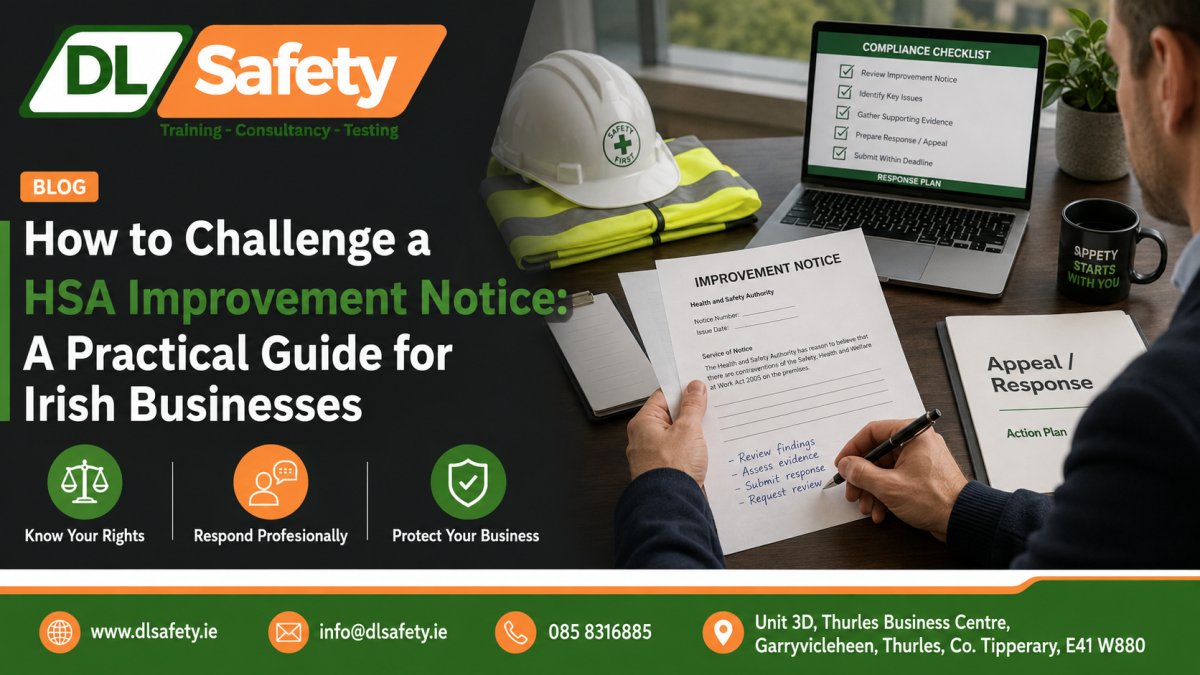
Receiving a HSA Improvement Notice doesn’t mean the inspector is automatically right. That’s a fact many Irish business owners don’t realise until it’s too late, and the window to act has already closed. If you’ve just been handed a notice and you’re wondering whether you have to simply accept it, the answer is no; you have the right to challenge it, and doing so is often the most professionally responsible course of action.
It’s understandable to feel the pressure immediately. There’s the fear of prosecution hanging over you, the prospect of operational downtime, and a very real concern about how this might look to colleagues, clients, or competitors. Those worries are legitimate, and they’re exactly why knowing how to challenge a HSA improvement notice, correctly and within the statutory timeframes, matters so much.
This guide cuts through the confusion and gives you a clear, practical roadmap. You’ll learn the precise legal grounds for lodging an appeal, the timelines you cannot afford to miss, and how a well-structured challenge can result in the notice being cancelled, varied, or significantly amended, without escalating the situation into something far more serious.
Key Takeaways
- Knowing how to challenge a HSA improvement notice correctly — including the precise legal grounds and statutory timelines — can result in a notice being cancelled, varied, or significantly amended in your favour.
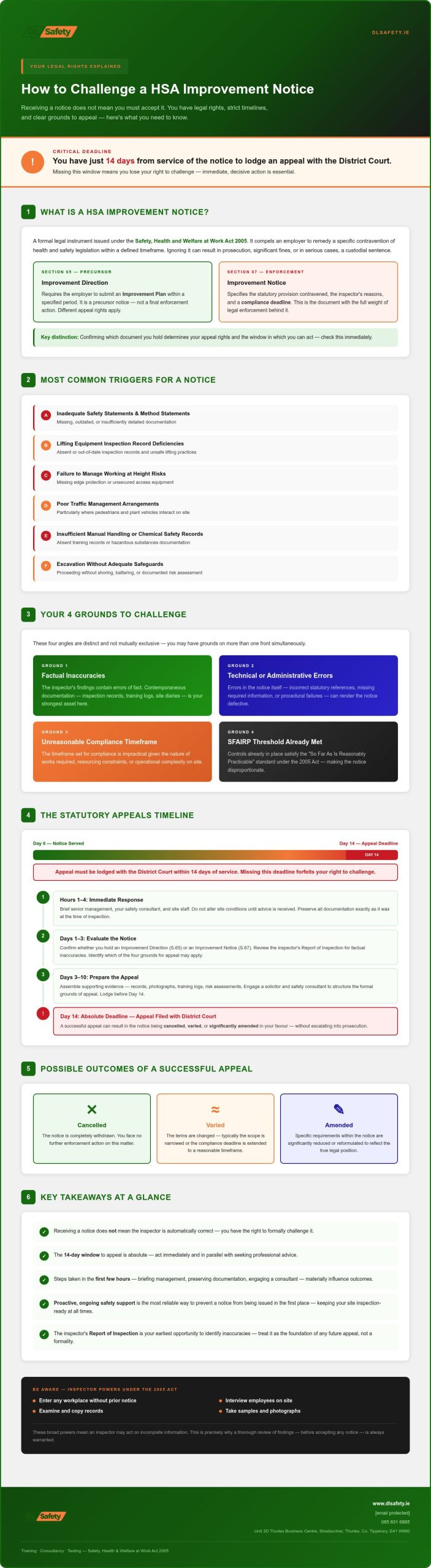
- You have just 14 days from the moment a notice is served to lodge an appeal with the District Court, making immediate, decisive action an absolute priority.
- Not every notice is legally sound; inspectors can make factual errors or impose unreasonable timeframes, and both are legitimate grounds for a formal challenge.
- The steps you take in the first hours after receiving a notice — including briefing senior management, your safety consultant, and site staff — can significantly influence the outcome of any subsequent appeal.
- Proactive, ongoing safety support is the most reliable way to prevent a notice from being issued in the first place, keeping your site in a perpetual state of readiness before any inspector arrives.
What is a HSA Improvement Notice and Why is it Issued?
An Improvement Notice is a formal legal instrument issued under the Safety, Health and Welfare at Work Act 2005. It compels an employer, or any person in control of a workplace, to remedy a specific contravention of health and safety legislation within a defined timeframe. This isn’t a strongly worded letter or a verbal warning from an inspector; it’s a statutory document with real legal teeth. Ignoring it, or failing to comply within the stated period, exposes you to prosecution under the 2005 Act, which can result in significant fines or, in serious cases, a custodial sentence.
On Irish construction and industrial sites, notices are most commonly triggered by:
- Inadequate or absent safety statements and method statements
- Deficiencies in lifting equipment inspection records or unsafe lifting practices
- Failure to manage working at height risks, including missing edge protection or unsecured access equipment
- Poor traffic management arrangements on site, particularly where pedestrians and plant interact
- Insufficient manual handling training records or chemical safety documentation
- Excavation work proceeding without adequate shoring, battering, or documented risk assessment
Understanding precisely what type of document you’ve received is the critical first step in knowing how to challenge a HSA improvement notice effectively.
Improvement Direction vs. Improvement Notice
This is the distinction that most guidance sources fail to explain clearly, and it’s genuinely important. Under Section 65 of the 2005 Act, an inspector can issue an Improvement Direction, which requires the employer to submit an Improvement Plan within a specified period. It’s a precursor, not a final enforcement action. A formal Improvement Notice, issued under Section 67, is a different matter entirely. It specifies the statutory provision being contravened, the reasons the inspector believes a contravention exists, and a compliance deadline. The type of document you hold determines your appeal rights and the window in which you can act, so confirming this immediately is non-negotiable.
The Role of the HSA Inspector
HSA inspectors hold broad powers under the 2005 Act, including the authority to enter any workplace without prior notice, examine records, interview employees, and take samples or photographs. Before issuing a formal Improvement Notice, an inspector will typically produce a Report of Inspection, which documents their findings. Many businesses treat this report as a formality. That’s a mistake. It’s your earliest opportunity to identify factual inaccuracies, challenge the inspector’s interpretation of the relevant legislation, and build the foundation of a credible appeal if one becomes necessary. If you’ve received a Report of Inspection and a formal notice has followed, that sequence matters when understanding how to challenge a HSA improvement notice through the District Court.
Evaluating Your Grounds to Challenge a HSA Notice
Before you can decide how to challenge a HSA improvement notice effectively, you need to do something that many businesses skip in the panic of the moment: sit down and critically evaluate whether the notice is actually correct. Not every inspector gets it right. Legislation is complex, site conditions change rapidly, and the documentation available to an inspector during a visit may be incomplete. Your first task is to determine, honestly and methodically, whether there are solid grounds to contest what’s been served on you.
There are four primary angles worth examining: factual inaccuracies in the inspector’s findings, technical or administrative errors in the notice itself, the reasonableness of the compliance timeframe, and whether the standard of control already in place satisfies the “So Far As Is Reasonably Practicable” (SFAIRP) threshold under the Safety, Health and Welfare at Work Act 2005. Each of these represents a distinct, legitimate basis for appeal, and they’re not mutually exclusive. You may have grounds on more than one front simultaneously.
Factual Inaccuracies and Technical Errors
This is often the most straightforward ground to pursue, and it’s where contemporaneous documentation becomes your strongest asset. If an inspector notes, for example, that lifting equipment lacked current inspection records, but your records were simply stored in a site office the inspector didn’t access, that’s a factual error you can refute directly. Site photographs timestamped before the inspection, maintenance logs, training records, and GA1 testing records can all serve as concrete evidence that the conditions described in the notice didn’t accurately reflect the reality on the ground.
Beyond factual errors, check whether the legislation cited in the notice actually applies to your specific activity. An inspector may reference a regulation designed for one sector or process and apply it to a materially different situation. If the cited provision doesn’t govern your activity, the legal foundation of the notice collapses. Also review the notice for administrative deficiencies: missing or incorrect details regarding the statutory provision, an absence of the inspector’s identifying information, or failure to specify the contravention with adequate clarity. These aren’t technicalities to be dismissed; under Section 67 of the 2005 Act, a notice must meet defined content requirements, and a notice that falls short of those requirements is vulnerable to challenge on those grounds alone.
The “Reasonableness” Argument
Even where the underlying concern identified by an inspector is legitimate, the timeframe imposed for compliance may not be. If a notice requires structural scaffolding changes, procurement of specialist equipment, or engagement of a third-party contractor within, say, seven days, and the industry norm for procuring that resource is four to six weeks, that’s a credible argument for variation rather than outright cancellation. The distinction matters: seeking a variation of the notice is often a more achievable and proportionate outcome, and it demonstrates good faith to the court.
The SFAIRP principle adds another layer. Irish health and safety law doesn’t demand perfection; it demands that risks be controlled to the extent that is reasonably practicable, weighing the degree of risk against the cost, time, and effort required to eliminate it. If your existing controls demonstrably reduce risk to an acceptable level relative to the resources required to go further, that’s a substantive argument. Industry benchmarks, comparative risk assessments, and documented evidence of your existing control measures all support this position. If you’re uncertain whether your current safety management system is strong enough to mount this argument, a professional health and safety site audit can give you an objective assessment before you commit to an appeal strategy.
The Statutory Appeals Process: Timelines and Procedures
Once you’ve assessed your grounds for challenge, the procedural clock becomes the single most critical factor in how to challenge a HSA improvement notice successfully. Miss the deadline, and your right to appeal is extinguished. There’s no discretion available to the court, and no mechanism to apply for an extension after the fact. The window is fixed, and it’s shorter than most people expect.
Under Section 67 of the Safety, Health and Welfare at Work Act 2005, you have 14 days from the date the notice is served to lodge a formal appeal with the District Court. That clock starts the moment the notice is handed to you or your authorised representative, not when you read it, not when you’ve had a chance to take legal advice. The day of service counts. If the 14th day falls on a weekend or public holiday, you should not assume you automatically gain extra time; seek legal guidance on this immediately rather than relying on an assumption that could cost you your appeal.
The “Stay of Execution”: Does the Notice Remain Active Whilst You Appeal?
This is the question most guidance sources fail to answer clearly, and it’s genuinely important to your operational planning. For an Improvement Notice, lodging an appeal with the District Court automatically suspends the notice whilst the appeal is pending. In practical terms, this means you’re not in breach simply because you haven’t yet complied, provided you’ve filed your appeal within the 14-day window. The compliance deadline is effectively paused until the court makes its determination. That said, this suspension does not give you licence to abandon whatever interim safety measures are reasonable; courts take a dim view of businesses that treat an appeal as an excuse to do nothing.
Prohibition Notices vs. Improvement Notices
The distinction here is critical, and confusing the two is a serious mistake. A Prohibition Notice, issued under Section 66 of the 2005 Act, takes effect immediately upon service and carries a shorter 7-day appeal window. Unlike an Improvement Notice, lodging an appeal against a Prohibition Notice does not automatically suspend it. The activity or process identified as a risk must cease straight away. To continue operating whilst your appeal is heard, you’d need to make a separate application to the District Court seeking a suspension of the notice pending the outcome, and that application must be made promptly and supported by credible evidence that the risk is being adequately managed in the interim.
Step-by-Step Filing Procedure
The procedural steps for appealing an Improvement Notice are as follows:
- Identify the correct District Court district. The appeal must be lodged in the District Court for the area where the notice was served, which is typically the district in which your premises or site is located. Filing in the wrong district is an avoidable error that wastes time you don’t have.
- Draft and file your Notice of Appeal. This document sets out the grounds on which you’re contesting the notice. It must be filed with the court office and a copy served on the HSA directly. Both steps are required; serving the HSA is not optional.
- Prepare your evidence bundle. This is where your preparation from the earlier assessment stage becomes tangible. Witness statements from site personnel, expert reports from a qualified safety professional, photographic evidence, inspection records, and any documentation that contradicts the inspector’s findings should all be compiled and organised before the hearing date.
- Attend the hearing. The District Court judge will examine the notice, your grounds of appeal, and the evidence presented by both sides. The judge has the authority to confirm, vary, or cancel the notice entirely. A variation might mean an amended compliance timeframe or a modification of the specific requirements; cancellation means the notice is set aside in full.
If you need expert safety evidence to support your appeal, a professional health and safety site audit from a qualified consultant can provide the independent, documented assessment that carries genuine weight in court. For further information on how DL Safety can support your position, visit www.dlsafety.ie or contact the team directly at info@dlsafety.ie or 085 8316885.
Immediate Actions: What to Do the Moment a Notice is Served
The first hour after a notice lands in your hands is the most consequential. Panic is understandable, but it’s also expensive. What you do in those initial moments shapes the strength of any subsequent challenge, the credibility of your compliance posture, and ultimately how the District Court views your organisation if the matter proceeds to a hearing. Most guidance tells you to call a solicitor and stop there. That’s necessary, but it’s nowhere near sufficient.
Your first call should go to senior management. Not after you’ve read the notice twice over, not after you’ve discussed it with a colleague; immediately. The decision-maker responsible for site operations needs to know within minutes, because operational and documentation decisions made in the next few hours can either support or undermine how to challenge a HSA improvement notice effectively. Simultaneously, contact your safety consultant. They can begin assessing the notice against your existing safety management system whilst you’re still absorbing its contents.
Briefing site staff is equally critical and often overlooked. Every person on site needs to understand that a notice has been served, what it relates to, and what they must and must not do whilst it’s active. This is especially important where subcontractors are involved. Unmanaged subcontractor behaviour following a notice can generate secondary breaches that significantly complicate your appeal. Structured guidance on managing subcontractor safety compliance is worth reviewing immediately to ensure your entire site operates consistently during this period.
Open a Compliance Log on the same day the notice is served. This is a dated, chronological record of every action taken in response: conversations held, documents reviewed, interim measures implemented, professional advice sought, and correspondence issued. If your appeal proceeds to court, this log is tangible evidence of good faith and organisational diligence. Courts respond well to businesses that demonstrate they took the matter seriously from the outset.
Don’t avoid the inspector. A brief, professional dialogue to clarify exactly which aspects of the site concerned them most can reveal whether there’s been a misunderstanding, a documentation gap, or a genuine hazard that needs addressing. This isn’t an admission of liability; it’s intelligent information gathering.
Stabilising the Site
Run an immediate gap analysis against every specific requirement listed in the notice. For each item, identify whether your current controls already satisfy it, whether a temporary stop-gap measure can reduce the risk whilst a permanent solution is arranged, and whether your health and safety compliance documentation accurately reflects what’s actually in place on site. Outdated or incomplete records are frequently the difference between a notice that sticks and one that doesn’t. Bring everything current before your appeal hearing date.
The Importance of Professional Advice
An independent site audit from a qualified safety consultant serves two purposes simultaneously: it gives you an objective, expert assessment of whether the inspector’s findings hold up, and it generates documented evidence you can present in court. A consultant also acts as a professional intermediary, helping you draft a formal written response to the HSA that clearly signals your intent, whether that’s to comply, to challenge, or to seek a variation of the notice. That letter, sent promptly and professionally, sets the tone for everything that follows.
For expert support in the critical period following a notice, contact DL Safety at info@dlsafety.ie or 085 8316885, or visit www.dlsafety.ie to find out how a professional site audit can strengthen your position from day one.
Preventing Enforcement: The Value of Monthly Safety Support
The most effective way to handle a HSA Improvement Notice is to ensure one is never issued in the first place. That sounds obvious, but the gap between knowing it and actually achieving it is where most businesses struggle. Reactive compliance, where you scramble to fix problems after an inspector has already identified them, is expensive, stressful, and entirely avoidable. A structured Monthly Safety Support Package shifts your organisation from a reactive posture to a proactive one, and that shift is the single most reliable protection against enforcement action.
Regular, scheduled site audits are the cornerstone of this approach. When a qualified safety professional visits your site on a consistent basis, they’re identifying the same notice-worthy risks that an HSA inspector would flag, but they’re doing it before the inspector arrives, and with the express purpose of helping you fix them rather than documenting them for enforcement. Your site exists in a perpetual state of readiness. There’s no scramble, no gap analysis under pressure, and no frantic search for documentation that should have been updated months ago.
Safety Statements and Method Statements are another area where ongoing support pays dividends. Documents that sit on a shelf and gather dust are not compliance tools; they’re liabilities. A retained safety consultant ensures these documents are reviewed, updated, and genuinely reflective of current site conditions and activities. When an inspector arrives and asks to see your Safety Statement, handing over a document that’s clearly been maintained and recently reviewed sends an immediate signal about the culture of your organisation.
Professional representation during an inspection is also worth considering. Having an experienced safety consultant present when an inspector visits can de-escalate a situation that might otherwise result in formal enforcement. An expert who understands both the legislation and the inspector’s likely concerns can clarify misunderstandings in real time, provide documentation promptly, and ensure the conversation remains constructive rather than adversarial. This alone can be the difference between a verbal advisory and a formal notice that forces you to consider how to challenge a HSA improvement notice through the courts.
Building a Culture of Compliance
Retained monthly support also means you’re never caught off guard by expiring certifications. GA1 testing schedules, PAT testing cycles, manual handling training renewals, working at height refreshers; a professional consultant tracks these on your behalf and prompts action before a lapse occurs. Having an expert on-call to handle HSA queries as they arise, rather than waiting until a formal inspection, keeps your compliance posture consistent year-round. Contact DL Safety at info@dlsafety.ie or 085 8316885 for a confidential compliance review.
DL Safety: Your Partner in Regulatory Readiness
Operating from Unit 3D Thurles Business Centre, Stradavoher, Thurles, County Tipperary, E41 W880, DL Safety supports sites nationwide with a full range of technical safety services. From Health and Safety Site Audits and Accident Investigation to Safety Statements, Method Statements, and Lift Plans, the team provides the expert evidence and documented support that strengthens your position whether you’re preparing for an inspection or building a case for how to challenge a HSA improvement notice that’s already been served. Visit www.dlsafety.ie to explore the full range of services and find out how proactive, professional safety support can keep your business one step ahead.
Take Control Before the Next Inspection Arrives
Knowing how to challenge a HSA improvement notice correctly, within the 14-day statutory window and on solid legal grounds, gives you genuine options where many businesses assume they have none. The key lessons are straightforward: assess the notice critically before accepting it, act immediately to preserve your appeal rights, and document everything from the moment it’s served.
If you’re ready to move from reactive to proactive, secure your site with a Monthly Safety Support Package from DL Safety and put a qualified expert in your corner before the next inspection. Reach the team at info@dlsafety.ie or 085 8316885, or visit www.dlsafety.ie. DL Safety operates from Unit 3D Thurles Business Centre, Stradavoher, Thurles, Co. Tipperary, E41 W880, supporting sites nationwide.
You’ve got more control over this than you think. Use it.
Frequently Asked Questions About Challenging a HSA Improvement Notice
How long do I have to appeal a HSA Improvement Notice?
You have 14 days from the date the notice is served to lodge a formal appeal with the District Court. That clock starts on the day of service, not the day you read it or seek advice. If you’re unsure whether the 14th day falls on a weekend or public holiday, get legal guidance immediately rather than assuming you have extra time. Missing this window extinguishes your right to appeal entirely.
Can I continue working while I challenge an Improvement Notice?
Yes, in most cases. Lodging an appeal against an Improvement Notice automatically suspends the notice whilst the appeal is pending, meaning you’re not in breach simply because you haven’t yet complied. That said, this suspension isn’t a licence to ignore reasonable interim safety measures. Courts take a dim view of businesses that treat an appeal purely as a delay tactic rather than a genuine challenge to the notice’s validity.
What happens if I lose my appeal against the HSA?
If the District Court confirms the notice, the original compliance deadline is reinstated, and you’ll need to fulfil the requirements promptly. The court may also vary the terms rather than simply confirming them outright, so the outcome isn’t always binary. Failing to comply with a confirmed notice exposes you to prosecution under the Safety, Health and Welfare at Work Act 2005, which can result in significant fines or, in serious cases, a custodial sentence.
Is an Improvement Notice the same as a criminal conviction?
No. Receiving an Improvement Notice is an administrative enforcement action, not a criminal conviction. It doesn’t appear on a criminal record. However, if you fail to comply with a confirmed notice and the HSA pursues prosecution, a conviction resulting from that prosecution is a separate and serious matter. The notice itself is a formal legal instrument requiring action, but it’s not, in isolation, evidence of criminal wrongdoing.
Do I need a solicitor to challenge a HSA notice in the District Court?
You’re not legally required to have a solicitor, but it’s strongly advisable. District Court proceedings involve procedural rules, evidence requirements, and legal arguments that are genuinely complex to navigate without professional support. A solicitor working alongside a qualified safety consultant gives you the best combination: legal procedural expertise paired with technical evidence that directly addresses the inspector’s findings. Attempting to represent yourself without either is a significant risk given what’s at stake.
What is the most common reason for a HSA notice being cancelled?
The most frequent successful ground is demonstrating that the inspector’s findings contained factual inaccuracies, typically because relevant documentation existed but wasn’t accessible or presented during the inspection. Maintenance logs, training records, and inspection certificates that directly contradict the notice’s stated basis can be compelling. A notice can also be cancelled where the legislation cited doesn’t actually apply to the specific activity or process in question, which collapses the legal foundation of the enforcement action entirely.
Can an inspector issue a notice for something that was okay during the last inspection?
Yes. Each inspection is assessed against conditions on the day, and site conditions, staffing, equipment, and documentation can all change between visits. An inspector isn’t bound by a previous inspector’s findings, and a clean inspection record doesn’t provide immunity from future enforcement. This is precisely why consistent, ongoing safety support matters more than occasional compliance reviews: it keeps your site in a state of readiness regardless of when an inspector arrives, rather than relying on the outcome of a previous visit.
How much does it cost to appeal a HSA notice in Ireland?
We won’t quote specific figures here, as costs vary considerably depending on the complexity of the case, legal representation fees, and whether expert safety evidence is required. What’s worth understanding is that the cost of a well-prepared appeal, particularly one supported by an independent site audit and professional safety evidence, is frequently far lower than the cost of unplanned compliance work carried out under pressure. For a confidential discussion about how DL Safety can support your position, contact the team at info@dlsafety.ie, call 085 8316885, or visit www.dlsafety.ie. DL Safety operates from Unit 3D Thurles Business Centre, Stradavoher, Thurles, Co. Tipperary, E41 W880.