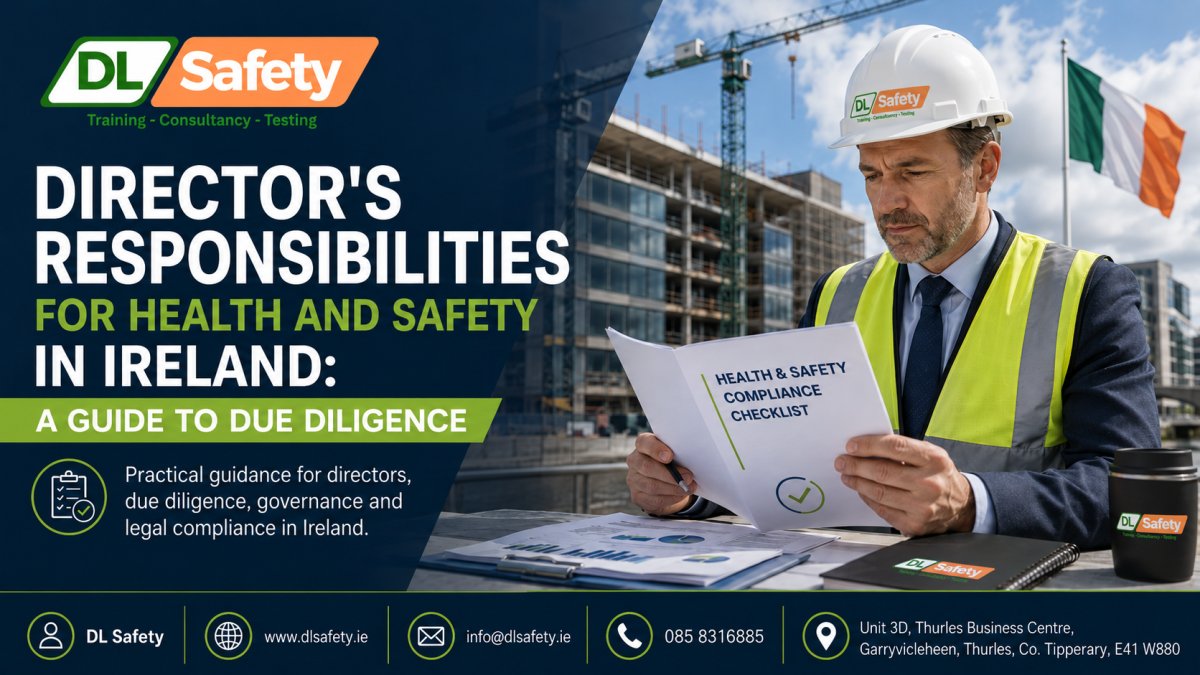
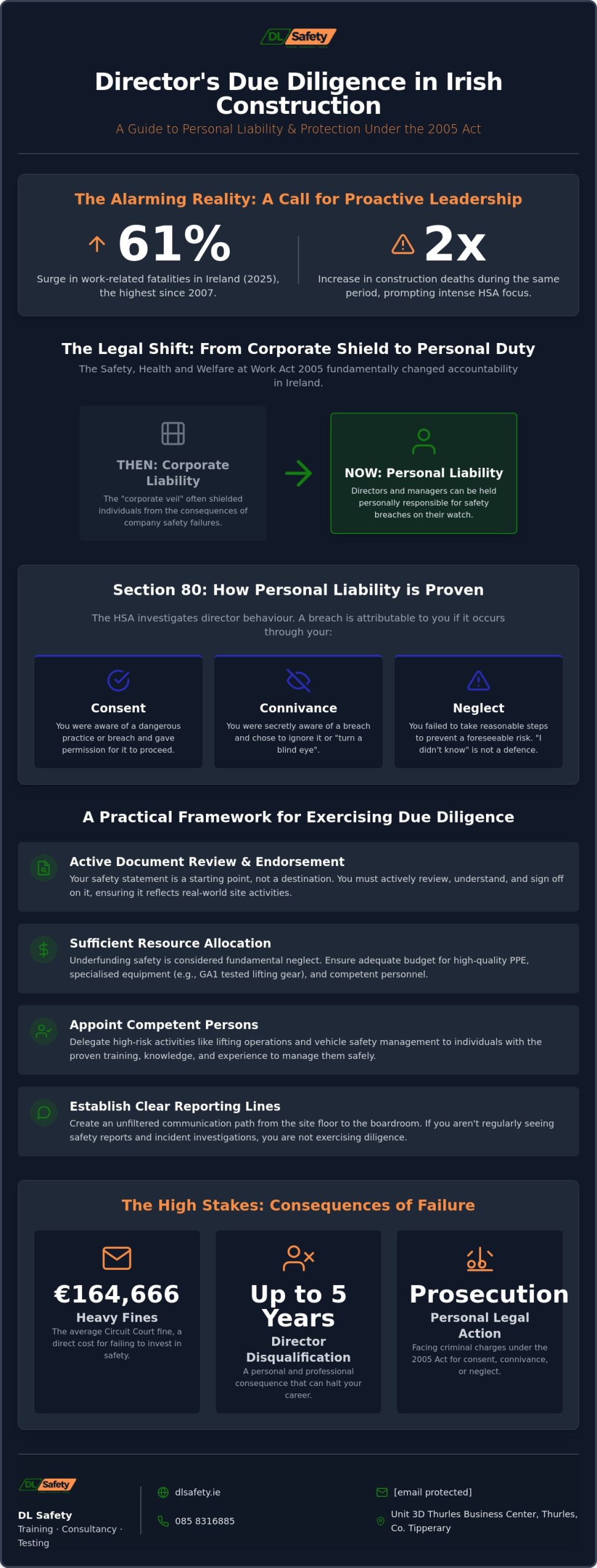
Did you know that work-related fatalities in Ireland surged by 61% in 2025, marking the highest annual figure since 2007? With construction deaths doubling in that same period, the Health and Safety Authority is more focused than ever on directorial accountability. You likely recognise that writing a safety statement for construction Ireland is a legal necessity, yet many directors still worry that a paper document won’t be enough to prevent personal prosecution under the 2005 Act.
It’s understandable to feel overwhelmed by the technicalities of Section 80 or uncertain about what constitutes sufficient due diligence during a surprise inspection. At DL Safety, we believe compliance shouldn’t be a source of stress, but a transparent part of your leadership strategy. This guide explains your specific legal duties and provides a robust framework to protect your business and your reputation. You’ll gain the clarity needed to move from a state of uncertainty to one of total confidence, ensuring your safety protocols are as rigorous as they are practical.
Key Takeaways
- Understand the critical shift from corporate to personal liability and why documenting your proactive safety behaviours is essential for legal protection.
- Discover why writing a safety statement for construction Ireland serves as the foundation for your due diligence framework rather than a one-off administrative task.
- Identify how to effectively allocate resources and appoint competent persons to manage high-risk activities like lifting operations and vehicle safety.
- Recognise the severe personal consequences of failing to uphold your duties, ranging from heavy fines to director disqualification.
- Learn how expert oversight through monthly support packages creates a robust evidence trail that satisfies HSA inspectors and protects your business.
What is Due Diligence in Health and Safety for Irish Directors?
Due diligence is often misunderstood as a simple compliance checklist or a stack of signed documents. In reality, it represents the proactive, verifiable steps a leader takes to ensure every person on their site returns home safely at the end of the day. Since the introduction of the Safety, Health and Welfare at Work Act 2005, the legal landscape in Ireland has shifted dramatically. It moved the focus from faceless corporate entities to the individuals who lead them. This means the “corporate veil” no longer offers a shield against personal liability if safety standards fail on your watch.
For many, writing a safety statement for construction Ireland feels like the finish line of a compliance race. However, the courts view this document merely as the starting point of your obligations. A safety statement that sits on a shelf gathering dust is evidence of neglect, not diligence. Your daily behaviour as a director must mirror the commitments made in that document. Irish courts have made it clear that “I didn’t know” is no longer a valid legal defence. If a risk was foreseeable, you’re expected to have known about it and taken concrete action to mitigate it.
Effective communication is the bedrock of any safety culture, ensuring that every instruction and report is perfectly understood. For professionals working in global environments who want to ensure their communication is as sharp as their safety protocols, English Explorer provides structured language training to enhance corporate clarity and precision.
The Legal Foundation: Section 80 of the 2005 Act
Section 80 is the mechanism the Health and Safety Authority (HSA) uses to bridge the gap between a company’s failure and a director’s personal responsibility. When an accident occurs, inspectors don’t just look at the faulty equipment; they look at the decisions made in the boardroom. They investigate whether the breach occurred through your “consent, connivance, or neglect.” Under Section 80 of the Safety, Health and Welfare at Work Act 2005, a director can be held personally liable for a safety breach if it’s proven to have been committed with their consent, connivance, or attributable to their neglect.
Due Diligence as a Continuous Behaviour
True due diligence isn’t an annual event. It’s a continuous behaviour that integrates safety into every project lifecycle and board agenda. The law distinguishes between “passive” oversight, where you assume things are fine because nobody has complained, and “active” oversight, where you verify they’re fine through audits and testing. This is where many directors struggle to find the time. By utilising Monthly Safety Support Packages, you create a consistent, independent evidentiary paper trail. These packages ensure that writing a safety statement for construction Ireland leads to real-world implementation, providing the expert oversight necessary to prove you’ve taken every reasonable step to protect your workforce and your business.
Core Director’s Responsibilities for Health and Safety in Ireland
Directorial responsibility isn’t a passive state. It’s a series of active, documented decisions that shape the safety culture of your organisation. Whilst many leaders view safety as a site-level concern, the law views it as a boardroom priority. This starts with the active review and signing of the company’s core documents. When writing a safety statement for construction Ireland, you’re essentially creating a contract of care between the leadership and the workforce. This document must be based on genuine risk assessments that reflect the actual work being carried out on your sites today, rather than generic templates that offer no real protection.
You must also establish clear reporting lines that bridge the gap between the site floor and the boardroom. If a safety issue occurs at the coalface, there must be a direct, unfiltered path for that information to reach you. Monitoring safety performance through regular audits and accident investigation reports ensures you aren’t operating in a vacuum. If you aren’t seeing these reports, you can’t claim to be exercising due diligence. It’s your job to ask the difficult questions before an incident occurs, not after the HSA arrives at your door.
Resource Allocation and Budgeting
Underfunding safety is a common pitfall that the courts view as a fundamental failure of directorial due diligence. If an accident occurs and it’s found that a lack of specialised equipment or an insufficient budget for PPE was a contributing factor, your personal liability increases significantly. Ensuring that high-quality lifting equipment is available and that all machinery undergoes rigorous GA1 testing is a non-negotiable part of your role. The cost-benefit analysis is clear. Investing in safety is far more economical than facing the average Circuit Court fine of €164,666 recorded in 2025.
The Duty to Appoint Competent Persons
Irish law requires directors to ensure that those managing safety are competent. This means they possess the training, experience, and knowledge to identify and control workplace hazards. For many firms, maintaining this level of expertise internally is a significant challenge. This is when engaging health and safety compliance Ireland experts becomes a strategic necessity. Utilizing monthly safety support Ireland fulfils your directorial duty by providing the consistent, professional oversight required to keep your operations safe and compliant.
If you’re unsure if your current oversight meets these standards, our team at DL Safety is here to help. We provide nationwide support across Ireland. You can reach out to us at info@dlsafety.ie or call 085 8316885 to discuss a support package tailored to your business needs.
A Practical Framework for Exercising Due Diligence
Exercising due diligence isn’t about having a gut feeling that your sites are safe; it’s about having a structured, verifiable management system that proves it. When the HSA conducts an inspection, they look for evidence of a “top-down” safety culture. This begins with writing a safety statement for construction Ireland that isn’t just a document, but a living framework for every decision you make. To help you manage these obligations, we recommend following a five-step framework designed to bridge the gap between boardroom policy and site-level reality.
- Step 1: Knowledge. You must stay informed about the specific risks inherent in your industry, whether that’s the complexities of deep excavations or the unique hazards of quarrying.
- Step 2: Planning. Safety shouldn’t be an afterthought. Integrate it into your business strategy and project lifecycles from the tendering stage onwards.
- Step 3: Implementation. Verify that the systems you’ve paid for are actually being used. This means ensuring Method Statements are followed and that writing a safety statement for construction Ireland leads to tangible on-site controls.
- Step 4: Monitoring. Safety metrics, including near-miss reports and audit results, should be a standing item at every board meeting. Ensuring your leadership team is equipped with a structured approach to presenting safety statistics to the board transforms these reviews from a compliance formality into a powerful demonstration of active directorial oversight.
- Step 5: Improvement. When a failure is identified, you must take immediate, documented action to prevent a recurrence.
Leading by Example: Creating a Safety Culture
Your presence on-site speaks louder than any policy document. When workers see a director taking a genuine interest in safety protocols, it fundamentally shifts their own behaviour. It’s about moving away from a culture of blame and towards one of transparency. If staff feel they can report a hazard without being penalised, you gain the “big picture” data needed to prevent accidents. Encouraging your team to stay sharp by completing online safety courses Ireland is a practical way to demonstrate that you value their competence as much as their productivity.
Verifying Site-Level Compliance
A director’s duty of care extends to the technical integrity of the equipment used on their watch. You don’t need to be a mechanic, but you do need to verify that your statutory obligations are met. This includes ensuring that GA1 testing Ireland certificates are valid and readily available for all lifting equipment. Similarly, if you operate in the industrial or extractive sectors, you must check that specialised quarry vehicle brake testing Ireland is performed by qualified professionals. At DL Safety, we provide the expert oversight needed to manage these technical requirements, giving you the peace of mind that your due diligence is robust and verifiable.
For expert guidance on implementing this framework, contact our team at Unit 3D Thurles Business Center, Stradavoher, Thurles, County Tipperary, E41 W880. You can also reach us at info@dlsafety.ie or 085 8316885.
The Consequences of Failing to Uphold Directorial Duties
The legal stakes for Irish directors have never been higher. In 2025, completed prosecutions for health and safety breaches resulted in total fines of €2.468 million, with the highest single fine reaching €650,000. Beyond the balance sheet, the emotional toll of a workplace fatality investigation is profound, often lasting years and involving intense scrutiny from the HSA and the Gardai. For a director, a safety failure isn’t just a corporate setback; it’s a personal legal crisis that can lead to heavy personal fines, imprisonment for gross negligence, or disqualification from acting as a company director in Ireland.
Reputational damage often proves just as devastating as the legal penalties. In an industry built on trust and rigorous standards, a public safety breach can lead to the immediate loss of major contracts and exclusion from government tenders. If your firm is seen as a risk, partners and clients will look elsewhere. This is why writing a safety statement for construction Ireland must be treated with the utmost seriousness. It’s your primary defence against claims of negligence, proving that you’ve established a robust system to protect your workforce.
Dealing with HSA Enforcement
HSA inspectors typically arrive unannounced, and their focus will be on whether the board has translated policy into practice. Understanding what to expect during a HSA inspection is essential preparation for any director, as inspectors will assess whether your safety statement, risk assessments, and site controls reflect genuine, day-to-day implementation. If they identify a risk, they may issue an Improvement Notice or a Prohibition Notice. An Improvement Notice requires you to fix a breach within a set timeframe, whilst a Prohibition Notice stops work immediately because of an imminent danger. These notices are public records and can severely impact your insurance premiums and project timelines. If you find yourself in this position, it’s vital to know how to challenge a HSA improvement notice effectively and professionally.
Corporate Manslaughter and Individual Liability
The Safety, Health and Welfare at Work Act 2005 ensures that individual directors cannot hide behind the company name. You can be held personally liable even if the company itself is also fined. Under Section 80, the threshold for individual prosecution often centres on whether the breach occurred with your “consent, connivance, or neglect.” Legally, “consent” implies you actively agreed to a safety breach, whilst “neglect” suggests you failed to act when you had a clear duty to do so. This personal liability remains a constant factor in writing a safety statement for construction Ireland, as the document must clearly outline who is responsible for what.
Don’t wait for an accident to test your due diligence framework. Our team at Unit 3D Thurles Business Center, Stradavoher, Thurles, County Tipperary, E41 W880, can provide the expert oversight you need to stay protected. Contact us today at www.dlsafety.ie, email info@dlsafety.ie, or call 085 8316885 to ensure your business is fully compliant.
How DL Safety Supports Directorial Due Diligence
The burden of health and safety shouldn’t rest solely on your shoulders as a director. Whilst the 2005 Act is clear about your personal liability, it also allows for the appointment of competent persons to manage these risks effectively. Our Monthly Safety Support Packages are designed to act as your “Safety Director” on the ground, providing the high-level oversight required to satisfy HSA inspectors. By partnering with us, you move away from the stress of manual compliance and into a state of verifiable due diligence.
When we assist with writing a safety statement for construction Ireland, we don’t just hand over a folder and walk away. We implement the systems described within it to ensure they’re functioning as intended. This includes managing technical requirements like PAT testing and the creation of complex lift plans. These technical details often trip up businesses during an audit, but with our independent oversight, you can remain inspection-ready whilst focusing on the growth of your company.
Tailored Support for Construction and Industrial Sectors
Every site has a different profile of risk, and a generic safety statement is a liability in itself. We develop bespoke safety management systems that reflect your specific site conditions, from high-rise construction to heavy industrial manufacturing. This includes specialised services such as chemical risk assessment Ireland, ensuring that hazardous substances are handled with the same level of rigour as your mechanical equipment.
If an incident does occur, our accident investigation services are vital for your due diligence trail. We identify the genuine root causes of accidents to prevent recurrence, rather than simply looking for someone to blame. This methodical approach establishes the “active oversight” that Irish courts look for when evaluating directorial behaviour, protecting both your workforce and your personal reputation.
Your Next Steps for Compliance
Securing your business starts with a clear-eyed look at your current oversight. We invite you to contact DL Safety for a confidential audit of your directorial health and safety framework. We’ll help you identify gaps before the HSA does, ensuring that writing a safety statement for construction Ireland is just the first step in a robust, permanent culture of care. Our mission is to demystify these requirements and provide you with a practical path to total compliance.
Visit our centre at Unit 3D Thurles Business Center, Stradavoher, Thurles, County Tipperary, E41 W880, or call us on 085 8316885. You can also email info@dlsafety.ie or visit www.dlsafety.ie to discuss how a Monthly Safety Support Package can provide the peace of mind you need to lead with confidence.
Securing Your Legacy Through Proactive Leadership
By implementing a robust due diligence framework, you move beyond mere compliance and create a culture of integrity that shields your business and your reputation. You don’t have to manage these complex requirements alone. Our team at Unit 3D Thurles Business Center, Stradavoher, Thurles, County Tipperary, E41 W880, is ready to act as your trusted advisor. Protect your business and your directors-explore our Monthly Safety Support Packages today. You can also reach us directly at 085 8316885 or via email at info@dlsafety.ie. Let’s work together to ensure your business remains safe, compliant, and ready for future growth.
Frequently Asked Questions
Can I be held personally liable for a health and safety breach as a director?
Yes, you can be held personally liable under Section 80 of the Safety, Health and Welfare at Work Act 2005. If a breach occurs with your consent, connivance, or is attributable to your neglect, the HSA can prosecute you as an individual. This bypasses the corporate shield, meaning you could face personal fines or imprisonment. It’s why active oversight is essential rather than assuming safety is being handled by others.
What is the difference between a director’s duty and a manager’s duty?
Directors are responsible for the “big picture” of safety, including strategic planning, resource allocation, and appointing competent staff. Managers focus on the operational execution of these plans on-site. Whilst a manager handles daily supervision, a director must verify that the manager has the tools, time, and budget to work safely. The law expects directors to provide the framework that makes safe work possible.
How often should a board of directors review health and safety reports?
Health and safety should be a standing item on the agenda of every board meeting. For most Irish construction and industrial firms, a monthly review of safety metrics, accident reports, and audit results is considered best practice. This frequency ensures that trends are identified early and that the board remains actively involved in safety performance rather than reacting only after a serious incident occurs. Using a structured approach to presenting safety statistics to the board can help directors engage meaningfully with the data and demonstrate the active governance that Irish courts expect.
Is a Safety Statement enough to satisfy due diligence requirements?
A Safety Statement is a vital legal document, but it isn’t a “get out of jail free” card. Whilst writing a safety statement for construction Ireland is a mandatory first step, due diligence requires you to prove that the document’s contents are actually implemented. You must show that risk assessments are followed and that the safety culture described on paper matches the daily reality on your work sites.
What should a director do immediately after a serious workplace accident?
Your first priority is ensuring the injured party receives medical care and that the site is made safe to prevent further harm. You must secure the scene for investigation and notify the HSA immediately if the accident meets reporting criteria. Following this, you should trigger your internal accident investigation protocol to identify root causes. This proactive response is a key indicator of directorial responsibility and due diligence.
Can a non-executive director be liable for safety failures?
Yes, non-executive directors can be held liable if they’ve failed to exercise reasonable care and skill in their oversight role. If you sit on a board, you have a duty to ensure the company has a robust safety management system in place. You can’t plead ignorance if you failed to ask for safety reports or ignored evidence of systemic safety failures within the organisation.
What are the typical fines for directors under the 2005 Act in 2026?
Fines for health and safety breaches have increased significantly, with total fines in 2025 reaching €2.468 million. The average fine in the Circuit Court was €164,666, and the highest single fine recorded was €650,000. These figures reflect a rigorous enforcement environment where the courts use financial penalties to punish neglect and deter other directors from allowing similar safety failures to occur in their businesses.
How does outsourcing safety support help a director’s legal position?
Outsourcing support helps satisfy your legal duty to appoint “competent persons” under the 2005 Act. It provides an independent, expert perspective that internal staff might miss. Professional oversight from a partner like DL Safety creates a verifiable paper trail of audits and advice, which serves as powerful evidence of due diligence if you ever need to defend your actions to the HSA or a court.