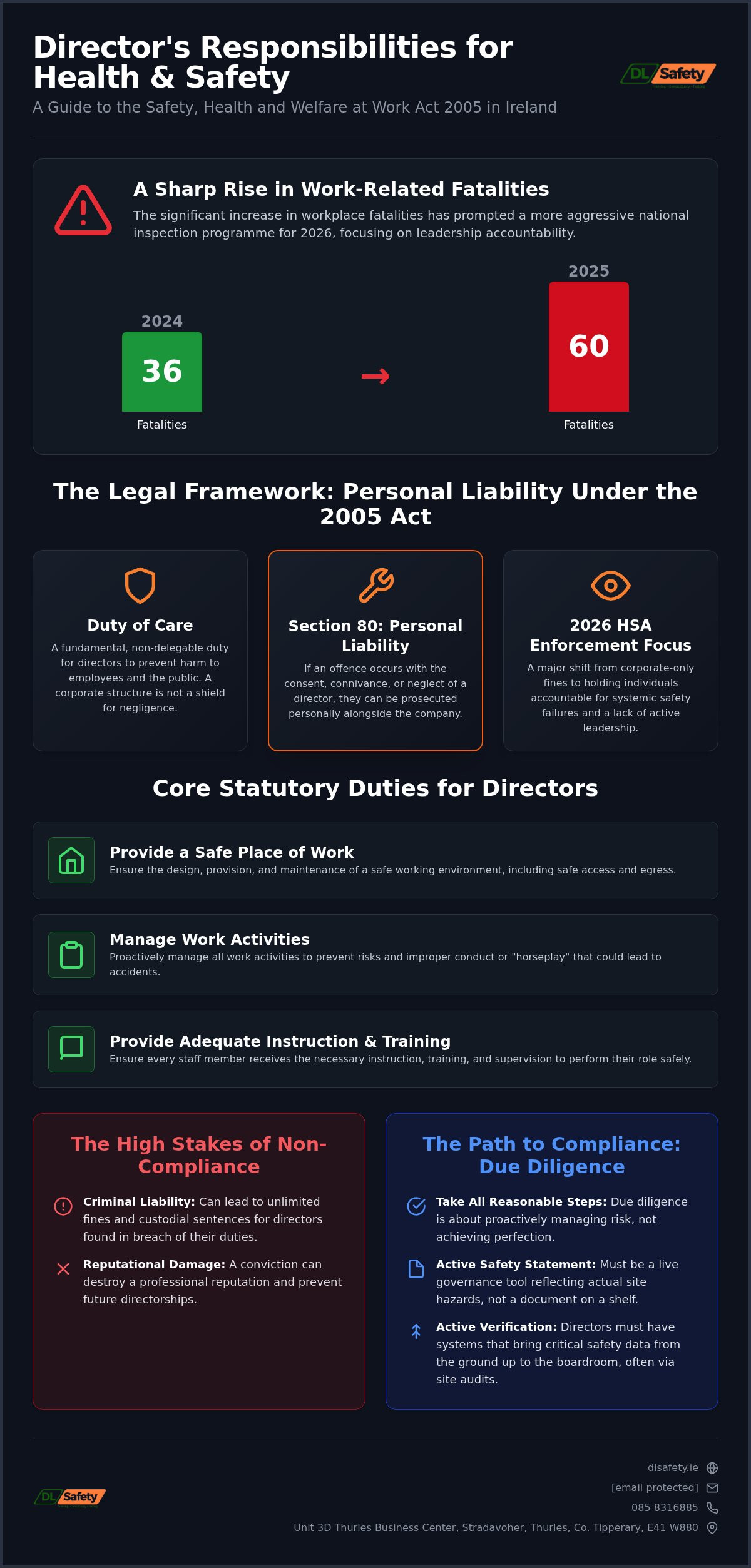
Did you know that work-related fatalities in Ireland jumped from 36 in 2024 to 60 in 2025? This sharp rise has triggered a more aggressive national inspection programme for 2026, placing a spotlight on how leadership teams manage risk. It’s natural to feel a sense of unease regarding the director’s responsibilities for health and safety Ireland, especially when the Safety, Health and Welfare at Work Act 2005 feels like a maze of complex legal requirements. You likely want to ensure your team is safe without being buried in paperwork, yet monitoring on-site behaviour from the boardroom remains a constant challenge.
We’ve created this guide to provide a clear, practical breakdown of your statutory duties and personal liability. You’ll learn how to move from passive oversight to active verification, ensuring your governance framework stands up to HSA scrutiny. We’ll preview the essential steps for reducing enforcement risks and detail how proactive safety leadership protects both your employees and your personal standing. At DL Safety, located at Unit 3D Thurles Business Center, Stradavoher, Thurles, County Tipperary, E41 W880, we specialise in demystifying these rules. For tailored support, visit www.dlsafety.ie, email info@dlsafety.ie, or call 085 8316885 to speak with our team.
Key Takeaways
- Understand the specific personal liabilities established under the Safety, Health and Welfare at Work Act 2005 and how the “duty of care” applies to your role in the boardroom.
- Navigate the director’s responsibilities for health and safety Ireland within the context of the 2026 HSA inspection programme, which prioritises active safety leadership over basic paper compliance.
- Discover how to implement safety-focused Key Performance Indicators (KPIs) to bridge the gap between corporate policy and the practical reality of on-site operations.
- Identify your core statutory duties for providing a safe place of work, including the necessity of adequate training and supervision to protect your workforce.
- Learn how Monthly Safety Support Packages from DL Safety, based at Unit 3D Thurles Business Center, Stradavoher, Thurles, County Tipperary, E41 W880, provide a pragmatic route to compliance; contact 085 8316885 or visit www.dlsafety.ie for expert guidance.
Understanding the Legal Framework and Personal Liability in Ireland
The Safety, Health and Welfare at Work Act 2005 stands as the cornerstone of Irish workplace law. It doesn’t simply apply to the company as a faceless entity; it places specific, non-delegable obligations on those at the top. This includes a fundamental ‘Duty of Care’ that directors owe to their employees and the general public to prevent harm. The Health and Safety Authority (HSA) is the primary body responsible for monitoring these standards. They’ve made it clear that a corporate structure isn’t a shield for individual negligence, particularly when leadership fails to oversee critical safety systems.
Section 80 of the 2005 Act is particularly critical for leadership. It states that if an offence is committed with the consent, connivance, or neglect of a director or manager, that person can be prosecuted personally alongside the company. In 2026, we’re seeing a distinct shift in enforcement. Authorities are moving away from corporate-only fines toward holding individuals accountable for systemic failures. Understanding the director’s responsibilities for health and safety Ireland is no longer just a box-ticking exercise. It’s a fundamental requirement for personal legal protection and effective corporate governance.
The Concept of ‘Due Diligence’ for Directors
Due diligence isn’t about achieving perfection. It’s about taking all reasonable steps to manage risk. This process starts with your Safety Statement. If this document stays on a shelf, it isn’t serving its purpose as a governance tool. It must reflect the actual hazards on your site and be updated regularly to account for new equipment or operational changes. Relying on the excuse that you weren’t aware of risks on the factory floor or the construction site won’t hold up in court. Directors must have systems that bring critical safety data from the ground up to the boardroom. Active verification through site audits is often the only way to prove you’ve done your part.
Civil vs Criminal Liability: What is at Stake?
The stakes are exceptionally high for those who ignore their duties. Criminal liability can lead to unlimited fines and custodial sentences for directors found to be in breach of their statutory obligations. Beyond the legal penalties, a safety conviction can destroy your professional reputation and prevent you from holding future directorships. Proactive health and safety compliance Ireland acts as your primary shield. It demonstrates that you’ve prioritised the director’s responsibilities for health and safety Ireland by implementing robust, verifiable systems that protect your people and your personal standing.
Our team at DL Safety helps you manage these risks with confidence. Based at Unit 3D Thurles Business Center, Stradavoher, Thurles, County Tipperary, E41 W880, we provide the expertise you need to ensure compliance. You can reach us at 085 8316885 or email info@dlsafety.ie. Visit www.dlsafety.ie to see how our support packages can strengthen your boardroom safety governance.
Core Statutory Duties under the Safety, Health and Welfare at Work Act 2005
The Safety, Health and Welfare at Work Act 2005 outlines the specific actions leaders must take to protect their workforce. It isn’t enough to simply have a safety policy tucked away in a drawer; the law requires you to ensure the design, provision, and maintenance of a safe place of work. This includes managing work activities to prevent improper behaviour or “horseplay” that could lead to accidents. When we look at a director’s responsibilities for health and safety Ireland, the focus is on proactive management rather than reactive fixes. You’re legally required to provide adequate instruction, training, and supervision to every staff member, ensuring they have the tools to work safely.
The Role of the Competent Person
Under Section 18 of the Act, directors must appoint one or more “competent persons” to assist in safety compliance. For many SMEs, hiring a full-time safety officer isn’t always practical or cost-effective. This is where external support becomes invaluable. A competent advisor brings an objective perspective to your risk assessments and safety audits. At DL Safety, we bridge this gap through our monthly safety support Ireland packages. This service provides you with ongoing access to expert advice, ensuring your governance remains robust without the overhead of a permanent hire.
Information, Instruction, and Training (IIT)
Training is a core pillar of a director’s responsibilities for health and safety Ireland. You have a statutory duty to ensure that safety information is provided in a form and language that employees likely understand. This is particularly relevant in diverse modern workplaces. Additionally, HSA inspectors prioritise training records during any site visit. If it isn’t documented, from a legal perspective, it didn’t happen. Utilising online safety courses Ireland is an efficient way to meet these IIT requirements, providing verifiable proof of competence for your team.
Maintaining these standards doesn’t have to be overwhelming. If you’re unsure if your current training records would pass an inspection, you might consider a professional health and safety site audit to identify any hidden gaps in your compliance.
Our office is located at Unit 3D Thurles Business Center, Stradavoher, Thurles, County Tipperary, E41 W880. For direct assistance, you can reach us at 085 8316885 or via email at info@dlsafety.ie. We’re here to help you turn these statutory duties into a practical, manageable safety culture.
Corporate Manslaughter and HSA Enforcement Trends for 2026
The landscape of safety enforcement has shifted significantly following the 60 work-related fatalities recorded in Ireland during 2025. This sharp increase has led to a more aggressive national inspection programme for 2026. Whilst a specific Corporate Manslaughter Act hasn’t been enacted, the HSA is increasingly using the 2005 Act to name directors personally in prosecutions. The director’s responsibilities for health and safety Ireland now involve a higher level of scrutiny, particularly regarding how leadership manages high-risk activities. Inspectors are no longer just looking for a paper trail; they’re looking for evidence that the board is actively driving a safety culture from the top down.
We’re seeing a clear trend where ‘Improvement’ and ‘Prohibition’ notices are used as immediate precursors to criminal proceedings. If an inspector identifies a recurring failure in vehicle safety or working at height, the likelihood of a personal summons for directors has never been higher. High-profile cases in the construction and quarrying sectors have demonstrated that the HSA is willing to pursue individual accountability when systemic neglect is evident. This makes it vital for directors to understand that their legal obligations can’t be delegated to a junior site manager.
Managing High-Risk Technical Compliance
Technical failures are often the quickest route to a prosecution. Ensuring that all lifting equipment has valid GA1 testing Ireland certification is a non-negotiable statutory duty. Similarly, for those in the industrial or extractive sectors, quarry vehicle brake testing Ireland has become a top priority for inspectors this year. The financial cost of non-compliance extends far beyond HSA fines. You’re looking at massive legal fees, soaring insurance premiums, and the potential for custodial sentences if neglect is proven. It’s simply not worth the risk to cut corners on technical safety audits.
What to do when the HSA Inspector arrives
An unannounced HSA inspection can be a high-stress event for any leadership team. As a director, you’re responsible for ensuring the inspector has immediate access to safety documentation and key personnel. Transparency is your best ally here. Many firms now find that having a retained consultant from DL Safety manages this relationship effectively, providing the inspector with professional, organised data that demonstrates proactive compliance. This approach reduces friction and shows that you take the director’s responsibilities for health and safety Ireland seriously.
If you need support managing an ongoing HSA relationship or want to book a technical audit, our team is ready to assist. You can find us at Unit 3D Thurles Business Center, Stradavoher, Thurles, County Tipperary, E41 W880. Contact us at 085 8316885, email info@dlsafety.ie, or visit www.dlsafety.ie to learn more about our support packages.
Practical Governance: Bridging the Gap between Boardroom and Site
Effective governance requires more than a signature on a policy document. It demands a culture where safety is viewed as a core business function rather than a separate administrative burden. Moving beyond ‘paper compliance’ means directors must actively verify that the systems they’ve approved are actually working on the ground. This transition to active safety leadership is a key part of the director’s responsibilities for health and safety Ireland. By setting clear Key Performance Indicators (KPIs), such as near-miss reporting rates and training completion percentages, the board can monitor safety trends with the same level of detail as financial performance.
Integrating Safety into Boardroom Decisions
Safety should never be an afterthought in corporate strategy. One of the most effective ways to ensure this is by making safety a standing item on every board meeting agenda. This ensures that safety concerns are discussed whilst they are still manageable, rather than after an incident has occurred. Directors must also ensure that sufficient budget is allocated for essential items like PPE, specialist training, and equipment maintenance. Amongst successful Irish firms, there is a clear link between high safety standards and long-term business sustainability. Investing in a safe workplace reduces downtime, protects your reputation, and fosters employee loyalty.
Verification: The Director’s Secret Weapon
Verification is how you prove your due diligence. Conducting occasional ‘Director’s Safety Walks’ allows you to see the reality of site operations firsthand. These aren’t technical inspections but opportunities to ask staff about their safety concerns and observe the culture. During these walks, you should verify that technical requirements, such as PAT testing for construction sites Ireland, are being managed correctly and that certificates are accessible. You might also review how construction site traffic management plans are being implemented to protect both workers and the public. These practical steps ensure that the director’s responsibilities for health and safety Ireland are fulfilled through visible, active leadership.
If you want to strengthen your site oversight, you can book a health and safety site audit with our team today.
DL Safety is located at Unit 3D Thurles Business Center, Stradavoher, Thurles, County Tipperary, E41 W880. For professional guidance on safety governance, contact us at 085 8316885 or email info@dlsafety.ie. Explore our full range of services at www.dlsafety.ie.
Securing Compliance through Professional Safety Support Packages
Managing a director’s responsibilities for health and safety Ireland shouldn’t be a source of constant stress. Whilst the legal framework is rigid, the solution can be flexible and pragmatic. A Monthly Safety Support Package offers a cost-effective alternative to hiring a full-time safety officer, providing SMEs with the same level of professional oversight without the overhead. This service gives your board an external “eye” that is often better at identifying the subtle gaps between boardroom policy and site-level reality. It ensures that your governance isn’t just a collection of documents, but a living system that protects your people and your personal liability.
Technical services like GA1 testing and quarry vehicle brake testing provide the audit-ready proof of due diligence that HSA inspectors look for. When these technical audits are integrated into a retained support package, you create a continuous record of compliance. This proactive approach is far more effective than trying to assemble documentation in the wake of an accident. Your next step should be a thorough audit of your current safety statement and governance structures to identify any immediate priorities that require attention.
Tailored Support for the Construction and Industrial Sectors
Every industry faces unique hazards, and your safety systems must reflect the specific risks of your operations. We provide bespoke safety solutions that go beyond generic templates, focusing on the high-risk activities that lead to HSA scrutiny. If an incident occurs, having access to professional accident investigation is vital for protecting the business. We help you conduct a root-cause analysis that prevents recurrence and demonstrates to authorities that you take the director’s responsibilities for health and safety Ireland seriously. Our goal is to simplify the complexities of Irish law so you can focus on running your business with confidence.
Contacting DL Safety for a Consultation
Getting started with a Monthly Safety Support Package is a straightforward process that begins with a conversation about your current operations. Whether you need to update your safety statement or require specialised technical testing, our team is here to provide disciplined, expert guidance. You can find us at Unit 3D Thurles Business Center, Stradavoher, Thurles, County Tipperary, E41 W880. For immediate advice or to book a consultation, please contact us using the details below:
- Telephone: 085 8316885
- Email: info@dlsafety.ie
- Website: www.dlsafety.ie
We’re dedicated to helping Irish directors build safer workplaces through proactive problem-solving and modern efficiency. Reach out today to ensure your governance framework is robust, compliant, and ready for 2026.
Securing Your Legacy through Proactive Safety Leadership
The landscape of 2026 demands more than passive oversight from Irish boardrooms. Protecting your workforce and your personal standing requires a shift toward active verification and robust governance. By moving beyond basic paper compliance, you ensure that the director’s responsibilities for health and safety Ireland are not just met, but integrated into your business’s long-term sustainability. David and our team of construction safety professionals provide the expert guidance needed to bridge the gap between corporate policy and site reality.
With national coverage across Ireland, DL Safety offers comprehensive GA1 and technical testing services that provide audit-ready proof of due diligence. You don’t have to navigate these regulatory complexities alone. Protect your business and your directors with a Monthly Safety Support Package from DL Safety. For tailored advice, visit us at Unit 3D Thurles Business Center, Stradavoher, Thurles, County Tipperary, E41 W880. You can also reach us at 085 8316885, email info@dlsafety.ie, or explore our services at www.dlsafety.ie. We’re here to help you turn compliance into a practical, manageable advantage for your firm.
Frequently Asked Questions
Can a director be held personally liable for a workplace accident in Ireland?
Yes, a director can be held personally liable for accidents. Section 80 of the 2005 Act allows for the prosecution of individuals if a company’s safety failure occurred because of their neglect or consent. This means the legal veil doesn’t protect you if you’ve failed to oversee director’s responsibilities for health and safety Ireland. The HSA’s 2026 strategy prioritises holding leadership teams accountable when they fail to provide a safe working environment.
What is the difference between a director’s duty and a manager’s duty?
Directors are responsible for the strategic governance and resourcing of safety; managers focus on day-to-day operational compliance. A director’s duty is to ensure the company has a robust Safety Statement and sufficient budget for training. Managers then implement these systems on the ground. Fulfilling the director’s responsibilities for health and safety Ireland means you must verify the work of your managers to ensure they’re following the board’s safety directives.
Do I need a specific safety qualification to be a director in a construction firm?
No specific safety qualification is legally required to hold a directorship. However, you must be “competent” to lead the organisation. This implies having enough knowledge to understand the risks associated with construction and the ability to oversee safety systems effectively. Many directors choose to complete bespoke training or use Monthly Safety Support Packages to ensure they have access to the expert technical knowledge required for full compliance.
What are the penalties for a breach of the Safety, Health and Welfare at Work Act 2005?
Penalties for breaching safety laws are severe. On summary conviction, you could face fines up to €5,000 per charge and up to 12 months in prison. For more serious offences tried on indictment, fines can reach €3 million; custodial sentences can extend to two years. Beyond these legal hits, a conviction often leads to disqualification from acting as a director and significant damage to your professional reputation amongst your peers.
How often should a director review the company’s Safety Statement?
You should review your Safety Statement at least once a year. However, a review is also mandatory if there are significant changes to your work processes, new machinery is introduced, or following a workplace accident. It shouldn’t be a static document. Treating it as a living governance tool ensures that your risk assessments remain relevant and that you’re actively fulfilling your statutory duties to provide a safe place of work.
Is it enough to hire a safety officer to fulfil my director responsibilities?
Hiring a safety officer is a proactive step, but it doesn’t transfer your legal liability. You can delegate the performance of safety tasks, but the ultimate accountability remains with the board. Directors must still monitor safety performance through regular reports and audits. Our team at DL Safety in Thurles often acts as the “competent person” for firms, providing the expert verification you need to stay protected whilst managing site risks.
What happens if a director ignores a HSA Improvement Notice?
Ignoring an Improvement Notice is a serious criminal offence. The HSA issues these notices to rectify specific breaches within a set timeframe. If you fail to comply, the inspector may issue a Prohibition Notice, which stops work immediately, or proceed directly to a prosecution. Wilful neglect of an official notice is viewed unfavourably by the courts and can significantly increase the severity of any personal fines or custodial sentences imposed on directors.
Does professional indemnity insurance cover safety fines for directors?
Professional indemnity insurance typically doesn’t cover criminal fines. Whilst your policy might cover the legal costs of defending a case, most insurance providers cannot legally pay fines resulting from a criminal conviction under the 2005 Act. This is why proactive risk management is the only reliable way to protect your personal finances. Relying on insurance to bail you out after a safety failure is a risky and often impossible strategy.
For further guidance on safety governance, contact DL Safety at Unit 3D Thurles Business Center, Stradavoher, Thurles, County Tipperary, E41 W880. You can reach us at 085 8316885, email info@dlsafety.ie, or visit www.dlsafety.ie for expert support.