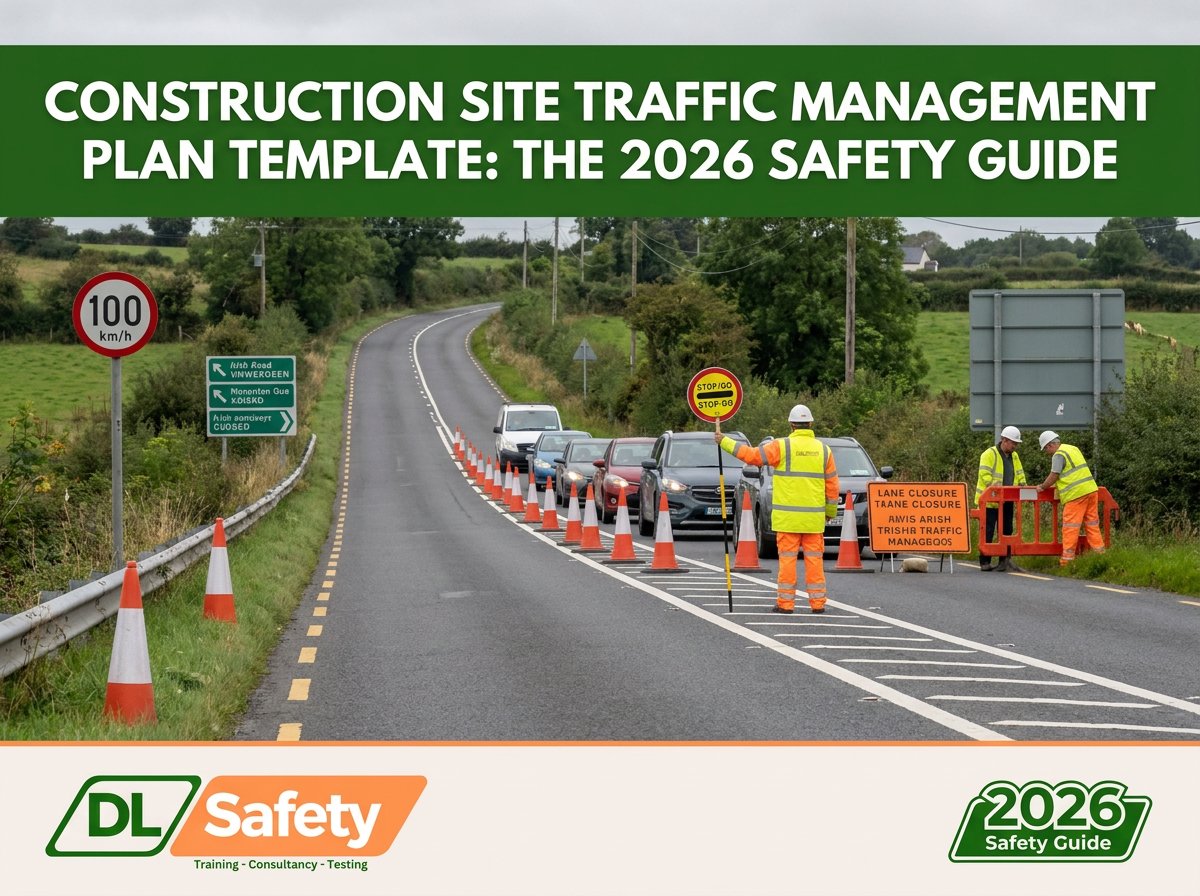
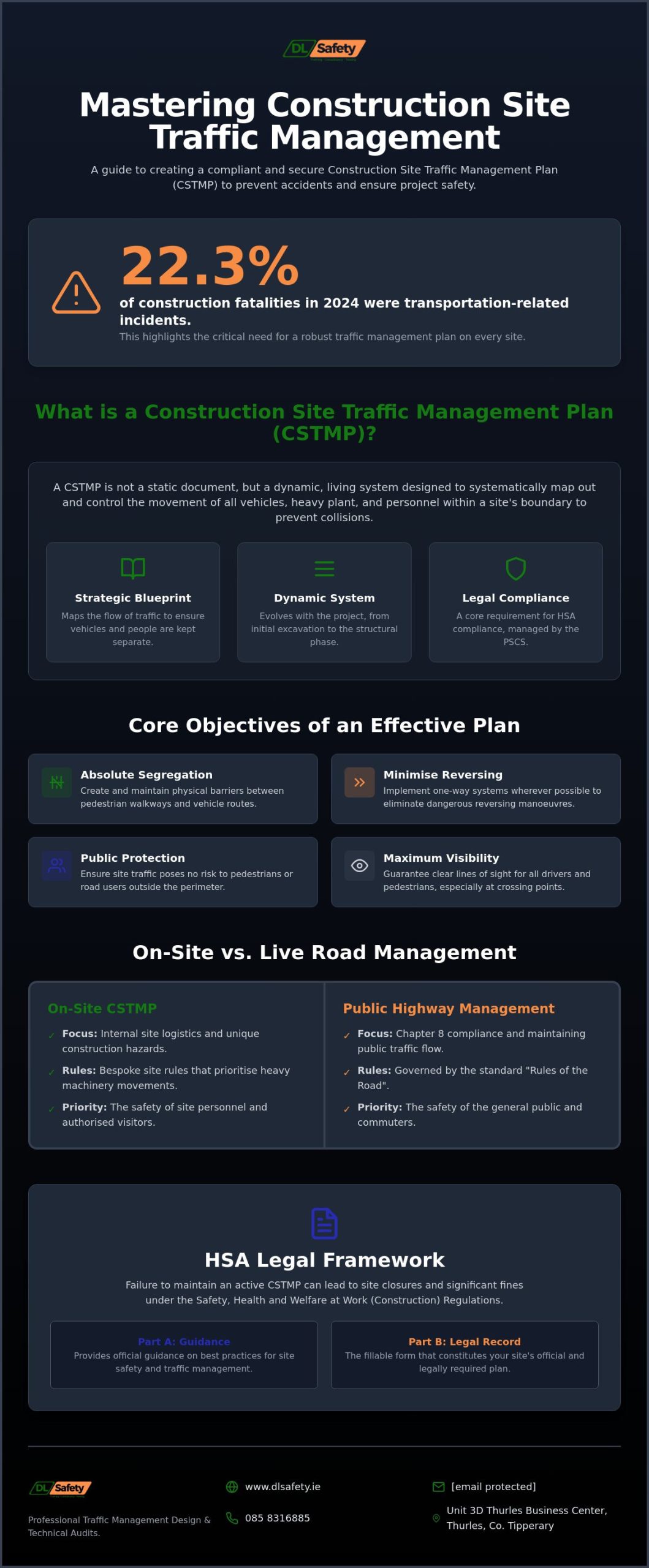
Did you know that transportation-related incidents accounted for 22.3% of construction fatalities in 2024? It is a sobering figure that highlights the constant danger of vehicle-pedestrian collisions, making a robust construction site traffic management plan template an essential tool for any project manager. You likely feel the pressure of this reality every day, especially when you are trying to organise a complex build within a restricted footprint whilst ensuring every HSA requirement is met with total precision. It is often difficult to find the right balance between maintaining a high work rate and upholding the rigorous safety standards that protect your team.
We want to help you move from a state of uncertainty to one of absolute confidence by mastering the essentials of site safety. This guide provides a framework that ensures your project remains fully compliant and secure, reducing the risk of accidents through practical, methodical planning. You will gain a clear understanding of the vital components of a CSTMP and learn how to implement a safety system that evolves with your site. For bespoke support, contact DL Safety at Unit 3D Thurles Business Center, Stradavoher, Thurles, County Tipperary, E41 W880, call 085 8316885, or visit www.dlsafety.ie.
Key Takeaways
- Understand the legal necessity of a CSTMP for HSA compliance and how it functions as a strategic document for managing vehicle and pedestrian movements.
- Learn how to effectively use a construction site traffic management plan template to identify key safety contacts and conduct site-specific risk assessments.
- Master the essential components of pedestrian segregation and the logistics of organising clear access and egress for heavy plant on restricted sites.
- Discover how to coordinate traffic flow during high-risk phases, including excavation spoil removal and the setup of lifting operation exclusion zones.
- Recognise when to seek professional traffic management design or technical audits from the experts at DL Safety, located at Unit 3D Thurles Business Center, Stradavoher, Thurles, County Tipperary, E41 W880, by calling 085 8316885 or visiting www.dlsafety.ie.
What is a Construction Site Traffic Management Plan (CSTMP)?
A Construction Site Traffic Management Plan (CSTMP) is a strategic safety document that serves as the blueprint for every vehicle and pedestrian movement within a site’s boundary. It isn’t a static piece of paper gathering dust in a site office; it’s a dynamic, living system designed to prevent the most common causes of workplace fatalities. By using a construction site traffic management plan template, you can systematically map out the flow of heavy plant, delivery lorries, and site personnel to ensure they never occupy the same space at the same time. This document translates complex site logistics into clear, actionable rules that every worker must follow.
The Project Supervisor Construction Stage (PSCS) carries the primary responsibility for developing and maintaining this plan. It’s their job to ensure the CSTMP evolves alongside the project. As a site moves from initial excavation to the structural phase, the traffic risks change fundamentally. A plan that worked during the first week of groundworks won’t be fit for purpose when tower cranes are active and multiple subcontractors are vying for limited access space. Professional support from a partner like DL Safety, based at Unit 3D Thurles Business Center, Stradavoher, Thurles, County Tipperary, E41 W880, ensures your plan remains robust throughout these transitions.
The core objectives of any effective traffic management plan include:
- Absolute Segregation: Creating physical barriers between walkways and vehicle routes.
- Minimising Reversing: Implementing one-way systems to eliminate the need for dangerous reversing manoeuvres.
- Public Protection: Ensuring that site traffic doesn’t pose a risk to pedestrians or road users outside the perimeter.
- Visibility: Ensuring all drivers and pedestrians have clear sightlines at crossing points.
The Difference Between Live Road and On-Site Management
It’s vital to distinguish between traffic management on public highways and the internal logistics of a construction site. Whilst public Road traffic control focuses on Chapter 8 compliance and maintaining the flow of general commuters, a CSTMP is concerned with the unique hazards of a closed site. On-site, the Rules of the Road are replaced by bespoke site rules that prioritise heavy machinery movements. The boundary where the public road ends and the site begins is a critical safety threshold; it’s the point where public liability ends and your specific site safety duties become the priority.
Legal Framework and HSA Compliance in 2026
In 2026, the Health and Safety Authority (HSA) continues to enforce the Safety, Health and Welfare at Work (Construction) Regulations with a focus on proactive prevention. The HSA provides a two-part structure for compliance: Part A offers guidance on best practices, while Part B is the fillable form that constitutes your legal record. Failing to maintain an active construction site traffic management plan template can lead to significant legal consequences, including site closures or heavy fines. For help navigating these requirements, you can contact the DL Safety team at info@dlsafety.ie or call 085 8316885. Our experts can help you implement a plan that meets every HSA standard whilst keeping your site efficient. Visit www.dlsafety.ie for more details on our traffic management design services.
Core Components of an Effective Traffic Management Plan
Building a safe site environment requires more than just good intentions; it demands a structured approach to logistics. Using a construction site traffic management plan template allows you to break down the site into manageable zones, ensuring that every entry and exit point is fit for the heavy plant expected to use it. You must designate specific access and egress routes that prevent lorries from backing out onto public roads, which is a high-risk manoeuvre that often leads to accidents. By planning these routes early, you reduce congestion and ensure that deliveries don’t compromise the safety of site personnel or the general public.
In addition to site safety, securing the transit of these materials is a critical part of the logistics chain. Cargo Insure Online offers specialised insurance for trucking and freight, providing peace of mind for global and local delivery operations.
Every effective plan must address these fundamental elements:
- Site Access and Egress: Clear, separate gates for vehicles and pedestrians to prevent any chance of a crossover collision.
- Signage and Lighting: High-visibility markers and task lighting, which are especially critical during the winter months when low-light conditions increase the risk of incidents.
- Vehicle Rules: Strict enforcement of site speed limits, typically 10km/h or 15km/h, alongside clear one-way systems to eliminate reversing.
- Designated Parking: Keeping private vehicles away from active plant zones to maintain clear sightlines for machinery operators. This should also encompass secure areas for staff who cycle to the site; for those in need of a reliable bike, Chain Driven Cycles offers flexible payment plans for high-quality bicycles.
Segregation Strategies: Barriers and Walkways
Pedestrian segregation is the “Golden Rule” of site safety. If you can physically prevent a person from entering a vehicle’s path, you have effectively eliminated the primary cause of site fatalities. Integrating these physical controls into your construction site traffic management plan template ensures they are prioritised from day one. Choosing the right barrier is essential; whilst Jersey barriers offer high impact resistance for heavy plant areas, Heras fencing or water-filled barriers might suffice for lighter foot traffic zones. You must also ensure that walkways are kept clear of debris and well-maintained to prevent slips and trips amongst the workforce, particularly in areas where pedestrian and vehicle paths must intersect at designated crossing points.
Competency and Training Requirements
The best traffic plan in the world will fail if the people implementing it aren’t competent. A skilled vehicle banksman or signaller is your most valuable asset on a busy site, acting as the bridge between the driver’s blind spots and the safety of nearby workers. According to best practices in Work Zone Traffic Management, human oversight remains a critical layer of protection that technology cannot yet fully replace. You must also verify that every operator holds the correct certifications for their specific machinery. If you need to upskill your team to meet these standards, our Online Safety Courses Ireland provide a flexible way to ensure compliance across your entire project. For operators working at height on mobile elevated work platforms, a MEWP operator online theory course offers a practical way to maintain certification standards without disrupting your site schedule.
If you’re managing a site with a particularly tight footprint, DL Safety can provide specialized Traffic Management Design to help you navigate these challenges. For professional advice, contact us at info@dlsafety.ie or call 085 8316885. Our team is based at Unit 3D Thurles Business Center, Stradavoher, Thurles, County Tipperary, E41 W880, and we are ready to support your next project. Visit www.dlsafety.ie to learn more about how we can help you reduce site risks.
How to Use the Construction Site Traffic Management Plan Template
A template provides the essential skeleton for your safety strategy, but the real value lies in how you customise it to reflect the daily realities of your project. Filling out a construction site traffic management plan template isn’t just a box-ticking exercise for the HSA; it’s a methodical process of identifying where your biggest risks lie. You should start by gathering project-specific information, such as the names of the Project Supervisor Construction Stage (PSCS) and designated traffic coordinators. Once these safety contacts are established, you can move into the site-specific risk assessment, focusing specifically on how vehicle movements will interact with the surrounding environment.
To use the template effectively, follow these five practical steps:
- Step 1: Identify all key safety personnel and emergency contact details for the site.
- Step 2: Conduct a thorough risk assessment that accounts for every vehicle type, from small vans to heavy excavators.
- Step 3: Create a detailed sketch of the site layout, clearly marking loading bays, storage areas, and turning circles.
- Step 4: Define the traffic flow to prioritise one-way systems, which is the most effective way to eliminate reversing.
- Step 5: Schedule regular reviews to ensure the plan remains accurate as the site footprint evolves.
Mapping Your Site Layout
Visualising the site is often where the most critical safety gaps are discovered. You should use your site drawings to identify “blind spots” where operators might lose sight of pedestrians and narrow pinch points where machinery cannot safely pass. It’s also vital to position welfare facilities, such as canteens and drying rooms, well away from high-traffic zones to ensure workers don’t have to cross active vehicle routes during their breaks. If you’re struggling with a restricted area, our guide on Expert Delivery and Vehicle Management on Tight Sites offers advanced strategies for these high-pressure environments.
Hazard Identification and Control Measures
Your plan must specifically address environmental hazards that could lead to a catastrophe. This includes identifying overhead power cables that require goalposts or underground services that might be crushed by heavy plant. Implementing “No-Go” zones for pedestrians during high-risk deliveries is an essential control measure that should be clearly documented in your construction site traffic management plan template. To ensure operator clarity, we recommend a “one sentence” rule for site speed limits; for example, “All vehicles must remain under 10km/h at all times without exception.”
At DL Safety, we specialise in helping contractors turn these templates into high-performance safety systems. Whether you need a technical audit or a bespoke traffic management design, we’re here to help. Contact our team at info@dlsafety.ie, call us on 085 8316885, or visit us at Unit 3D Thurles Business Center, Stradavoher, Thurles, County Tipperary, E41 W880. You can also explore our full range of services at www.dlsafety.ie.
Integrating Traffic Safety with High-Risk Site Phases
A static safety document is often a liability on a fast-moving project. Whilst a construction site traffic management plan template provides a solid starting point, it must be adapted to reflect the specific risks of high-intensity milestones. Excavation and lifting phases introduce unique hazards that standard flow plans might overlook, such as the massive increase in vehicle frequency during spoil removal or the temporary exclusion zones required for heavy lifting. Recognising these shifts allows you to transition from a general safety overview to a precise, phase-specific control system that protects every worker on the ground.
Managing ‘unusual’ traffic is another critical factor. Concrete pours and oversized load deliveries often require temporary suspension of normal site rules, demanding a high level of coordination between the Project Supervisor Construction Stage (PSCS) and the delivery teams. You must also account for changing ground conditions; a route that is safe for a tipper truck on dry hardcore can become a skidding hazard on wet clay. This instability significantly impacts braking distances and vehicle stability, requiring constant monitoring and adjustments to your traffic routes to prevent tip-overs or collisions.
Excavation Safety and Spoil Management
During the groundworks phase, the volume of traffic usually peaks as lorries move in and out to clear the site. A primary concern here is excavation safety and shoring requirements in relation to traffic. Heavy vehicles must never be allowed to surcharge the edges of an open trench, as the weight can cause a catastrophic slope failure. Your construction site traffic management plan template should clearly define ‘set-back’ distances for all plant and organise tipping areas that are structurally capable of supporting the anticipated loads. Proper stockpiling logic is essential to ensure that spoil heaps do not encroach on designated vehicle routes or pedestrian walkways.
Lifting Operations and Traffic Exclusion Zones
Co-ordinating vehicle movements with lifting operations requires surgical precision. When a crane is active, the area beneath the boom and around the outriggers must be strictly controlled to prevent unauthorised access. You should establish clear exclusion zones for all lifting gear and suspended loads, ensuring that no vehicle or pedestrian enters the ‘drop zone’ whilst the lift is in progress. To maintain the highest standards of equipment safety, all lifting plant must undergo regular GA1 Testing Ireland to ensure statutory compliance and mechanical integrity.
If you need expert assistance in developing a comprehensive lift plan or a bespoke traffic management design, the team at DL Safety is here to support you. We specialise in high-risk environments and can help you maintain HSA compliance throughout every project phase. Contact us at info@dlsafety.ie, call 085 8316885, or visit our office at Unit 3D Thurles Business Center, Stradavoher, Thurles, County Tipperary, E41 W880. For more information on our full range of safety services, explore our website at www.dlsafety.ie.
Professional Support for Traffic Management Design
A construction site traffic management plan template provides the essential foundation for your safety strategy, but there are moments when a standardised document reaches its limit. On sites with multi-layered logistics, high-density vehicle movements, or particularly restricted footprints, the complexity often exceeds what a basic framework can manage. Professional traffic management design moves beyond the basics by creating a bespoke system that accounts for every technical nuance of your project. This high-level planning ensures that your site remains productive whilst maintaining the absolute highest standards of safety and HSA compliance.
Our Monthly Safety Support Packages are designed to provide this ongoing expertise, ensuring your traffic plan is never out of date. As your project evolves, so do the risks. Having a dedicated safety partner allows you to focus on the build whilst we handle the continuous refinement of your CSTMP. This proactive approach ensures your documentation is always ready for a surprise HSA inspection, demonstrating a level of due diligence that goes far beyond a simple paperwork exercise. It is about building a narrative of trust and thoroughness that protects both your workers and your professional reputation.
Technical Testing and Site Audits
Ensuring the mechanical integrity of the plant on your site is just as vital as the routes they travel. DL Safety specialises in on-site quarry vehicle brake testing, a critical service for heavy machinery operating in high-risk environments. This testing provides verifiable data on vehicle stopping distances, which is essential for validating the safety zones defined in your traffic plan. Regular Health & Safety Site Audits further strengthen this system by identifying emerging traffic risks before they result in an incident. These audits provide an objective, expert perspective that helps you maintain a culture of constant vigilance amongst your workforce.
Conclusion and Next Steps
Before you finalise your construction site traffic management plan template, run through this final checklist to ensure no gaps remain:
- Are pedestrian and vehicle routes physically segregated with appropriate barriers?
- Has every operator’s competency and certification been verified?
- Is there a clear, enforced one-way system to minimise reversing?
- Does the plan account for the specific risks of the current site phase?
If you require expert assistance with your traffic management design or need to schedule technical testing, the team at DL Safety is ready to help. You can contact us at Unit 3D Thurles Business Center, Stradavoher, Thurles, County Tipperary, E41 W880. For direct enquiries, please email info@dlsafety.ie or call our office on 085 8316885. We invite you to visit www.dlsafety.ie to explore how our specialised support can protect your team and ensure your project’s success. Let us help you turn compliance into a practical, life-saving reality on your site.
Securing Your Project with Proactive Traffic Management
Managing site logistics is a continuous challenge that requires more than just initial planning; it’s about maintaining a high-standard safety culture that protects every individual on the ground. We’ve explored how a construction site traffic management plan template serves as your vital starting point, provided it is adapted for high-risk phases like excavation and lifting. True compliance involves a combination of robust documentation and practical, on-site controls such as pedestrian segregation and clear signage.
DL Safety is here to elevate your site standards through HSA-compliant safety documentation and specialised technical testing for heavy plant. We provide professional site audits and accident investigation services that identify risks before they lead to collisions. For expert guidance tailored to your specific project needs, Get Expert Help with Your Traffic Management Design Today. You can find our team at Unit 3D Thurles Business Center, Stradavoher, Thurles, County Tipperary, E41 W880, email us at info@dlsafety.ie, or call 085 8316885. We look forward to helping you build a safer, more efficient site for your entire team.
Frequently Asked Questions
Is a construction site traffic management plan a legal requirement in Ireland?
Yes, it is a mandatory requirement under the Safety, Health and Welfare at Work (Construction) Regulations 2006. Every project must have a clear strategy for managing vehicle and pedestrian movements to ensure worker safety. Failing to produce a valid plan during an audit can lead to significant legal penalties or site shutdowns. For assistance with compliant documentation, you can contact DL Safety at info@dlsafety.ie.
Who is responsible for creating the CSTMP on a project?
The Project Supervisor Construction Stage (PSCS) holds the primary responsibility for developing and maintaining the traffic management plan. Whilst they may delegate the drafting to a safety professional, the PSCS must ensure the plan is implemented and followed by all contractors. This includes coordinating different site phases to prevent conflicting vehicle movements and ensuring all site rules are clearly communicated.
How often should a traffic management plan be reviewed?
You should review your plan whenever there is a significant change to the site layout or a new high-risk phase begins. At a minimum, a formal monthly review is recommended to ensure the construction site traffic management plan template remains accurate. Static plans often become dangerous as the site footprint evolves; keeping it updated is a key part of active safety management.
What are the most common causes of vehicle accidents on construction sites?
Reversing manoeuvres and poor pedestrian segregation are the leading causes of site-based transportation incidents. In 2024, transportation-related incidents accounted for 22.3% of construction fatalities, often due to blind spots or the lack of a trained banksman. Other common factors include excessive speed, poor ground conditions, and inadequate lighting during winter months which reduces visibility for plant operators.
Do I need a different plan for pedestrians and vehicles?
You need one integrated plan that clearly defines separate routes for both pedestrians and vehicles. The goal is total segregation, ensuring that people and machines never occupy the same space simultaneously. Your plan should include physical barriers, designated crossing points, and clear signage to guide everyone safely through the site. If you need bespoke design, visit www.dlsafety.ie for professional support.
Can I use a generic template for all my construction sites?
No, every site has unique hazards that a generic document cannot address. Whilst a construction site traffic management plan template provides a useful structure, you must customise it with site-specific risk assessments and layout drawings. A plan for a city centre build will look very different from one for a rural greenfield project. Contact our team at 085 8316885 for help with site-specific planning.
What training do site banksmen and vehicle signallers need?
Banksmen and signallers must hold a valid CSCS card or an equivalent recognised qualification to prove their competency. They need specific training to understand hand signals, blind spots, and safe positioning when directing heavy plant. Regular refresher training is also vital to maintain high standards of safety on a busy project. For operators of mobile elevated work platforms, completing a MEWP operator online theory course is an efficient way to keep certifications current without taking your team off-site for extended periods. DL Safety offers various training solutions from our office at Unit 3D Thurles Business Center, Stradavoher, Thurles, County Tipperary, E41 W880.
How does a CSTMP help during a HSA inspection?
A well-maintained CSTMP provides immediate evidence of due diligence and proactive safety management to an inspector. It shows that you’ve identified site-specific risks and implemented physical controls to mitigate them. Having an active, signed, and updated plan demonstrates that safety is a lived reality on your site rather than just a paperwork exercise. To fully prepare your team for an unannounced visit, it is worth understanding what to expect during a HSA inspection so that your documentation and site controls are always ready for scrutiny. This transparency builds trust with the Health and Safety Authority during their visit.