Crane Lifting Essentials: A Complete Guide to Safe Lifting Under Irish Law
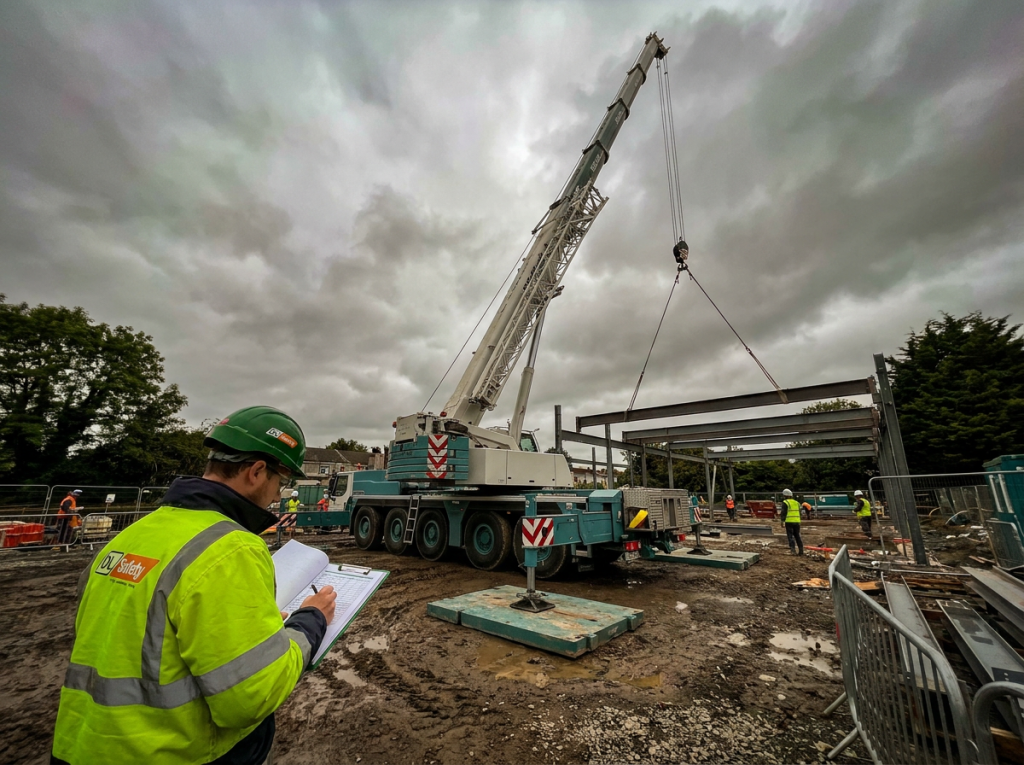
Crane lifts are among the highest-risk operations on any construction, civil, or industrial site. When something goes wrong — an overloaded crane, soft ground beneath an outrigger, a sling failure, a live power line overhead — the consequences are catastrophic and, in most cases, entirely preventable. This guide covers everything required under Irish health and safety law, British and Irish standards, and best practice to plan and execute a safe crane lift. Whether you’re a site manager, appointed person, or safety officer, use this as your reference from initial planning through to post-lift documentation. 1. Why Crane Lifting Safety Matters: The Regulatory Landscape in Ireland Crane lifting operations are regulated under a layered framework of primary legislation, statutory regulations, and technical standards. There is no single document that covers everything — compliance means understanding how these instruments work together. Irish law places a general duty on every employer to ensure, so far as is reasonably practicable, the safety, health, and welfare of all employees and others who may be affected by their work. For lifting operations, that duty is given specific, enforceable form in the regulations and standards detailed below. 2. Applicable Legislation and Standards Primary Legislation Statutory Regulations Technical Standards 3. Pre-Lift Planning No crane lift — however routine it appears — should proceed without planning. The level of formality scales with the complexity and risk of the lift, but the principle is non-negotiable. Appointing a Competent Person / Appointed Person (AP) Under BS 7121, every lifting operation must be planned by a competent person. For crane lifts of any significant complexity, this person is formally designated the Appointed Person (AP). The AP: The AP does not need to be on-site at all times but must be contactable during the lift. Conducting a Site Survey Before preparing a lift plan, a thorough site survey must be carried out. This covers: Preparing a Formal Lift Plan Every non-routine lift requires a written lift plan (method statement with an integrated risk assessment). Routine repetitive lifts may use a simplified pre-approved method, but even these must be reviewed when conditions change. Categories of Lifts BS 7121 categorises lifts to help determine the level of planning required: 4. Ground Bearing Capacity and CBR Testing Ground failure is one of the leading causes of crane overturns. The ground must be capable of supporting the crane’s outrigger loads — and this must be verified, not assumed. What Is CBR Testing? CBR (California Bearing Ratio) testing measures the bearing strength of a soil or sub-base material. The result is expressed as a percentage of the bearing value of a standard crushed stone material. It is a standard method used by geotechnical engineers to characterise ground conditions. When and Why It Is Required CBR testing (or equivalent geotechnical investigation) is required when: How Ground Bearing Pressure Is Calculated The outrigger reaction forces from the crane (published in the manufacturer’s load chart) must be spread over an area large enough to keep the pressure within the ground’s capacity. The formula is: Ground Bearing Pressure (kN/m²) = Outrigger Load (kN) ÷ Pad Area (m²) The calculated pressure must not exceed the allowable ground bearing capacity established by geotechnical assessment. A safety factor is applied. Role of a Geotechnical Engineer Where ground conditions are uncertain, a geotechnical engineer must be engaged to: Special Considerations 5. Crane Selection The right crane for the job is determined by the lift requirements — not by what happens to be available. Choosing the Right Crane Type Crane Type Typical Use Mobile (all-terrain, rough terrain) Most common for construction and civil work; versatile, fast to mobilise Crawler crane Heavy lifts on stable ground; slow to mobilise but high capacity Tower crane Long-duration construction sites; fixed position Lorry-mounted / loader crane Lighter lifts; delivery and installation work Capacity Charts and Radius/Load Assessment Every crane comes with a load chart from the manufacturer. The AP must: Safe Working Load (SWL) The SWL (Safe Working Load) is the maximum load a crane is rated to lift under specified conditions. It must never be exceeded. The SWL on the capacity chart accounts for the outrigger configuration — using extended, partially extended, or retracted outriggers changes the SWL significantly. 6. Crane Pads and Outrigger Pads Purpose and Importance Outrigger pads spread the point load from each outrigger foot over a larger ground area, reducing the ground bearing pressure to within the ground’s safe capacity. Without adequate pads, the ground can fail locally, causing the crane to overturn. Calculating Required Pad Size The required pad area is calculated from: Minimum Pad Area (m²) = Outrigger Load (kN) ÷ Allowable Ground Bearing Capacity (kN/m²) Both inputs must be verified — the outrigger load from the manufacturer’s chart, and the bearing capacity from geotechnical assessment. Types of Pads Correct Placement and Inspection 7. Formal Lift Plan A lift plan is the core document that governs the lift. It must be prepared before the lift commences and must be communicated to all personnel involved. Contents of a Lift Plan A complete lift plan includes: Who Prepares and Who Approves The lift plan is prepared by or under the supervision of the Appointed Person. On critical lifts, it should be reviewed and countersigned by a second competent person. The contractor’s safety officer and client/PSDP may also be required to approve before the lift commences. Toolbox Talk and Briefing Before every lift, a toolbox talk must be delivered to all personnel involved. This covers: Permit to Lift For complex and critical lifts, a Permit to Lift (PTL) should be issued. This is a formal authorisation document that confirms all pre-conditions have been checked and met before the lift begins. The PTL is typically signed off by the AP, the site manager, and — where relevant — the owner of the infrastructure being lifted over. 8. Load Assessment Underestimating the weight of a load is a direct cause of crane failures and fatalities. Identifying and Verifying Load Weight Centre of Gravity The centre of gravity (CoG)
Online Training, Compliance Made Simple
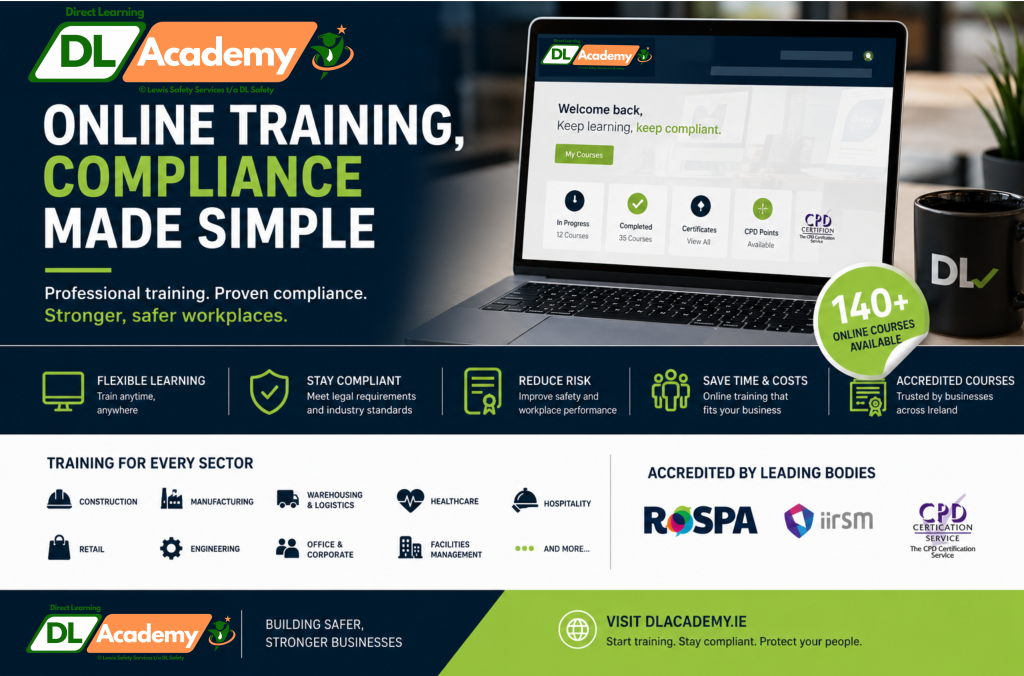
In today’s fast-moving business environment, keeping staff trained, competent, and compliant is no longer optional — it is a core business requirement. Whether you operate in construction, manufacturing, logistics, warehousing, engineering, retail, hospitality, healthcare, or office-based environments, companies are under increasing pressure to demonstrate compliance, reduce risk, and maintain high safety standards. That is where DL Academy delivers real value. Powered by the team behind DL Safety, DL Academy provides a simple, affordable, and professional online training solution designed specifically for modern Irish businesses. The platform gives companies instant access to over 140 online training courses covering health & safety, compliance, HR, business skills, wellbeing, food safety, fire safety, working at height, manual handling, plant safety awareness, asbestos awareness, COSHH, first aid awareness, cyber security, environmental awareness, and much more. Training Designed for Multiple Industries DL Academy supports businesses across a wide range of sectors including: This broad industry coverage allows companies to centralise their staff training in one easy-to-manage platform, reducing administration while improving compliance visibility. Professional Accredited Training One of the biggest concerns businesses have with online training is credibility and accreditation. DL Academy courses are approved and accredited by recognised industry bodies including: These accreditations provide confidence that staff are receiving professional, recognised, and high-quality training aligned with industry best practice. Why Businesses Are Moving to Online Training Traditional classroom training can be expensive, disruptive, and difficult to coordinate. Online learning allows businesses to: For many businesses, online learning has become the most practical and cost-effective way to maintain compliance standards while continuing daily operations. More Than Just Training DL Academy is not simply an online course provider. It forms part of a wider compliance support solution delivered by DL Safety. This means businesses can combine online training with: This integrated approach allows companies to simplify compliance management under one trusted provider. Safety Compliance Made Simple For businesses looking to modernise training, improve compliance, and reduce administrative burden, DL Academy provides a professional and scalable solution. With over 140 accredited online courses, flexible learning access, and expert industry support, DL Academy helps businesses stay compliant, protected, and inspection-ready — without the complexity traditionally associated with workforce training. Explore the full course library today at: DL Academy
What to Expect From an HSA Visit to Site
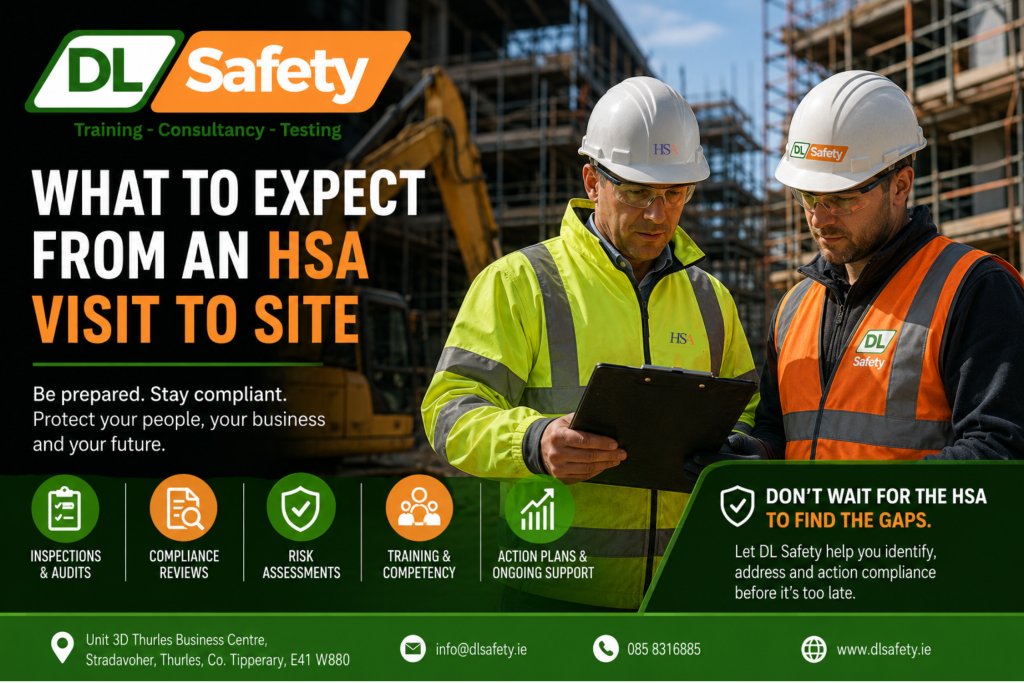
Are You Ready for an Inspection… or One Step Away From Enforcement? For many contractors across Ireland, a visit from the Health and Safety Authority (HSA) creates immediate stress on site. Supervisors start searching for paperwork, managers begin making phone calls, and suddenly everyone is asking the same question: “Are we actually compliant?” The reality is that HSA inspections are becoming more targeted, more detailed, and increasingly focused on areas where contractors continue to fail — particularly within construction, groundworks, utilities, lifting operations, working at height, and plant safety. And when compliance is missing, the consequences can be severe. Why Does the HSA Visit a Site? HSA inspections happen for several reasons, including: Inspectors have significant legal powers under the Safety, Health and Welfare at Work Act 2005, including the ability to: Common Areas Where Companies Fail 1. Working at Height One of the most common enforcement areas in Ireland continues to be falls from height. Typical failures include: In several Irish prosecutions, contractors faced substantial fines following incidents where workers fell through fragile roofs or from unprotected edges. What Happens? The HSA may: 2. Excavations & Underground Services Excavation collapses remain a major concern across civil engineering and utilities sectors. Common failings include: In previous Irish enforcement cases, companies were prosecuted where excavations collapsed or where underground services were struck due to poor planning and inadequate controls. Consequences Can Include: 3. Plant & People Interface HSA inspectors pay particular attention to interaction between pedestrians and moving plant. Typical problems: This is one of the leading causes of fatalities within Irish construction. 4. Lifting Operations & Statutory Testing Another major compliance failure is incomplete lifting documentation and unsafe lifting practices. Common issues include: The HSA regularly prosecutes companies where lifting equipment was used outside compliance requirements. What Are the Real Consequences of an HSA Conviction? Many companies underestimate the long-term impact of enforcement action. An HSA conviction affects far more than just a fine. Financial Impact Costs may include: A single serious incident can cost a business hundreds of thousands of euro. Damage to Reputation In Ireland, HSA prosecutions are public. Convictions are often: This can severely damage trust and professional credibility. Difficulty Winning Future Work Many major contractors and clients now examine: A poor safety record can directly impact: For some companies, one prosecution can remove them from tender opportunities entirely. The Biggest Problem? Most Companies Don’t Know Where Their Gaps Are Many businesses believe they are compliant because: But during inspections, inspectors often uncover major weaknesses including: Compliance is not just paperwork. It is the ability to demonstrate that safety systems are actively implemented and monitored on site. How DL Safety Can Help At DL Safety, we work with contractors across Ireland to identify compliance gaps before the HSA does. Our approach is practical, site-focused, and designed specifically for Irish construction and industry. Our Safety Compliance Checks Include: We Don’t Just Identify Problems — We Help Fix Them DL Safety provides: Our goal is simple: Help your company become compliant, inspection-ready, and safer for everyone on site. Could Your Site Pass an HSA Inspection Today? If you are unsure, now is the time to act before an incident, complaint, or inspection happens. A proactive safety review today could prevent: Book a Safety Compliance Check with DL Safety DL Safety provides professional health & safety consultancy, training, inspections, and compliance support throughout Ireland. Contact DL Safety Today DL SafetyTraining • Consultancy • Testing 📍 Unit 3D Thurles Business Centre, Stradavoher, Thurles, Co. Tipperary, E41 W880📧 info@dlsafety.ie📞 085 8316885🌐 www.dlsafety.ie
Why Where You Buy Your Lifting Equipment Matters — and What a GA1 Certificate Really Means for Your Business
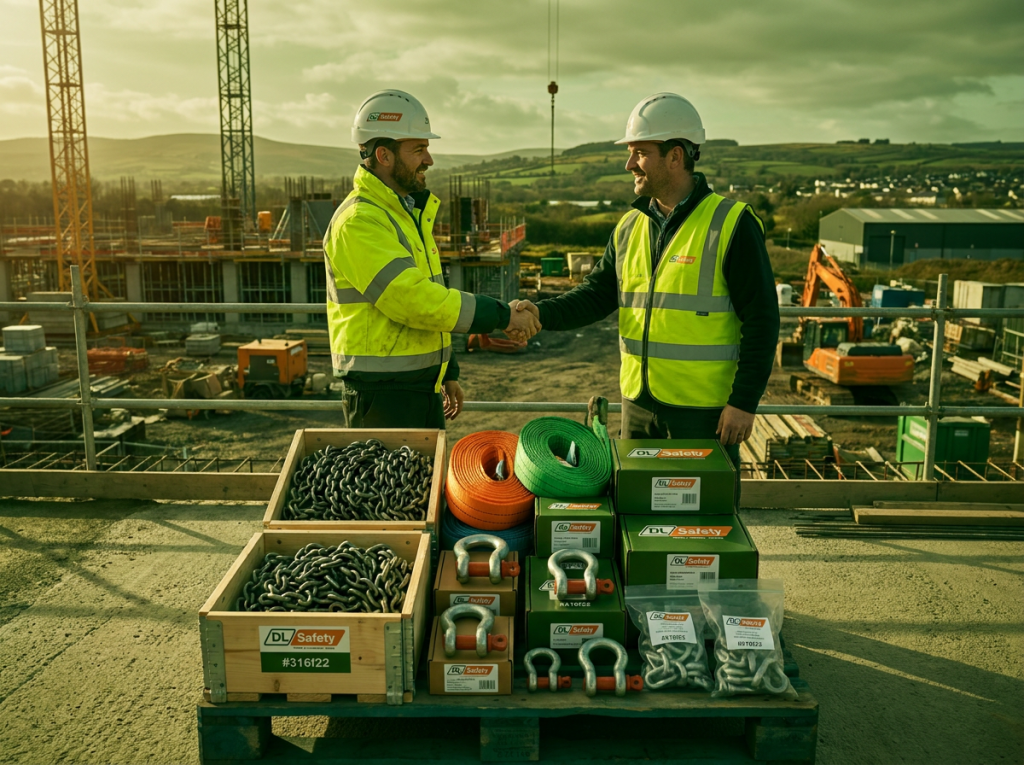
The Hidden Risk in Lifting Equipment Every day across Ireland, workers on construction sites, in quarries, on farms, and in industrial facilities use lifting equipment to move heavy loads. Lifting chains, webbing slings, and shackles are among the most common — and most critical — pieces of safety equipment on any site. Here’s the problem: not all lifting equipment is equal, and not all suppliers are either. Buying from an unvetted or non-certified source might seem like a straightforward cost saving. But when that equipment fails — and poorly certified or improperly examined equipment does fail — the consequences can be catastrophic. We’re talking about serious injury, loss of life, legal liability, and the kind of incident that shuts down a site and ends careers. The question isn’t just what you’re buying. It’s who is supplying it, how it’s been examined, and what documentation backs it up. What Is a GA1 Thorough Examination Certificate? In Ireland, lifting equipment used in the workplace must comply with the Safety, Health and Welfare at Work (General Application) Regulations 2007, which require that all lifting accessories — chains, slings, shackles, and similar items — undergo a thorough examination before first use and at regular intervals thereafter. A GA1 Certificate of Thorough Examination is the formal documentation confirming that a piece of lifting equipment has been inspected by a competent person and is deemed safe and fit for its intended purpose. This isn’t a simple visual check — it’s a structured, technical examination against defined standards. LEEA standards — set by the Lifting Equipment Engineers Association, one of the world’s leading authorities on lifting equipment safety — define the benchmark for what a competent thorough examination looks like. LEEA-trained and LEEA-member examiners follow rigorous technical protocols to assess the condition, load capacity, and integrity of lifting accessories before they’re cleared for use. Without a valid GA1 certificate from a LEEA-standard examiner, your equipment is not legally compliant — regardless of how new it looks or who it came from. Why Buying from a Trusted, Certified Source Changes Everything 1. You Know Exactly What You’re Getting When you purchase lifting equipment from DL Safety, every item — from a 1-tonne Grade 80 lifting chain to a polyester webbing sling — comes with a GA1 Certificate of Thorough Examination issued to LEEA standards. You’re not just buying equipment. You’re buying verified, documented, legally compliant safety gear. That certificate tells you: No guesswork. No assumptions. Just clear, traceable documentation you can show an inspector, an insurer, or a client. 2. You’re Protected Under Irish Law Under the Safety, Health and Welfare at Work Act 2005 and the General Application Regulations 2007, employers have a duty to ensure that all lifting accessories are: If an incident occurs and you cannot produce a valid GA1 certificate from a qualified examiner, your exposure — both legally and in terms of insurance — is significant. Buying from a supplier who provides that documentation as standard removes a major compliance risk from your operation. 3. You Get Real-World Expertise Alongside the Equipment DL Safety isn’t a warehouse. We are an active health and safety consultancy with 25 years of hands-on experience across construction, civils, quarrying, transport, and agriculture. David Lewis is a member of LEEA — meaning the technical knowledge behind every GA1 examination we issue is backed by international lifting industry standards. When you buy from us, you’re not dealing with an order fulfilment team. You’re dealing with people who have worked on major Irish infrastructure projects, who understand how this equipment is actually used in the field, and who can advise you on: That’s the difference between buying a product and buying genuine peace of mind. 4. Your Equipment Record is Clean from Day One One of the most overlooked aspects of lifting equipment compliance is traceability. During a site audit, HSA inspection, or insurance review, you may be asked to demonstrate the full history of your lifting accessories. When every item purchased from DL Safety comes with a GA1 certificate, your equipment record starts clean. Serial numbers are documented, examination dates are logged, and re-examination timelines are clearly indicated. You’re building a compliant lifting register from the ground up — not scrambling to retrofit documentation after the fact. 5. Reduced Risk of Equipment Failure in the Field LEEA-standard thorough examinations catch problems that a visual check simply cannot. Micro-fractures in chain links, strand wear in wire rope slings, chemical degradation in webbing, deformation in shackle pins — these are the kinds of defects that look fine to the untrained eye but represent a serious failure risk under load. By sourcing your equipment from a LEEA member who conducts GA1 examinations as part of the supply process, you’re adding a technical filter before anything reaches your site. Equipment that doesn’t pass, doesn’t ship. It’s that simple. For site managers and safety officers, that layer of assurance is genuinely valuable — not just for compliance, but for the confidence of the workers who have to use the equipment every single day. 6. Ongoing Support and Re-Examination Made Easy Compliance with lifting equipment regulations isn’t a one-time event — it’s an ongoing process. Under Irish law, lifting accessories must be re-examined at regular intervals (typically every 6 months). DL Safety can provide those periodic thorough examinations on your existing equipment as well. That means when you buy from us, you’re not starting a transaction — you’re building a relationship with a supplier and examiner who knows your equipment, knows your operation, and can keep you continuously compliant without the headache of managing multiple contractors. What We Supply DL Safety supplies a full range of CE-marked, Grade 80 lifting accessories, including: All items are supplied with GA1 Thorough Examination Certificates issued to LEEA standards and are CE marked in compliance with the Machinery Directive 2006/42/EC. The Bottom Line Lifting equipment failures are rarely accidents in the true sense. They’re the predictable result of poor purchasing decisions, inadequate documentation, and insufficient oversight. The good
DL Safety launches Direct Learning Academy
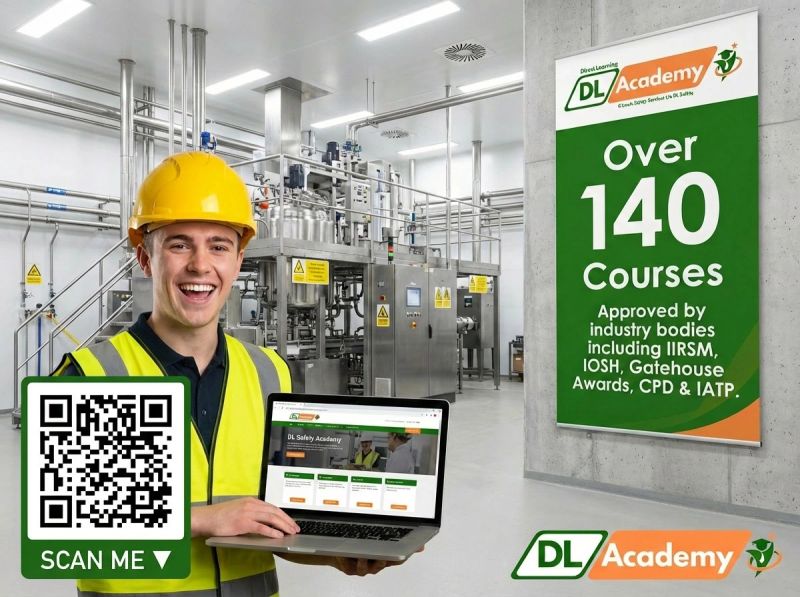
We are live Folks, Direct Learning Academy, over 140 courses online for you and your teams. Learn and up skill on your terms, start stop and resume to suit your timetable. check it out for a free trial: DL Academy
Webbing Slings for Lifting Operations – What Every Site Manager Needs to Know
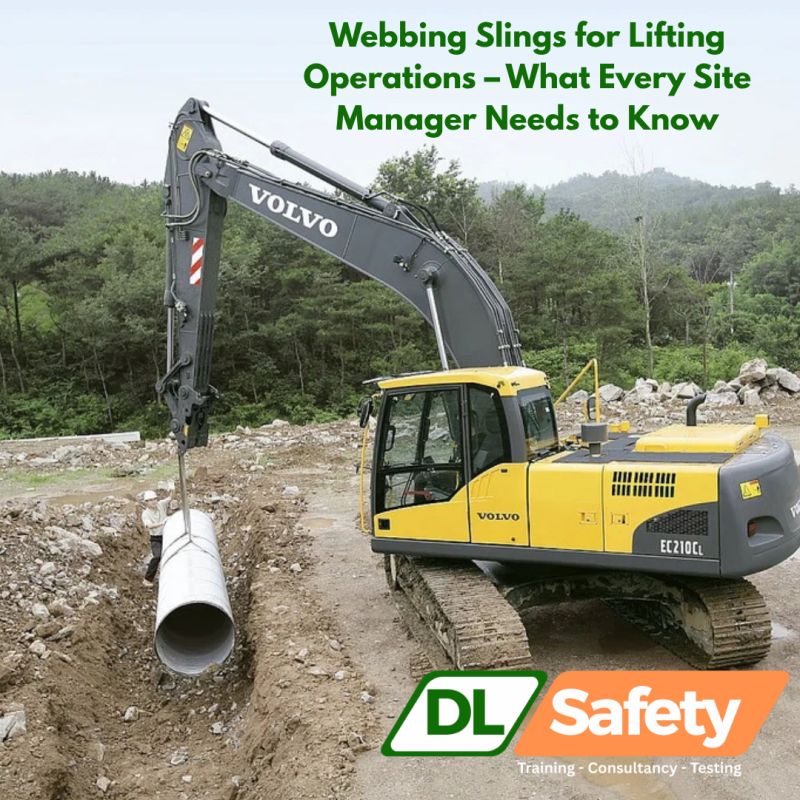
Are your team using the right sling for the right lift? Flat woven webbing slings — particularly those made from Polyamide (Nylon) — are one of the most widely used pieces of lifting equipment on Irish sites. Lightweight, flexible, and gentle on load surfaces, they’re a go-to for many operations. But used incorrectly, they can fail — with serious consequences. Here’s what you need to know. (Ref: LEEA Capsule v10) What They’re Good For Lifting loads with polished, painted, or delicate surfaces — webbing won’t scratch or damage Choker, basket, and straight pull configurations Multi-leg assemblies when slings are matched by material and length Combined use in series with chain slings (e.g. wrap and choke onto a polished surface, then hook into a chain sling) Temperature range: -40°C to 100°C (Nylon/Polyester) Key Limitations Nylon loses up to 15% strength when wet — always factor this in Never use near acids — Nylon is attacked by moderate strength acids Do NOT mix webbing slings in parallel with chain or wire rope — unequal stretch causes load instability Avoid shock loading — it effectively multiplies the load weight Do not use outside the manufacturer’s stated temperature range The eye angle must never exceed 20° when in use Modes of Use & SWL (Single Leg, 1T WLL example) SWL – Straight Pull ×1.0 = 1.0T Choke Hitch ×0.8 = 0.8T Basket (Parallel)×2.0 = 2.0T Basket (0–45° to vertical) ×1.4 = 1.4T Always check the label — never rely on colour coding alone to confirm WLL. Storage – Do It Right Inspect before storing — check for damage after every use Store on a suitable rack in a dry, clean area Keep away from acids, alkalis, solvents, and extremes of temperature Never leave slings on the ground or in direct contact with chemicals The right sling, used correctly, is safe and effective. The wrong sling — or the right sling used the wrong way — puts lives at risk. If your team are handling lifting operations, they need proper training. At DL Safety, we deliver expert-led lifting and slinging advice grounded in LEEA standards and 25 years of real-world experience. Get in touch: info@dlsafety.ie or 085 8316885 #LiftingSafety#WebblingSlings#HealthAndSafety#ConstructionSafety#LEEA#DLSafety#SiteManagement#IrishConstruction
Lack of Planning?
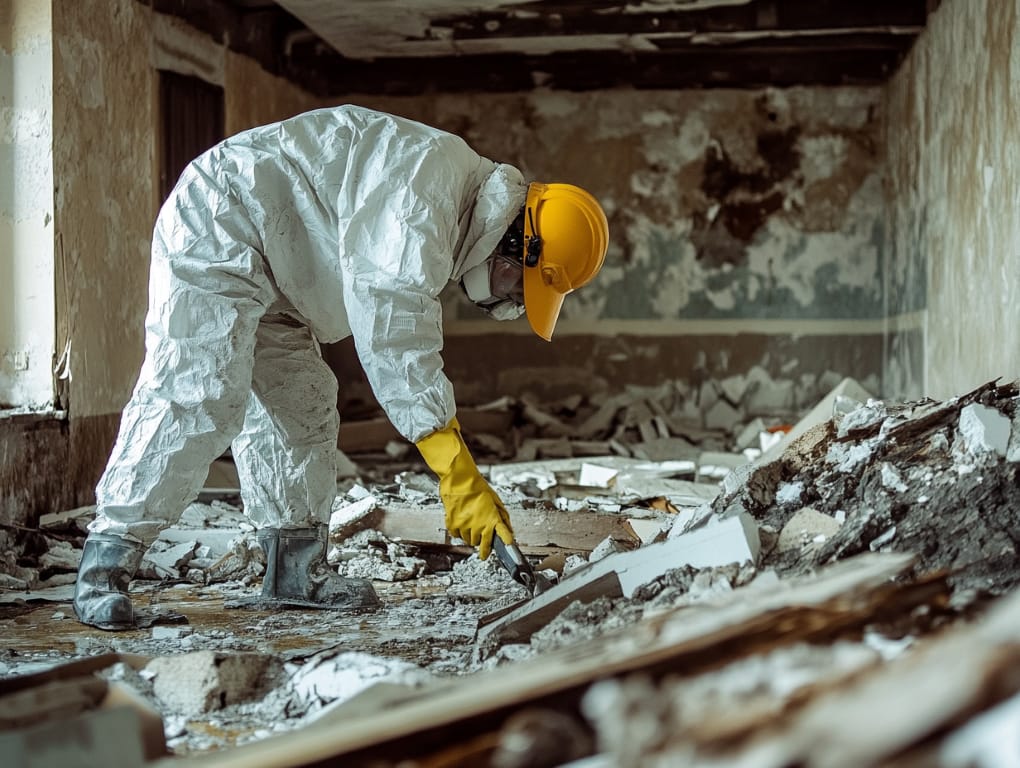
It may be a Marine Port environment, but the same failing we see everyday in Civils and Construction, whether it involves excavations of Cranes working in close proximity: 👉Poor Planning👉Ineffective communication👉No Spotter – eyes on whats happening👉No co ordination👉 Supervision?👉Risk assessed?? not thoroughly.. Whats your thoughts on this? 👉 For All your onsite Health & Safety requirements, Contact us: Phone: 085 8316885 Email: info@dlsafety.ie Website: www.dlsafety.ie
Crane Accident: A deadly reminder
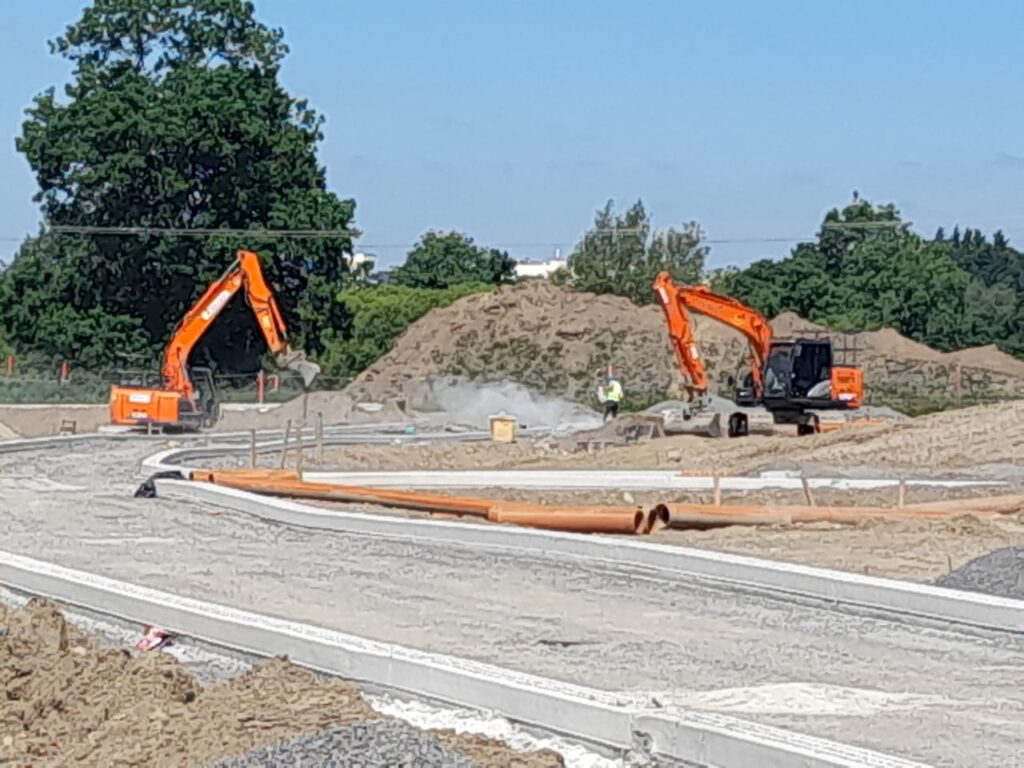
A lifted load dropped unexpectedly — striking the operator and risking lives. This incident shows why strict lifting safety protocols are non-negotiable!📋 Inspect lifting equipment regularly📋 Keep unauthorized personnel out of danger zones📋 Ensure clear communication and signals📋 Always wear proper PPE📋 Train staff on safe load handling One mistake can change everything. Safety first—always! Contact DL Safety Phone: 085 8316885, Email: info@dlsafety.ie, Website: www.dlsafety.i
DL Safety Recognised For Raising Standards In Irish Workplace Safety
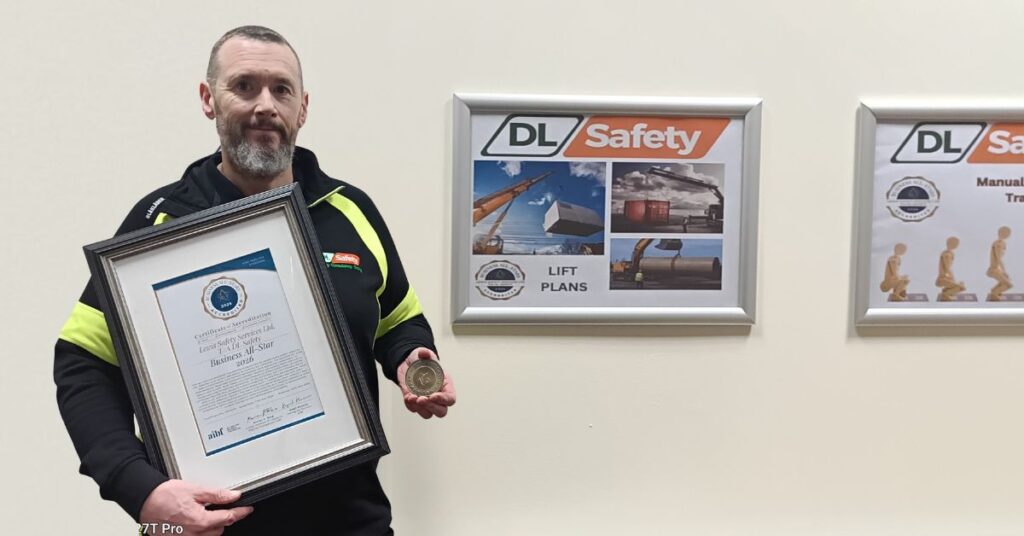
Based in Thurles, Co Tipperary, the company is recognised for its performance in health and safety training and consultancy and for reflecting the AIBF’s benchmark standards of performance, trust and customer centricity. Founded and led by David Lewis, DL Safety delivers expert-led programmes for construction and quarry operations, supported by site audits and practical compliance guidance. The business is known for clear, grounded training that helps clients strengthen safety culture, meet regulatory responsibilities and protect teams in high-risk environments. Over the past year DL Safety has continued to deepen its work with contractors, operators and site managers across the region, supporting safer workplaces through consistent delivery and responsive client support. This accreditation confirms the company’s standing as a trusted partner in Irish workplace safety and highlights its ongoing contribution to advancing professional standards. Kieran Ring, Deputy Chair of the AIBF Adjudication Board, said: “We are delighted to recognise DL Safety with Business All-Star accreditation for 2026. The company has demonstrated strong sector expertise, dependable delivery and a clear commitment to helping organisations operate safely and compliantly. Their work reflects the trust and performance that sit at the heart of the Business All-Star programme.” David Lewis, Founder and Director of DL Safety, said: “I’m honoured to receive this accreditation from the All-Ireland Business Foundation. DL Safety was built on a straightforward principle: give clients practical safety guidance they can rely on, and deliver training that makes a real difference on site. We work closely with people operating in demanding environments, so clarity, consistency and trust matter hugely. Thank you to our clients for continuing to place their confidence in us, and to the AIBF for recognising what our team stands for.” Kapil Khanna, Co-CEO of the All-Ireland Business Foundation, said:“DL Safety represents the professionalism, integrity and client-centred service that the Business All-Star programme is designed to honour. Their continued focus on training, consultancy and practical safety improvement makes them a deserving recipient of this 2026 accreditation.” He said: “We evaluate a company’s background, trustworthiness and performance, and we speak to customers, employees and vendors. We also anonymously approach the company as a customer and report back on the experience. The business goes through at least two interviews and is scored on every part of the process against set metrics.” About The All-Ireland Business Foundation The All-Ireland Business Foundation is an autonomous national accreditation body tasked with enterprise development and the promotion of Best-in-Class Irish businesses. As the accreditation body for the Business All-Star mark, the AIBF recognises Best-In-Class Irish businesses. Companies that merit recognition based on an independent audit of their performance, reputation, and customer-centricity. Business All-Star Accreditation Is The Nation’s Symbol Of Trust. Currently, there are over 750 companies that are accredited by AIBF. Since 2014, over 5000 companies have participated in our programs. The AIBF also hosts the annual All-Ireland Summit and monthly gatherings to promote peer-learning and collaboration among its accredited companies. For more information please visit www.aibf.ie here.
Need GA1 Testing?
Why Do You Need GA1 Testing? GA1 testing is a critical part of ensuring workplace safety, legal compliance, and operational reliability—particularly in high-risk environments such as construction, transport, agriculture, and industrial settings. What Is GA1 Testing? GA1 testing involves the inspection, assessment, and certification of equipment, systems, or safety controls to confirm they meet required safety standards and regulatory obligations. It helps identify potential hazards before they become incidents, protecting both people and operations. Why GA1 Testing Is Essential Workplaces that operate machinery, vehicles, or complex systems carry inherent risks. GA1 testing ensures that: Without regular testing, small issues can escalate into costly downtime, serious injuries, or legal penalties. Who Needs GA1 Testing? GA1 testing is especially important for businesses involved in: If your organisation relies on equipment or systems that pose a safety risk, GA1 testing is not just recommended—it’s essential. The Benefits of Professional GA1 Testing Working with experienced safety professionals ensures testing is carried out correctly, documented accurately, and aligned with current regulations. This provides peace of mind, improves safety performance, and supports a strong safety culture across your organisation. Stay Compliant. Stay Safe. Regular GA1 testing demonstrates your commitment to safety, compliance, and employee wellbeing. It reduces risk, supports operational efficiency, and helps your business operate with confidence. Need GA1 testing or expert safety advice?Contact DL Safety today for practical, affordable, and expert-led safety solutions tailored to your industry.Contact DL Safety Phone: 085 8316885, Email: info@dlsafety.ie, Website: www.dlsafety.ie