What if the most dangerous element of your next lift isn’t the ten-tonne load suspended in the air, but a single missing signature on your lifting plan? For many site managers across Ireland, the weight of legal liability often feels heavier than the machinery itself. We know that the confusion surrounding appointed person lifting operations responsibilities can lead to genuine anxiety, especially when you’re trying to distinguish between an AP and a Crane Supervisor whilst keeping a busy site productive.
It’s a constant challenge to stay on top of evolving HSA standards, but you deserve to feel confident that your safety systems are beyond reproach. This guide is designed to help you master every essential duty of the Appointed Person to ensure legal compliance and maximum safety during every lift. We’ll provide a definitive checklist of responsibilities, clarify Irish statutory requirements, and show you how to integrate this vital role into your broader safety management system. For expert support with lift plans or GA1 testing, you can reach the DL Safety team at Unit 3D Thurles Business Center, Stradavoher, Thurles, County Tipperary, E41 W880, or via www.dlsafety.ie. You can also email info@dlsafety.ie or call 085 8316885 to discuss your specific site needs.
Key Takeaways
- Understand the legal foundation of the Appointed Person role under Irish regulations to ensure your lifting operations remain fully compliant and safe.
- Master the core appointed person lifting operations responsibilities, including the development of robust Lift Plans and the selection of certified accessories like chains and shackles.
- Clarify the distinction between the strategic duties of the AP and the execution-focused role of the Crane Supervisor to eliminate confusion and liability on site.
- Learn a practical step-by-step approach to site surveys and load calculations that ensures every lift is prepared for the “worst-case” scenario.
- Partner with DL Safety for professional GA1 testing and Lift Plans at www.dlsafety.ie or 085 8316885; our experts are based at Unit 3D Thurles Business Center, Stradavoher, Thurles, County Tipperary, E41 W880.
Defining the Appointed Person Role in Lifting Operations
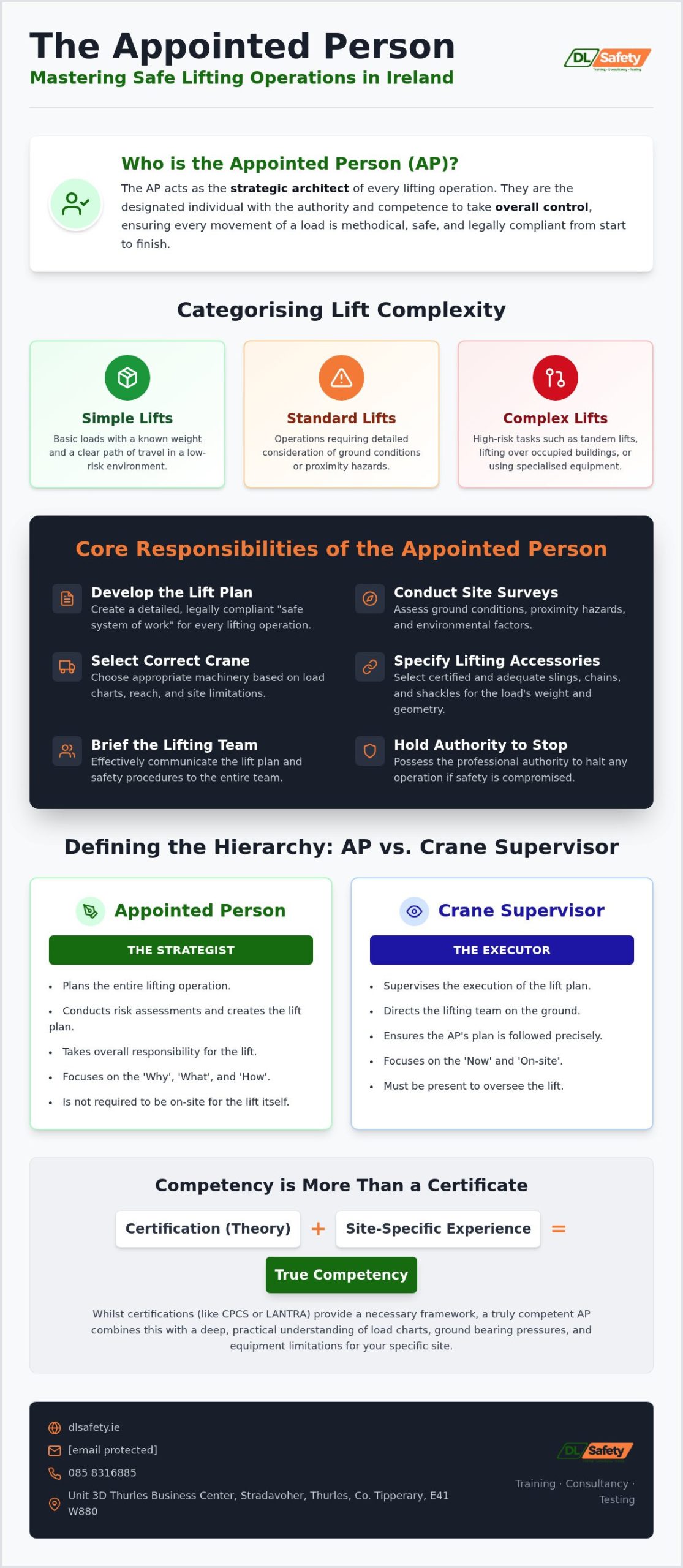
The Appointed Person (AP) acts as the strategic architect of every lifting operation. They are the individual designated by the organisation to take overall control, ensuring that every movement of a load is methodical and safe. The appointed person lifting operations responsibilities aren’t limited to just signing off on a document; they encompass the entire lifecycle of a lift, from the initial site survey to the final decommissioning of the crane. This role requires a pragmatic approach to safety, balancing the technical demands of the machinery with the practical realities of a busy site.
The legal foundation for this role is primarily driven by the Safety, Health and Welfare at Work (General Application) Regulations. Whilst many industry professionals reference the Lifting Operations and Lifting Equipment Regulations 1998 (LOLER) as a gold standard for methodology, Irish statutory requirements mandate a clear chain of command. This chain ensures that the level of planning matches the complexity of the task. We categorise these tasks into three distinct levels:
- Simple Lifts: Basic loads with a known weight and a clear path of travel in a low-risk environment.
- Standard Lifts: Operations involving common equipment but requiring more detailed consideration of ground conditions or proximity hazards.
- Complex Lifts: High-risk tasks such as tandem lifts, lifting over occupied buildings, or using specialised equipment in confined spaces.
The AP’s involvement must scale accordingly. Crucially, they must possess the professional authority to stop any operation if they believe safety is being compromised. This power is vital because it ensures that commercial pressure never takes precedence over human life. At DL Safety, we believe that an empowered AP is the best defence against site accidents.
The Legal Framework for Lifting in Ireland
The 2013 Construction Regulations brought about a more rigorous approach to site safety, specifically regarding how lifting equipment is managed amongst multiple contractors. The HSA remains the primary body for enforcing these standards, and their inspectors look for a clear audit trail of planning and inspection. Under the 2005 Safety, Health and Welfare at Work Act, the Appointed Person is legally accountable for ensuring that a safe system of work is not only designed but effectively communicated to the entire lifting team. Failure to meet these standards can result in significant legal liability for the organisation.
Competency vs. Certification: What Makes a Qualified AP?
It’s a common mistake to assume that a CPCS or LANTRA card alone makes someone a qualified Appointed Person. While these certifications provide the necessary theoretical framework, true competency requires site-specific experience and a nuanced understanding of the equipment’s limitations. An AP must be able to interpret load charts, assess ground bearing pressures, and select the appropriate lifting accessories for the specific geometry of the load. DL Safety supports this process by verifying safety training certificates and offering bespoke advice to ensure your designated AP is fully prepared for the realities of your site. Our experts at Unit 3D Thurles Business Center, Stradavoher, Thurles, County Tipperary, E41 W880 can provide the guidance you need to maintain a high-level safety culture. Contact us at 085 8316885 or info@dlsafety.ie for more information on our support packages or visit www.dlsafety.ie.
Core Responsibilities: From Planning to Equipment Oversight
The transition from understanding the legal framework to executing a safe lift requires a meticulous focus on detail. Whilst the AP oversees the strategy, their daily appointed person lifting operations responsibilities involve deep technical oversight of both the site and the machinery. This begins with the selection of the correct crane and lifting accessories, such as slings, chains, and shackles, ensuring they’re fit for the specific load geometry and weight. For a comprehensive overview of the statutory requirements, the HSE’s guide to LOLER remains an essential reference for any safety professional managing these assets.
A critical part of this oversight is ensuring that every piece of equipment on site possesses a valid GA1 certificate of thorough examination. The AP must also organise the site to ensure that ground conditions are suitable for the specific crane’s outrigger loads, often requiring coordination with temporary works engineers. They must also liaise with other site parties to manage traffic management and delivery logistics, ensuring that the crane’s arrival and setup don’t create new hazards for the public or other workers. Our team at DL Safety provides professional lift plans that simplify this coordination for busy site managers.
The Lift Plan: The AP’s Master Document
The Lift Plan is the definitive system of work for any lifting operation. It must include precise data on the weight of the load, the maximum radius of the lift, the required height, and environmental factors like wind speed limits. A generic lift plan is rarely sufficient for modern construction sites; a site-specific method statement is required to address unique local hazards. The Appointed Person must personally sign off on every revision of the plan to confirm that all technical calculations remain valid as site conditions change.
Equipment Selection and Integrity
Determining the appropriate Factor of Safety for different lifting accessories is a core technical duty. The AP ensures that colour-coding systems for lifting gear are implemented correctly, allowing for immediate visual confirmation that equipment is within its inspection period. By integrating GA1 testing results into daily site safety checks, the AP creates a robust barrier against equipment failure. If you require assistance with these rigorous standards, contact DL Safety at Unit 3D Thurles Business Center, Stradavoher, Thurles, County Tipperary, E41 W880, or call 085 8316885. You can also email info@dlsafety.ie or visit www.dlsafety.ie for expert guidance.
Appointed Person vs Crane Supervisor: Defining the Hierarchy
The distinction between strategy and execution is where many site safety systems fail. Whilst the Appointed Person acts as the architect of the safe system of work, the Crane Supervisor is the boots-on-the-ground leader responsible for the physical execution of that plan. Understanding this hierarchy is a vital part of the appointed person lifting operations responsibilities, as it ensures that accountability never becomes diluted amongst the team. The AP doesn’t need to be present for every individual lift, but they remain legally and professionally accountable for the plan’s validity and the competency of the personnel involved.
In this chain of command, the Slinger/Signaller works directly under the Crane Supervisor’s direction to ensure the load is securely attached and the crane is guided safely. This structured approach follows global best practices, such as LEEA training and standards, which emphasise that a clear division of labour is the most effective way to prevent equipment failure or human error. By maintaining this clear line of authority, the AP can manage the big picture whilst the Supervisor manages the immediate environment.
Can One Person Hold Both Roles?
On low-risk, standard lifts, it’s often permissible for a single individual to act as both the Appointed Person and the Crane Supervisor. This “dual-role” competency is typically acceptable when the lift is repetitive and the environment is controlled. However, complex or high-risk operations, such as tandem lifts or lifting over live plant, require a dedicated, separate AP and Supervisor. This separation ensures a “second pair of eyes” on the operation, managing the communication flow between the Operator and the rest of the team without the AP being distracted by immediate site logistics.
The Handover Process
The transition from office-based planning to site-based lifting is often the most dangerous moment in any operation. A formal handover process ensures the Crane Supervisor fully understands the constraints of the Lift Plan before any chains are tensioned. This briefing must be documented to provide a clear audit trail for the HSA, proving that every team member was aware of the risks and the chosen control measures. If site conditions change from the original plan, such as a sudden increase in wind speed or a change in ground stability, the team must follow a strict “stop work” protocol until the AP can review and revise the system of work.
DL Safety provides the technical partnership you need to manage these complex hierarchies. Whether you need professional lift plans or certified lifting equipment, our team is ready to assist. Contact us at info@dlsafety.ie or call 085 8316885. You can also visit our office at Unit 3D Thurles Business Center, Stradavoher, Thurles, County Tipperary, E41 W880 or explore our services at www.dlsafety.ie.
Executing a Safe Lift: A Practical Step-by-Step for the AP
Executing a safe lift requires a disciplined transition from paper-based theory to live site management. While previous sections focused on the legal framework and hierarchy, the physical execution is where appointed person lifting operations responsibilities are most visible. A successful lift is never an accident; it’s the result of a methodical, step-by-step process that accounts for every variable before the load leaves the ground. This operational phase ensures that the strategic planning actually protects the people working under the hook.
- Step 1: Site Survey. Conduct a physical walk-through to identify overhead hazards and ground stability issues. Never rely solely on site drawings that might be outdated.
- Step 2: Load Calculations. Calculate the ‘worst-case’ load scenario. This must include the weight of the load, the weight of the lifting accessories, and the impact of wind speed and dynamic forces.
- Step 3: Team Briefing. Brief the lifting team on the Method Statement. Ensure every member understands their role and the specific emergency procedures for this operation.
- Step 4: Equipment Verification. Verify that all lifting accessories have been inspected. Check for physical defects or wear in slings and chains before they’re tensioned.
- Step 5: Monitoring and Debrief. Monitor the operation from start to finish. Conduct a post-lift debrief to capture ‘near-miss’ data, which is essential for improving future safety protocols.
Managing Site Hazards and Environmental Factors
The AP must account for the wind sail area of the load, particularly when using large panels or containers. Using anemometers to get real-time wind speed readings is a non-negotiable requirement for high-level safety. You must also plan for strict exclusion zones to protect other site workers and the public from the fall zone. This is especially critical when working near overhead power lines, where even close proximity can result in electrical arcing. Our team at DL Safety can provide the technical oversight needed to manage these high-risk environments safely.
Dynamic Risk Assessments During the Lift
Site conditions can change in minutes. If ground conditions deteriorate due to heavy rain whilst a crane is in situ, the AP must possess the authority to halt the operation immediately. This is also true for ‘blind lifts’ where the operator cannot see the load; the AP ensures that communication via radios or signalmen is flawless. Recording these changes and decisions in the site diary is vital for maintaining HSA inspection readiness. For professional assistance with on-site safety audits or bespoke lift plans, contact DL Safety at Unit 3D Thurles Business Center, Stradavoher, Thurles, County Tipperary, E41 W880. You can reach us at 085 8316885 or info@dlsafety.ie, or visit www.dlsafety.ie to see how we support site managers across Ireland.
How DL Safety Supports Your Appointed Person and Site Safety
Managing the daily appointed person lifting operations responsibilities is a high-stakes task that requires both technical precision and constant vigilance. DL Safety acts as your dedicated technical partner, providing professional Lift Plans that transform complex regulatory demands into clear, actionable systems of work. By outsourcing the technical calculations and hazard identification for intricate lifts, your AP can focus on broader site management whilst maintaining total confidence in the safety of the operation.
Beyond planning, our GA1 testing services provide the rigorous inspection regime required to keep your equipment compliant and safe for use. We don’t just point out issues; we provide the solution by supplying high-quality, certified lifting gear, including slings, chains, and shackles, tailored to your AP’s specific requirements. Our Monthly Safety Support Packages further empower your team by providing access to expert advice and proactive site audits when you need them most.
The Value of a Monthly Safety Support Package
The administrative burden on an Appointed Person can be overwhelming, often leading to overlooked paperwork or delayed inspections. Our retained safety services are designed to absorb this burden, ensuring that your Safety Statements and risk assessments are always up to date and reflective of current HSA standards. Regular site audits conducted by our specialists ensure that lifting operations remain strictly within the ‘Safe System of Work’ established in the original plan. This proactive approach identifies potential risks before they manifest as accidents, offering peace of mind to both the individual AP and the wider organisation.
Contact DL Safety Today
If you’re ready to enhance your site’s safety culture and simplify your compliance journey, our team is here to help. You can find us at Unit 3D Thurles Business Center, Stradavoher, Thurles, County Tipperary, E41 W880. To discuss your specific project needs or to learn more about our technical support services, call us on 085 8316885 or email info@dlsafety.ie for a consultation. You can also visit www.dlsafety.ie to explore our full range of technical safety services and equipment.
Securing Your Site with Professional Lifting Oversight
Mastering the full scope of appointed person lifting operations responsibilities is about more than just ticking boxes; it’s about building a culture of technical excellence that protects every person on your site. We’ve explored how the AP acts as the strategic architect of the lift, the vital distinction between planning and supervision, and the practical steps required to manage environmental hazards. By ensuring your site-specific lift plans are robust and your equipment carries valid GA1 certification, you turn complex regulatory demands into a straightforward, safe system of work.
DL Safety is here to support you with LEEA-certified inspectors, comprehensive monthly safety support packages, and a full supply of certified lifting equipment. Whether you need a technical partner for complex tandem lifts or expert guidance on statutory compliance, our team has the pragmatic solutions you need. You can find us at Unit 3D Thurles Business Centre, Stradavoher, Thurles, County Tipperary, E41 W880, or reach us directly at 085 8316885 and info@dlsafety.ie. Take the first step toward total compliance and book a professional Lift Plan consultation with DL Safety today. We’re ready to help you elevate your safety standards with confidence and integrity.
Frequently Asked Questions
Is an Appointed Person legally required for every lifting operation in Ireland?
Yes, an Appointed Person is legally required for every lifting operation under the Safety, Health and Welfare at Work (General Application) Regulations. The law dictates that all lifting must be planned by a competent person who ensures the operation is supervised and carried out safely. This requirement applies regardless of the lift’s size, as the AP remains the individual ultimately accountable for the safe system of work on any Irish construction or industrial site.
Can a crane driver act as the Appointed Person for their own lift?
While a crane driver can technically act as the AP for very simple, low-risk lifts, it is generally discouraged for standard or complex operations. Best practice requires a separation of duties to ensure that the person planning the lift can provide an objective, high-level assessment of the risks. Combining these roles often leads to a conflict of interest or an oversight of critical site hazards whilst the operator is focused on the machinery.
How often should an Appointed Person review a site’s lifting plan?
A lifting plan must be reviewed whenever there is a significant change in the site environment, the personnel involved, or the equipment being used. Even if site conditions remain stable, it is good practice for the AP to review the plan periodically or at the start of a new project phase. This ensures that the system of work remains relevant and that any ‘near-miss’ data from previous operations is effectively integrated into updated safety protocols.
What is the difference between a standard lift and a complex lift under HSA guidelines?
A standard lift involves loads with a known weight and centre of gravity where the path of travel is clear and ground conditions are stable. In contrast, a complex lift involves high-risk factors such as tandem lifting with two cranes, lifting over live plant, or using specialised equipment in confined spaces. Complex operations require a much higher level of technical planning and oversight from the Appointed Person to mitigate the increased risk of failure.
Does the Appointed Person need to be on-site whilst the crane is operating?
No, the Appointed Person does not need to be physically present for every lift, provided they have appointed a competent Crane Supervisor to oversee the execution. The AP retains overall responsibility for the plan’s validity, but they can delegate the on-site supervision to a qualified individual. However, for complex or high-risk lifts, the AP should consider being present to manage any dynamic risks that may arise during the operation.
What training qualifications must an Appointed Person hold in 2026?
In 2026, the industry standard remains the CPCS A61 Appointed Person qualification or a LANTRA equivalent to demonstrate theoretical knowledge. However, certification is only one part of appointed person lifting operations responsibilities; they must also prove competency through site-specific experience and technical equipment knowledge. DL Safety provides bespoke training and support from our centre at Unit 3D Thurles Business Center, Stradavoher, Thurles, County Tipperary, E41 W880.
What happens if a lifting operation proceeds without a designated Appointed Person?
Proceeding without a designated AP is a serious breach of health and safety law that can lead to immediate work stoppages and significant HSA fines. Beyond the financial impact, the organisation faces increased legal liability in the event of an accident or equipment failure. Without an AP to provide a robust Lift Plan, the safety of the entire team is compromised, as there is no formal system of work to manage site-specific hazards.
How does GA1 testing relate to the Appointed Person’s daily responsibilities?
The Appointed Person is responsible for ensuring that all lifting equipment and accessories used on site possess a valid GA1 certificate of thorough examination. Integrating these results into daily site safety checks is a fundamental part of appointed person lifting operations responsibilities, as it prevents equipment failure and maintains compliance with HSA standards. For professional assistance with GA1 testing or Lift Plans, visit www.dlsafety.ie or call our Tipperary office at 085 8316885; you can also email info@dlsafety.ie for more information.