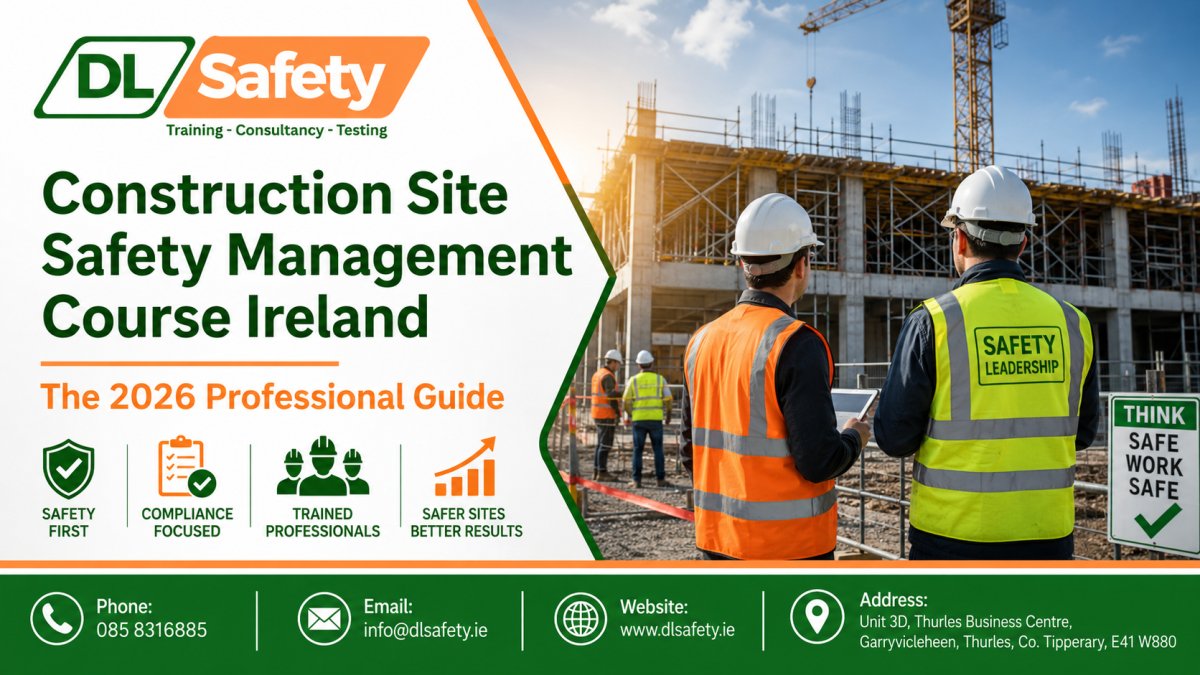
Did you know that workplace fatalities in Ireland surged by over 75% in 2025, with construction sector deaths more than doubling during that same period? It’s a sobering reality that makes the prospect of an unannounced HSA inspection feel like a significant burden, especially when you’re grappling with complex regulatory jargon and the weight of director liability. Generic training that fails to address your project’s unique hazards simply isn’t enough. Finding the right construction site safety management course Ireland is no longer just about ticking a box; it’s about building a proactive culture that protects your team and your professional reputation.
This 2026 guide will help you understand the current legal framework, ensuring you stay ahead of the HSA’s focus on digital record-keeping and proactive risk management. We’ll show you how to select a course that offers site-specific control and full compliance. At DL Safety, based at Unit 3D Thurles Business Centre, Stradavoher, Thurles, County Tipperary (E41 W880), we combine technical expertise with a personable approach, ensuring you move from uncertainty to confidence. You can reach us at info@dlsafety.ie, 085 8316885, or via www.dlsafety.ie to ensure your site meets the highest standards of safety and integrity.
Key Takeaways
- Understand the 2026 HSA enforcement landscape to protect against director liability and navigate the mandatory shift towards digital safety documentation.
- Identify the essential components of a high-quality construction site safety management course Ireland, from mastering RAMS development to effective incident investigation.
- Evaluate the benefits of simulation training and bespoke face-to-face sessions over generic programmes for improving site-specific hazard awareness amongst your workforce.
- Learn to integrate statutory requirements like GA1 testing and PAT testing into a functional safety management system that stands up to unannounced inspections.
- Discover how DL Safety (www.dlsafety.ie) provides the professional support and bespoke training at their Thurles centre (E41 W880) needed to maintain rigorous safety standards.
The Legal and Operational Mandate for Safety Management in Ireland
The foundation of Irish safety law rests on the Safety, Health and Welfare at Work Act 2005. In 2026, this legislation isn’t just a static document; it’s the benchmark the Health and Safety Authority (HSA) uses to measure your site’s operational health. Under the 2013 Construction Regulations, the role of the Project Supervisor Construction Stage (PSCS) carries significant weight. You’re responsible for coordinating health and safety during the construction phase, ensuring that every contractor follows the safety plan. Without a proper construction site safety management course Ireland, fulfilling these duties becomes a legal minefield that puts your project at risk.
Failing to manage these duties leads to more than just paperwork. We’ve seen a shift towards stricter enforcement, with the HSA issuing stop-work notices that can freeze a project’s budget and timeline overnight. Beyond immediate fines, the reputational damage can be permanent, often leading to a loss of future contracts. Modern Irish construction tenders now demand proof of management-level competency as a standard entry requirement. They want to see that your team adheres to global construction safety standards whilst managing the specific risks of the Irish landscape. At DL Safety, based at Unit 3D Thurles Business Centre, Stradavoher, Thurles (E41 W880), we help managers bridge this gap between legal theory and site reality.
Director’s Liability and Legal Accountability
Senior site management can no longer hide behind corporate structures. Irish law increasingly holds directors personally accountable for systemic safety failures, especially when negligence is proven. The HSA’s current 2025-2027 Action Plan emphasises a proactive safety culture rather than reactive fixes. In this context, due diligence is defined as the ongoing, documented process of identifying hazards, implementing controls, and verifying that those controls actually work on the ground. If you can’t prove you’ve taken every reasonable step to protect your workers, the legal consequences are severe.
HSA Inspections: Why Training is Your Best Defence
When an inspector arrives unannounced, they aren’t just looking at hard hats and high-vis vests. They’re looking for documented competency and a clear chain of command. A management-level construction site safety management course Ireland gives you the tools to organise a compliant Safety Statement that reflects real-world site conditions. This preparation ensures you aren’t scrambling for records whilst an inspector waits in the site office. For a deeper look at this process, read our guide on what to expect during a HSA inspection. If you need immediate support with your safety systems, you can contact us at info@dlsafety.ie or call 085 8316885 to speak with our team.
Core Curriculum: What Every Site Safety Management Course Must Include
Selecting a construction site safety management course Ireland requires a careful look at the curriculum to ensure it balances technical knowledge with leadership skills. It isn’t enough to simply know the law; you must know how to apply it when the pressure of a deadline meets the reality of a busy site. A comprehensive programme should focus on the development and oversight of Risk Assessment and Method Statements (RAMS). These shouldn’t be static documents that sit in a folder; they must be living guides that reflect the actual site conditions and the specific hazards your team faces every day.
When incidents do occur, managers need the skills to conduct thorough investigations using root cause analysis. This technique moves the conversation away from finger-pointing and towards systemic prevention. By understanding human behaviour and its impact on site safety performance, managers can identify why workers might bypass controls. This allows for more effective interventions and communication strategies, such as site-wide safety briefings that actually resonate with the workforce. Citing the Health and Safety Authority (HSA) benchmarks during these briefings helps ground your instructions in national standards, building a culture of transparency and trust.
Mastering Risk Control Systems
Effective management means moving from static risk assessments to dynamic site management. Risks change with the weather, the arrival of new sub-contractors, or the introduction of different plant machinery. A high-quality construction site safety management course Ireland teaches you how to organise ‘Toolbox Talks’ that engage the team and change behaviour on the ground. If you want to understand how these systems fit into broader legal requirements, our guide on health and safety compliance Ireland provides a helpful roadmap.
Environmental and Occupational Health Management
Modern construction sites face complex environmental hazards, including silica dust and asbestos. Managing these requires a firm grasp of COSHH (Control of Substances Hazardous to Health) requirements. Managers must be trained to monitor noise, vibration, and respiratory risks whilst implementing chemical spill response plans that are easy for the team to follow. If you’re looking for a partner to help implement these systems, our monthly safety support packages provide ongoing expert guidance to keep your site compliant.
You can find our team at Unit 3D Thurles Business Center, Stradavoher, Thurles, County Tipperary, E41 W880. For bespoke training enquiries, feel free to email info@dlsafety.ie or call us directly on 085 8316885 to discuss your project’s needs.
Beyond the Certificate: Practical vs Academic Safety Training
Many managers fall into the trap of pursuing long-term academic diplomas that take several months to complete, which can leave a gap in immediate site safety. Whilst academic qualifications have their place, a practical construction site safety management course Ireland should focus on the operational realities you face every Monday morning. You need the ability to spot a faulty harness or a poorly secured excavation immediately, rather than waiting for a semester to end. This is where the distinction between standardised IOSH-accredited courses and bespoke industry training becomes critical for your project’s success.
IOSH programmes provide an excellent baseline for general management, but they can sometimes lack the site-specific depth required by the Safety, Health and Welfare at Work (Construction) Regulations 2013. Bespoke training allows us to focus on the exact plant, equipment, and hazards present on your project. At DL Safety, we’ve found that simulation training is the most effective way to build real-world hazard perception. It allows your management team to experience high-pressure scenarios in a controlled environment, ensuring they’ve developed the right instincts before an actual emergency occurs. This hands-on approach delivers better site-wide results than purely theoretical learning.
The Value of Bespoke and Simulation Training
Tailoring safety management to specific sectors, such as quarrying or high-rise construction, ensures that the training is relevant and engaging for the team. Simulation training is particularly effective at identifying management blind spots, such as failing to verify a sub-contractor’s credentials or overlooking a subtle change in ground conditions. If you’re looking for flexible options for your workforce, our online safety courses Ireland provide a strategic starting point for building a compliant team whilst maintaining project momentum.
Choosing the Right Level for Your Team
It’s essential to match the training level to the individual’s responsibility. A supervisor’s construction site safety management course Ireland will focus on tactical daily oversight, whilst director-level training deals with strategic liability and corporate governance. For projects involving heavy lifting, managers must understand LEEA standards. In 2026, LEEA continues to offer structured qualification pathways that move from foundational knowledge to advanced technical inspection, providing a clear route for professional development. Our team at DL Safety is ready to help you choose the right path. Visit us at Unit 3D Thurles Business Center, Stradavoher, Thurles, County Tipperary, E41 W880, or reach us at info@dlsafety.ie or 085 8316885. Explore our full range of services at www.dlsafety.ie today.
Implementing Management Systems: From Risk Assessment to Site Audits
Turning the theory from a construction site safety management course Ireland into a functional site system is where many managers truly prove their worth. A certificate demonstrates that you understand the concepts, but real safety comes from the ability to organise daily operations around rigorous risk control. This means moving beyond a simple paper trail and establishing a culture where statutory inspections, such as PAT testing and vehicle brake testing, are integrated into the project’s rhythm. You aren’t just waiting for an external auditor; you’re using internal site audits as a proactive tool to identify gaps before they lead to incidents.
Effective management requires a big-picture perspective on how different safety elements interact. For instance, a manager must ensure that traffic management design isn’t just a static plan but a daily schedule that accounts for new deliveries and changing site boundaries. Similarly, lift planning on complex sites requires a disciplined approach to coordination. By mastering these technical management skills, you transition from a reactive supervisor to a proactive leader who commands respect from both the workforce and the HSA. If you’re ready to elevate your site’s standards, you can book a comprehensive site audit with our team today.
Technical Oversight: GA1 and Lifting Operations
A critical part of any management system is the oversight of lifting equipment. You must ensure that every piece of machinery, from shackles to excavators, meets the thorough examination requirements. Managing the chain of command during complex crane lifts is essential to prevent communication breakdowns that lead to accidents. For a detailed look at managing these statutory requirements, see our guide on GA1 testing Ireland. This level of technical oversight is a core component of a high-level construction site safety management course Ireland.
Logistics and Traffic Management
On a busy site, logistics can quickly become a safety hazard if not managed with precision. Integrating traffic management design into the daily site schedule ensures that plant machinery and pedestrians never occupy the same space unexpectedly. You must also manage subcontractor compliance through rigorous site inductions that clearly outline these traffic rules. To help you get started, we’ve developed a construction site traffic management plan template that reflects current 2026 best practices.
Our team at DL Safety is dedicated to helping you implement these systems effectively. You can visit us at Unit 3D Thurles Business Center, Stradavoher, Thurles, County Tipperary, E41 W880. For direct support, email us at info@dlsafety.ie or call 085 8316885. Let us help you turn safety theory into a practical, life-saving reality on your site.
Elevating Site Standards with DL Safety’s Training and Support
Safety training shouldn’t be a box-ticking exercise that is forgotten as soon as the certificate arrives. At DL Safety, we believe that a construction site safety management course Ireland is just the beginning of a robust safety ecosystem. We bridge the gap between classroom theory and daily site operations by acting as your dedicated partner. This approach ensures that the high standards learned during training are consistently applied on the ground, reducing accident rates and preparing you for any unannounced HSA inspection. By treating safety as a managed system rather than a one-off event, you create a culture where compliance becomes second nature.
Our monthly safety support packages are designed to integrate seamlessly with your management team’s competency. Instead of struggling with complex regulatory changes alone, you have access to a Trusted Advisor who understands the nuances of Irish safety law. We handle the technical heavy lifting, such as GA1 testing and lift plans, allowing your managers to focus on project delivery. This collaborative model transforms safety from a source of stress into a streamlined part of your business operations. It provides the big-picture perspective needed to look beyond immediate tasks toward long-term site success.
Comprehensive Support for Construction Leaders
We offer a unique blend of online safety courses and on-site technical expertise. This combination is particularly valuable for firms undergoing Safe-T-Cert or ISO preparation, as we provide the rigorous documentation and testing required to meet these high standards. Whether you need a standard Safety Statement update or a bespoke construction site safety management course Ireland for your senior team, we tailor our services to your project’s specific risks. You can learn more about how these services fit together in our guide to monthly safety support in Ireland.
Contact DL Safety for Expert Guidance
If you’re ready to move beyond generic training and implement a proactive safety management system, David and the DL Safety team are here to help. We specialise in simulation training and bespoke face-to-face courses that address the real-world hazards of your specific site. Our team is based at Unit 3D Thurles Business Center, Stradavoher, Thurles, County Tipperary, E41 W880. We pride ourselves on being easy to work with whilst maintaining a disciplined commitment to excellence.
Taking the next step is simple. You can call us directly on 085 8316885 or email info@dlsafety.ie to arrange a consultation. We invite you to explore our full range of safety management tools and training options at www.dlsafety.ie. Let’s work together to protect your workforce and ensure your project remains fully compliant with the latest Irish safety standards.
Lead Your Project with Confidence and Compliance
Navigating the 2026 safety landscape requires a shift from passive compliance to proactive leadership. By choosing the right construction site safety management course Ireland, you ensure your team is equipped with the practical instincts needed to manage complex risks and avoid the pitfalls of director liability. We’ve explored how technical oversight, such as GA1 testing and traffic management design, forms the backbone of a resilient site management system that stands up to unannounced inspections and daily operational pressures.
DL Safety is here to act as your Trusted Advisor, providing specialised GA1 and technical testing support alongside monthly compliance packages for Irish firms. Our team, based at Unit 3D Thurles Business Center, Stradavoher, Thurles, County Tipperary (E41 W880), is dedicated to helping you translate safety theory into daily operational excellence. Whether you need accident investigation support or bespoke face-to-face training, we provide the tools to protect your workforce and your professional reputation. You can reach us at info@dlsafety.ie or call 085 8316885 to discuss your project requirements.
Book Your Bespoke Construction Safety Management Training with DL Safety today to start building a safer, more compliant project. We’re ready to help you lead with integrity and confidence.
Frequently Asked Questions
What is the best construction site safety management course in Ireland for 2026?
The best course depends on your specific role, but for most site leaders, the IOSH Managing Safely for Construction Managers or bespoke simulation-based training is highly regarded. A high-quality construction site safety management course Ireland should focus on practical application rather than just theory. We recommend looking for programmes that offer face-to-face interaction or simulation to build real-world hazard perception and leadership skills.
How long does a construction safety management certification remain valid?
Most construction safety management certifications, such as IOSH or SSSTS, typically remain valid for three to five years before a refresher is required. However, it’s essential to check the specific awarding body’s guidelines, as some industry standards in 2026 may require more frequent updates to reflect new digital compliance laws. Ongoing support and monthly compliance packages can help bridge the gap between these formal renewals.
Is IOSH SHE for Construction Managers mandatory for site supervisors?
No, IOSH SHE for Construction Managers isn’t strictly mandatory for all supervisors, but it’s increasingly required by major contractors and project clients across Ireland. For those in supervisory roles, the SSSTS (Site Supervisor Safety Training Scheme) is often the preferred benchmark. Holding these qualifications demonstrates that you meet the competency standards expected under the 2013 Construction Regulations and helps protect against director liability.
Can I complete safety management training entirely online?
You can complete many aspects of safety management training online, but we recommend a blended approach for leadership roles. Whilst online modules are excellent for theoretical knowledge, management-level skills benefit from face-to-face simulation or bespoke on-site training. This ensures you can apply complex risk control systems to your project’s specific machinery and environment, which is difficult to replicate in a purely digital format.
What is the difference between a Safety Officer and a Safety Manager course?
A Safety Officer course usually focuses on the technical aspects of monitoring and reporting, whilst a Safety Manager course emphasises leadership, strategic risk control, and legal liability. Managers are responsible for implementing the entire safety management system, including traffic design and lift plans. Officers typically support this by conducting daily checks and ensuring the workforce follows the established Risk Assessment and Method Statements (RAMS).
How much does a construction safety management course cost in Ireland?
The cost of a construction site safety management course Ireland varies based on the duration and accreditation level. Short supervisor courses might range from €425 to €500, whilst comprehensive five-day management programmes often cost between €895 and €995. It’s important to view this as a long-term investment in reducing accident rates and protecting against HSA fines rather than just an upfront expense for the business.
Does safety management training cover GA1 and lifting equipment oversight?
Most standard management courses provide an overview of lifting safety, but specialised oversight of GA1 testing often requires bespoke training. At DL Safety, we integrate technical testing support into our management guidance to ensure you understand the thorough examination process for chains, slings, and shackles. This technical depth is vital for managers who must oversee complex lifting operations and maintain statutory records on-site.
Will this course prepare me for a HSA inspection?
Yes, a professionally designed course is specifically structured to prepare you for unannounced HSA inspections. You’ll learn how to organise your Safety Statement, maintain real-time digital documentation, and demonstrate proactive risk management. This training gives you the confidence to lead an inspector through your site, proving that your safety systems are functional and that your team is competent. For direct support, contact us at info@dlsafety.ie.