
A construction site safety plan isn’t a document you print once and leave in a site office to gather dust until a HSA inspector arrives. It’s a dynamic project management tool that must evolve alongside your site’s physical changes to remain effective. If you’ve ever felt overwhelmed by regulatory paperwork or confused by the overlapping roles of the PSDP and PSCS, you’re certainly not alone. Many Irish contractors find the administrative side of safety more stressful than the actual build, often fearing that a single oversight could lead to heavy fines or site closures.
At DL Safety, we believe compliance shouldn’t be a burden that slows your progress. This 2026 guide will help you master the essentials of a Construction Stage Safety and Health Plan to ensure total HSA compliance and robust workforce protection. We’ll outline exactly what’s required to pass an inspection, how to reduce the risk of accidents, and how to maintain peace of mind through proactive planning. For expert support, you can reach our team via info@dlsafety.ie and 085 8316885. You’ll also find comprehensive resources at www.dlsafety.ie.
Key Takeaways
- Understand why a Construction Stage Safety and Health Plan is the legal foundation for every Irish site and how it protects you from HSA penalties.
- Learn to build a comprehensive construction site safety plan that focuses on specific site hazards rather than relying on generic, ineffective templates.
- Clarify the distinct responsibilities of the PSDP and PSCS to ensure your project remains compliant from the initial design to the final build.
- Identify practical ways to implement safety protocols through site inductions and toolbox talks that actually engage your workforce.
- Discover how monthly safety support can eliminate paperwork fatigue and provide the peace of mind needed during unannounced inspections.
What is a Construction Stage Safety and Health Plan (CSSHP)?
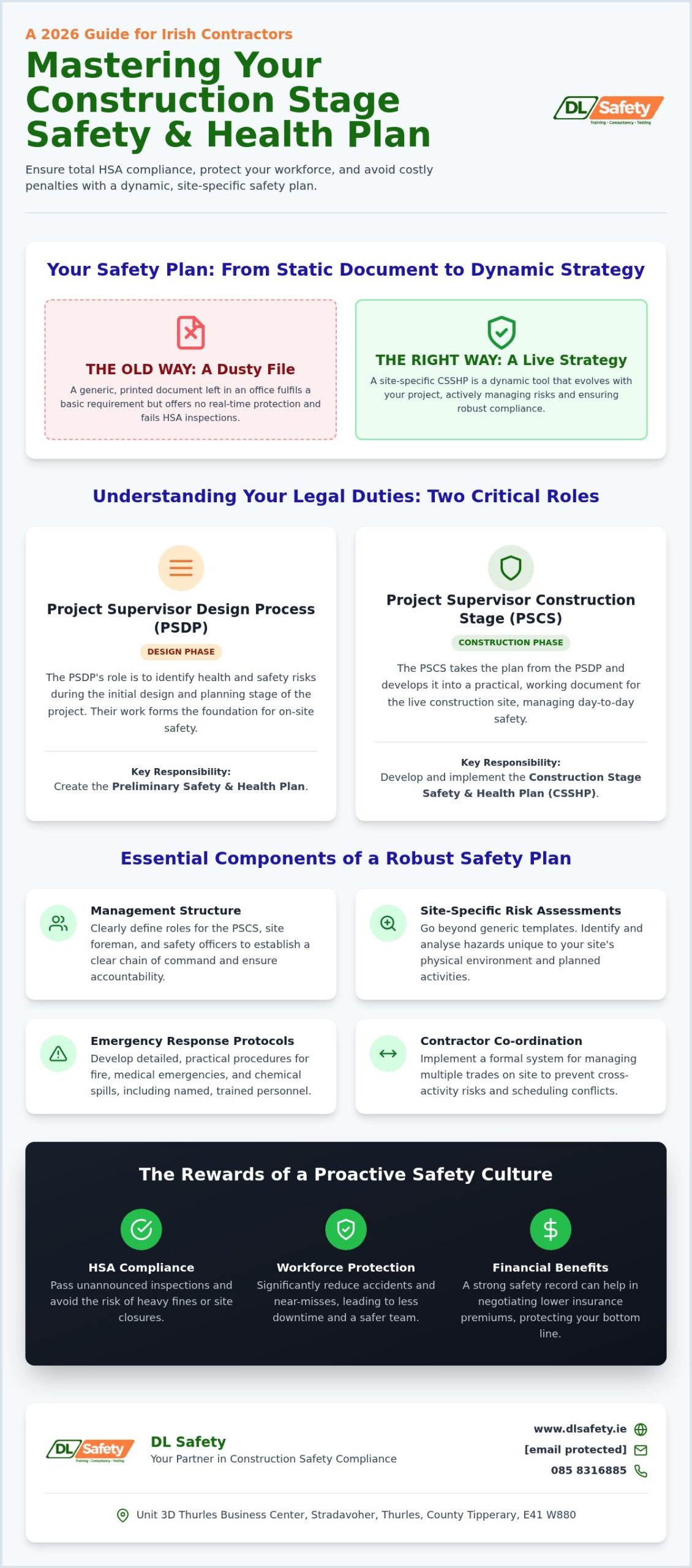
At its core, the Construction Stage Safety and Health Plan (CSSHP) is the operational blueprint for safety on any Irish build. It isn’t a static document meant to sit in a drawer; it’s a live strategy that dictates how risks are managed from the moment the first fence goes up until the final handover. Whilst a Preliminary Plan is developed during the design phase by the Project Supervisor Design Process (PSDP), the CSSHP is the practical application of those safety goals. Developing a robust construction site safety plan ensures that every contractor, visitor, and worker understands the specific hazards they face daily.
Beyond the legal mandate, there’s a compelling moral and financial case for a high-quality plan. Sites with clear, well-communicated safety protocols experience significantly less downtime caused by accidents or near-misses. From a financial perspective, a history of rigorous compliance often helps in negotiating lower insurance premiums. It shows underwriters that your organisation is proactive rather than reactive, protecting your bottom line as much as your workforce.
The Legal Framework in Ireland 2026
The legal backbone of site safety is found in the Safety, Health and Welfare at Work (Construction) Regulations. These laws require a structured approach to safety for every project, regardless of its scale. A common mistake is assuming that a general company “safety statement” is sufficient. It isn’t. The HSA expects a site-specific construction site safety plan that addresses the unique physical layout, surrounding environment, and specific high-risk activities of that particular project. During unannounced visits, HSA inspectors will look for evidence that the plan is being actively used to manage real-time risks, not just fulfilling a paperwork requirement.
Who is Responsible for Creating the Plan?
The primary responsibility for developing and updating the CSSHP lies with the Project Supervisor Construction Stage (PSCS). This individual or organisation must take the safety information provided by the Client and the PSDP to create a workable plan before construction begins. Effective collaboration is essential; the PSDP identifies risks during the design stage, but the PSCS must decide how to control those risks on the ground. Failing to appoint a competent PSCS, or failing to ensure they produce a compliant plan, can lead to site closures and personal liability for directors. At DL Safety, we act as a trusted advisor to help you navigate these appointments and ensure your documentation meets every regulatory standard. You can reach our team at 085 8316885 or visit us at Unit 3D Thurles Business Center, Stradavoher, Thurles, County Tipperary, E41 W880 for bespoke guidance.
Essential Components of a Robust Site Safety Plan
A construction site safety plan must begin with a definitive management structure. It’s not enough to simply list roles; you need to name the specific individuals responsible for safety, such as the PSCS and the designated first aiders. This clarity creates a chain of command that is vital during an emergency. Your plan should also move beyond generic risk assessment templates. Every site across the country has unique challenges, whether it’s the geological stability of a deep trench or the specific wind loads on a high-reach crane. Identifying these specific hazards is the only way to truly protect your workforce.
To remain robust and compliant, your construction site safety plan should include the following core elements:
- Management Structure: Clearly defined roles for the PSCS, site foreman, and safety officers to ensure accountability.
- Site-Specific Risk Assessments: Hazard identification tailored to the physical environment and surrounding infrastructure.
- Emergency Response: Detailed protocols for fire, medical emergencies, and chemical spill deployment.
- Contractor Co-ordination: A formal system for managing multiple trades to prevent cross-activity risks and scheduling conflicts.
Emergency procedures must be more than a map on a wall. Your plan should outline specific response protocols for fire, first aid, and even spill kit deployment, especially if you’re handling hazardous materials. This includes naming the personnel trained in these areas and identifying the nearest emergency services. When multiple trades share a confined space, the risk of accidents increases. A well-structured plan defines how different teams communicate to avoid overlapping hazards.
Technical Requirements and Statutory Testing
Statutory compliance is a core pillar of any safety strategy. Integrating GA1 testing Ireland into your site plan ensures that all machinery is legally compliant and safe to operate. Every piece of lifting equipment, including slings, chains, and shackles, must undergo thorough examination at regular intervals. By keeping these certificates within your central safety folder, you’re always prepared for an unannounced HSA inspection. Our experts at DL Safety can help you manage these testing schedules, ensuring no piece of plant ever falls out of compliance.
Traffic and Pedestrian Management
One of the most complex tasks is designing a construction site traffic management plan. The primary objective is the total separation of plant and people. This is often referred to as the “Golden Rule” of site logistics. In tight industrial locations or busy urban centres, managing site access and delivery windows becomes a high-stakes balancing act. A clear plan dictates exactly how vehicles enter, move within, and exit the site, reducing the likelihood of a collision. For bespoke advice on site logistics, you can reach us at Unit 3D Thurles Business Center, Stradavoher, Thurles, County Tipperary, E41 W880, or call 085 8316885.
Navigating Your Legal Duties: PSCS vs PSDP
The distinction between the Project Supervisor Design Process (PSDP) and the Project Supervisor Construction Stage (PSCS) is often a source of confusion for clients and contractors alike. In the Irish regulatory framework, these roles are designed to create a seamless safety narrative from the first drawing to the final handover. The PSDP’s primary duty is to identify and eliminate risks during the design and pre-planning phase. This involves coordinating the work of designers to ensure that the project can be built, maintained, and eventually demolished safely. They produce the Preliminary Safety and Health Plan, which serves as the essential foundation for everything that follows.
Once the construction phase begins, the baton passes to the PSCS. This role is responsible for managing on-site risks and ensuring that the construction site safety plan is implemented effectively. A critical moment in any project is the handover of the Preliminary Plan from the PSDP to the PSCS. This document provides the vital risk data that the PSCS needs to develop the live site plan. Without a clear handover, the PSCS is essentially working blind, which significantly increases the risk of accidents and HSA intervention. Clear communication between these two roles ensures that safety isn’t just an afterthought but a core component of the project’s lifecycle.
Common Pitfalls in Role Appointment
A frequent mistake on Irish sites is assuming the main contractor is automatically the PSCS. This appointment must be made formally in writing by the client. Another risk is the “dual role” scenario, where one individual attempts to manage both design and construction safety without adequate resources. To verify competency, you should look for a proven track record, specific safety qualifications, and a deep understanding of the 2013 Construction Regulations. At DL Safety, we act as a trusted advisor to help you verify these credentials or provide the necessary oversight to keep your project compliant. You can reach our team at info@dlsafety.ie or call 085 8316885 to discuss your project’s specific needs.
The Safety File: The Final Deliverable
The Safety File is the ultimate project deliverable, providing the end client with vital information for future maintenance or renovation work. Whilst the construction site safety plan manages risks during the build, it also serves as the primary source of information for this file. It must include “as-built” drawings, operation and maintenance manuals, and details of the materials used. Providing a comprehensive Safety File isn’t just a courtesy; it’s a legal obligation that ensures anyone working on the building in the future can do so without hidden dangers. For more information on our compliance services, visit www.dlsafety.ie or visit us at Unit 3D Thurles Business Center, Stradavoher, Thurles, County Tipperary, E41 W880.
From Paper to Practice: Implementing Your Plan on Site
A construction site safety plan only provides value if it leaves the site office and influences behaviour on the ground. The first step in this transition is the site induction. Every person entering the site must be briefed on the specific hazards and control measures relevant to their work area. This ensures that the plan isn’t just a compliance tick-box but a shared understanding amongst the entire workforce. Daily communication through toolbox talks keeps safety at the forefront of everyone’s mind, particularly when high-risk activities like deep excavations or complex lifts are scheduled.
Site conditions in Ireland can change in minutes. A sudden downpour or high winds can render a previously safe activity dangerous. This is where dynamic risk assessments come into play. Your site management team must be empowered to pause work and adjust the construction site safety plan to reflect current environmental conditions. This proactive approach prevents accidents before they occur and demonstrates a high level of safety leadership. If you need help structuring these daily protocols, you can reach David and the team at info@dlsafety.ie or call 085 8316885.
Site Audits and Inspections
Conducting regular health and safety site audits is the most effective way to identify gaps between your written plan and actual site practices. During a daily walk-around, supervisors should look for physical hazards like missing guardrails or obstructed fire exits. They should also verify that equipment is safe to use. For example, ensuring PAT testing for construction sites is up to date prevents electrical incidents from faulty tools. These small, consistent checks build a culture of reliability and ensure your site is always ready for an unannounced inspection.
Managing Subcontractor Compliance
Managing subcontractors requires a rigorous review process. Before any specialist trade starts work, their specific method statements and risk assessments (RAMS) must be reviewed to ensure they align with the master construction site safety plan. You must also verify that every worker holds a valid Safe Pass and the necessary CSCS cards for their specific plant or trade. The PSCS holds a fundamental legal duty to coordinate the safety efforts of all subcontractors to ensure their activities don’t create risks for others on site. If you’re struggling with the administrative load of compliance, our Monthly Safety Support Packages provide the ongoing oversight you need to stay safe. Visit us at Unit 3D Thurles Business Center, Stradavoher, Thurles, County Tipperary, E41 W880 for more information.
Streamlining Compliance with Monthly Safety Support
Maintaining a comprehensive construction site safety plan is a continuous commitment that often pulls site managers away from their primary focus. For many Irish contractors, the administrative weight of keeping records up to date can lead to paperwork fatigue, which ironically increases the risk of a critical oversight. Outsourcing your health and safety requirements to a dedicated consultancy isn’t just about ticking boxes; it’s about integrating expert oversight into your daily operations. Our Monthly Safety Support Packages are designed to alleviate this burden, providing the professional discipline needed to keep your site compliant without the overhead of a full-time staff member.
Safety legislation doesn’t stand still. As we move through 2026, the HSA continues to refine its expectations for digital record-keeping and real-time hazard management. Having a partner who understands what to expect during a HSA inspection gives you a distinct advantage. You won’t be scrambling to find documents during an unannounced visit because your plan will be a live, audited strategy that reflects the current state of your project. This proactive approach ensures your documentation is always ready for scrutiny, reducing the risk of fines or work stoppages.
Why Retained Safety Services Make Financial Sense
From a purely commercial perspective, a support package offers a far more predictable cost structure than hiring a full-time safety officer. You gain access to a team of experts for a fraction of the salary and benefit costs associated with a permanent hire. This “Trusted Advisor” model is particularly valuable during high-stress events like accident investigations, where impartial, expert analysis is required to identify root causes. Additionally, professional safety oversight significantly improves your standing during large-scale tenders. Main contractors and public bodies favour partners who can prove they have a robust, externally verified safety culture.
Get Started with DL Safety
At DL Safety, we don’t believe in generic templates. Our approach focuses on creating bespoke, site-specific safety plans that address the actual risks your team faces every day. We combine technical proficiency with a personable, approachable style that makes safety feel like a support function rather than a policing one. If you’re ready to streamline your compliance and protect your workforce more effectively, we’re here to help you move forward with confidence.
You can contact our team at info@dlsafety.ie or call 085 8316885 to arrange a consultation. Alternatively, visit us at our office: Unit 3D Thurles Business Center, Stradavoher, Thurles, County Tipperary, E41 W880. More information about our full range of services can be found at www.dlsafety.ie.
Building a Safer Future for Your Construction Projects
We’ve explored how a construction site safety plan acts as a live blueprint for your site’s health rather than a mere administrative hurdle. By clearly defining the responsibilities of the PSCS and ensuring your technical testing is integrated into daily operations, you protect both your workers and your legal standing. Moving from paper to practice requires consistent engagement through inductions and site audits, ensuring that safety becomes a core part of your project’s culture. These steps don’t just prevent accidents; they build a reputation for reliability and professionalism that is invaluable in the Irish construction market.
If the burden of regulatory paperwork is slowing your progress, our team is ready to provide the expert oversight you need to stay compliant. You can secure your site with a professional Safety Support Package from DL Safety today. Reach us at info@dlsafety.ie or 085 8316885, or visit us at Unit 3D Thurles Business Center, Stradavoher, Thurles, County Tipperary, E41 W880. Compliance doesn’t have to be complex when you have a trusted advisor by your side. We look forward to helping you build with confidence and peace of mind.
Frequently Asked Questions
Is a Construction Stage Safety and Health Plan a legal requirement for small sites?
Yes, a construction site safety plan is a legal requirement for any project where there is more than one contractor involved or where the work involves particular risks. Even on small residential builds, if you’re coordinating multiple trades, the law requires a formal approach to safety management. Failing to have a structured plan in place can lead to significant legal liabilities for the client and the appointed supervisors, regardless of the project’s physical scale.
How often should a construction site safety plan be updated?
You must treat your construction site safety plan as a live document that is updated whenever significant changes occur on the project. This includes the arrival of new subcontractors, the introduction of new high-risk activities, or changes in site layout and weather conditions. Regular reviews ensure the document remains relevant to the physical reality of the build. DL Safety recommends a formal review at least once a month to maintain total compliance and protect your workforce.
What is the difference between a safety statement and a site safety plan?
A safety statement is a company-wide document that outlines your general approach to health and safety, whilst a site safety plan is a project-specific strategy. The safety statement covers your overall organisational policy and permanent office hazards. In contrast, the site safety plan addresses the unique risks of a specific construction project, such as deep excavations, lifting operations, and the coordination of various trades in a confined or constantly changing environment.
Can I write my own construction site safety plan using a template?
You can use a template as a starting point, but the final plan must be site-specific to satisfy HSA requirements. Generic templates often lack the detail needed to address real-world hazards, which is the primary reason many plans fail during unannounced inspections. To ensure your plan is robust, it should reflect the actual management structure and physical layout of your site. DL Safety can provide the expert oversight needed to move beyond generic templates.
What happens if a HSA inspector finds my safety plan is inadequate?
If a HSA inspector determines your safety plan is inadequate, they have the authority to issue several types of enforcement actions. This can range from an improvement notice, which gives you a set time to rectify the issues, to a prohibition notice that shuts down the site immediately. Beyond the immediate disruption to your schedule, an inadequate plan can lead to heavy fines and long-term damage to your professional reputation within the Irish construction industry.
Who is responsible for the safety plan if there are multiple contractors?
The Project Supervisor Construction Stage (PSCS) is legally responsible for coordinating safety when multiple contractors are present. Their role is to ensure that the activities of one trade don’t create unforeseen risks for another. The PSCS must take the lead in developing and updating the safety plan, ensuring that all subcontractors submit their own risk assessments and method statements for review. This centralised coordination is the backbone of a safe and compliant project.
Does the safety plan need to include a traffic management design?
Yes, a robust safety plan must include a detailed traffic management design to protect both workers and the public. This section should outline how you intend to separate plant machinery from pedestrian walkways, which is often cited as a critical safety failure on busy sites. It should also specify delivery windows, site access points, and the use of banksmen. Proper traffic planning reduces the likelihood of collisions and ensures a smoother flow of site logistics.
How long must I keep records of the site safety plan after the project ends?
Certain site safety records should be kept for several years after the project concludes, though the Safety File itself must be handed over to the client for the lifetime of the building. For insurance and legal purposes, many Irish contractors retain site inductions, training records, and inspection logs for up to ten years. Maintaining these records provides a vital paper trail in the event of a delayed accident claim or a retrospective audit of your safety management systems.