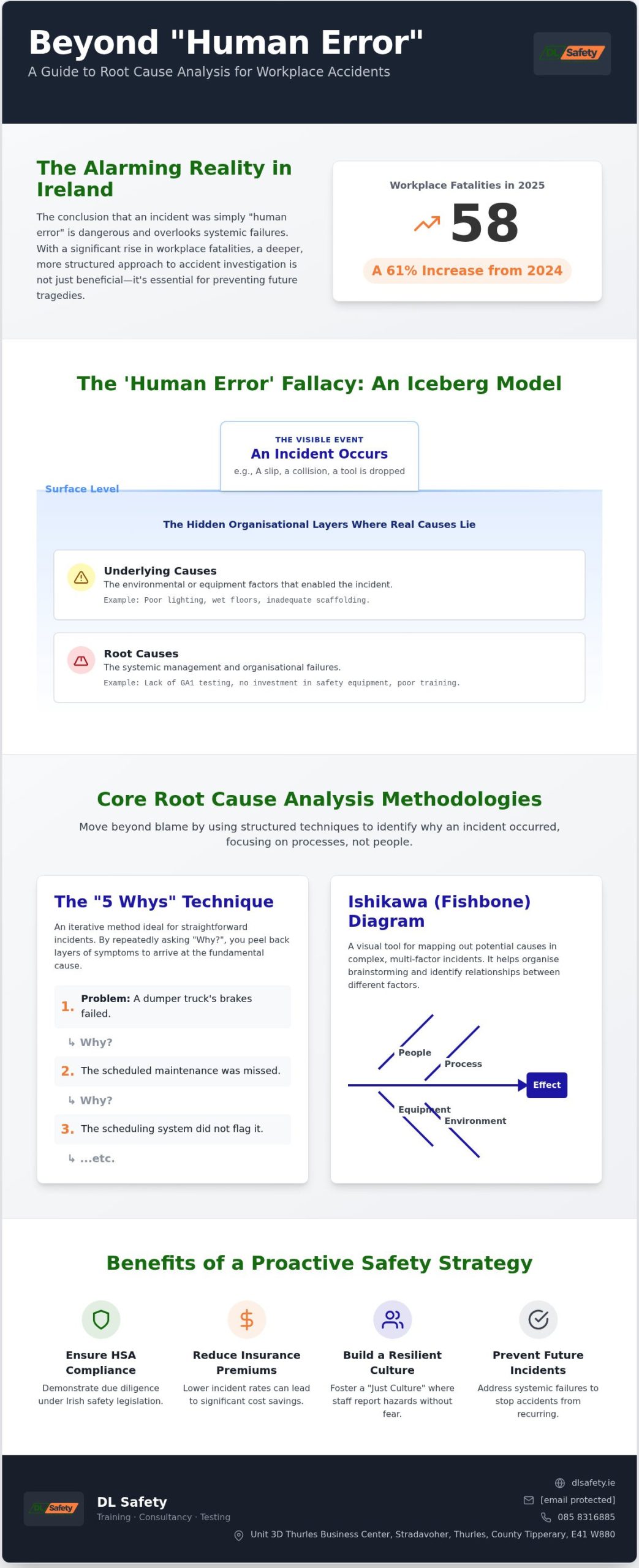
The most dangerous conclusion you can reach after a workplace incident is that it was simply caused by “human error.” With workplace fatalities in Ireland rising to 58 deaths in 2025, a sharp 61% increase from 2024, the need for a deeper perspective has never been more urgent. It’s understandable to feel frustrated when investigations lead to dead ends or when the fear of a looming HSA inspection creates unnecessary pressure. You likely recognise that a blame culture does little to prevent the next incident, yet the complexity of multi-factor site accidents can make it difficult to find a clear path forward.
We promise that by mastering a structured root cause analysis for accident investigation, you can transform these stressful events into vital opportunities for systemic improvement. This guide provides a clear framework for investigating accidents that ensures full compliance with Irish safety legislation whilst helping to reduce insurance premiums. We will preview essential methodologies, such as the “5 Whys” and fishbone diagrams, to move beyond surface-level symptoms. Our team at DL Safety, located at Unit 3D Thurles Business Center, Stradavoher, Thurles, County Tipperary, E41 W880, is available at www.dlsafety.ie, info@dlsafety.ie, or 085 8316885 to support your safety journey.
Key Takeaways
- Discover how a systematic root cause analysis for accident investigation allows you to move beyond the myth of “human error” to identify the real systemic failures.
- Understand your mandatory reporting duties to the HSA, including specific deadlines for fatal and non-fatal incidents under Irish safety legislation.
- Master a practical five-step framework for gathering fresh, objective evidence that stands up to legal scrutiny and prevents future occurrences.
- Learn how to build a more resilient safety culture that protects your team and reduces insurance premiums through proactive problem-solving.
- Access professional support from DL Safety at Unit 3D Thurles Business Center, Stradavoher, Thurles, County Tipperary, E41 W880, or via www.dlsafety.ie for complex investigations.
What is Root Cause Analysis for Accident Investigation?
At its core, root cause analysis for accident investigation is a systematic process designed to dig beneath the surface of an incident to find the actual source of the problem. Whilst a standard investigation often stops at describing what happened, RCA asks why it happened. It’s the difference between merely recording a broken limb and identifying the management failure that allowed a faulty ladder to remain on site. The ultimate goal isn’t to assign blame to an individual; it’s to prevent the same event from ever happening again by fixing the system.
Think of an accident like an iceberg. The immediate event, such as a slip or a collision, is the visible tip. However, the true dangers often lie amongst the hidden organisational layers beneath the waterline. By focusing only on the tip, you leave the underlying hazards untouched, virtually guaranteeing that another accident will occur. A robust Root-cause analysis approach ensures that your safety strategy addresses these submerged risks, protecting both your workforce and your business reputation.
The Difference Between Immediate and Latent Causes
Understanding the layers of causation is vital for any safety professional. We typically categorise these into three distinct levels to ensure no stone is left unturned:
- Immediate causes: These are the direct events that triggered the incident, such as a worker falling from a height or a tool being dropped.
- Underlying causes: These are the environmental or equipment factors that made the accident possible, including poor lighting, wet floors, or inadequate scaffolding.
- Root causes: These are the systemic failures at a management level, such as the absence of a robust GA1 testing schedule or a lack of investment in proper safety equipment.
Why RCA is Essential for Irish Industrial Sectors
For businesses operating in Ireland, conducting a thorough root cause analysis for accident investigation isn’t just best practice; it’s a shield against legal and financial ruin. Following the 2025 spike in workplace fatalities, the Health and Safety Authority (HSA) has increased its focus on systemic management failures rather than individual slip-ups. A professional RCA provides tangible evidence that you’re taking your duties under the Safety, Health and Welfare at Work Act 2005 seriously. It helps reduce costly downtime and equipment repairs whilst fostering a “Just Culture” where employees feel safe reporting hazards. If you need expert guidance, DL Safety is based at Unit 3D Thurles Business Center, Stradavoher, Thurles, County Tipperary, E41 W880. You can reach us at www.dlsafety.ie or info@dlsafety.ie, or call 085 8316885 to discuss how we can support your site investigations.
Core RCA Methodologies: Moving Beyond Human Error
It’s tempting to point at a single person when things go wrong, but professional root cause analysis for accident investigation reveals that human error is usually the last link in a long chain of systemic failures. We use the “Swiss Cheese Model” to visualise this; each layer of protection in your business is like a slice of cheese with holes in it. An accident only happens when the holes in every slice align perfectly. By focusing on the processes rather than the personalities involved, we can identify which “slices” failed and why. This shift in focus ensures you’re looking at the work environment and equipment condition as primary factors rather than afterthoughts.
The 5 Whys Technique for Simple Investigations
For straightforward incidents, the “5 Whys” is a highly effective, iterative technique. You start with the problem and ask “why” it occurred, then ask “why” again for each subsequent answer until you reach the root cause. For instance, if a dumper truck fails during on-site quarry testing, you don’t just stop at “the brakes failed.” You ask why the brakes failed, why the maintenance was missed, and why the scheduling system didn’t flag the requirement. Whilst brilliant for its simplicity, this method can be too linear for complex, multi-factor site accidents where several things went wrong at once.
Ishikawa (Fishbone) Diagrams for Complex Incidents
When an accident involves multiple variables, an Ishikawa or Fishbone diagram is the superior tool. It allows us to categorise contributing factors into distinct branches: People, Methods, Machines, Materials, and Environment. This visual mapping makes it much easier to see the relationship between a lack of training and a mechanical failure. It’s a powerful way to identify specific gaps in your health and safety compliance that might otherwise remain hidden in a standard report. Understanding these complexities is essential for meeting HSA reporting requirements accurately and professionally.
At DL Safety, we help businesses navigate these complex methodologies to ensure their investigations are thorough and legally sound. Whether you’re dealing with a minor near-miss or a serious site incident, having a trusted advisor to guide your safety strategy makes the process far less daunting. You can find our team at Unit 3D Thurles Business Center, Stradavoher, Thurles, County Tipperary, E41 W880, or contact us at 085 8316885 to learn how we can support your internal investigations through detailed expertise and commitment.
A Practical 5-Step Framework for Conducting RCA
For many Irish SMEs without a dedicated safety department, the immediate aftermath of an accident is often chaotic. Efficiency is your best ally during these first few hours. You must act whilst the evidence is fresh and the site remains undisturbed. Relying on subjective opinions or memory is risky; instead, we prioritise objective data to build an accurate picture. This systematic approach is a core component of our monthly safety support package, ensuring that every incident leads to a stronger, more resilient workplace. By following a structured framework, you move away from panic and toward professional resolution.
Step 1: Data Collection and Evidence Preservation
The first step is securing the scene to prevent the loss of vital physical evidence. High-quality photographs from multiple angles and precise measurements are essential for a professional root cause analysis for accident investigation. When you interview witnesses, keep questions open-ended to avoid leading them toward a specific conclusion. It’s also vital to review statutory records. Training logs and GA1 certs often reveal whether the equipment was legally compliant or if a maintenance lapse contributed to the failure.
Step 2: Mapping the Sequence of Events
Once you’ve gathered the facts, you need to organise them into a logical timeline. This mapping process helps you identify “critical points” where a different decision or a functioning safety barrier could have changed the outcome. For site-based incidents, we frequently look for gaps in the Construction Site Traffic Management Plan. Did a vehicle enter a pedestrian zone because the signage was missing, or was the plan itself fundamentally flawed? Identifying these gaps allows you to see the accident as a series of events rather than a single moment of misfortune.
Step 3: Identifying and Implementing Corrective Actions
A successful investigation concludes with actions that fix the root cause, not just the temporary symptom. If a worker slipped, simply telling them to “be more careful” is a failure of leadership. You need SMART improvements: Specific, Measurable, Achievable, Relevant, and Time-bound. Finally, communicate these findings to your entire team. Collective learning is the only way to build a culture where safety is a shared responsibility. If you’re struggling to manage this process internally, our team at DL Safety is here to help. We’re based at Unit 3D Thurles Business Center, Stradavoher, Thurles, County Tipperary, E41 W880. You can reach us at www.dlsafety.ie, info@dlsafety.ie, or 085 8316885. We provide the technical oversight needed to ensure your investigations lead to genuine, long-term improvement.
HSA Compliance and Legal Responsibilities in Ireland
Under the Safety, Health and Welfare at Work Act 2005, every Irish employer has a non-delegable duty to ensure a safe workplace. When an incident occurs, the Health and Safety Authority (HSA) expects more than a superficial report. A documented root cause analysis for accident investigation serves as your primary evidence that you’ve fulfilled your legal obligations. It transforms a potentially damaging situation into a demonstration of professional due diligence, protecting your business from claims of negligence. Failing to investigate near-misses is a significant risk, as these “free lessons” often precede major accidents that could have been prevented with a more proactive approach.
Reporting Requirements and HSA Thresholds
Knowing when to trigger the official reporting process is vital for compliance. Under current regulations, you must report an accident using the IR1 form if an employee is unable to perform their normal work for more than three consecutive days, not including the day of the accident. This ten-day window for non-fatal accidents is strict, and failing to meet it can lead to heavy fines or prosecution. Fatal accidents, however, require immediate notification to the HSA followed by a written report within five days. By aligning your internal investigation with these thresholds, you ensure that your records are ready for scrutiny. Understanding what to expect during a HSA inspection can alleviate much of the stress associated with these legal deadlines.
Evidencing Continuous Improvement
The HSA doesn’t just look at the accident itself; they look at what you did next. They seek proof of a “feedback loop” where the findings from an RCA are used to update your Safety Statement and Risk Assessments. If your investigation identifies a lack of specific knowledge or a lapse in protocol, integrating targeted online safety courses into your corrective action plan shows a proactive commitment to closing training gaps. This evidence of continuous improvement is often what separates a compliant business from one facing an improvement notice. It demonstrates that safety isn’t just a document on a shelf but a living part of your organisational culture.
Don’t wait for a major incident to test your systems. Investigating near-misses before they escalate is the hallmark of a robust safety culture. If you need assistance navigating these legal complexities, our team at DL Safety provides the expert oversight required to keep your business compliant. You can find us at Unit 3D Thurles Business Center, Stradavoher, Thurles, County Tipperary, E41 W880. Contact us today at 085 8316885, via email at info@dlsafety.ie, or visit www.dlsafety.ie to learn how our accident investigation services can safeguard your operations and protect your workforce.
Professional Support: Integrating RCA into Your Safety Strategy
Whilst your internal team knows your site operations better than anyone, there are moments when an internal review isn’t enough. Investigating a serious incident requires a level of distance that is difficult to maintain when you’re close to the people and processes involved. Integrating a professional root cause analysis for accident investigation into your strategy ensures that the final report is free from internal bias or “groupthink.” Our role at DL Safety is to act as your trusted advisor, providing the technical oversight needed to turn a difficult situation into a clear plan for long-term resilience. By allowing an expert to lead the process, you demonstrate to both your workforce and the authorities that you’re committed to transparency and genuine improvement.
The Value of Independent Accident Investigation
An independent investigator brings a fresh pair of eyes to a scene where others might overlook familiar hazards. We specialise in the technical aspects of safety, such as GA1 testing and the analysis of complex lifting equipment failures. This level of expertise is vital when an accident involves mechanical breakdown or structural issues that require more than a cursory glance. Beyond the technical data, an independent report carries significant weight with insurers and legal counsel. It provides a robust, professional narrative that shows your business took every reasonable step to identify the truth. This objective approach doesn’t just satisfy immediate requirements; it builds a stronger foundation for your entire safety management system.
How to Get Started with DL Safety
We believe that the best way to handle an accident investigation is to prevent the need for one in the first place. Our Monthly Safety Support Packages are designed to be proactive, identifying systemic weaknesses before they lead to an incident. However, if the worst does happen, we’re ready to step in with immediate, disciplined support. We help you move beyond the stress of the moment to find practical solutions that protect your team and your bottom line. Our team is dedicated to your success, combining high-level proficiency with a friendly, approachable demeanor that makes complex compliance feel manageable.
If you’re looking for a reliable partner to strengthen your safety culture, contact us today. You can reach David and the team at 085 8316885 or via email at info@dlsafety.ie. For formal correspondence or to visit us in person, our office is located at Unit 3D Thurles Business Center, Stradavoher, Thurles, County Tipperary, E41 W880. You can also find more information about our range of services at www.dlsafety.ie. Let’s work together to ensure your workplace is as safe and compliant as it can possibly be.
Building a Resilient Safety Culture for the Future
Effective safety management requires a shift from identifying who made a mistake to understanding why the system allowed it to happen. By adopting a structured root cause analysis for accident investigation, you move beyond surface-level blame and begin to address the latent organisational failures that lead to incidents. This proactive approach doesn’t just satisfy HSA requirements; it protects your workforce and reduces the long-term costs of downtime and insurance premiums. Whether you’re mapping a sequence of events or implementing SMART corrective actions, the goal is always continuous improvement and a “just culture” that values transparency.
You don’t have to navigate these complex legal and technical challenges alone. At DL Safety, we provide expert support for HSA compliance and statutory testing to ensure your site remains safe and operational. Our team is based at Unit 3D Thurles Business Center, Stradavoher, Thurles, County Tipperary, E41 W880. You can reach us at 085 8316885 or info@dlsafety.ie. Take the first step toward a more robust safety strategy and Book a Professional Accident Investigation or Safety Site Audit today. We’re here to help you turn every challenge into a safer way of working for everyone.
Frequently Asked Questions
What is the most common root cause of workplace accidents?
Systemic failures in management and communication are the most frequent root causes. Often, accidents aren’t just bad luck; they stem from inadequate training, poor maintenance schedules, or unclear safety protocols. Whilst an immediate cause might be a slip or fall, the root cause is frequently found in the organisational culture that allowed the hazard to exist. Addressing these systemic gaps is the only way to ensure long-term site safety.
How long should an accident investigation take?
An investigation should begin immediately and typically concludes within a few weeks, depending on complexity. Initial data collection must happen whilst the scene is fresh to preserve physical evidence. More complex cases involving technical failures or multiple stakeholders may require more time for thorough analysis. The goal is to produce a high-quality report that satisfies legal requirements without rushing the process or overlooking vital details.
Do I need to perform a root cause analysis for a near-miss?
Yes, investigating near-misses is one of the most effective ways to prevent future injuries. A near-miss is a “free lesson” that reveals a weakness in your safety system before someone gets hurt. Performing a root cause analysis for accident investigation on these events allows you to implement corrective actions proactively. It demonstrates a commitment to safety that both your employees and the HSA value highly.
Is human error a valid root cause in an accident investigation?
Human error is rarely the root cause; it’s usually a symptom of a deeper systemic issue. If a worker makes a mistake, we look at why the system allowed that mistake to happen or why there were no barriers to stop it. We investigate whether the training was sufficient, if the environment was distracting, or if equipment was faulty. Fixing the system is more effective than blaming an individual.
What is the difference between RCA and a standard site audit?
A site audit is a proactive check of current conditions, whilst RCA is a reactive analysis following a specific event. Audits look for potential hazards to ensure ongoing compliance with safety statements. In contrast, a root cause analysis for accident investigation digs into a past incident to find out why existing barriers failed. Both are essential components of a robust safety management strategy and work together to protect your business.
Can I perform a root cause analysis myself or do I need a consultant?
You can perform basic RCA internally, but complex or serious incidents often require an external expert. A consultant provides a fresh perspective and technical expertise that internal staff might lack. They also help avoid the internal bias that can cloud an investigation. For businesses in high-risk sectors, having a professional report from a trusted advisor like DL Safety ensures the findings are objective, thorough, and legally robust.
How does the HSA view internal root cause analysis reports?
The HSA views detailed internal reports as evidence of a proactive and responsible safety culture. They expect employers to go beyond simple reporting and actually learn from their mistakes. A well-documented RCA shows that you’ve identified systemic failures and taken steps to prevent recurrence. This documentation is vital during an inspection to prove you’re meeting your legal duties under the Safety, Health and Welfare at Work Act 2005.
What tools are best for small businesses performing RCA?
Small businesses often find the “5 Whys” and fishbone diagrams to be the most practical and effective tools. These methods don’t require expensive software but provide a clear, logical framework for identifying underlying issues. They help you categorise causes into manageable groups like methods, machines, and people. Using these simple tools consistently ensures your investigations remain thorough without becoming overly complex or difficult for your team to manage.