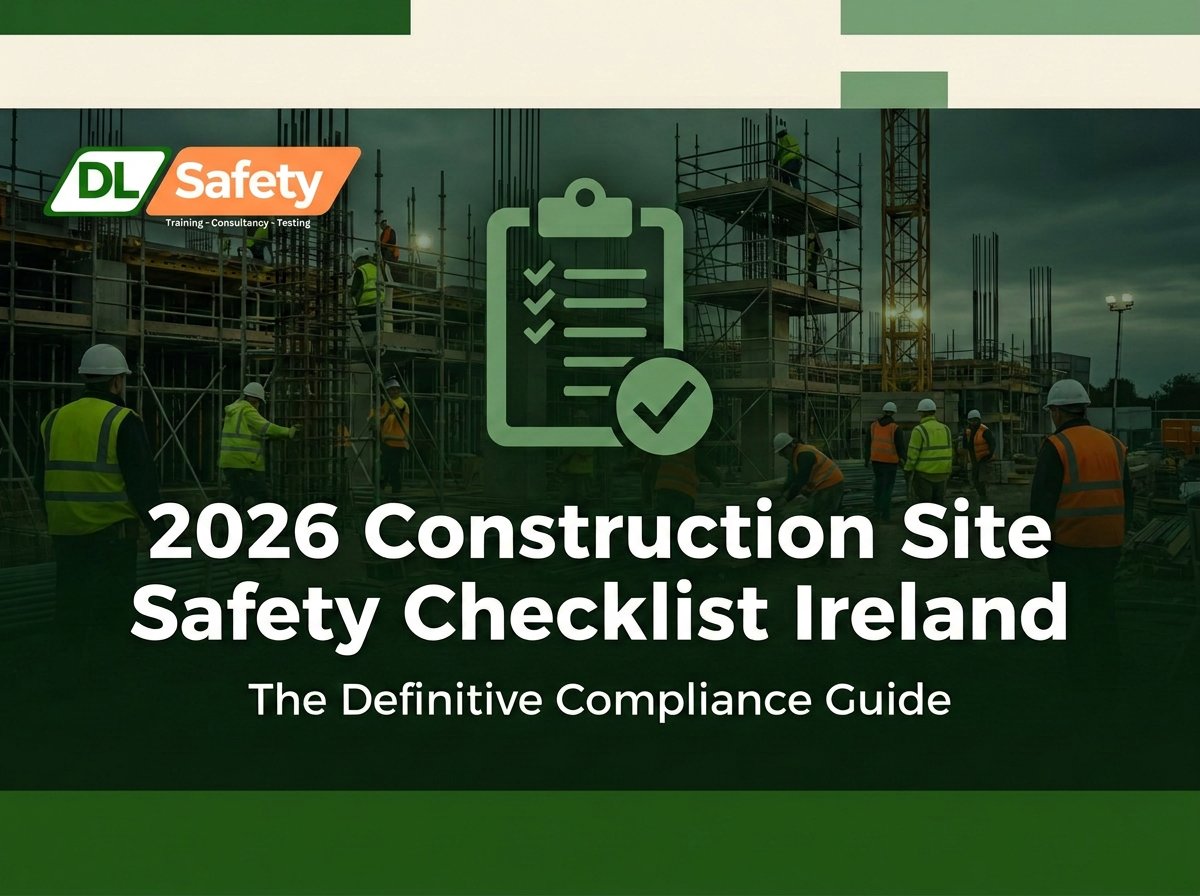
Did you know that construction fatalities in Ireland doubled in 2025? This sobering statistic from the Health and Safety Authority has triggered a significant shift in enforcement for 2026, making a robust construction site safety checklist Ireland more critical than ever before. We know that managing a busy site often feels like a constant balancing act between hitting project deadlines and keeping up with evolving regulations, such as the new 2026 Code of Practice for Chemical Agents. It’s frustrating to face the fear of HSA improvement notices or the challenge of engaging a crew that has heard the same safety briefings a thousand times.
This guide provides a foolproof roadmap to master your statutory obligations, ensuring you stay ahead of inspectors while protecting every person on your team. At DL Safety, we believe in a pragmatic approach that goes beyond a simple tick-box exercise. You’ll learn how to integrate technical requirements like GA1 testing and quarry vehicle brake certificates into your daily routine, ultimately building a site culture where safety is second nature. From new exposure limits for diisocyanates to the latest CSPAC action plans, we’ve got you covered. For tailored support, visit us at www.dlsafety.ie, email info@dlsafety.ie, or call 085 8316885.
Key Takeaways
- Learn how to transition from traditional paper records to the digital documentation systems now prioritised by HSA inspectors in 2026.
- Discover how to customise a comprehensive construction site safety checklist Ireland to address specific project phases and modern welfare requirements.
- Understand the critical importance of statutory GA1 testing and daily plant inspections in preventing high-risk mechanical failures.
- Identify effective strategies for managing ‘silent killers’ like silica dust and ensuring your team is trained in chemical spill kit deployment.
- Master a five-step framework designed to transform safety checks from a repetitive tick-box exercise into a proactive tool for cultural change.
The 2026 Regulatory Landscape: Why Your Site Checklist Needs an Upgrade
A construction site safety checklist Ireland is often viewed as a simple administrative requirement, but in 2026, its role has evolved into a dynamic tool for real-time risk management. Following a challenging year in 2025, where construction fatalities in Ireland doubled to 10 provisional deaths, the Health and Safety Authority (HSA) has sharpened its focus. A modern checklist is no longer a static piece of paper kept in a dusty folder; it is a living document that must reflect the daily changing environment of a busy site. While global construction safety standards provide a baseline, Irish contractors must now account for specific 2026 amendments, such as the updated Code of Practice for Chemical Agents and stricter exposure limits for substances like diisocyanates.
The shift from a “tick-box” paperwork exercise to a behavioural audit is perhaps the most significant change for site managers this year. It isn’t enough to simply record that a guardrail is present. You must observe whether the crew is actually using the safety equipment provided and if their behaviour aligns with the site’s Safety Statement and Method Statements. These foundational documents set the rules, but your construction site safety checklist Ireland is what ensures those rules are followed on the ground, day in and day out.
HSA Priorities and Statutory Duties in 2026
Inspectors are currently targeting three high-risk areas that contributed to the majority of workplace deaths last year: vehicle movements, falling objects, and falls from height. In 2026, the HSA is also prioritising digital record-keeping. They expect to see evidence of inspections that are timestamped and verifiable, rather than lists filled out in bulk at the end of the week. For the Project Supervisor Construction Stage (PSCS), this means oversight must be proactive. In the event of an accident investigation, your checklist serves as a primary legal defence, proving that you exercised due diligence and maintained statutory compliance throughout the project’s duration.
The ROI of Robust Safety Documentation
Investing time in thorough checklists provides a tangible return on investment that goes beyond avoiding fines. Clear, consistent safety documentation is a key factor in reducing insurance premiums and preventing the costly project delays that follow a site shutdown or a serious near-miss. When safety communication is transparent, crews feel more confident, leading to a noticeable drop in accidents. At DL Safety, we adopt a “Trusted Advisor” approach to site leadership, where we help you transform compliance from a burden into a streamlined part of your operational excellence. By maintaining high standards, you protect your workforce and your bottom line simultaneously. For expert guidance on modernising your safety protocols, you can reach our team at www.dlsafety.ie, info@dlsafety.ie, or 085 8316885. Our office is located at Unit 3D Thurles Business Center, Stradavoher, Thurles, County Tipperary, E41 W880.
The Essential Components of a 2026 Construction Safety Checklist
Building on the regulatory shifts discussed previously, a construction site safety checklist Ireland must first address the physical foundations of site security and worker well-being. Your perimeter is your first line of defence. Ensure that all fencing is secure and boundaries are clearly defined to prevent unauthorised access. Signage must be legible and positioned strategically at every entry point. Beyond the hoarding, welfare facilities are a major focus for HSA inspectors in 2026. Canteens, toilets, and drying rooms must meet high hygiene standards, providing a clean, heated, and dignified environment for your team. Maintaining these facilities isn’t just about morale; it’s a fundamental requirement of health and safety compliance Ireland.
Personal Protective Equipment (PPE) remains a staple, but 2026 requirements demand more than just a hard hat and high-vis vest. With stricter exposure limits now in place for substances like lead and diisocyanates, your checklist should verify that specialised respiratory protective equipment (RPE) is available and that face-fit testing has been conducted where necessary. Fire safety also requires constant vigilance. Your weekly checks must confirm that evacuation routes are clear, extinguishers are serviced, and first aid kits are fully stocked and accessible to all workers.
Site Organisation and Pedestrian Segregation
Effective traffic management is vital for preventing the vehicle-related accidents that have historically plagued the industry. Your checklist should verify that pedestrians and vehicles are physically separated with robust barriers. Haul roads must be kept clear of debris, and as we move into winter months, adequate lighting is essential for safe movement during early mornings and late evenings. A key part of your routine should be the verification of the construction site traffic management plan, ensuring that all temporary diversions or loading bays are operating as intended.
Electrical Safety and PAT Testing
Electricity on-site presents a constant hazard, particularly with temporary power supplies. All 110v equipment, including transformers and leads, must be inspected for physical damage before use. When working near overhead lines, ensure that ‘goalposts’ and warning signs are correctly positioned to prevent accidental contact. A critical component of your electrical safety regime is PAT testing for construction sites Ireland. Regular testing ensures your tools are fit for purpose and reduces the risk of fire or shock. If you’re unsure about your current testing schedule, our team at DL Safety can provide a comprehensive Health & Safety Site Audit to identify any gaps in your documentation. You can reach us at Unit 3D Thurles Business Center, Stradavoher, Thurles, County Tipperary, E41 W880, or call 085 8316885 to discuss your specific site needs.
High-Risk Technical Verification: Lifting Equipment and Plant Safety
While general site layout and welfare provide the framework for a safe project, the technical verification of machinery is where the highest risks reside. A comprehensive construction site safety checklist Ireland must include specific prompts for statutory documentation. It’s a common mistake to assume that a machine is safe just because it was delivered to the site recently. In reality, the legal responsibility for ensuring equipment is fit for purpose sits with the site management. Your checklist must also include verification of inspection tags on scaffolding and MEWPs, ensuring that only competent, trained operators are permitted to work at height.
Statutory thorough examinations, often referred to as GA1 certs, are non-negotiable. GA1 testing Ireland provides the technical assurance that lifting equipment, from excavators to small shackles, meets the required safety standards. Your checklist should distinguish between the operator’s daily pre-start checks and these formal statutory reports. If an inspector arrives, they won’t just look for a signature; they’ll want to see the corresponding certificate for every piece of plant on-site.
Lifting Operations and Equipment Compliance
Lifting accessories like slings, chains, and shackles are frequently overlooked during routine audits. According to LEEA standards, these items require rigorous inspection for signs of wear, such as distorted chain links, frayed webbing, or pins that no longer sit flush in shackles. If any gear shows signs of stretching or chemical degradation, it must be removed from service immediately and destroyed to prevent accidental reuse. Your checklist should also verify that the current Lift Plan is relevant to the specific site configuration and hasn’t become outdated as the project progresses.
Heavy Plant and Quarry Vehicle Verification
For sites involving heavy earthworks or quarrying activities, the stakes are even higher. Every 360 excavator and telehandler must have a valid GA1 certificate clearly displayed or accessible in the site office. Beyond lifting, the mechanical integrity of braking systems on heavy dumpers is a critical focus. Regular, documented quarry vehicle brake testing Ireland is essential to ensure these machines can stop safely under full load on inclined haul roads.
During site inductions, always verify that operators hold the correct CSCS cards for the machinery they intend to use. At DL Safety, we specialise in these technical verifications, providing the peace of mind that your plant is fully compliant. For assistance with your site audits or technical testing, contact us at Unit 3D Thurles Business Center, Stradavoher, Thurles, County Tipperary, E41 W880. You can also reach our team at www.dlsafety.ie, info@dlsafety.ie, or 085 8316885.
Health, Environment, and the Human Factor: Modern Safety Priorities
The 2026 regulatory landscape has brought occupational health hazards into sharper focus than ever before. While mechanical failures are immediately visible, the “silent killers” like silica dust and asbestos cause long-term damage that is often harder to track until it’s too late. A modern construction site safety checklist Ireland needs to move beyond physical barriers to include these health-critical checks. Since the new Code of Practice for Chemical Agents came into effect on 9 April 2026, HSA inspectors are looking for evidence that you’ve addressed the updated exposure limits for inorganic lead (0.03 mg/m3) and diisocyanates (0.01 mg/m3).
Protecting the local environment is an equally vital component of your statutory duties. Your checklist should verify that measures are in place to prevent silt runoff into local watercourses and that groundwater remains protected from fuel spills or chemical leaks. This means ensuring Safety Data Sheets (SDS) are not just filed away in the office but are accessible to those actually handling the substances. You must also confirm that spill kits are deployed in high-risk areas and that the crew knows how to use them effectively. These environmental safeguards are now a core part of the 2025-2027 CSPAC Action Plan priorities.
Hazardous Substances and Respiratory Protection
Respiratory Protective Equipment (RPE) is only effective if it fits the wearer correctly. Your weekly audit should verify that every crew member required to wear a mask has undergone a formal face-fit test. Managing these chemical agents requires a robust chemical risk assessment Ireland to ensure your controls are proportionate to the specific task. Don’t forget to monitor noise and vibration levels. Prolonged exposure can lead to irreversible conditions like Hand-Arm Vibration Syndrome (HAVS), which remains a significant focus for inspectors targeting long-term worker health.
Behavioural Safety and Mental Wellbeing
The human factor is the most unpredictable element on any project. Integrating psychological safety into your daily site walk-round involves spotting signs of fatigue or burnout that could lead to critical errors. Encouraging a “no-blame” culture makes it easier for workers to report near-misses, providing you with the data needed to prevent actual accidents before they occur. When competency gaps are identified, utilising online safety courses Ireland helps bridge the gap efficiently.
If you find it difficult to keep track of these evolving health and environmental standards, our Monthly Safety Support Packages offer a streamlined solution to keep you compliant. Contact our team at www.dlsafety.ie or call 085 8316885 to ensure your site remains a safe and healthy environment for everyone. We are located at Unit 3D Thurles Business Center, Stradavoher, Thurles, County Tipperary, E41 W880.
Implementing Your Safety Checklist: A 5-Step Framework for Success
Having a comprehensive construction site safety checklist Ireland is only the first half of the battle; the real value lies in how you implement it on the ground. A checklist that sits in a van or an office drawer provides no protection when an inspector arrives or, worse, when an accident occurs. To move from a passive “tick-box” culture to a proactive safety environment, you need a structured approach to your inspections. This framework ensures that your safety efforts are consistent, documented, and, most importantly, effective at preventing harm.
- Preparation: Never use a generic template for every project. Customise your checklist to reflect the specific phase of your work, whether you’re in the high-risk demolition stage or the busy final fit-out.
- Execution: Conduct your site walk-round with a “critical eye.” Instead of just looking for the presence of a guardrail, check its stability and height. You aren’t just looking for items; you’re looking for hazards that others might have missed.
- Engagement: Involve your crew in the process. Ask the operators about their plant’s performance or talk to the tradespeople about any near-misses they’ve witnessed. This builds a positive safety culture where everyone feels responsible for the site’s wellbeing.
- Documentation: Store your records securely and digitally where possible. As we’ve discussed, the HSA now prioritises verifiable, timestamped records that prove you’re maintaining statutory compliance daily.
- Action: A checklist is useless if the identified hazards aren’t rectified. Close the loop by assigning clear deadlines for corrective actions and verifying they’ve been completed. For specialised surface restoration or emergency repairs, resources such as The Solution can provide valuable guidance on rapid response strategies for maintaining a safe environment.
Best Practices for Site Managers
For high-risk sites, weekly checks are the absolute minimum. Conditions on a construction project change by the hour, and a week is a long time for a new hazard to develop unnoticed. One of the most effective ways to improve engagement is through visual aids. Take photos of both “Good” and “Bad” examples during your walk-round and use them in your next toolbox talk. Showing the crew a photo of their own workspace is far more impactful than a generic safety poster. Understanding what to expect during a HSA inspection will help you tailor these photos to the areas inspectors are most likely to scrutinise.
Outsourcing Your Safety Compliance
Managing the fine details of a construction site safety checklist Ireland whilst juggling project deadlines is a significant challenge. Many businesses find that our Monthly Safety Support Packages provide the perfect balance of expert oversight and operational freedom. A professional site audit offers a neutral perspective, identifying the “site blindness” that can occur when you see the same environment every day.
At DL Safety, we act as your “Trusted Advisor,” helping you maintain a foolproof compliance roadmap that protects your workforce and your reputation. For expert support and tailored safety solutions, contact us at Unit 3D Thurles Business Center, Stradavoher, Thurles, County Tipperary, E41 W880. You can reach our team via email at info@dlsafety.ie, visit our website at www.dlsafety.ie, or call us directly on 085 8316885.
Building a Future-Proof Safety Culture on Your Site
The 2026 regulatory landscape demands a shift from passive compliance to active site leadership. By evolving your construction site safety checklist Ireland into a tool for technical verification and behavioural oversight, you do more than just satisfy HSA inspectors; you create a resilient environment where every worker returns home safely. We’ve explored the necessity of digital record-keeping, the nuances of new chemical exposure limits, and the critical role of statutory GA1 testing in preventing high-risk failures. Ensuring these elements are integrated into your daily routine is the hallmark of a modern, professional contractor.
Navigating these complexities doesn’t have to be a solo effort. At DL Safety, our LEEA-certified lifting equipment inspectors and specialised quarry vehicle brake testing teams provide the technical depth your projects require. Our comprehensive monthly compliance packages are designed to take the administrative burden off your shoulders, allowing you to focus on delivery while we ensure your site remains above reproach. Secure your site with expert safety support-Contact DL Safety today at 085 8316885 or info@dlsafety.ie. We look forward to helping you build a safer, more efficient workplace from our base at Unit 3D Thurles Business Center, Stradavoher, Thurles, County Tipperary, E41 W880.
Frequently Asked Questions
Is a construction site safety checklist a legal requirement in Ireland?
Yes, maintaining inspection records is a statutory duty under the Safety, Health and Welfare at Work (Construction) Regulations 2013. While the law doesn’t specify a “checklist” format, the Project Supervisor Construction Stage (PSCS) is legally required to monitor site safety and keep written records of inspections. Using a structured checklist is the industry-standard method to prove you’ve met these monitoring obligations during an audit.
How often should a site safety inspection be carried out?
Weekly inspections are the minimum statutory requirement for most active construction projects in Ireland. However, for high-risk sites or those with rapidly changing environments, daily walk-rounds are highly recommended. Frequent use of your construction site safety checklist Ireland ensures that temporary hazards, such as moved barriers or new excavations, are identified and controlled before they lead to an incident.
What are the most common failings found during HSA site inspections?
Inspectors frequently identify inadequate edge protection for work at height and poor segregation between pedestrians and vehicles. Other common failings include missing or expired GA1 certificates for lifting equipment and a lack of proper welfare facilities. Many sites also fail to provide accessible Safety Data Sheets for hazardous chemicals, which has become a major focus following the 2026 regulatory updates.
Do I need a separate checklist for lifting equipment and plant?
Yes, technical machinery requires a more detailed level of verification than a general site audit. A dedicated checklist for plant ensures that operator pre-start checks are being performed and that statutory thorough examinations are up to date. This separate focus prevents technical requirements, like verifying the integrity of lifting slings or shackles, from being overlooked during a broad site walk-round.
What is the difference between a GA1 certificate and a daily check?
A GA1 certificate is a formal report of thorough examination conducted by a competent person every six or twelve months. In contrast, a daily check is a visual inspection performed by the operator before the machine is used. Both are essential. The GA1 proves the machine’s structural and mechanical integrity, whilst the daily check ensures no immediate faults have developed since its last use.
How long must I keep safety inspection records on-site?
You must keep statutory inspection records, such as those for scaffolding and excavations, on-site for the duration of the project. Once the project is complete, these records should be archived for at least five years. Some health-related records, particularly those involving exposure to hazardous substances like asbestos or lead, may need to be retained for up to 40 years to meet legal requirements.
Can digital checklists replace paper records for HSA compliance?
Yes, digital record-keeping is fully accepted and often encouraged by HSA inspectors in 2026. Digital systems provide verifiable timestamps and ensure that records can’t be easily lost or damaged. The only requirement is that the records must be “readily available” for an inspector to view on a screen or via a shared link during a site visit.
What should I do if a subcontractor fails to follow the safety checklist?
You should issue a formal safety notice and stop the specific task immediately if the breach poses a risk to any person. As the PSCS, you have the authority to remove individuals or companies from the site if they refuse to comply with your safety rules. It’s vital to document the failure and the corrective actions taken to protect your own legal position.