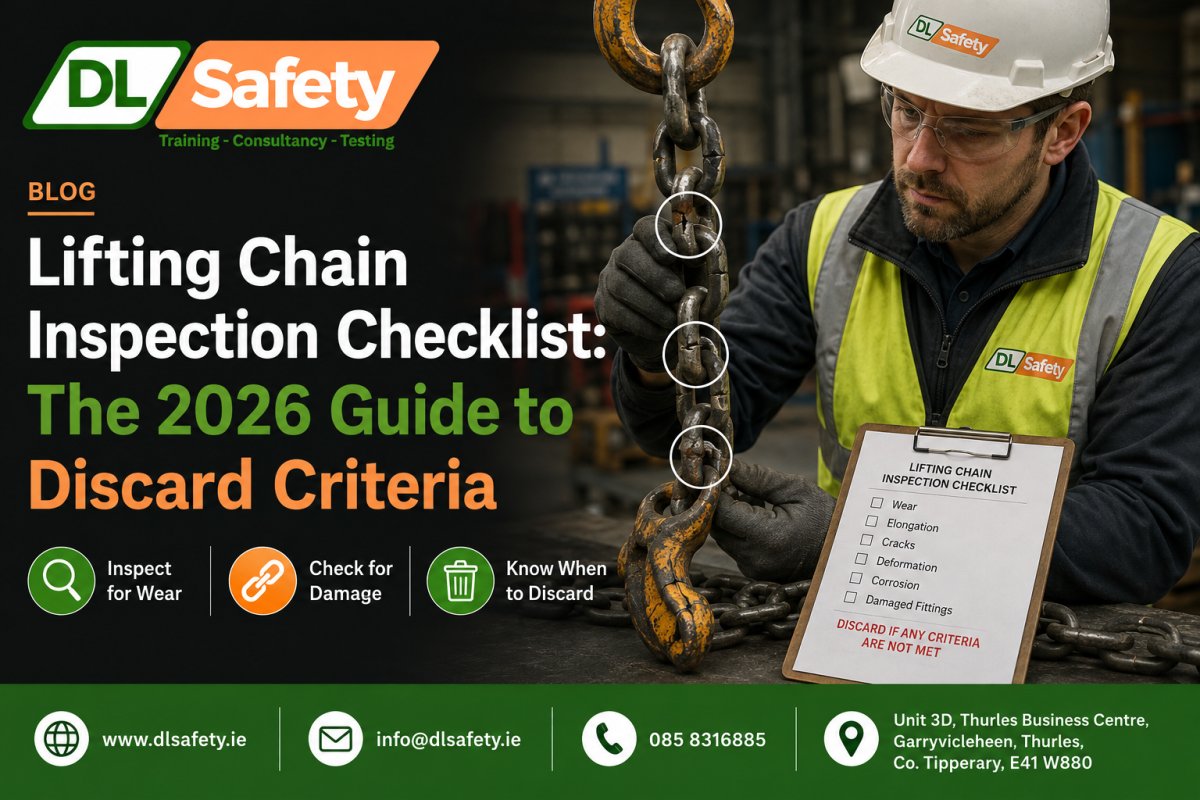
What if the difference between a successful lift and a catastrophic site failure is a mere three millimetres of steel? For site managers and safety officers across Ireland, the safety of every person on the ground rests on the integrity of a few critical links. We understand that the pressure to maintain a valid GA1 certificate whilst keeping projects on schedule can feel like a constant balancing act; you likely worry whether a slightly worn link will pass an unannounced HSA inspection. This guide provides a definitive lifting chain inspection checklist to help you master the technical discard criteria, from the 10% rule on wear to identifying subtle heat damage. By understanding these precise tolerances, you can make confident decisions about chain disposal and ensure your gear remains fully compliant.
We will break down the exact measurements and visual warning signs that dictate when a chain must be removed from service to ensure total site safety. Our team at DL Safety is here to support your compliance journey, offering our expertise nationwide. You can reach us at info@dlsafety.ie or 085 8316885, or visit www.dlsafety.ie to learn more about our certified inspection services and professional GA1 testing. Our goal is to ensure you lead your team with the confidence that every piece of lifting equipment is fit for purpose and fully documented.
Key Takeaways
- Understand the statutory requirements for GA1 certification in Ireland. Ensuring your lifting accessories undergo a thorough examination every six months is essential to remain HSA compliant.
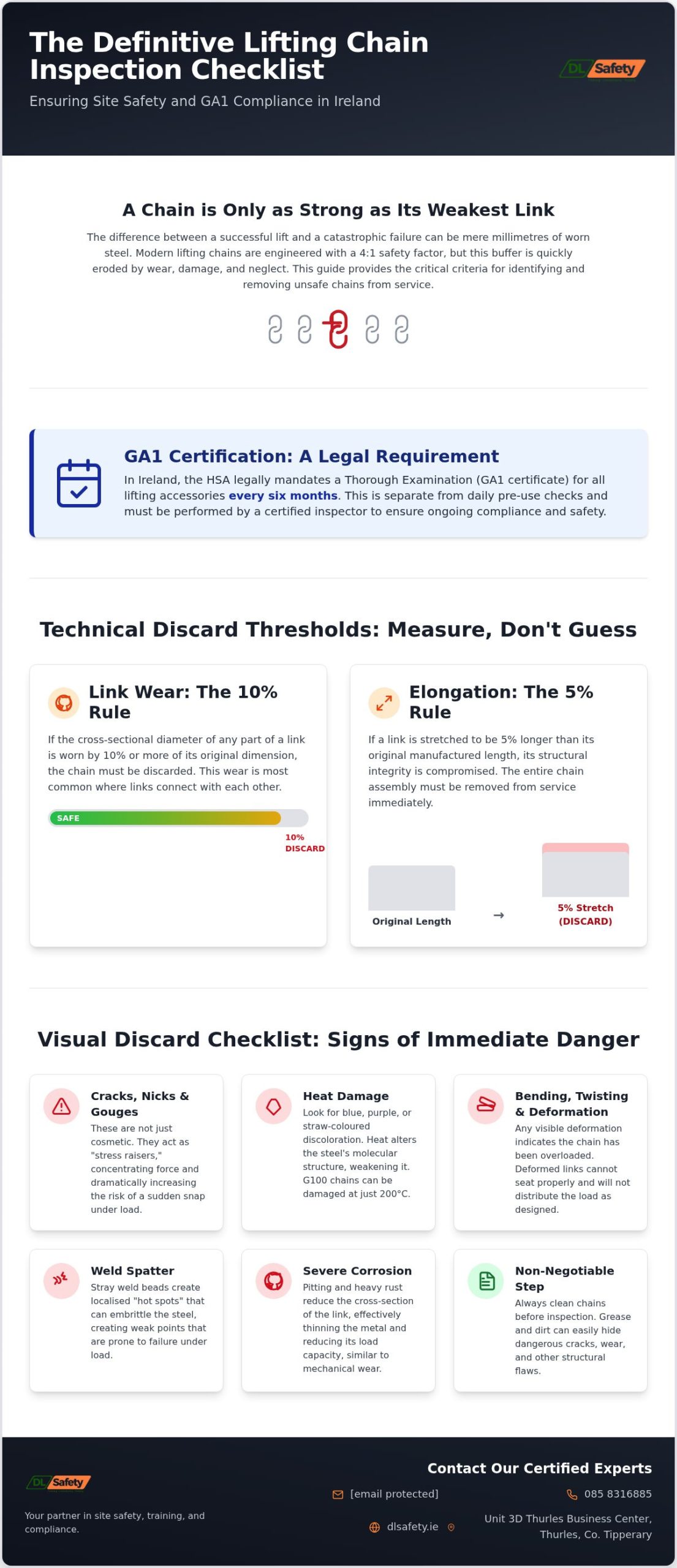
- Master the technical discard thresholds, including the 10% rule for cross-sectional wear and the 5% rule for link elongation. These measurements are vital to prevent catastrophic failure.
- Implement a robust lifting chain inspection checklist. This helps your team identify immediate visual dangers like nicks, cracks, and heat discolouration before any lift begins.
- Learn why cleaning your equipment is a non-negotiable step in the inspection process. Grease and dirt often hide structural flaws that can compromise site safety.
- Discover how to transition seamlessly from a failed inspection to a certified replacement. Sourcing LEEA-standard lifting gear from trusted Irish experts keeps your site operational and safe.
Understanding Lifting Chain Safety Standards in 2026
Lifting chains are the literal lifeline of any overhead operation on an Irish construction site or industrial facility. They represent the critical link in a safety path that must remain unbroken from the crane hook to the load itself. Because these components endure immense tension and environmental stress, maintaining a rigorous lifting chain inspection checklist is the only way to ensure that “wear and tear” doesn’t quietly transform into a catastrophic failure. Modern engineering has gifted us with incredibly resilient materials, but this strength relies entirely on the chain’s structural integrity remaining within very tight tolerances.
The evolution of chain metallurgy has moved rapidly over the last decade. Whilst Grade 80 was once the industry standard, we now see a widespread shift toward Grade 100 and the high performance Grade 120 alloy steels. These newer grades offer a superior strength to weight ratio, allowing for lighter slings that can handle heavier loads. However, these harder alloys can sometimes be more sensitive to surface nicks or extreme temperatures. To maintain high Lifting Equipment Safety Standards, site managers must look beyond the surface of the metal and understand how precise link geometry ensures that weight is distributed evenly across the entire assembly.
The Role of GA1 Certification in Ireland
In Ireland, statutory compliance is governed by the Health and Safety Authority (HSA), which mandates a Thorough Examination, commonly known as a GA1, every six months for all lifting accessories. This isn’t a suggestion; it’s a legal requirement that protects business owners from massive liability and insurance disputes if an accident occurs. At DL Safety, we distinguish clearly between the daily pre-use check performed by your operators and the six-monthly professional examination. Whilst your team looks for obvious flaws, our certified inspectors use a technical lifting chain inspection checklist to measure minute changes in link diameter and length that the naked eye might miss. You can find our expert team at Unit 3D Thurles Business Center, Stradavoher, Thurles, County Tipperary, E41 W880, where we help businesses across the country stay on the right side of the law.
The Physics of Chain Failure
The physics of a lift are unforgiving. A single compromised link dictates the failure point of the entire assembly, meaning a 10 metre chain is only as strong as its weakest 10 millimetres. When a link deforms or wears down, the predictable behaviour of the load is lost, creating a “snapping” risk that endangers everyone on site. Modern lifting chains are engineered with a safety factor of 4:1, meaning the actual breaking strength is four times the rated Safe Working Load. This margin isn’t there to encourage overloading; it’s a vital buffer designed to account for shock loading and minor wear, but once that buffer is eroded by neglect, the risk of a snap becomes an eventual certainty. For more information on maintaining your equipment, contact us at info@dlsafety.ie or call 085 8316885.
The Visual Discard Checklist: Signs of Immediate Danger
Before you even reach for the callipers, your eyes are your most powerful tool in maintaining site safety. A visual inspection is the most frequent part of any lifting chain inspection checklist, acting as the first line of defence before a load ever leaves the deck. Whilst metallurgy has advanced, the physical signs of stress remain consistent. Nicks, gouges, and cracks aren’t just cosmetic blemishes; they act as “stress raisers” that concentrate tension into a single point, significantly increasing the likelihood of a sudden snap under load.
Heat damage is another silent killer of lifting gear. If you notice a blue, purple, or straw-coloured tint on the metal, the chain has likely been exposed to extreme temperatures that have altered its molecular structure. For Grade 80 chains, temperatures above 400°C are the danger zone, whilst Grade 100 chains can be permanently compromised at just 200°C. Similarly, weld spatter from nearby site works can create localised “hot spots” that embrittle the steel. If you spot these discolourations or stray weld beads, the chain must be quarantined immediately to prevent a failure.
Identifying Surface Damage and Corrosion
Distinguishing between superficial oxidation and deep, structural pitting is a vital skill for any competent person. Surface rust is common on Irish sites due to our damp climate, but it becomes a structural concern when it develops into pitting, which creates small holes that eat into the link’s diameter. Whilst we follow HSA guidelines in Ireland, global benchmarks like the OSHA Lifting Chain Regulations provide excellent technical context for identifying when corrosion has transitioned from an eyesore to a safety hazard.
When inspecting “high-tension” zones, pay close attention to the points where links interlock, as these areas endure the most friction. You can use the “thumb test” for a quick field assessment: if a nick or gouge is deep enough to catch your fingernail or feels like a significant indentation under your thumb, it likely warrants a technical measurement to see if it has exceeded the 10% wear limit. If you’re ever in doubt about the integrity of a specific sling, it’s always best to source a certified replacement rather than risking a heavy lift.
Detecting Deformation and Stretching
Deformation is often the result of improper loading or snagging. Look for links that appear bent, twisted, or “pulled” out of their original oval shape. A chain that’s been severely overstressed will often lose its flexibility; the links may bind together or fail to seat correctly within the assembly. A simple but effective test is to hang the chain vertically. If it doesn’t “hang straight” or shows a visible twist in the hang, it’s a clear indicator that the geometry has been compromised. These “stretched” links are often invisible precursors to failure, as the metal has been pulled beyond its elastic limit and can no longer support its rated Safe Working Load.
Technical Thresholds: Measuring Wear and Elongation
Visual cues provide the initial warning, but technical measurements offer the hard truth about a chain’s remaining service life. When you move through your lifting chain inspection checklist, you transition from subjective observation to objective data. This phase is where many site managers feel the most uncertainty, yet it’s the most critical for maintaining statutory compliance. Precision is non-negotiable here; a few millimetres of steel can be the difference between a safe working day and a catastrophic equipment failure on an Irish site.
Reliable data requires the right tools. Whilst a standard tape measure is fine for checking the overall “reach” of a sling, assessing link-by-link wear demands high-quality vernier callipers or dedicated chain gauges. These tools allow you to identify diameter reduction that the naked eye simply cannot detect. Global benchmarks like the ASME B30.9 Sling Standard highlight the importance of these rigorous measurement protocols to ensure that every component within a lifting assembly maintains its intended strength and geometry.
The 5% Wear Rule Explained
Industry standards generally dictate two primary thresholds for wear. A reduction of 5% in the nominal diameter of a link is often the internal trigger for many safety-conscious firms to schedule a replacement, particularly for critical or high-frequency lifts. However, once the cross-sectional diameter of any part of a link is reduced by 10% or more from its original size, the chain must be discarded immediately. To measure the diameter at the point of maximum wear, use callipers to find the thinnest cross-section of the link, ideally taking two measurements at right angles to ensure accuracy.
Assessing Inter-Link Bearing Points
The most common failure zones aren’t the straight sides of the link, but the bearing points where links interlock and articulate. These areas endure constant friction and “grinding” during every lift, making them prone to accelerated thinning. During your inspection, you must physically manipulate the chain, slackening the links to reveal these hidden wear surfaces that are usually tucked away. If you find that the links no longer move freely or if you see deep “grooving” at the contact points, it’s time to involve a professional GA1 inspector for a more thorough analysis.
Measuring “Reach” is the final technical hurdle. If a section of the chain has elongated by more than 5% of its original length, it’s a clear sign the metal has been overstressed. At DL Safety, we provide the expert oversight needed to navigate these technicalities. Based at Unit 3D Thurles Business Center, Stradavoher, Thurles, County Tipperary, E41 W880, our team is ready to assist with professional testing. Contact us at info@dlsafety.ie or call 085 8316885, or visit www.dlsafety.ie to ensure your equipment meets every technical safety standard.
Best Practices for Pre-Use Inspections and Maintenance
Whilst the statutory six-monthly examination is the legal backbone of site safety, the real work of preventing accidents happens in the moments before a lift begins. Organising a “Pre-Use Habit” amongst your lifting team is the most effective way to catch flaws before they escalate into failures. This daily check isn’t just a box-ticking exercise; it’s a proactive safety leadership role that should be spearheaded by a “Competent Person.” In the Irish context, this individual must possess the theoretical and practical knowledge to identify defects, ensuring that every lifting chain inspection checklist is executed with a high level of discipline and integrity.
One of the most overlooked aspects of maintenance is the simple act of cleaning. On a busy site in Tipperary or Dublin, chains quickly become coated in grease, grit, and concrete dust. This debris can easily hide fatal structural flaws such as hairline cracks or deep pitting. We always recommend that chains are wiped clean before a thorough inspection. This is particularly vital for modern Grade 100 and Grade 120 high-performance alloy chains. Whilst these materials offer incredible strength, their sophisticated metallurgy can be more susceptible to hydrogen embrittlement if exposed to certain chemicals or corrosive environments, making a clean surface essential for a true assessment of their condition.
Recording Your Inspections
Consistency in documentation is what transforms a simple check into a robust safety system. Maintaining a detailed inspection log for every serialised lifting chain ensures you have a clear audit trail for the HSA. Many forward-thinking Irish firms are now moving away from paper and using digital safety management systems to track the life cycle of their lifting accessories. For a deeper understanding of how this fits into your broader site requirements, you can refer to our guide on Health and Safety Compliance Ireland, which outlines the documentation standards expected in 2026.
Proper Storage and Handling
How you store your gear when it’s not in use directly impacts its longevity and safety. Lifting chains should never be left on the damp ground where moisture can trigger oxidation. Instead, organise your lifting store with dedicated racks that keep chains suspended and dry. This visual order makes it easier to spot missing tags or damaged links at a glance. If you’ve identified gear that no longer meets the grade, don’t leave it in the store where it might be used by mistake; quarantine it immediately. If you need professional GA1 testing or replacement lifting equipment to keep your site running smoothly, our team at Unit 3D Thurles Business Center, Stradavoher, Thurles, County Tipperary, E41 W880, is ready to help. You can reach us at info@dlsafety.ie or call 085 8316885 to discuss your specific site needs.
Professional GA1 Testing and Replacement Solutions
Mastering your internal lifting chain inspection checklist is a vital first step, but it doesn’t replace the legal necessity of a professional statutory examination. Whilst your daily and weekly checks catch immediate hazards, the six-monthly GA1 thorough examination provides the technical certification required to keep your site operational and your insurance valid. We see ourselves as your partner in this process, moving beyond simple “pass or fail” reports to provide a comprehensive overview of your equipment’s health and longevity. Our team bridges the gap between complex HSA regulations and the practical realities of a busy Irish site.
For many site managers, the stress of compliance stems from the administrative burden of tracking multiple accessories. We alleviate this by helping you maintain a robust lifting equipment register, ensuring every chain, shackle, and sling is accounted for and correctly serialised. This methodical approach doesn’t just satisfy an inspector; it provides you with a “big picture” view of your gear’s life cycle, allowing you to budget for replacements before they become an emergency. If you’re looking for total peace of mind, our Monthly Safety Support Packages integrate these inspections into a broader safety strategy tailored to your specific needs.
Statutory Thorough Examinations by DL Safety
When you book a professional GA1 inspection with us, you aren’t just getting a signature on a page. Our certified inspectors conduct deep-dive examinations to LEEA and HSA standards, using precision tools to verify the integrity of every link. We look for the subtle indicators of fatigue that a standard lifting chain inspection checklist might miss during a quick pre-use walkaround. For a more detailed look at what these legal requirements entail, you can read our comprehensive guide on GA1 Testing Ireland, which breaks down the 2026 statutory landscape for businesses.
Sourcing Certified Replacement Lifting Gear
The transition from a failed inspection to a safe replacement should be seamless. If a chain is discarded due to wear or elongation, we provide a direct path to sourcing certified, high-grade replacements. We supply a full range of lifting chains, slings, and shackles specifically selected for the rigours of the Irish construction and quarrying industries. Whether you need Grade 80, 100, or the latest Grade 120 alloy steel, every item we supply comes with the essential EC Declaration of Conformity. This document is your proof that the equipment meets all relevant safety directives, ensuring you remain fully compliant from the moment the new gear arrives on site.
Safety is about more than just hardware; it’s about the expertise and commitment behind it. David and the entire team at DL Safety are dedicated to helping you build a culture of safety that goes beyond the minimum requirements. We are always available for site audits or expert advice to ensure your lifting operations remain efficient and risk-free. You can find us at www.dlsafety.ie or visit our office to discuss your equipment needs in person.
Ensure your lifting operations are compliant and safe. Contact David at DL Safety today on 085 8316885 or email info@dlsafety.ie. Visit us at Unit 3D Thurles Business Centre, Stradavoher, Thurles, County Tipperary, E41 W880.
Securing Your Site with Professional Oversight
Maintaining a rigorous safety culture isn’t just about avoiding fines; it’s about the peace of mind that comes from knowing every lift is secure. You’ve now seen how a technical lifting chain inspection checklist acts as your first line of defence against equipment failure. By combining daily visual checks with a strict adherence to the 10% wear rule, you ensure that your gear never reaches the point of catastrophic snapping. These proactive habits, paired with proper storage and cleaning, will significantly extend the service life of your high-grade alloy chains whilst keeping your team safe on the ground.
When the time comes for your statutory six-monthly examination, we’re here to provide the professional authority you need. Our team offers national service coverage to ensure every Irish site remains fully HSA compliant. You can book your GA1 lifting equipment inspection with DL Safety today to secure your site’s future. For direct support, you can reach David on 085 8316885 or at info@dlsafety.ie. We’re also available for in-person consultations at Unit 3D Thurles Business Centre, Stradavoher, Thurles, County Tipperary, E41 W880. Let’s work together to make your lifting operations the gold standard for safety in Ireland.
Frequently Asked Questions
How often should lifting chains be inspected in Ireland?
In Ireland, all lifting accessories must undergo a professional GA1 thorough examination every six months. This is a mandatory requirement under the Safety, Health and Welfare at Work (General Application) Regulations. In addition to this statutory check, operators must perform a visual pre-use inspection before every single lift to ensure no damage has occurred since the last shift.
Can a damaged lifting chain be repaired by welding or heat treatment?
No, you should never attempt to repair a lifting chain link through welding or heat treatment on-site. These processes alter the molecular structure of the alloy steel, making the chain brittle and prone to sudden failure. If a link is compromised, the entire sling must be removed from service and replaced with a certified alternative to maintain your lifting chain inspection checklist standards.
What is the maximum allowable wear on a lifting chain link before discard?
The absolute discard limit is a 10% reduction in the nominal cross-sectional diameter of any part of the link. For high-frequency or critical lifts, many safety officers choose to replace gear once wear reaches 5%. You should measure this at the thinnest point of the link, which is typically the inter-link bearing zone where friction is highest.
Is a GA1 certificate the same as a UK LOLER inspection?
Whilst they share similar safety goals, a GA1 certificate is the specific statutory requirement for the Irish market under HSA regulations. LOLER is the equivalent framework in the United Kingdom. If you’re operating in Ireland, you must ensure your documentation is on the correct GA1 forms to remain compliant with local health and safety laws and insurance requirements.
What should I do if I find a small nick or gouge on a chain link?
You must immediately assess the depth of the nick or gouge to see if it acts as a stress raiser. If the damage catches your fingernail or exceeds the 10% wear tolerance when measured with callipers, the chain is no longer fit for purpose. Even small surface flaws can lead to cracks that propagate under the tension of a heavy load.
How can I tell if my lifting chain has been exposed to excessive heat?
Look for distinct discolouration, such as a blue, purple, or straw-coloured tint on the metal surface. These tints indicate that the chain has reached temperatures that permanently compromise its strength. You should also check for weld spatter from nearby site works, as these small beads of molten metal create brittle spots that can lead to a snap.
Does a rusty lifting chain always need to be discarded immediately?
Not necessarily, as surface oxidation is quite common in the damp Irish climate. However, you must distinguish between light surface rust and deep, structural pitting. If the rust has created small holes or “pits” that reduce the link’s diameter, it must be discarded. Cleaning the chain is essential to see the true extent of any corrosive damage.
Who is considered a “Competent Person” for lifting equipment inspections in Ireland?
A competent person is someone who has the appropriate theoretical and practical knowledge to identify defects and assess their importance. Whilst a trained operator can perform daily checks, the six-monthly thorough examination must be conducted by an expert with specialist testing equipment. At DL Safety, our certified inspectors provide the professional oversight needed to keep your lifting chain inspection checklist accurate and compliant.