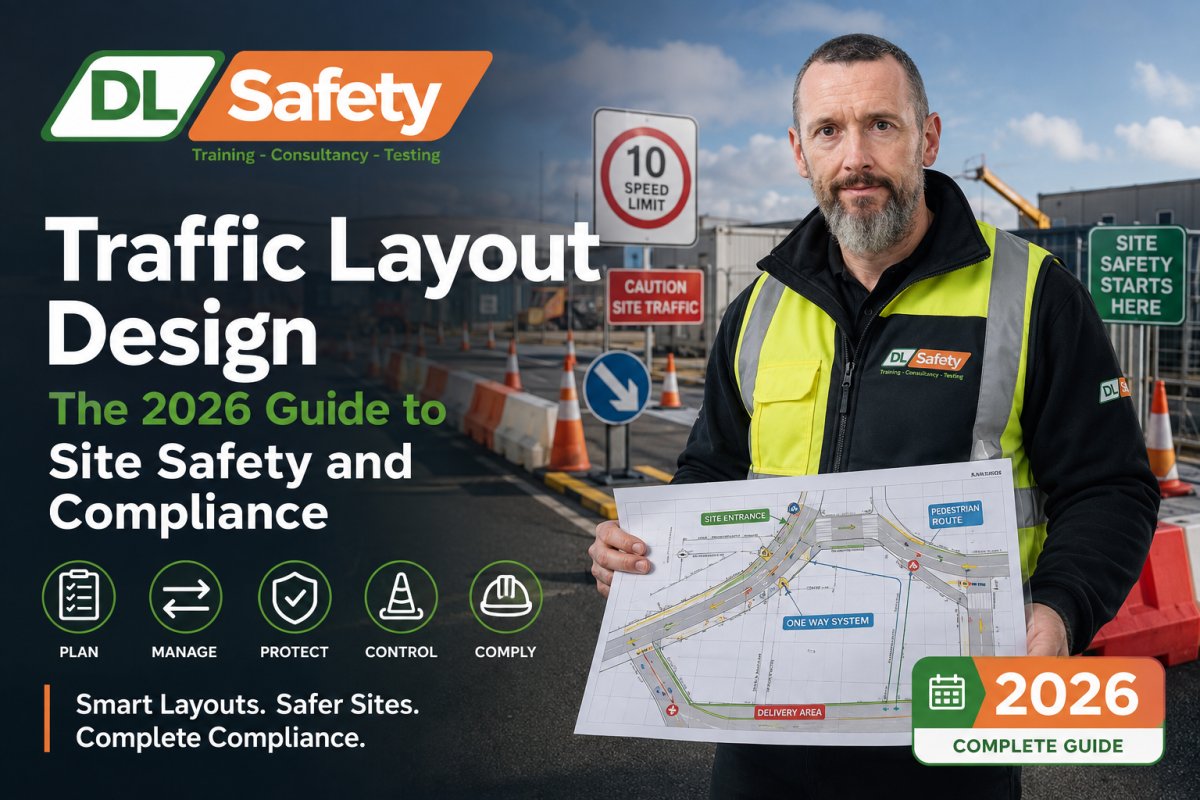
What if your traffic layout was the only thing standing between a productive workday and a devastating site incident? It’s a sobering thought, but in the high-stakes environments of Irish construction and industrial sites, the margin for error is non-existent. You likely already know that a robust traffic layout is essential for legal compliance, yet the complexity of Chapter 8 requirements and the constant challenge of segregating heavy plant machinery from workers can feel like a mountain to climb. At DL Safety, we believe that safety shouldn’t be a source of stress, but a foundation for success.
In this 2026 guide, you’ll learn how to master the essentials of designing a safe, compliant traffic layout that satisfies the Health and Safety Authority whilst keeping your team protected. We’ll walk through the methodology of creating permit-ready documentation that avoids costly delays, focusing on practical strategies to achieve zero vehicle-pedestrian incidents. Whether you’re based at our centre in Unit 3D Thurles Business Center, Stradavoher, Thurles, County Tipperary, E41 W880, or managing a site elsewhere in Ireland, our goal is to provide the expert clarity you need to move forward with confidence. For direct support, you can visit www.dlsafety.ie, email us at info@dlsafety.ie, or call 085 8316885 to discuss your specific site requirements.
Key Takeaways
- Understand why a professional traffic layout is more than just a drawing, serving as the vital visual component of your site’s broader Traffic Management Plan.
- Discover core design principles that prioritise physical segregation whilst minimising high-risk reversing manoeuvres through the implementation of efficient one-way systems.
- Learn to identify the hidden risks of DIY design software and why professional oversight is essential to avoid permit delays and Health and Safety Authority improvement notices.
- Follow a practical implementation process that moves your plan from paper to pavement through rigorous pre-start site audits and the strategic installation of physical barriers.
- Achieve full compliance with Irish standards by partnering with DL Safety at www.dlsafety.ie; contact info@dlsafety.ie or 085 8316885, or visit us at Unit 3D Thurles Business Center, Stradavoher, Thurles, County Tipperary, E41 W880.
What is a Traffic Layout? Defining Site Safety Fundamentals
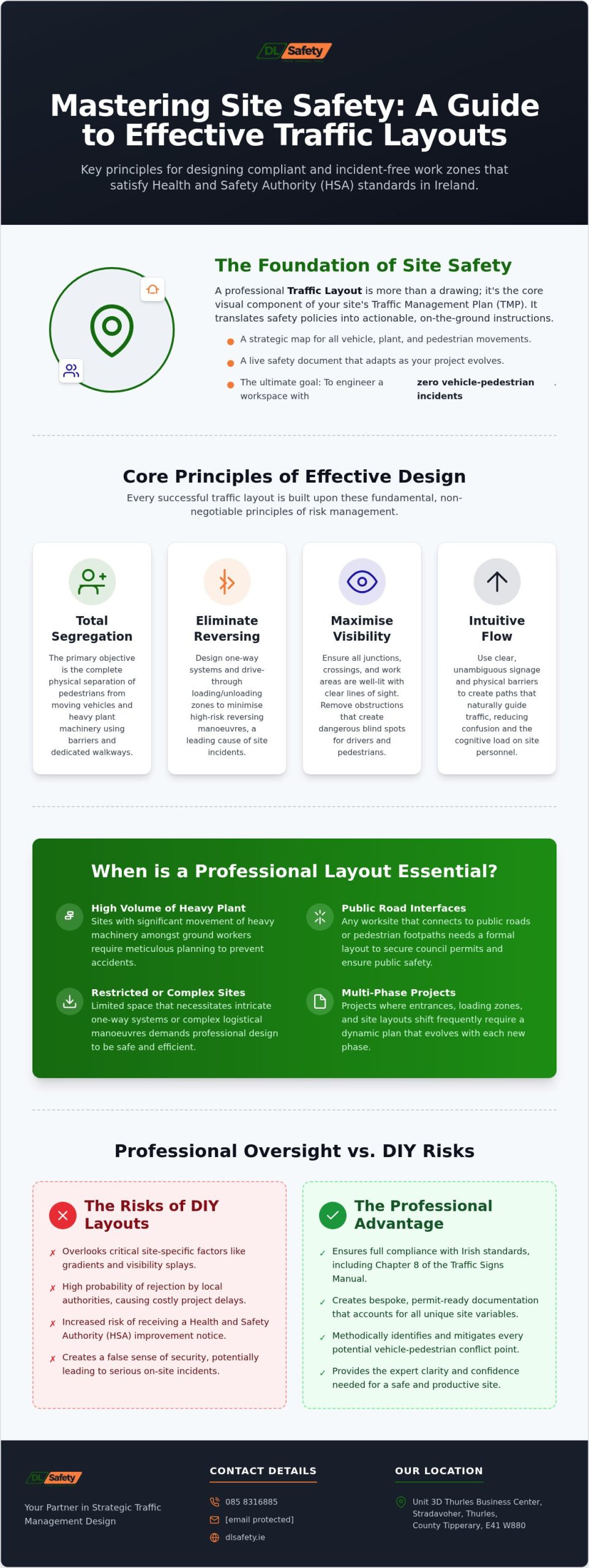
A traffic layout is far more than a simple diagram attached to a permit application. It’s a strategic map that details the precise movement of vehicles, heavy plant, and pedestrians across a workspace. By serving as the primary visual component of a broader Traffic Management Plan (TMP), it transforms abstract safety policies into actionable, on-the-ground instructions. A traffic layout is a live safety document that evolves with site phases, ensuring that as your project grows, your protection measures grow with it. Without this visual guide, even the most detailed written safety statements can fail during the morning rush of deliveries and plant movements.
The Legal Framework: Chapter 8 and HSA Requirements
In Ireland, the mandatory technical standard for temporary works is Chapter 8 of the Traffic Signs Manual. This document provides the framework that the Project Supervisor Construction Stage (PSCS) must implement to satisfy legal obligations under the Safety, Health and Welfare at Work Act. Relying on a generic template is a high-risk strategy that often leads to HSA improvement notices or permit rejections from local authorities. A compliant traffic layout must account for specific site gradients, visibility splays, and the unique behaviour of heavy machinery. It’s about demonstrating to regulators that you’ve identified every potential conflict point before the first vehicle enters the site.
When is a Professional Traffic Layout Required?
Formal traffic management design becomes essential the moment vehicles and pedestrians share a workspace. Professional oversight helps prevent the most common cause of site fatalities: workplace transport accidents. While a simple site might manage with basic signage, complex environments require a methodical approach to risk mitigation. Professional design is typically required for:
- High volumes of heavy plant machinery movement amongst ground workers.
- Interfaces with public roads or pedestrian footpaths that require council permits.
- Sites with restricted space that necessitate complex one-way systems.
- Multi-phase projects where site entrances and loading zones shift frequently.
The requirements differ significantly between roadworks, where public speed limits are a factor, and industrial centres, where the focus shifts to internal logistics and loading bay safety. At DL Safety, we specialise in creating bespoke layouts that ensure your site remains both safe and compliant. You can reach our team at Unit 3D Thurles Business Center, Stradavoher, Thurles, County Tipperary, E41 W880. For expert assistance with your next project, visit www.dlsafety.ie, email info@dlsafety.ie, or call 085 8316885.
Core Principles of Effective Traffic Layout Design
Designing a high-performance traffic layout requires a commitment to the total physical segregation of people and vehicles. This isn’t merely a suggestion; it’s the primary goal that dictates every line on the plan. By prioritising one-way systems and drive-through loading zones, we can effectively eliminate the need for reversing manoeuvres, which remain a leading cause of workplace transport incidents. Detailed planning, often informed by global best practices found in the FHWA Traffic Control Design Guidelines, ensures that every movement is predictable and controlled. When vehicles move in a single direction, the cognitive load on both drivers and pedestrians is significantly reduced.
Visibility and lighting are equally critical at every crossing point and junction. Signage and physical barriers must be placed strategically to guide behaviour without causing confusion or information overload. If a driver has to stop and think about where to go, the layout has failed. We focus on creating intuitive paths that naturally funnel traffic away from high-risk zones.
The Hierarchy of Control in Traffic Management
This focus on intuitive pathfinding and risk reduction is also a key component of managing safety in the wilder environments of outdoor sports. For instance, organising large-scale endurance races like Scilly60 Events requires meticulous planning to guide participants safely through complex, natural landscapes.
We approach every design using the hierarchy of control to ensure the highest level of protection possible. This methodical process helps us move beyond simple warnings to more robust safety solutions. It’s about finding the most effective way to manage risk before work even begins:
- Elimination: Removing vehicle access entirely from high-footfall areas or designated pedestrian-only zones.
- Engineering Controls: Installing heavy-duty physical barriers and raised walkways to provide a hard barrier between plant and people. For those who require specialist steel fabrication for these essential safety structures, you can learn more about Phoenix SteelGuard Maintenance (PTY) LTD.
- Administrative Controls: Setting clear site speed limits and restricting vehicle access times during shift changes or scheduled breaks.
Designing for Heavy Plant and Machinery
Designing for a standard car is simple, but a traffic layout for an industrial site must accommodate the massive turning circles of telehandlers and 360-degree excavators. Failure to account for these dimensions leads to kerb-hopping and barrier damage. We also designate specific areas for on-site quarry vehicle brake testing and loading, ensuring that mechanical safety is integrated into the site’s flow. By aligning your traffic design with professional lift plans, you can also manage overhead hazards, preventing vehicles from entering zones where suspended loads are present. This holistic approach is a core part of our safety support, providing you with continuous peace of mind from our centre at Unit 3D Thurles Business Center, Stradavoher, Thurles, County Tipperary, E41 W880. For expert guidance, contact us at info@dlsafety.ie or call 085 8316885.
Traffic Layout Software vs. Professional Design Services
Software is a tool for drawing, whilst professional design is a process of risk mitigation. While a drag-and-drop interface can produce a clean-looking diagram, it lacks the technical intuition required to anticipate how a site actually breathes during a busy shift. A traffic layout must be more than a static image; it’s a dynamic response to the physical constraints and human behaviours present on your specific site. Relying solely on automated tools often leads to the “hidden costs” of DIY planning, such as repeated permit rejections from local authorities or, more critically, dangerous safety gaps that only become apparent when a near-miss occurs.
Complex sites require the eye of a personable expert who understands that a 30-centimetre difference in a turning circle can be the difference between a safe manoeuvre and a collapsed barrier. At DL Safety, we don’t just draw lines; we utilize simulation training to test layout efficacy before the first cone is placed. This proactive approach ensures that your plan is battle-tested against the realities of heavy plant movement and pedestrian flow.
The Limitations of Automated Traffic Planning
Software often misses site-specific hazards that a computer algorithm simply cannot “see,” such as blind corners created by temporary stockpiles or the risks of soft ground near a trench. There’s a significant danger in using “copy-paste” layouts that haven’t been updated to reflect current site phases. Perhaps most importantly, there’s a total lack of accountability when a software-generated plan fails a Health and Safety Authority audit. A tool cannot stand over its work or provide the professional justification required when a permit is questioned; an expert can.
The Value of a Retained Safety Consultant
Integrating professional traffic design into Monthly Safety Support Packages provides a level of continuity that software cannot match. This relationship allows us to use our expertise in accident investigation to “future-proof” new layouts, identifying potential conflict points based on real-world data rather than theory. We also ensure that the traffic layout aligns with the mechanical reality of your site, verifying that all lifting equipment and traffic plant are GA1 certified for the tasks assigned to them in the plan. For a layout that truly protects your team, visit us at Unit 3D Thurles Business Center, Stradavoher, Thurles, County Tipperary, E41 W880, or contact our team at info@dlsafety.ie or 085 8316885. You can also explore our full range of services at www.dlsafety.ie.
Implementing Your Traffic Layout: From Paper to Pavement
A traffic layout is a blueprint for safety, but its value is realised only when it’s correctly translated to the site floor. Before a single vehicle enters the work zone, you must conduct a pre-start site audit to verify that the physical environment matches your drawing exactly. It’s common for temporary stockpiles, ground conditions, or even adjacent site works to change between the design phase and mobilisation. You should also check for new overhead hazards or changes in ground stability. Once verified, install all physical barriers, water-filled blocks, and Chapter 8 signage. These must be fully in place before any vehicle movements commence to establish clear, non-negotiable boundaries from the outset.
Communication remains the most vital step in the implementation process. Brief every member of staff and all subcontractors through a specific toolbox talk that focuses on the unique risks of the site’s flow and designated crossing points. Finally, appoint and train competent vehicle banksmen to oversee high-risk manoeuvres. These individuals must have the authority to halt movements immediately if safety is compromised or if a pedestrian enters a restricted zone without authorisation.
The Role of the Vehicle Banksman
Traffic controllers and banksmen require formal training to manage the high-pressure interface between heavy plant and pedestrians. They must use standardised hand signals and clear communication protocols to avoid the confusion that leads to accidents. On tight construction sites where space is at a premium, a skilled banksman acts as the eyes and ears of the driver. They manage deliveries safely whilst protecting ground workers from the blind spots inherent in large machinery like 360-degree excavators or telehandlers.
Daily Inspections and Dynamic Adjustments
A successful traffic layout isn’t a “set and forget” task; it’s a living system that requires constant oversight. Use a daily checklist to ensure that barriers haven’t been nudged by plant and that signs remain visible and correctly positioned. You must be prepared to make dynamic adjustments when conditions change, such as after heavy rain that affects ground stability or when moving into a new project phase. Recording near-misses provides invaluable data to identify patterns and improve your design over time. For expert help implementing your plan, contact us at info@dlsafety.ie or call 085 8316885. You can also visit our centre at Unit 3D Thurles Business Center, Stradavoher, Thurles, County Tipperary, E41 W880, or explore our services at www.dlsafety.ie.
To ensure your implementation meets every Irish regulatory standard, you can request a professional site audit and traffic plan review from our dedicated safety team.
Strategic Traffic Management Design with DL Safety
DL Safety provides bespoke traffic management design that’s built around the specific risks of your site. We don’t believe in one-size-fits-all templates because every workspace has its own unique challenges, from tight urban footprints to sprawling industrial complexes. Our approach combines high-level technical proficiency with a pragmatic, solution-oriented mindset that simplifies complex regulations. We ensure that every traffic layout we produce is not only permit-ready but also serves as a robust shield for your workforce. By choosing us, you’re ensuring your construction site traffic management plan meets all current HSA standards whilst maintaining operational efficiency.
Beyond the Drawing: Holistic Safety Support
We look at the big picture to ensure long-term impact. A traffic layout shouldn’t exist in a vacuum; it needs to work in harmony with your other safety protocols. We integrate our designs with your lift planning and equipment testing to prevent conflict between ground traffic and overhead hazards. This holistic view is a core part of our comprehensive suite of services, which includes GA1 testing and thorough site audits. Having a trusted advisor by your side means you can stop worrying about the stress of regulatory compliance. We’re here to manage the technical details so you can focus on project delivery. If you’re unsure about your current arrangements, you can request a site audit to evaluate your existing traffic risks and identify practical areas for improvement.
Contact DL Safety for Expert Guidance
Ongoing compliance requires a proactive partner who is deeply invested in your success. You can enquire about our Monthly Safety Support Packages to ensure your site remains safe and compliant throughout every phase of your project. We specialise in HSA inspection readiness, helping you avoid the stress of improvement notices through professional design and expert oversight. Reach out to David and the team today to start a dedicated safety partnership that values integrity and commitment. You can visit our centre at Unit 3D Thurles Business Center, Stradavoher, Thurles, County Tipperary, E41 W880. Alternatively, email info@dlsafety.ie, call 085 8316885, or explore our full offerings at www.dlsafety.ie. We’re ready to help you build a safer, more efficient site.
Building a Safer Site Culture for 2026
Mastering your traffic layout is about more than just checking a box for the local authorities; it’s about creating a living environment where every worker returns home safely. We’ve explored how prioritising total physical segregation and moving beyond generic software templates allows you to invest in the long-term resilience of your project. A successful plan relies on the transition from paper to pavement, requiring trained banksmen and consistent daily inspections to manage evolving site risks. At DL Safety, we’re dedicated to helping you navigate these complexities through our comprehensive Safety Support Packages for 2026 compliance. Whether you need a bespoke design or a full site audit, our team at Unit 3D Thurles Business Center, Stradavoher, Thurles, County Tipperary, E41 W880, is ready to act as your trusted advisor. You can reach us at info@dlsafety.ie or 085 8316885 to discuss your specific needs. Secure your site with professional Traffic Management Design from DL Safety. Safety doesn’t have to be a burden when you have the right partner by your side.
Frequently Asked Questions
What are the minimum requirements for a site traffic layout in Ireland?
Minimum requirements include a site-specific risk assessment, a visual map following Chapter 8 of the Traffic Signs Manual, and clear physical segregation. Your traffic layout must specify entry and exit points, speed limits, and designated pedestrian walkways. It’s essential to demonstrate that all hazards have been identified and mitigated through engineering controls rather than just administrative warnings. For professional guidance, visit our centre at Unit 3D Thurles Business Center, Stradavoher, Thurles, County Tipperary, E41 W880.
How often should a traffic management plan be reviewed?
You should review your traffic management plan whenever site conditions change or at the start of a new project phase. At a minimum, a weekly inspection is necessary to ensure barriers and signage haven’t been displaced. If a near-miss occurs, an immediate review is mandatory to prevent a recurrence. Constant vigilance ensures your traffic layout remains a live, effective safety tool rather than a static document that no longer reflects reality.
Do I need a separate traffic layout for pedestrians and vehicles?
Yes, total physical segregation is the gold standard for site safety and compliance. Your design should clearly distinguish vehicle routes from pedestrian paths using physical barriers like water-filled blocks or heavy-duty fencing. Crossing points must be minimised, clearly marked, and well-lit. By creating separate zones, you significantly reduce the risk of workplace transport accidents, which remain a primary concern for the HSA on Irish construction and industrial sites.
What is the role of a PSCS in traffic management design?
The Project Supervisor Construction Stage (PSCS) is legally responsible for coordinating safety during the construction phase, which includes traffic management. They must ensure that a robust plan is developed, implemented, and followed by all subcontractors. The PSCS oversees the integration of the traffic design into the broader safety file and ensures that all vehicle movements are managed to protect both workers and members of the public.
Can I use standard road signs for an internal site traffic layout?
Standard road signs are often preferred because they are universally recognised by drivers and plant operators. However, they must be used appropriately according to Chapter 8 standards to avoid confusion. Using familiar signage for speed limits, No Entry zones, and pedestrian crossings ensures that instructions are understood instantly. For bespoke advice on signage placement, you can email info@dlsafety.ie or call 085 8316885 to speak with our technical team.
What happens if a HSA inspector finds a flaw in my traffic layout?
If a Health and Safety Authority (HSA) inspector finds flaws, they may issue an improvement or prohibition notice. This can lead to immediate work stoppages, significant fines, and damage to your professional reputation. In some cases, legal prosecution follows if the flaw led to an incident. Our Monthly Safety Support Packages are designed to keep you inspection-ready at all times, ensuring your site meets every regulatory standard.
How do I manage traffic on a site with very limited space?
Managing traffic in confined spaces requires strategic planning, such as implementing one-way systems and strict delivery schedules. You should eliminate reversing manoeuvres wherever possible and use trained banksmen for every vehicle movement. High-visibility barriers and clear floor markings help define boundaries in tight areas. If space is restricted, consider off-site holding areas for deliveries to prevent congestion at the site entrance, which can be managed via www.dlsafety.ie.
Is specific training required for staff working within the traffic layout?
Yes, all staff working within or near vehicle routes must have a valid Safe Pass and receive a comprehensive site-specific induction. Those with specific duties, such as vehicle banksmen or traffic controllers, require specialised training to manage plant movements safely. Ensuring your team understands the logic behind the layout is just as important as the physical barriers themselves. We offer bespoke training and online safety courses to help your team maintain full compliance.