
Can downloading a generic safety statement template Ireland business owners find online actually protect you during an unannounced Health and Safety Authority (HSA) inspection, or does it leave your operation dangerously exposed? If you feel frustrated after spending hours tweaking off-the-shelf Word files that never quite reflect your daily site realities, you aren’t alone. Most employers recognise they need a written policy under Section 20 of the Safety, Health and Welfare at Work Act 2005, yet few feel certain that their paperwork would withstand statutory scrutiny or prevent a costly stop-work notice.
In this guide, you’ll discover how to transform a basic safety statement template into an audit-proof, legally compliant framework tailored to Irish workplace legislation. We will walk through the exact legal anatomy required under Irish law, uncover the operational blind spots where generic templates collapse, and outline how to maintain a dependable, living safety management system that actively protects your workforce.
Key Takeaways
- Understand why relying on an off-the-shelf safety statement template Ireland businesses download online leaves employers vulnerable to statutory penalties under Section 20 of the 2005 Act.
- Identify the operational red flags that Health and Safety Authority (HSA) inspectors spot instantly, from unedited risk ratings to non-applicable control measures.
- Master the definitive five-part structural blueprint required to establish a comprehensive, legally compliant workplace safety framework.
- Discover how high-risk sectors can successfully bridge the gap between overarching corporate safety policy and practical, site-specific method statements.
- Learn why transforming static paperwork into an active, audit-proof safety system requires ongoing competent oversight, periodic workplace reviews, and routine technical verification.
Irish Safety Statements: Why Templates Are Only the Start
At its core, a safety statement represents an employer’s formal, written commitment to safeguarding the health, welfare, and safety of staff and visitors. Many organisations begin this process by downloading a safety statement template Ireland resource to save administrative time. However, a template serves merely as a structural skeleton. Irish legislation does not permit a cut-and-paste approach; your completed document must directly evaluate the actual physical hazards, daily site routines, and operational controls operating across your specific place of work.
The Legal Mandate Under Section 20 of the 2005 Act
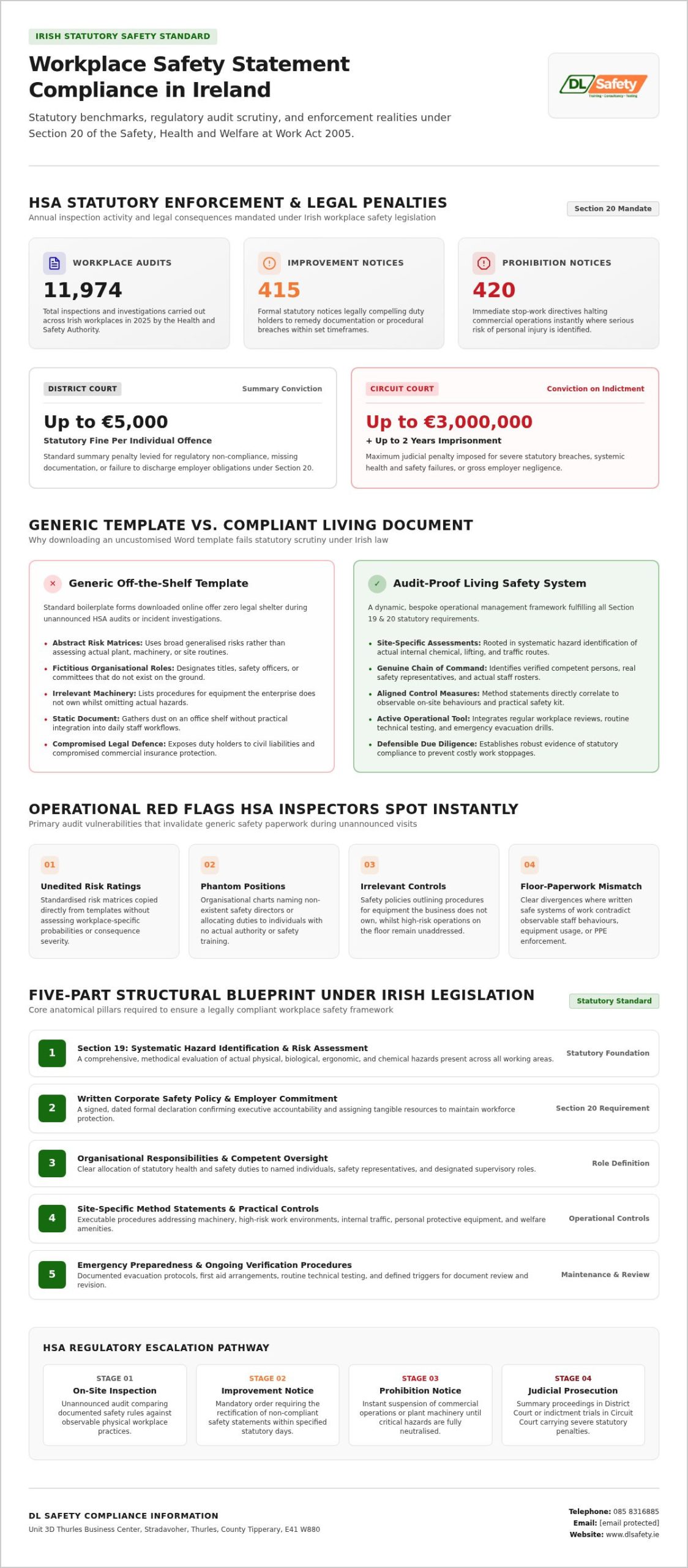
Section 20 of the Safety, Health and Welfare at Work Act 2005 places an absolute statutory obligation on every employer and self-employed individual in Ireland to prepare and maintain an up-to-date written safety statement. This framework must rest on systematic hazard identification and risk assessment carried out under Section 19. The Health and Safety Authority (HSA) actively inspects workplaces across all commercial sectors, ensuring that businesses maintain compliant documentation regardless of their staff numbers.
Ignoring this statutory requirement leads to severe legal repercussions:
- Summary convictions: Breaches prosecuted in the District Court can incur statutory fines of up to €5,000 per individual offence.
- Convictions on indictment: Serious failures brought before the Circuit Court carry fines reaching up to €3,000,000 and potential terms of imprisonment of up to two years for responsible duty holders.
Template vs. Living Document: Understanding the Critical Distinction
Generic boilerplate phrasing offers zero legal or practical protection during an unannounced workplace audit or following an accident. Regulatory inspectors readily spot standardised matrices that fail to mention your actual plant machinery, lifting gear, chemical handling, or internal vehicle routes. Real compliance requires documenting genuine working procedures, designated safety representatives, and practical training schedules.
A compliant safety statement functions as an active management tool. It clearly communicates responsibilities, establishes emergency evacuation protocols, and guides daily operations on the ground, ensuring that safety documentation lives on the shop floor rather than gathering dust on an office shelf.
Why Generic Safety Statement Templates Fail Health and Safety Authority Audits
Relying on an uncustomised safety statement template Ireland employers download off the internet introduces immediate legal vulnerability. According to official HSA guidance on Safety Statements, generic paperwork does not satisfy statutory obligations because it fails to evaluate the unique risks of an individual workplace. When an inspector audits your site, standard forms downloaded without rigorous adaptation are instantly evident, leaving management exposed to strict regulatory enforcement.
The Telltale Signs of an Unimplemented Safety Template
Experienced inspectors quickly identify boilerplate downloads. Common red flags include organizational charts listing non-existent safety officers, assessments covering equipment your company doesn’t own, or the complete absence of controls for your high-risk operations. As detailed in our guide on what to expect during a HSA inspection, an auditor checks whether the procedures written on paper match the observable behaviours on your work floor.
If an incident occurs and investigators discover you provided workers with boilerplate templates rather than genuine operational procedures, insurance coverage may be compromised and legal defences quickly crumble.
Legal Consequences: Improvement Notices, Prohibition Notices, and Prosecution
The HSA maintains extensive statutory enforcement powers to address non-compliance. In 2025 alone, the authority completed 11,974 inspections and investigations across Irish workplaces, issuing 415 Improvement Notices and 420 Prohibition Notices. An Improvement Notice legally compels an employer to rectify document shortfalls or unsafe procedures within a set timeframe. A Prohibition Notice is far more disruptive, halting specified work operations immediately until serious risks are controlled.
Beyond commercial disruption from stop-work orders, company directors face personal liability under Section 80 of the 2005 Act if offences occur with their consent, connivance, or neglect. Total prosecution fines exceeded €2.468 million in 2025, proving that tick-box paperwork offers no barrier against determined enforcement. If you want peace of mind that your documentation withstands regulatory scrutiny, partnering with the team at DL Safety ensures your assessments reflect your real operational environment.
The 2026 Structural Blueprint: Core Components of a Compliant Safety Statement
Transforming a basic safety statement template Ireland employers acquire into an audit-ready asset requires a robust five-part structure. Under the Safety, Health and Welfare at Work Act 2005, your document must demonstrate clear leadership oversight, granular hazard identification, and actionable emergency protocols. Building this blueprint ensures your paperwork stands up under intense regulatory scrutiny while keeping your daily operations protected.
Section 1 & 2: Policy Statement and Operational Governance
Your safety statement begins with a formal health and safety policy signed and dated by the managing director or business owner. This declaration affirms executive accountability for safe working conditions. Immediately following this policy, establish an operational governance framework that defines safety duties for every managerial level, supervisor, and operative. Outline specific procedures for appointing external competent persons, funding protective gear, and maintaining broader health and safety compliance Ireland benchmarks.
Section 3: Systematic Hazard Identification and Risk Assessments
The operational core of your framework rests on comprehensive risk assessments. Evaluate every hazard using a structured matrix balancing likelihood against severity, strictly applying the hierarchy of controls:
- Elimination: Redesign workflows to eliminate physical hazards at the source.
- Substitution: Replace dangerous substances or mechanical processes with safer alternatives.
- Engineering controls: Install physical barriers, local exhaust ventilation, or machine guarding.
- Administrative controls: Implement safe systems of work, staff rotation, and task-specific training.
- Personal Protective Equipment (PPE): Treat protective kit as the final line of defence, never the first.
Section 4 & 5: Operational Protocols, Emergency Plans, and Review Cycles
The final sections establish daily operational arrangements and emergency response procedures. Detail practical welfare facilities, first-aid box locations, designated first-aiders, and scheduled fire drill routines. Include strict protocols for reporting dangerous occurrences and reportable workplace accidents directly to the HSA.
Conclude with mandatory document review triggers. Irish law requires safety statements to be reviewed at least annually, but immediate revisions are mandatory when introducing new plant machinery, altering work premises, or following an incident. By building this systematic architecture, your business elevates an off-the-shelf safety statement template Ireland framework into a dependable, living defence system.
Industry-Specific Customisation: Adapting Your Statement for High-Risk Environments
Workplace environments involving heavy mechanical kit, complex civil engineering, or heavy goods transit cannot depend on standard office documentation. Tailoring an entry-level safety statement template Ireland contractors use requires layering sector-specific operational controls directly into the core document. For industries like construction, manufacturing, and extractive operations, high-risk tasks demand clear procedural links between overarching company policy, equipment testing regimes, and frontline method statements.
Integrating Technical Testing: GA1 Certifications and Brake Audits
A safety statement that claims plant machinery is maintained without verifiable engineering proof will raise immediate flags during an audit. Under the Safety, Health and Welfare at Work (General Application) Regulations 2007, lifting accessories, excavators, and hoists require periodic thorough examinations. Integrating up-to-date GA1 testing Ireland certificates directly into your safety management files proves that your mechanical controls operate in the physical world.
Similar standards apply to heavy site vehicles and quarry haulage. Adding decelerometer test certificates from specialised quarry vehicle brake testing substantiates your transport risk assessments, proving that braking efficiencies match manufacturer and statutory baselines.
Safe Systems of Work: Lift Plans and Temporary Works
High-risk field tasks require dynamic safe systems of work that expand on your core safety statement. Lifting operations, deep excavations, structural steel erection, and temporary falsework must be backed by task-specific documentation:
- Detailed Lift Plans: Identify ground bearing capacities, crane configurations, sling angles, and exclusion zones before rigging begins.
- Method Statements: Set out step-by-step sequences for complex tasks, detailing precise plant interactions and supervisor sign-offs.
- Subcontractor Briefings: Ensure all visiting plant operators and trade crews sign off on the documented control measures before entering active work zones.
Bridging this gap between high-level policy and technical site verification is essential for high-hazard operations. To build custom documentation backed by certified lifting plans and plant brake inspections, speak to our technical team at DL Safety to align your documentation with daily site realities.
Beyond the Template: Implementing Ongoing Compliance with DL Safety
What happens once your safety statement is drafted, approved, and signed? For many firms, the folder sits unopened on a shelf until an inspector arrives or an incident occurs. Treating health and safety as a one-time administrative exercise creates massive corporate exposure. Relying solely on an unassisted DIY safety statement template Ireland setup rarely delivers long-term protection, whereas engaging experienced external advisors secures genuine, ongoing peace of mind. As evaluated in our detailed breakdown of the cost of a health and safety consultant in Ireland, professional oversight consistently delivers measurable returns by eliminating stop-work downtime, preventing regulatory penalties, and keeping insurance premiums competitive.
The DL Safety Methodology: Pragmatic, Nationwide Protection
DL Safety bridges the gap between static paperwork and dynamic site operations. Led by David, a seasoned safety professional with deep roots across the Irish construction and industrial sectors, our team creates bespoke documentation built on physical workplace reviews. Rather than handing you a sterile safety statement template Ireland business owners struggle to adapt, we assess your operational routines on the ground, designing practical Safety Statements and Method Statements that match your workflow. Operating nationwide, we deliver full coverage across all 26 counties, providing comprehensive technical solutions including GA1 plant testing and quarry brake assessments wherever you operate.
Monthly Safety Support Packages: Total Compliance Peace of Mind
To eliminate compliance headaches entirely, our structured monthly safety support in Ireland programme acts as your dedicated, retained health and safety department. Instead of scrambling before an audit, you gain continuous professional governance tailored to your business:
- Routine site safety audits: Scheduled workplace inspections to detect emerging physical hazards and correct operational blind spots.
- Dynamic documentation updates: Ongoing revisions to your safety statements, risk registers, and lifting plans as equipment and staff evolve.
- Direct HSA audit support: Expert representation, professional guidance, and priority assistance during unannounced statutory inspections.
- Workforce competence tracking: Coordinated safety training schedules ensuring staff certifications and tickets remain fully compliant.
Move beyond generic online templates and build an audit-proof safety framework today. Contact DL Safety directly at www.dlsafety.ie, call us on 085 8316885, or email info@dlsafety.ie to discuss securing your operations.
Transform Your Safety Documentation into an Audit-Proof Asset
A generic safety statement template Ireland download provides a basic structural scaffold, but genuine regulatory compliance requires place-specific substance. Protecting your workforce and shielding your business from severe HSA enforcement demands documentation that mirrors your daily site hazards, identifies clear management accountability, and integrates your routine equipment testing.
Led by David, an experienced health and safety professional in the Irish construction sector, DL Safety delivers comprehensive national coverage across all 26 counties. From our headquarters at Unit 3D Thurles Business Center, Stradavoher, Thurles, County Tipperary, E41 W880, we provide practical Safety Statements, technical GA1 inspections, and retained support packages that keep your team protected.
Take control of your regulatory obligations today. Partner with DL Safety for fully bespoke, audit-ready safety statements and retained compliance support. Contact our expert consultants directly on 085 8316885, email info@dlsafety.ie, or visit www.dlsafety.ie to secure lasting operational peace of mind.
Frequently Asked Questions
Can I legally write my own safety statement using a free template in Ireland?
Yes, you can legally draft your own statement, but a blank template alone doesn’t satisfy statutory requirements. Irish legislation requires that the document reflects a competent risk assessment of your exact workplace hazards. If you lack the in-house technical competence to evaluate complex operational risks or adapt boilerplate text, relying on an unverified safety statement template Ireland download leaves your business exposed during an enforcement audit.
What are the main legal penalties if an Irish business operates without a valid safety statement?
Operating without a compliant safety statement breaches Section 20 of the Safety, Health and Welfare at Work Act 2005. Summary convictions in the District Court can result in statutory fines of up to €5,000 per offence. Serious convictions on indictment can incur penalties reaching up to €3,000,000 or two years’ imprisonment. Inspectors can also issue binding prohibition notices that shut down site operations immediately.
How often must a company safety statement be reviewed and updated under Irish law?
Under Irish legislation, you must review your safety statement at least once annually. However, statutory duty holders must also update the document whenever significant operational changes occur. Key triggers include introducing new plant or machinery, altering work processes, relocating premises, restructuring staff responsibilities, or reviewing control measures immediately following a workplace accident or dangerous occurrence.
What is the exact difference between a safety statement and a method statement?
A safety statement is an organisation-wide legal framework establishing overarching safety policy, permanent risk assessments, management duties, and emergency arrangements. Conversely, a method statement focuses on a specific, high-risk operational task, such as complex lifting or deep excavation. It outlines the step-by-step sequence of work, required mechanical plant, and individual control measures necessary to complete that particular job safely.
Does a sole trader or small subcontractor need a full safety statement in Ireland?
Yes, Section 20 applies to all employers and self-employed individuals. While businesses with three or fewer employees may comply by adopting a relevant HSA Code of Practice if one exists for their trade, they must still conduct place-specific Section 19 risk assessments. Subcontractors cannot access active construction sites or industrial facilities without presenting a documented, verifiable safety system.
Will a downloaded template satisfy main contractor pre-qualification questionnaires on construction tenders?
Rarely. Main contractors and commercial procurement bodies scrutinise pre-qualification paperwork to verify genuine operational competence. If an evaluation team spots a standard safety statement template Ireland contractors pulled online without tailored plant details, GA1 testing schedules, or clear supervisory hierarchies, they will reject the tender. Winning tenders requires site-specific documentation proving that you manage risks responsibly on the ground.
What role does a competent health and safety consultant play in drafting my documentation?
A competent consultant removes regulatory guesswork by translating statutory obligations into practical site workflows. Experienced advisors evaluate your physical environment, uncover hidden machinery or vehicle hazards, and structure legally sound documentation. Partnering with professionals like DL Safety ensures your policies are backed by technical competence, audit representation, and ongoing support rather than static, unmonitored paperwork.
