A common misconception in Irish business is that PAT testing is merely a “sticker exercise,” but in reality, it’s a critical audit trail that protects directors from personal liability. If you’re feeling confused about the difference between a simple best practice and a strict legal requirement, you aren’t alone. Most employers find it difficult to manage testing schedules for large inventories, especially whilst fearing the repercussions of an unexpected HSA inspection. Understanding the specific pat testing requirements ireland mandates for 2026 is the only way to ensure your workplace remains safe and your business stays protected from avoidable risks.
This definitive guide provides the clarity you need to navigate Irish electrical safety regulations with confidence. We’ll show you how to move from a state of uncertainty to one of complete control by establishing a clear, manageable testing schedule that satisfies the Health and Safety Authority’s risk-based approach. You’ll learn exactly which appliances need testing, how to identify a competent person, and why maintaining records for five years is vital for your protection. For expert assistance, you can reach David and the team at DL Safety, located at Unit 3D Thurles Business Center, Stradavoher, Thurles, County Tipperary, E41 W880. You can also contact us via www.dlsafety.ie, info@dlsafety.ie, or by calling 085 8316885.
Key Takeaways
- Identify the core legal obligations under Regulation 89 of the 2007 General Application Regulations to protect your directors from personal liability.
- Clarify the specific pat testing requirements ireland mandates for different equipment categories, ensuring you distinguish between Class I and Class II appliances correctly.
- Implement a dynamic, risk-based testing frequency that moves beyond a “one-size-fits-all” approach to suit your specific workplace environment.
- Gain a clear understanding of the essential documentation and visual inspection standards required to maintain a robust audit trail for HSA inspectors.
- Streamline your safety management by contacting DL Safety at info@dlsafety.ie or 085 8316885 to discuss Monthly Safety Support Packages managed from our centre at Unit 3D Thurles Business Center, Stradavoher, Thurles, County Tipperary, E41 W880.
Understanding the Legal Framework: Is PAT Testing Compulsory in Ireland?
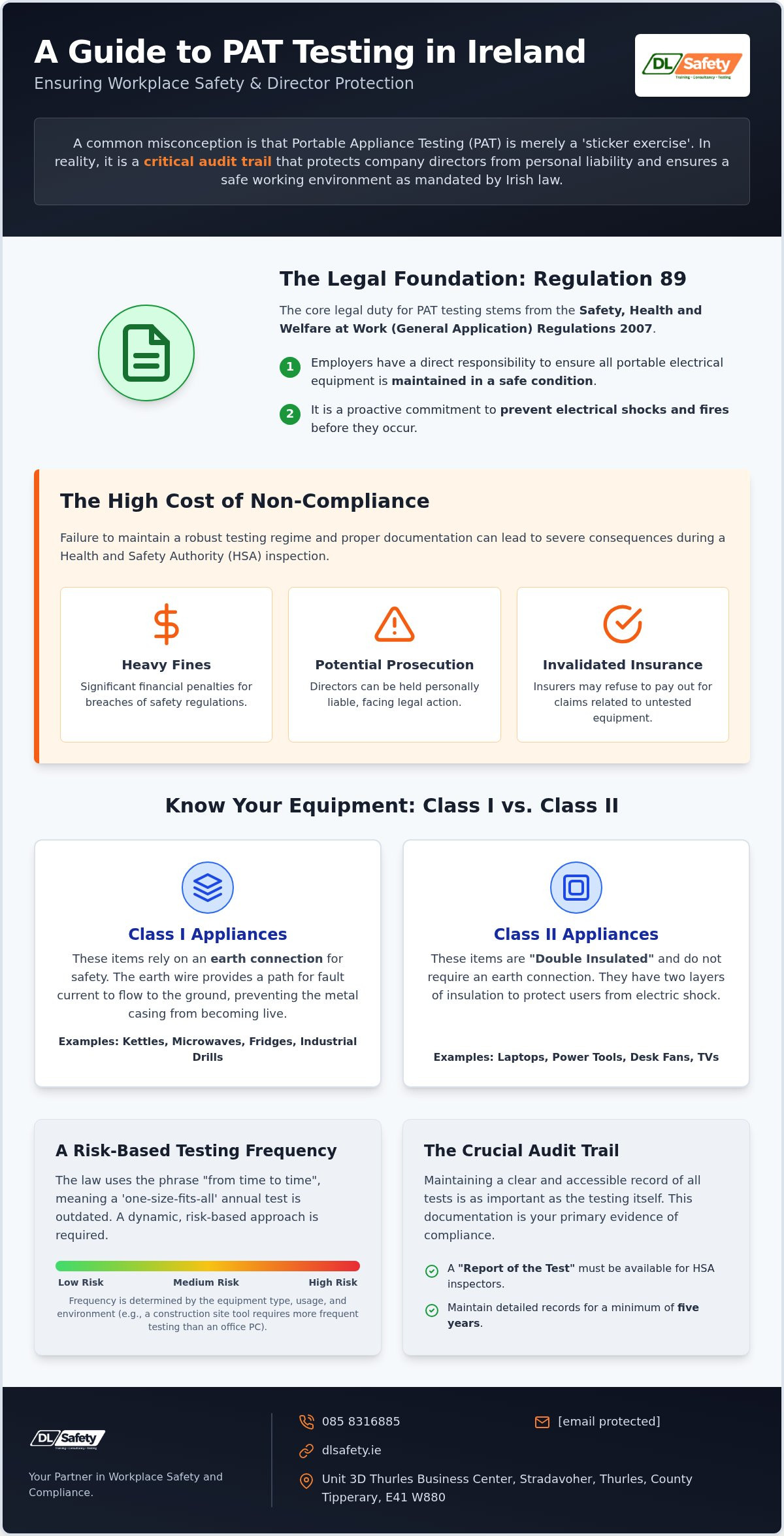
To understand your legal obligations, we first need to define the process clearly. Portable appliance testing (PAT) is the systematic and periodic inspection of electrical equipment to prevent danger to employees. Whilst the term “PAT” isn’t always named in every specific piece of legislation, the duty it fulfils is a fundamental part of Irish workplace safety. The primary legal framework for these activities is the Safety, Health and Welfare at Work (General Application) Regulations 2007, specifically Regulation 89. This regulation places a direct responsibility on employers to ensure that portable equipment is maintained in a safe condition. It’s a proactive commitment to preventing electrical fires and shocks before they occur.
The Health and Safety Authority (HSA) is clear that these inspections must be carried out by a “competent person.” This means the individual must have the technical knowledge, training, and experience to identify potential faults that a layperson might miss. At DL Safety, we provide this expertise to help you manage your pat testing requirements ireland without the guesswork. We believe that safety shouldn’t be a source of stress, but rather a reliable foundation for your daily operations.
The HSA’s Stance on Electrical Maintenance
During a routine site inspection, an HSA inspector will look for evidence of a robust maintenance regime. They expect to see a “Report of the Test,” which serves as your primary evidence of compliance. If you can’t produce this documentation, you face significant risks. Non-compliance can lead to heavy fines, potential prosecution, and the invalidation of your business insurance in the event of an accident. It’s about protecting your people and your personal liability as a director. Having a clear audit trail demonstrates that you take your duty of care seriously and have taken reasonable steps to ensure a safe environment.
Regulation 89: A Practical Interpretation for 2026
In 2026, the interpretation of Regulation 89 has evolved towards a more nuanced, risk-based approach. The law applies equally to new and existing installations, though new equipment typically only requires a visual check before its first use. The phrase “from time to time” in the regulations means you shouldn’t just test everything annually by default; instead, you should assess the environment and usage frequency to determine how often testing is required. An employer has an absolute duty to ensure that any electrical equipment found to be defective is removed from service and rectified immediately.
Managing these schedules is a core part of our Monthly Safety Support Packages at DL Safety. Based at Unit 3D Thurles Business Center, Stradavoher, Thurles, County Tipperary, E41 W880, we help businesses across Ireland stay compliant. You can reach David and the team at 085 8316885 or info@dlsafety.ie, or visit our website at www.dlsafety.ie for more information on meeting your pat testing requirements ireland.
Categorising Your Equipment: Which Appliances Require Testing?
Whilst the legal framework sets the stage, the practical application depends on knowing exactly what needs to be checked. A portable appliance is generally defined as any piece of equipment that connects to the mains power supply via a plug. This includes items that are easily moved, like a desk fan, but also stationary equipment like a communal refrigerator or a heavy industrial drill. To stay compliant with the Safety, Health and Welfare at Work (General Application) Regulations 2007, you must categorise these items correctly to meet the pat testing requirements ireland mandates for 2026.
The technical distinction between Class I and Class II appliances is vital for a thorough inspection. Class I equipment, such as kettles and microwaves, relies on an earth connection for safety. Class II equipment, like many modern laptops and power tools, uses double insulation and doesn’t require an earth. Understanding these differences helps determine which tests are necessary. Your inspector will use this information to decide whether an earth continuity test is required or if an insulation resistance test is sufficient.
Environment also dictates the level of scrutiny required for your inventory. For instance, 110v tools used on construction sites face much harsher conditions than 230v office gear. These yellow-plugged tools are subject to frequent vibration, dust, and moisture, making regular inspection a non-negotiable safety priority. By distinguishing between portable, hand-held, and stationary equipment, you can better allocate your resources and focus on high-risk items first.
Common Workplace Items Needing Inspection
- Office equipment: Laptops, monitors, printers, and multi-socket extension leads.
- Kitchen and canteen: Kettles, microwaves, and communal refrigerators.
- Industrial tools: Drills, grinders, and portable transformers used in construction or manufacturing.
What Is Often Overlooked in a PAT Audit?
It’s easy to miss the smaller components that pose the highest risk. Detachable power leads, often called ‘kettle leads’, are the most frequent point of failure because they’re swapped between devices and subject to constant bending. Similarly, charging stations for tablets and mobile devices in communal areas are often ignored despite their high usage. If you’re managing industrial sites, remember that lifting equipment controllers and site-specific technical gear also fall under pat testing requirements ireland.
Managing this inventory across multiple sites can be overwhelming for busy managers. Many of our clients find that incorporating these checks into our Monthly Safety Support Packages removes the administrative burden entirely. David and the team at DL Safety provide national coverage from our centre at Unit 3D Thurles Business Center, Stradavoher, Thurles, County Tipperary, E41 W880. For a clear, manageable approach to your safety obligations, call us on 085 8316885 or email info@dlsafety.ie.
Determining Testing Frequency: A Risk-Based Approach for 2026
One of the most persistent myths in workplace safety is that every electrical item requires a formal test every twelve months. In reality, there’s no “one size fits all” interval for pat testing requirements ireland. Instead, the Health and Safety Authority (HSA) expects employers to adopt a risk-based approach. This means you must evaluate the specific conditions of your workplace to decide how often inspections should occur. A kettle in a busy site canteen faces far more wear and tear than a desktop computer in a quiet office, and your testing schedule should reflect that reality.
Several factors influence this frequency, including the environment, the type of equipment, and user behaviour. For instance, equipment used in wet or dusty conditions requires more frequent scrutiny than items in a clean, temperature-controlled room. We often refer clients to the HSE guidance on maintaining portable equipment, which clarifies that the goal is to prevent danger through sensible, proportionate management. It’s also vital to encourage “User Checks” between formal inspections. Training your team to spot frayed cables or cracked plugs can identify 90% of faults before they lead to an accident. When an inspector visits, they’ll want to see the documented reasoning behind your chosen intervals, proving that you’ve actively managed the risks rather than just following a generic calendar.
Recommended Intervals by Sector
- Construction and Industrial: These high-wear environments involve heavy usage and transport, typically requiring 3 to 6-month intervals for 110v tools and transformers.
- Schools and Offices: These are generally lower-risk settings where most equipment is stationary. An annual or even biennial schedule is often sufficient for most IT gear.
- Hotels and Retail: High-frequency public use of items like hair dryers or vacuum cleaners requires robust 6 to 12-month checks to ensure ongoing safety.
Managing Your Asset Register
To keep your business running smoothly, it’s best to organise a rolling schedule. This prevents the need for site-wide downtime and ensures your testing remains manageable. Your asset register should track every item, specifically flagging failed equipment so it can be removed from service whilst awaiting repair or disposal. For many of our industrial clients, we find it most efficient to link these schedules with their GA1 testing requirements. Combining these technical inspections reduces administrative work and ensures no statutory deadlines are missed.
At DL Safety, we help you build these schedules as part of our Monthly Safety Support Packages. Whether you’re in Tipperary or operating nationally, David and the team provide the expert oversight needed to keep your inventory compliant. You can visit us at Unit 3D Thurles Business Center, Stradavoher, Thurles, County Tipperary, E41 W880, or reach us at 085 8316885 and info@dlsafety.ie. For more details on our services, explore www.dlsafety.ie.
The Inspection Process and Essential Documentation Requirements
Whilst the risk assessment determines “when” you test, the inspection process itself defines “how” safety is verified. A professional test is built upon three essential pillars: the visual inspection, earth continuity testing, and insulation resistance testing. It’s a startling reality that 90% of equipment failures are identified during the initial visual inspection. This phase involves a meticulous check for physical damage that a machine might miss, such as frayed cables or cracked casings. If an item passes these stages, it receives a “Pass” sticker. This label isn’t just for show; it must clearly display a unique asset ID, the test date, and the name of the inspector to provide immediate assurance to the person using the equipment.
A comprehensive Register of Electrical Equipment is your primary defence during a HSA audit. This document acts as a living history of your maintenance efforts, proving that you’ve met the pat testing requirements ireland mandates for your sector. Without this register, a sticker on a plug carries very little legal weight. You need a verifiable trail that shows every item in your inventory has been accounted for, tested, and, where necessary, removed from service.
What Happens During a Professional PAT Test?
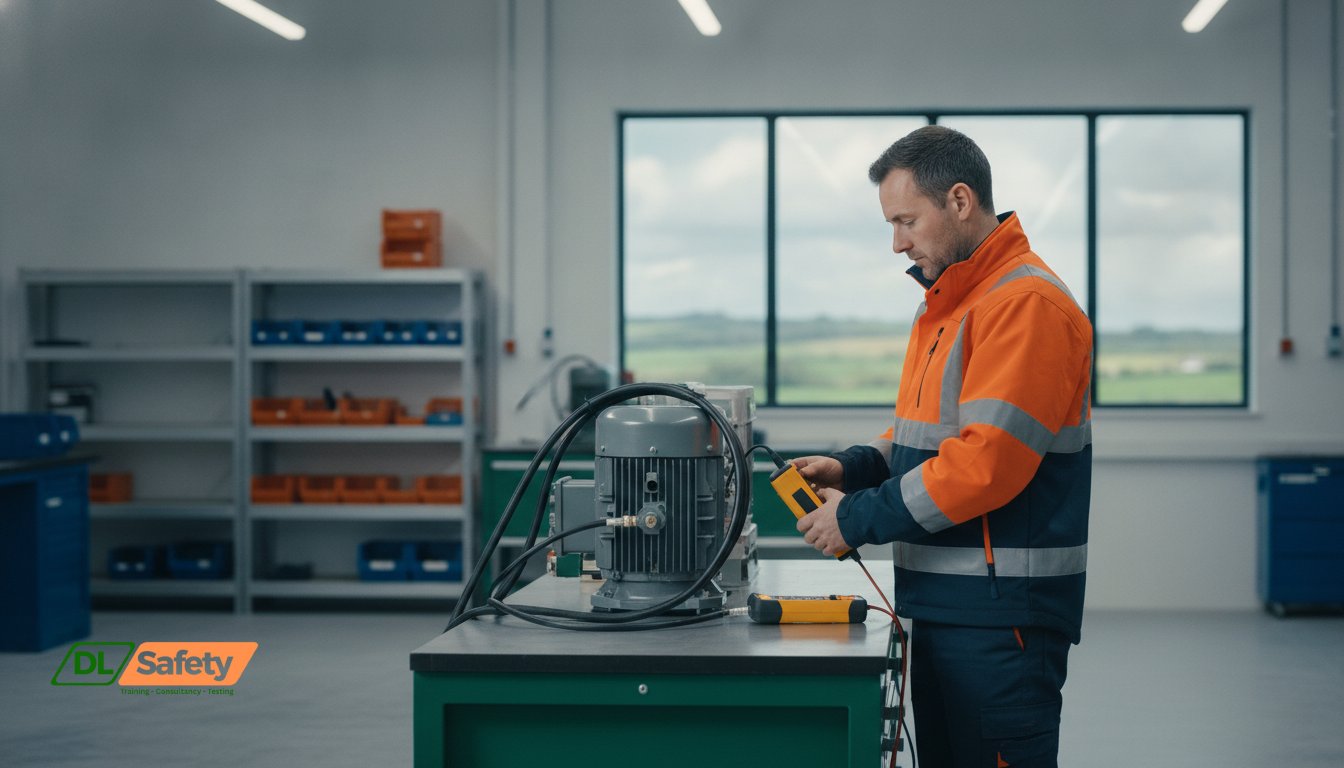
The process begins with a physical examination of the plug, the internal fuse, and the cable grip to ensure they’re secure and undamaged. Once the physical integrity is confirmed, we use a calibrated PAT tester to identify invisible electrical faults that could lead to shocks or fires. For Class I appliances, the tester measures the resistance of the protective earth conductor and the insulation resistance between live parts and the earthed metalwork. These technical readings are recorded precisely to ensure the device operates within safe tolerances.
The Compliance Report: What Your Records Must Show
Traceability is the cornerstone of a successful safety audit. Each item must be assigned a unique ID code, allowing you to track its history across different locations or departments. Your records must show the date of the test, the specific result, and the name of the competent person who performed the work. Transitioning to digital records significantly improves health and safety compliance for multi-site operations, as it allows managers to spot expired tests across the country instantly. Remember that Irish regulations require you to maintain these records for a minimum of five years.
Managing this level of detail can be complex, but you don’t have to do it alone. If you’re looking to simplify your documentation, you can book a comprehensive PAT audit with David and the team. We operate nationally from our centre at Unit 3D Thurles Business Center, Stradavoher, Thurles, County Tipperary, E41 W880. Contact DL Safety today at 085 8316885 or info@dlsafety.ie, or visit www.dlsafety.ie to ensure your business remains fully compliant and protected.
Strategic Safety Management: Why PAT Testing Belongs in a Retained Support Package
Treating electrical safety as an isolated, annual task often leads to what we call the “compliance gap.” This gap occurs when a business completes its initial testing but fails to track new equipment purchases or loses track of varying re-test dates for different environments. The hidden cost of “one-off” testing isn’t just the invoice from the technician; it’s the risk of fragmented records and missed deadlines that leave you exposed during a surprise HSA inspection. By shifting to a strategic management model, you ensure that pat testing requirements ireland mandates are met consistently without you having to micromanage a complex calendar.
A monthly safety support package provides the professional structure needed to keep your compliance live and accurate. Instead of a frantic scramble every twelve months, testing becomes a routine, manageable part of your broader safety framework. Having a single point of contact for all technical safety audits means that your PAT results aren’t just stored in a drawer; they’re integrated into your overall risk management strategy. This proactive approach transforms a technical chore into a protective asset that safeguards your directors from personal liability.
Integrating Technical Testing with Site Audits
When we combine PAT testing with regular site audits, we can identify systemic electrical risks that a simple plug test might overlook. For instance, if multiple appliances fail due to damaged cable grips in a specific department, it suggests a behavioural or training issue rather than just faulty hardware. We provide professional advice on how to rectify these failures and, more importantly, how to prevent them from recurring. This builds a genuine culture of safety where employees feel empowered to report damaged cables proactively before they become a hazard.
Partnering with DL Safety for National Compliance
DL Safety is committed to providing pragmatic, honest safety support across all of Ireland. We don’t believe in faceless corporate distance; instead, we act as your trusted advisor, managing the “big picture” of your compliance whilst you focus on your core operations. Whether you’re a high-risk industrial site or a large office network, we ensure your pat testing requirements ireland are fully satisfied through disciplined, methodical oversight.
Our team is led by David, an experienced professional dedicated to your long-term success and safety. Contact our Thurles office today to discuss a tailored safety package that fits your specific needs. You can reach us at Unit 3D Thurles Business Center, Stradavoher, Thurles, County Tipperary, E41 W880. Call 085 8316885, email info@dlsafety.ie, or visit www.dlsafety.ie to start a dialogue about protecting your business and your people.
Securing Your Future with Proactive Electrical Safety
Understanding the nuanced pat testing requirements ireland mandates for 2026 is the first step towards a safer, more compliant workplace. By moving away from “one-off” testing and embracing a risk-based approach, you protect your directors from liability and your employees from preventable accidents. Robust documentation and a clear asset register remain your best defences during an HSA inspection. These tools transform a technical obligation into a strategic asset for your business.
At DL Safety, we specialise in technical testing for the construction and industrial sectors, providing full national coverage across Ireland. Led by David, an expert in Irish health and safety legislation, our team helps you manage the big picture of compliance whilst you focus on your daily operations. You can secure your business with a Monthly Safety Support Package from DL Safety today. Our centre is located at Unit 3D Thurles Business Center, Stradavoher, Thurles, County Tipperary, E41 W880. For direct enquiries, call 085 8316885 or email info@dlsafety.ie. Taking control of your electrical safety today ensures a more resilient and protected business tomorrow.
Frequently Asked Questions
Is PAT testing a legal requirement for small businesses in Ireland?
Yes, small businesses must comply with Regulation 89 of the Safety, Health and Welfare at Work (General Application) Regulations 2007. This law requires every Irish employer to maintain portable electrical equipment in a safe condition to prevent danger. Whilst the term “PAT” isn’t explicitly in the text, performing these tests is the standard way to meet your pat testing requirements ireland. Failing to do so leaves you liable for workplace accidents.
How often should I have my office equipment PAT tested?
There is no fixed legal interval, as the HSA advocates for a risk-based approach. For low-risk office environments, a frequency of every 12 to 24 months is typical for stationary items like monitors or printers. However, equipment that is moved frequently, such as laptop chargers or vacuum cleaners, might require more regular checks. You should document your reasoning for these intervals within your company safety statement to satisfy any future inspections.
What happens if an item fails its PAT test?
If an appliance fails, it must be removed from service immediately to prevent any accidental use. The item should be clearly labelled with a “Fail” sticker and stored in a secure area until it can be professionally repaired or permanently disposed of. Simply putting a faulty kettle back in the canteen cupboard is a serious breach of safety. You must also update your asset register to reflect that the item is no longer in use.
Can my own maintenance staff carry out PAT testing?
Your internal staff can perform the testing provided they meet the legal definition of a “competent person.” This means they must possess the necessary technical knowledge, training, and experience to identify electrical faults accurately. They also need access to calibrated testing equipment and a clear understanding of the 2007 Regulations. Many businesses prefer outsourcing this to specialists like DL Safety to ensure that the inspections are impartial, thorough, and legally robust.
Do new electrical items need to be PAT tested before use?
New electrical items generally don’t require a full PAT test before their first use, as they should be safe from the manufacturer. However, you should still perform a formal visual inspection to ensure no damage occurred during transit or storage. Once the item is put into service, it must be added to your asset register. From that point onwards, it will fall into your regular risk-based testing schedule alongside your existing inventory.
What is the difference between a visual inspection and a full PAT test?
A visual inspection is a physical check of the plug, cable, and casing for obvious signs of damage or overheating. A full PAT test includes this visual check but adds technical measurements using a calibrated tester. These measurements verify “invisible” safety features like earth continuity and insulation resistance. Whilst most faults are found visually, the technical test is the only way to confirm that the internal safety mechanisms of the appliance are functioning correctly.
Does insurance cover electrical fires if PAT testing is not up to date?
Insurance providers often require proof that you have taken reasonable steps to maintain a safe workplace. If an electrical fire occurs and your records show that pat testing requirements ireland were ignored, your insurer may argue that you were negligent. This can lead to the invalidation of your policy or a significant reduction in your payout. Maintaining an up to date testing register is a vital part of protecting your business from such financial ruin.
How long should I keep my PAT testing records?
You are legally required to keep your PAT testing records for a minimum of five years. These records must be readily available for inspection by the Health and Safety Authority if they visit your site. Keeping a digital archive is often the most practical solution for multi-site operations, as it prevents fragmented records and ensures you can always provide a clear audit trail. At DL Safety, we help clients manage these registers through our Monthly Safety Support Packages.