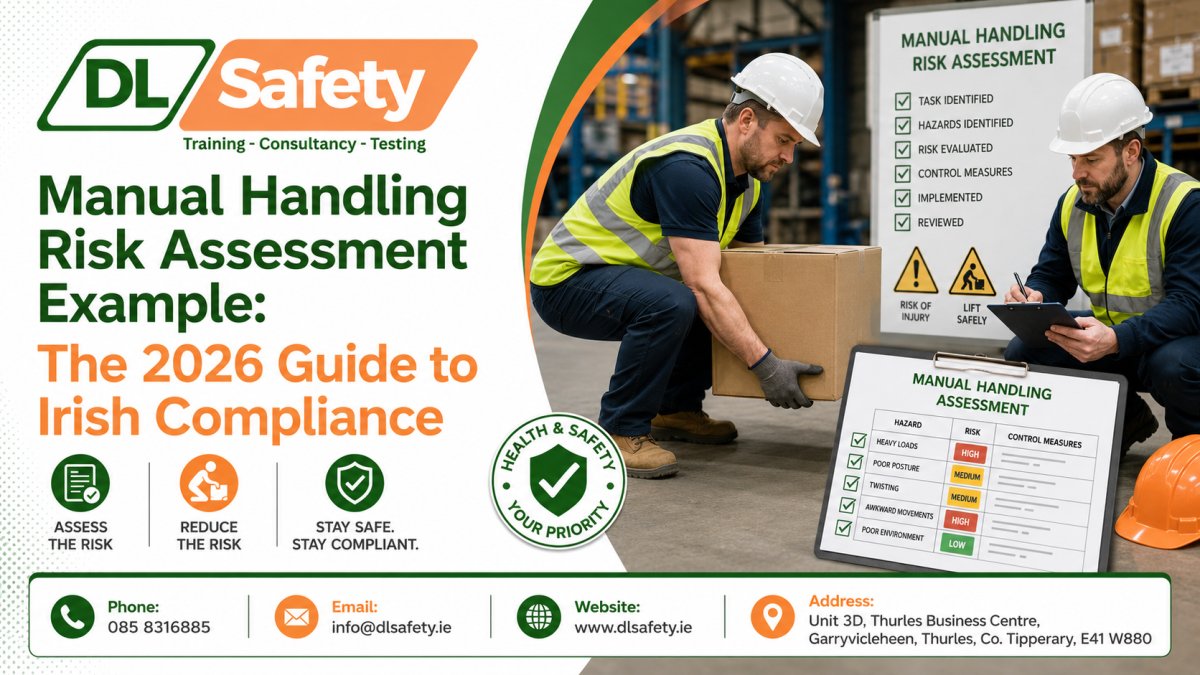
Did you know that manual handling remains the leading cause of non-fatal workplace injuries in Ireland, accounting for roughly one-third of all reported incidents? For many business owners across the country, the struggle isn’t just about safety; it’s about the mountain of paperwork that often feels like a hollow “tick-box” exercise. At DL Safety, we understand the pressure to protect your team from back injuries whilst shielding your business from HSA fines. This guide provides a clear manual handling risk assessment example designed to demystify Irish compliance for 2026.
It’s frustrating when the TILE framework feels more like a riddle than a safety tool. You need a solution that is pragmatic and easy to implement, not just a document that sits in a filing cabinet. We’ll show you exactly how to master these assessments and provide an actionable example that you can adapt for your specific workplace. By the end of this article, you’ll have the confidence to meet the requirements of the Safety, Health and Welfare at Work Act and ensure your site remains both safe and compliant.
Key Takeaways
- Understand the legal requirements under the 2007 General Application Regulations to ensure your business stays compliant and avoids HSA improvement notices.
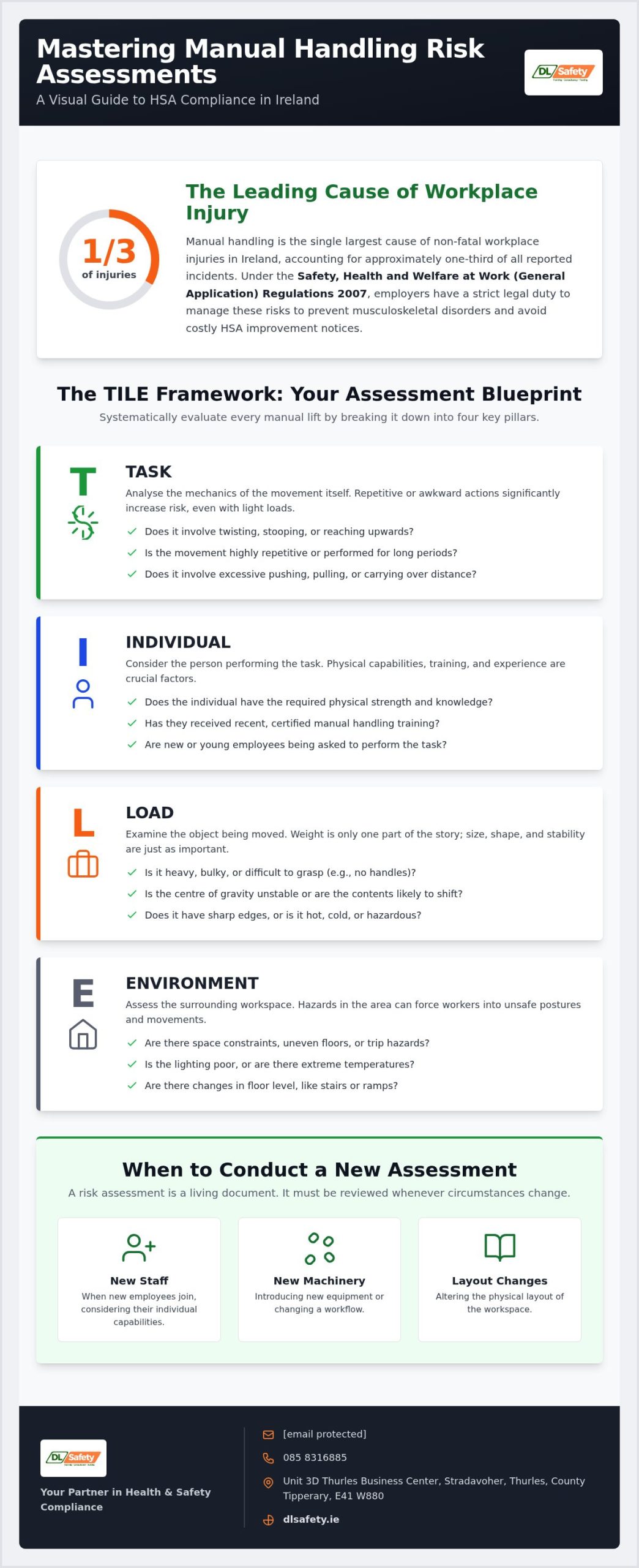
- Master the TILE framework to systematically evaluate the Task, Individual, Load, and Environment for every manual lift on your site.
- Learn from a practical manual handling risk assessment example that demonstrates how to identify and mitigate real-world risks in a warehouse setting.
- Discover the critical transition point where manual handling involves mechanical aids that require professional GA1 testing and certification.
- Identify how a Monthly Safety Support Package can automate your compliance paperwork, allowing you to focus on operations whilst maintaining high safety standards.
Manual Handling Risk Assessment: Why is it Mandatory?
Manual handling isn’t just about heavy lifting; it’s any activity involving the manual handling of loads by hand or bodily force. This includes pushing, pulling, or even putting down a crate in a warehouse. Under the Safety, Health and Welfare at Work (General Application) Regulations 2007, specifically Part 4, employers have a strict legal mandate to manage these risks. In 2026, the Health and Safety Authority (HSA) has intensified its focus on musculoskeletal disorders (MSDs) because they remain the single largest cause of non-fatal workplace injuries in Ireland. Neglecting this leads to more than just paperwork; it results in costly personal injury claims, a drop in productivity, and the looming threat of HSA improvement notices.
A robust manual handling risk assessment example provides more than a template; it offers a roadmap for behavioural change on the shop floor or construction site. By identifying hazards before they result in a chronic strain, you protect your most valuable asset: your people. This proactive approach is exactly what we champion at DL Safety, ensuring your business stays compliant whilst keeping your team safe on the job.
The Manager’s Duty of Care Under Irish Law
Employers must identify any task that poses a risk of injury, particularly to the back. The law is clear: you must avoid manual handling wherever it’s “reasonably practicable.” This might involve mechanising a process or reorganising a workflow to eliminate the need for bodily force. Ensuring your business stays on the right side of the law is a core part of Health and Safety Compliance Ireland. At DL Safety, we help managers move beyond a “tick-box” mentality to create safer environments through our Monthly Safety Support Packages, managed from our centre in Thurles.
When Must You Conduct a Specific Assessment?
There’s a common misconception that a general risk assessment is enough. It isn’t. You need a specific assessment when a task involves physical effort that could cause harm. Triggers for a new manual handling risk assessment example or review include hiring new staff with different physical capabilities, introducing new machinery, or changing the layout of your workspace. Your Safety Statement acts as the foundation, but these task-specific documents are the live tools that protect your team daily. If you’re unsure where to start, you can reach us at info@dlsafety.ie or visit our office at Unit 3D Thurles Business Center, Stradavoher, Thurles, County Tipperary, E41 W880. You can also call us on 085 8316885 to discuss your specific site needs.
The TILE Framework: Organising Your Assessment Correctly
To build a compliant manual handling risk assessment example, you must look at more than just the weight of an object. The industry standard for structuring these documents is the TILE framework, which stands for Task, Individual, Load, and Environment. Following the Irish Manual Handling Regulations requires a systematic approach to each of these four pillars. By breaking down the movement into these categories, you ensure that no hidden hazard, like a flickering light or a worker’s lack of recent training, goes unnoticed during your safety audit.
At DL Safety, we believe that safety shouldn’t be a puzzle. Our approach is to demystify these requirements so you can focus on your core business operations. If you’re finding the TILE framework overwhelming to document, our team at DL Safety can help you streamline your safety statements and risk assessments to ensure they’re both practical and fully compliant.
Breaking Down the ‘Task’ and ‘Load’ Factors
When you evaluate the Task, you’re looking at the mechanics of the movement. Does the worker need to twist their torso or stoop to reach the ground? Frequent repetition of even light loads can lead to chronic strain over time. The Load itself is equally complex. It isn’t just about the number of kilogrammes; you must consider the centre of gravity and whether the contents are likely to shift unexpectedly. A bulky 10kg box with sharp edges can be far more hazardous than a compact 15kg crate with ergonomic handles. Your manual handling risk assessment example should clearly note these physical characteristics to determine if mechanical aids are necessary.
Individual Capacity and the Work Environment
The ‘Individual’ element focuses on the person performing the lift. You must verify that staff have the physical capacity for the task and have completed relevant Online Safety Courses Ireland to ensure their safety behaviour is up to standard. It’s about matching the right person to the right task without making assumptions. Finally, the Environment on Irish sites often presents unique challenges. Slippery floors due to rain, extreme temperatures in cold storage, or poor lighting in older warehouses all increase the risk of a trip or fall. Ensure your assessment accounts for the pace of work and allows for adequate rest periods, particularly during physically demanding shifts. For expert guidance on managing these environmental risks, you can reach us at 085 8316885 or email info@dlsafety.ie.
A Practical Manual Handling Risk Assessment Example
To move from theory to practice, let’s look at a common manual handling risk assessment example found in Irish distribution centres. Imagine a warehouse operative tasked with moving 20kg crates from a delivery pallet at floor level to a shelving unit 1.5 metres high. This scenario is a classic high-risk activity because it combines weight with awkward vertical distances. When we apply the TILE logic, the “Task” involves repetitive stooping and reaching above chest height, whilst the “Load” is heavy enough to cause immediate strain if handled incorrectly. The “Environment” might include narrow aisles that restrict the operative’s ability to adopt a stable stance.
Before any safety measures are introduced, this task would likely receive a “High” risk rating. At DL Safety, we focus on pragmatic solutions that don’t just sit on paper but actually change how work happens on the floor. For more detailed templates and statutory worksheets, you can consult the Official HSA Manual Handling Guidance and Resources, which provide the legal foundation for these assessments. Our role is to help you translate these guidelines into a safer, more efficient workplace from our base in Thurles.
Step-by-Step: From Hazard Identification to Action
Effective documentation requires you to contrast the “Current Situation” with your “Required Actions.” In our crate scenario, the required action isn’t just “be careful.” Instead, you might record the need for a high-lift pallet jack or a height-adjustable trolley. It’s vital to set realistic deadlines for these improvements and assign a specific person responsible for the follow-up. A manual handling risk assessment example only works if someone is held accountable for implementing the controls. If you need help structuring these documents, you can reach us at info@dlsafety.ie or call 085 8316885.
Evaluating the Effectiveness of Controls
When choosing controls, we always follow the “Hierarchy of Control.” Elimination is the goal; if you can use a forklift to move the entire pallet to the shelf, you’ve eliminated the manual task. If that’s not possible, engineering controls like trolleys are the next best step. Administrative controls, such as staff rotation or extra training, are supportive but less effective on their own. It’s a common mistake to rely on PPE like back braces; these are rarely the primary solution in a robust assessment. Once your improvements are in place, you must record the “Residual Risk” to ensure the task is now at an acceptable, safe level for your team.
Integrating Manual Handling with Wider Site Safety
Manual handling safety is often the first domino in a broader site safety strategy. When your manual handling risk assessment example identifies that a load is too heavy or awkward for a person to lift, the logical step is to introduce mechanical aids. However, this transition shifts the regulatory focus from manual handling to the maintenance of lifting equipment. Pallet trucks, hoists, and cranes are indispensable for modern operations, yet they must carry a valid GA1 Testing Ireland certificate to be legally compliant on an Irish site. Failure to maintain these aids creates a new set of mechanical hazards that can be just as dangerous as the lifting risks they were meant to solve.
Electric lifting aids bring their own set of requirements. Any plug-in equipment used to mitigate lifting risks must undergo regular PAT Testing to prevent electrical hazards. A comprehensive site audit from our team in Thurles can help you identify these “hidden” risks amongst your team or subcontractors. We ensure that your solution for one hazard doesn’t accidentally introduce another. If you need help coordinating safety across a complex site, our Monthly Safety Support Packages provide the expert oversight required to keep everyone safe and compliant.
Training and Competency Verification
Effective training must be practical and specific to the tasks your team actually performs every day. Watching a generic video is rarely enough to change long-term safety behaviour. A competent person in the context of manual handling supervision is an individual who possesses the sufficient training, experience, and knowledge to identify hazards and implement control measures effectively. We often find that safety behaviour on-site slips as deadlines loom, so regular monitoring is essential to ensure that the techniques learned in training are being applied in real-world scenarios. This proactive approach is a hallmark of a robust manual handling risk assessment example in action.
Managing Subcontractor Risk Assessments
On multi-employer sites, the complexity of safety management increases significantly. You must review subcontractor safety statements to ensure their specific manual handling protocols align with your overarching site rules. Understanding What to Expect During a HSA Inspection is vital here; inspectors will look for evidence of coordination between different companies. Shared lifting equipment, like site cranes or hoists, must be safe for every worker who uses them, regardless of their employer. Clear communication and documented shared responsibility are the only ways to manage these risks effectively without leaving your business liable for another company’s oversight.
How DL Safety Simplifies Your Compliance Journey
Managing workplace safety shouldn’t feel like a burden that pulls you away from your core operations. At DL Safety, we specialise in turning complex regulatory requirements into straightforward, manageable systems. Whether you need a specific manual handling risk assessment example to kickstart your documentation or a complete overhaul of your safety protocols, our team provides the professional authority and reassuring support you need. We move beyond the theory of the TILE framework to offer pragmatic solutions that work in the high-stakes environments of Irish construction and industry.
Our Monthly Safety Support Packages are designed to automate your compliance journey. We take over the professional management of your risk assessments and safety statements, ensuring they are always up to date and HSA-ready. This proactive approach includes regular site audits, where we identify “hidden” manual handling hazards before they result in an accident. If an incident does occur, our expert accident investigation services provide the rigorous analysis required to understand the root cause and prevent a recurrence, protecting both your workers and your business reputation.
Technical expertise is at the heart of what we do. When your risk assessments suggest mechanical aids, we provide LEEA-standard GA1 testing for all mechanical handling and lifting equipment. This ensures that every pallet truck, hoist, or sling on your site is not only helping with the heavy lifting but is also fundamentally safe to operate. By combining technical testing with behavioural safety training, we create a 360-degree safety culture that stands up to the closest inspection.
The ROI of Retained Safety Support
Investing in a retained safety partner offers a significant return by reducing long-term liability costs and potential HSA fines. Choosing Monthly Safety Support in Ireland means you have peace of mind knowing your TILE assessments are technically sound and reflect current 2026 standards. You gain immediate access to our team for safety advice or urgent site visits, ensuring you’re never left guessing when a safety challenge arises. It’s about building a relationship with a “Personable Expert” who is as invested in your site’s success as you are.
Contact DL Safety for Professional Guidance
If you’re ready to move past the confusion of paperwork and implement a robust manual handling risk assessment example that actually protects your team, we’re here to help. You can explore our full range of safety services and training programmes by visiting our website at www.dlsafety.ie. For immediate assistance or to discuss your specific site requirements, please reach out to us directly.
Email: info@dlsafety.ie
Telephone: 085 8316885
Address: Unit 3D Thurles Business Center, Stradavoher, Thurles, County Tipperary, E41 W880
Future-Proofing Your Workplace Safety Strategy
Building a safer workplace in 2026 requires moving beyond basic checklists to embrace a proactive safety culture. By mastering the TILE framework and utilising a practical manual handling risk assessment example, you don’t just satisfy HSA inspectors; you actively reduce the risk of debilitating back injuries within your team. It’s vital to remember that safety is an integrated process. When your assessments lead to the use of mechanical aids, ensuring those tools meet LEEA standards through regular GA1 testing is essential for maintaining total site compliance.
Our expert Irish safety consultancy is dedicated to demystifying complex regulations through comprehensive site audit services and technical expertise. You don’t have to navigate these requirements alone. We act as your trusted advisor, providing the big-picture perspective needed for long-term impact and operational efficiency. Secure a Monthly Safety Support Package for total compliance peace of mind and let us handle the technicalities whilst you focus on growing your business. We are always available at info@dlsafety.ie or 085 8316885 to support your journey toward a safer, more productive workplace.
Frequently Asked Questions
What is the maximum weight a male or female can lift at work in Ireland?
Irish legislation doesn’t specify a single legal maximum weight for lifting. Instead, the Health and Safety Authority provides guideline weights based on the height and distance of the lift; for example, a lift at elbow height close to the body suggests a maximum of 25kg for men and 16kg for women. These guideline weights must be reduced significantly if the load is held at arm’s length or lifted above shoulder height.
How often should a manual handling risk assessment be reviewed?
You should review your assessment whenever there’s a significant change to the work process, the equipment used, or the physical capabilities of your staff. Even if no changes occur, it’s best practice to conduct a review at least once a year. This ensures your documentation remains a live tool for safety rather than a static piece of paperwork that no longer reflects the reality of your site operations.
Is manual handling training a legal requirement for all employees?
Manual handling training is a legal requirement for any employee whose role involves the manual handling of loads as defined by the 2007 General Application Regulations. This includes activities like lifting, putting down, pushing, or pulling. If an employee’s duties are strictly sedentary and involve no physical handling of objects, formal training may not be mandatory, but most industrial and construction roles require it for full compliance.
What does the TILE acronym stand for in risk assessments?
The TILE acronym stands for Task, Individual, Load, and Environment. It provides a structured way to evaluate risks by looking at the frequency of the movement, the person’s physical capacity, the weight of the object, and the workspace conditions. Using this framework helps you build a manual handling risk assessment example that is thorough and meets the standards expected by HSA inspectors during a site visit.
Can a manual handling risk assessment be done for a group of workers?
You can perform a group assessment if several workers are carrying out the same task in the same environment using the same equipment. However, you must still account for the “Individual” element of the TILE framework. If one worker in the group has a known health condition or different physical capabilities, they’ll require a specific individual assessment to ensure the task is safe for their unique circumstances.
What happens if a HSA inspector finds my risk assessments are outdated?
A HSA inspector can issue an improvement notice if they find your safety documentation is no longer relevant or up to date. This notice legally requires you to rectify the issues within a set period. If the lack of a current manual handling risk assessment example is deemed to pose a serious risk to life or health, they may issue a prohibition notice, which stops the work activity immediately until the risks are managed.
Do I need a separate assessment for every single lift on my site?
No, you don’t need a separate document for every individual lift if the tasks are repetitive and the risks are identical. A single assessment can cover a category of similar lifting activities, provided the control measures and environmental factors remain the same. You only need to create a new, task-specific assessment when a lift introduces unique hazards that aren’t addressed in your existing safety statement.
How long does a manual handling training certificate remain valid in Ireland?
The Health and Safety Authority recommends that manual handling training be refreshed every three years. Whilst there’s no specific expiry date written into the legislation, this three-year interval is the widely accepted industry standard in Ireland. Regular refreshers are essential to ensure that workers maintain correct safe lifting behaviours and don’t fall into dangerous habits that could lead to long-term musculoskeletal injuries.