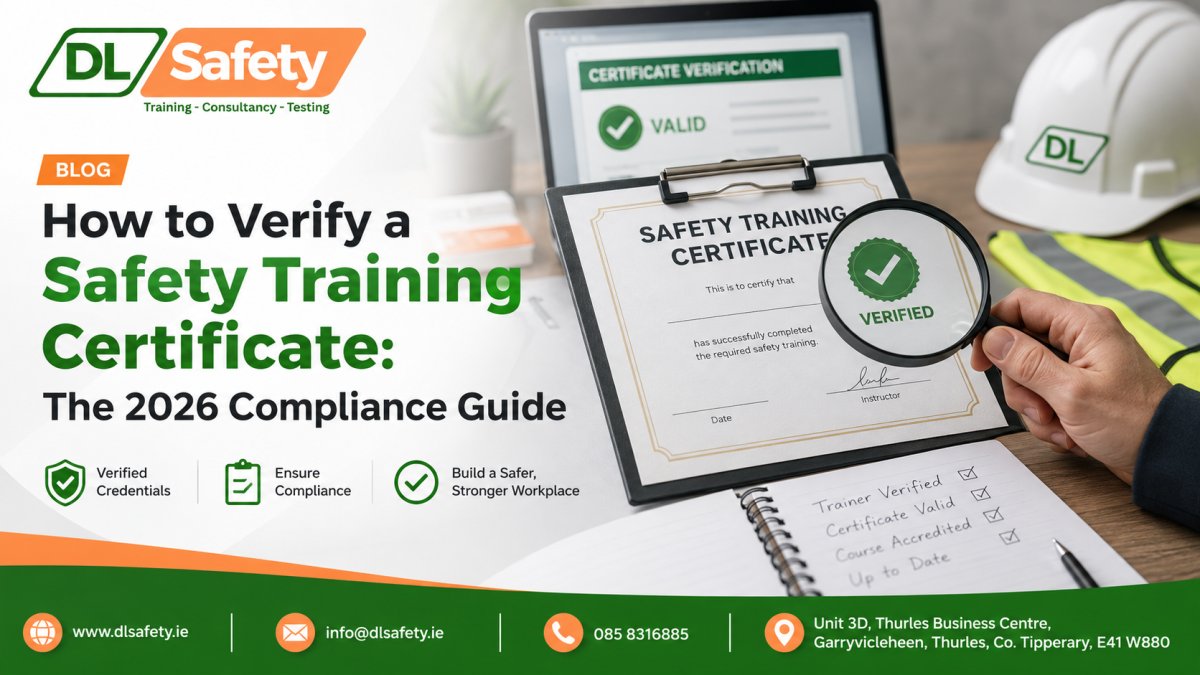
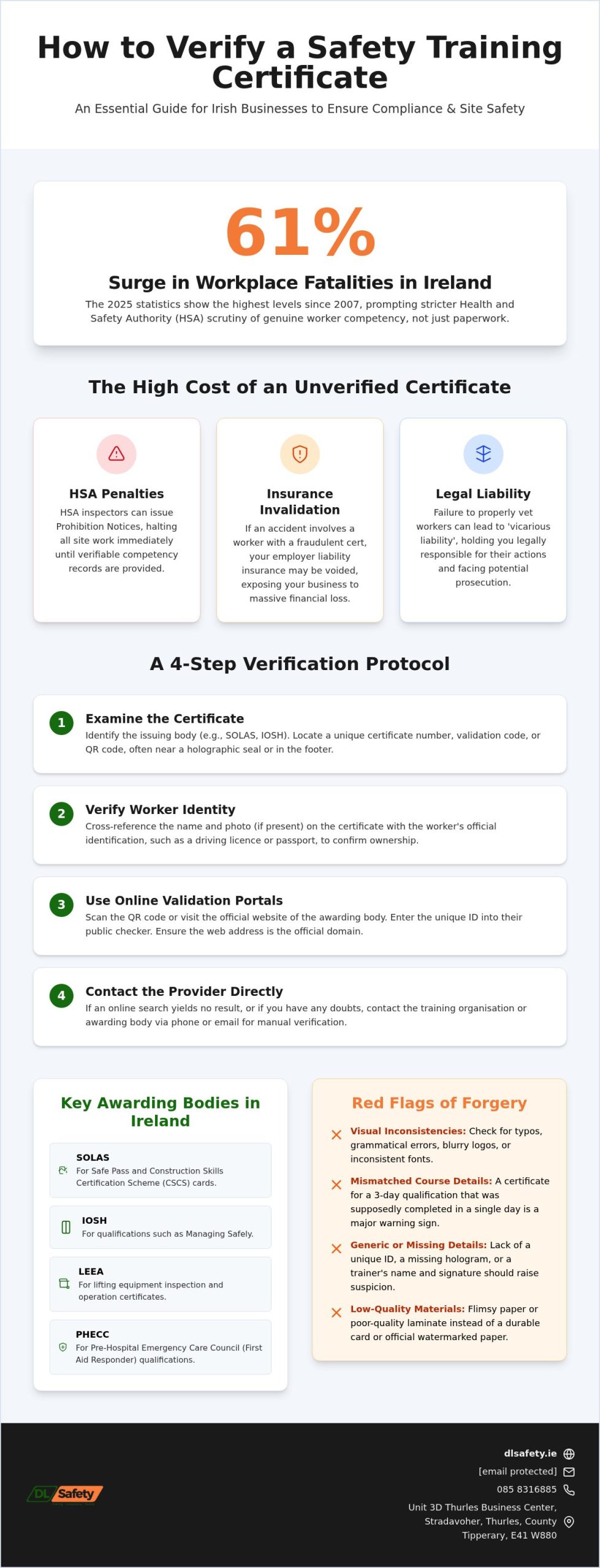
Did you know that workplace fatalities in Ireland surged by 61% in 2025, reaching the highest level since 2007? This sharp rise has forced the Health and Safety Authority to look closer at genuine competency rather than just paperwork. If you’re responsible for site safety, knowing how to verify a safety training certificate is no longer just a box-ticking exercise; it’s your primary defence against catastrophic legal and physical risks.
It’s understandable to feel overwhelmed by the manual effort of checking every card, especially with the constant worry that an uncertified worker might invalidate your insurance if an accident occurs. We’re here to help you move from uncertainty to total confidence. In this 2026 guide, you’ll learn a step-by-step protocol to authenticate any safety qualification and spot the red flags of a forgery. We’ll also show you how to build a robust competency management system that satisfies the latest 2026 Code of Practice. For tailored support, you can find us at www.dlsafety.ie or reach our team via 085 8316885, or at info@dlsafety.ie.
Key Takeaways
- Understand why confirming worker competency is your best defence against HSA fines and insurance risks in the current Irish regulatory landscape.
- Discover how to verify a safety training certificate using unique validation codes and recognised awarding bodies like QQI, SOLAS, and IOSH.
- Learn to identify common red flags of fraudulent documentation, including visual inconsistencies and mismatched course durations that don’t align with the qualification.
- Move towards a proactive competency management system that integrates verification into your standard onboarding and induction processes for better site safety.
- Explore how monthly safety support and professional site audits can uncover hidden competency gaps before they lead to accidents or legal liabilities.
The Critical Importance of Safety Training Verification in Ireland
Certificate verification is the essential process of confirming a worker’s competency by cross-referencing their credentials with the original records of the issuing body. In high-stakes environments like Irish construction sites or quarries, simply accepting a document because it ‘looks official’ is a dangerous gamble. Forgeries have become increasingly sophisticated, and a glossy card doesn’t always equate to genuine skill. This verification process sits at the heart of Occupational safety and health; it ensures that the people on your site aren’t just present, but are actually safe to be there.
Under the Safety, Health and Welfare at Work Act 2005, every employer in Ireland carries a legal ‘Duty of Care’ to provide a safe working environment. If you haven’t mastered how to verify a safety training certificate, you’re failing in that duty. Relying on unverified documents can lead to the immediate invalidation of your employer liability insurance. If an accident happens and the worker involved holds a fraudulent cert, your insurer may refuse to cover the claim. This leaves your business exposed to massive financial losses and potential criminal prosecution.
HSA Inspections and Competency Records
When a Health and Safety Authority (HSA) inspector arrives for an unannounced visit, they expect to see robust, verifiable training records. They aren’t just looking for ‘attendance’ certificates that prove someone sat in a room; they’re looking for ‘competency’ qualifications. In the context of Irish safety law, competency is defined as the specific combination of appropriate training, knowledge, and experience that allows an individual to perform a task safely whilst fully understanding the associated risks. If your records don’t stand up to scrutiny, the inspector can issue a Prohibition Notice, halting work immediately until you can prove your staff are qualified.
Insurance Liability and the ‘Paper Trail’
During an accident investigation, loss adjusters and insurers will scrutinise your training matrix to identify any signs of negligence. If it’s discovered that a worker lacked genuine training, your business faces the risk of ‘vicarious liability’. This means you’re held legally responsible for the worker’s mistakes because you failed to vet them properly before they started the job. Digital verification logs provide a far superior defence in court compared to dog-eared paper copies. At DL Safety (www.dlsafety.ie), we help businesses manage these records through our Monthly Safety Support Packages. You can contact our team at info@dlsafety.ie or call 085 8316885 to discuss your compliance needs. Our office is located at Unit 3D Thurles Business Center, Stradavoher, Thurles, County Tipperary, E41 W880.
Practical steps to verify a safety training certificate
Establishing a clear protocol is the only way to ensure your site remains compliant and safe. To learn how to verify a safety training certificate effectively, you should start by identifying the awarding body listed on the document. This might be a local training provider or a national authority. Look for a unique certificate number or a validation code, which is typically found in the footer or alongside a holographic seal. Before proceeding, always cross-reference the name on the certificate with the worker’s official identification, such as a driving licence or passport, to ensure the person holding the card is the person who earned it.
Using online validation portals
Most modern certifications now include QR codes or digital links for instant authentication. When you scan these, ensure the landing page belongs to the official domain of the awarding body rather than a generic third-party site. You can verify a student course completion card or certificate through these portals by entering the unique ID. In Ireland and the UK, several major bodies provide these public checkers:
- SOLAS (for Safe Pass and CSCS cards)
- IOSH (for Managing Safely qualifications)
- LEEA (for lifting equipment inspection certs)
- PHECC (for first aid responders)
If a search returns ‘No Result Found’, it doesn’t always indicate a fake. It may be due to a simple data entry error, a very recently issued cert that hasn’t synced yet, or an expired qualification that has been purged from the active database. If you’re unsure, our team at DL Safety can help you navigate these results as part of a site audit.
Manual verification checklist
When a digital portal isn’t available, you’ll need to contact the provider directly via email or telephone. Don’t just ask if the person attended; ask for specific details to confirm the record’s integrity. You can reach out to providers using their official contact details, or if you are checking a DL Safety cert, you can call us on 085 8316885. When verifying, remember to:
- Confirm the exact course modules completed.
- Verify the date of assessment and the expiry date.
- Ask if the instructor was suitably qualified and accredited to deliver that specific training on that date.
This level of diligence protects your business from ‘grey area’ training that might not stand up to an HSA audit. If managing these manual checks feels like a drain on your resources, our Monthly Safety Support Packages can take that weight off your shoulders by handling all competency tracking for you from our office at Unit 3D Thurles Business Center, Stradavoher, Thurles, County Tipperary, E41 W880.
Red Flags: Identifying Fraudulent or Invalid Certifications
Knowing how to verify a safety training certificate is only half the battle; you must also develop a sharp eye for the subtle signs of tampering. Fraudulent documents often betray themselves through visual inconsistencies that a quick glance might miss. Look for mismatched fonts, blurry logos, or poor formatting that suggests a low-quality scan or a DIY edit. If the certificate looks unprofessional, it probably is. A genuine awarding body invests in high-quality templates and secure printing or digital signatures to protect their reputation.
Another critical check is the ‘Too Good to Be True’ test. Compare the course duration with the level of qualification. For example, if a worker presents a certificate for a complex topic like Excavation Safety training but claims it was completed in a single hour, you should be concerned. Genuine competency takes time to build. You should also check expiry dates against Irish industry standards. Manual Handling training usually requires a refresher every three years, whilst other high-risk certifications may have shorter lifespans. Always verify that the training provider holds valid accreditation, such as QQI or LEEA registration, to ensure the training met national standards.
Common Forgery Techniques
Digital ‘photoshopping’ remains the most common method for creating fake credentials. Forgers often take a genuine certificate template and simply overlay a new name and date. Checking the ‘issue date’ against the provider’s operational history is vital because certificates are sometimes backdated to a time before the training centre even existed. Some forgers use the names of defunct training providers, hoping that the lack of an active verification database will make their lie harder to disprove. Using tools like the IOSH certificate verifier can quickly expose these discrepancies for specific health and safety qualifications.
Action Plan for Suspect Certificates
If you encounter a suspect certificate, you must act decisively but fairly. Professionally challenge the worker by asking for further proof of training or details about the course location and instructor. Maintaining a fair workplace culture is important, but safety cannot be compromised. You have a legal requirement to remove a worker from high-risk duties immediately if their training cannot be verified. This isn’t about being difficult; it’s about preventing accidents on your site. Don’t let a fear of confrontation lead to a site fatality.
Document every verification attempt and the reasons for your suspicion. This paper trail proves you are practising proactive safety management, which is vital for HSA compliance. If you find yourself frequently dealing with questionable paperwork, it might be time for a professional site audit from DL Safety to tighten your onboarding procedures. You can always reach us at info@dlsafety.ie or 085 8316885 for guidance on managing these tricky situations from our base at Unit 3D Thurles Business Center, Stradavoher, Thurles, County Tipperary, E41 W880.
Managing Staff Competency Records as a Business Strategy
Effective safety management requires moving away from reactive fire-fighting and towards a proactive, structured strategy. Whilst learning how to verify a safety training certificate is a vital skill for any site manager, the real value lies in how you organise and maintain those records over time. Integrating verification into your standard onboarding and induction process ensures that no worker ever steps onto your site without their credentials being vetted first. This approach is a cornerstone of health and safety compliance Ireland, transforming a clerical task into a robust defensive barrier for your business. By setting up automated alerts for upcoming certificate renewals, you can eliminate compliance gaps before they become legal liabilities.
Treating competency management as a core business strategy rather than an administrative burden allows you to win larger contracts. Many lead contractors in Ireland now demand proof of a robust safety culture before awarding work. When you can demonstrate a 100% verification rate through a managed training matrix, you position your business as a reliable, low-risk partner. This level of organisation doesn’t just prevent accidents; it builds your professional reputation in a highly competitive market.
Digital vs. Physical Record Keeping
Digital record keeping is no longer optional for modern site management. Cloud-based safety folders allow you to access verified credentials instantly from any device, which significantly speeds up what to expect during a HSA inspection. Storing this sensitive training and ID data requires strict adherence to GDPR, so it’s vital to ensure your system is secure and accessible only to authorised personnel. Digital logs provide a transparent, time-stamped history of your diligence that paper files simply cannot match, providing a superior defence if your records are ever called into question.
Subcontractor Verification Protocols
Subcontractors often present the highest risk to your safety standards if they aren’t properly vetted. Your Pre-Qualification Questionnaire (PQQ) must require verified certificates as a non-negotiable entry point for any third-party crew. Under Irish law, you are ultimately responsible for the training standards of everyone on your site, including sub-contractors and their employees. Regular site audits are the best way to spot-check certificates in real-time. This ensures that the person performing a high-risk task is exactly who they claim to be and possesses the genuine skills required for the job.
If you want to move from manual spreadsheets to a professionally managed system, our Monthly Safety Support Packages provide the expertise you need to stay ahead of the regulations. Contact us at info@dlsafety.ie or 085 8316885 to discuss your requirements, or visit our team at Unit 3D Thurles Business Center, Stradavoher, Thurles, County Tipperary, E41 W880.
Ensuring Compliance with DL Safety Training Solutions
DL Safety provides a suite of fully accredited online safety courses Ireland designed specifically for the high-risk sectors of construction and quarrying. Every course we offer comes with instant verification, removing the guesswork for site managers. When your team trains with us, you won’t need to spend hours researching how to verify a safety training certificate; our digital records are transparent and accessible whenever you need them. This level of clarity helps you maintain a seamless training matrix without the administrative headache.
Beyond training, our Monthly Safety Support Packages act as an extension of your business. We take the lead on comprehensive competency tracking and record management, ensuring your training matrix is always audit-ready. This proactive approach includes everything from GA1 testing Ireland to thorough accident investigations. We don’t just provide a service; we partner with you to build a culture of safety that protects your workers and your bottom line. It’s about looking beyond the immediate task to ensure long-term site safety.
Site audits are another vital tool in our arsenal. We visit your site to ensure that the paperwork in the office matches the actual behaviour on the ground. It’s one thing to have a verified certificate, but it’s another to ensure that knowledge is being applied correctly in a live environment. Our audits uncover hidden competency gaps before they lead to accidents or HSA intervention. We provide a fresh set of eyes that can spot the risks you might have become accustomed to over time.
Why Choose DL Safety for Your Training Needs?
David and the team offer pragmatic, grounded advice that stems from years of experience in the Irish construction and quarry sectors. We understand the unique pressures of these industries and provide solutions that work in the real world, not just in a textbook. Our high-tech simulation training offers advanced competency that goes far beyond a traditional classroom setting, giving your workers the hands-on experience they need in a safe, controlled environment. We pride ourselves on transparent, honest support that demystifies complex regulatory requirements, making safety accessible for everyone.
Contact Us for Expert Safety Support
We’re ready to help you secure your site and streamline your compliance processes. You can find us at Unit 3D Thurles Business Center, Stradavoher, Thurles, County Tipperary, E41 W880. If you have immediate questions about how to verify a safety training certificate or want to discuss a custom training plan, call us on 085 8316885 or email info@dlsafety.ie. We’re here to take the stress out of compliance and let you focus on your core business operations.
Visit dlsafety.ie for Monthly Safety Support and let’s work together to make your business safer and more efficient.
Future-Proof Your Site Compliance Today
Verification is the frontline of your safety culture. By mastering how to verify a safety training certificate, you aren’t just avoiding HSA fines; you’re actively protecting your workers’ lives and your company’s professional reputation. We’ve explored the necessity of digital record-keeping and the specific red flags that help you spot forgeries before they cause an incident on your site. Moving from a reactive approach to a proactive, managed training matrix is the smartest business move you can make in 2026.
As an expert Irish construction safety consultancy and accredited online safety training provider, DL Safety is here to make this transition effortless. Whether you need specialist GA1 technical testing or a complete overhaul of your competency tracking, our team provides the grounded, honest support you need to stay compliant. You can reach us at Unit 3D Thurles Business Center, Stradavoher, Thurles, County Tipperary, E41 W880, or call 085 8316885 to discuss your needs.
Secure your site with a Monthly Safety Support Package from DL Safety. We’re ready to help you turn compliance from a burden into a competitive advantage.
Frequently Asked Questions
Can I verify a safety certificate if the training company has closed down?
You can usually verify these credentials if the course was accredited by a national awarding body like QQI, SOLAS, or IOSH. These organisations maintain central databases that remain active even if the original training provider is no longer trading. If the training was unaccredited and the company has closed, verification becomes almost impossible, which is why we always advise using established, accredited providers for your team.
Is a photocopy of a safety training certificate legally acceptable on an Irish site?
A photocopy is generally not considered sufficient for statutory requirements like the Safe Pass or CSCS cards. HSA inspectors and site managers typically require the original physical card or a digital version that can be instantly authenticated via an official portal. Photocopies are easily tampered with, so relying on them creates a significant gap in your site’s safety defences.
How long are safety training certificates usually valid for in Ireland?
Validity periods vary depending on the specific qualification and industry standards. For example, a Safe Pass is valid for four years, whilst Manual Handling training is typically refreshed every three years. First Aid Response (PHECC) certificates generally require a refresher every two years. It’s vital to track these dates in a training matrix to ensure no worker’s competency expires unnoticed.
What should I do if a worker provides a certificate from another country?
You must determine if the qualification is recognised as equivalent under Irish health and safety legislation. Whilst some UK certifications like CSR cards have mutual recognition agreements with SOLAS, many international qualifications do not. If there’s no formal equivalence, the worker must complete an Irish-accredited course to ensure they understand local regulations and safety protocols before starting work.
Does ‘inconclusive’ on an online checker always mean the certificate is fake?
An inconclusive result doesn’t always indicate a forgery. It can be caused by technical maintenance on the awarding body’s database or a delay in syncing records for very recently issued certificates. If you’re unsure how to verify a safety training certificate when a portal fails, you should contact the provider directly. You can also reach our team at 085 8316885 for support in navigating these compliance hurdles.
Can the HSA fine me if I unknowingly accept a forged certificate?
Yes, you can still face fines and legal action if the HSA determines you didn’t exercise due diligence. Simply accepting a certificate at face value isn’t enough to satisfy your legal ‘Duty of Care’ as an employer. You must prove that you have a robust, proactive system for checking credentials. This is why many businesses use our Monthly Safety Support Packages to manage their competency records professionally.
How do I verify a CSCS or QSCS card for construction work?
The most reliable way to verify these cards is through the official SOLAS online card checker. You will need the worker’s registration number and their date of birth to access the record. This tool provides an instant confirmation of the card’s validity and the specific categories the worker is qualified for, such as 360 Excavator or Telescopic Handler operation.
What is the difference between a certificate of attendance and a certificate of competence?
A certificate of attendance merely confirms that an individual was present during the training session. In contrast, a certificate of competence proves that the individual was assessed and demonstrated the skills required to perform a task safely. For high-risk activities, the HSA requires proof of competence. At DL Safety, located at Unit 3D Thurles Business Center, Stradavoher, Thurles, County Tipperary, E41 W880, we focus on delivering competency-based training that stands up to the highest level of scrutiny.