If a Health and Safety Authority inspector walked onto your site this afternoon, would your trench support stand up to the latest BS 5975:2024 standards, or would it lead to an immediate shutdown? It’s a question that keeps many site managers awake, especially when the pressure to stay on schedule clashes with the complex reality of soil stability and underground services. You want to keep your team safe and your project moving, but the shifting landscape of Irish regulations can feel like a moving target. Understanding the specific excavation safety and shoring requirements isn’t just about ticking boxes; it’s about building a culture of reliability that protects your operatives and your professional reputation.
This guide will help you master the essential regulatory standards and practical shoring techniques required to ensure ground stability and operative safety on Irish construction sites. We’ll break down the critical 1.25m rule, explore various shoring types, and outline a robust inspection regime that ensures your site passes every audit with flying colours. At DL Safety, we’re dedicated to being your trusted advisors from our base at Unit 3D Thurles Business Center, Stradavoher, Thurles, County Tipperary, E41 W880. You can reach us at info@dlsafety.ie or 085 8316885, or visit www.dlsafety.ie to see how we can support your next project.
Key Takeaways
- Learn how to navigate the 1.25m depth rule and the latest BS 5975:2024 standards to ensure your site stays fully compliant with HSA expectations.
- Discover how to select the most effective support method by evaluating soil stability, groundwater levels, and site-specific constraints.
- Master the essential excavation safety and shoring requirements to prevent ground collapse and protect your team from high-risk service strikes.
- Understand the mandatory inspection regime, including the correct use of AF3 forms, to maintain a clear audit trail and avoid costly site shutdowns.
- Access professional support and bespoke training from our experts at Unit 3D Thurles Business Center, Stradavoher, Thurles, County Tipperary, E41 W880; you can also reach us at info@dlsafety.ie or 085 8316885.
Regulatory Requirements for Excavation Safety in Ireland
Excavation safety isn’t just about avoiding fines. Under the Safety, Health and Welfare at Work Act 2005, every employer must ensure that work is planned and carried out in a way that prevents danger from a collapse of the ground or the fall of materials. This legislation creates a proactive duty to manage risks before the first bucket of soil is lifted. In practical terms, this means you must identify hazards, assess the stability of the ground, and implement control measures that protect every person entering the trench.
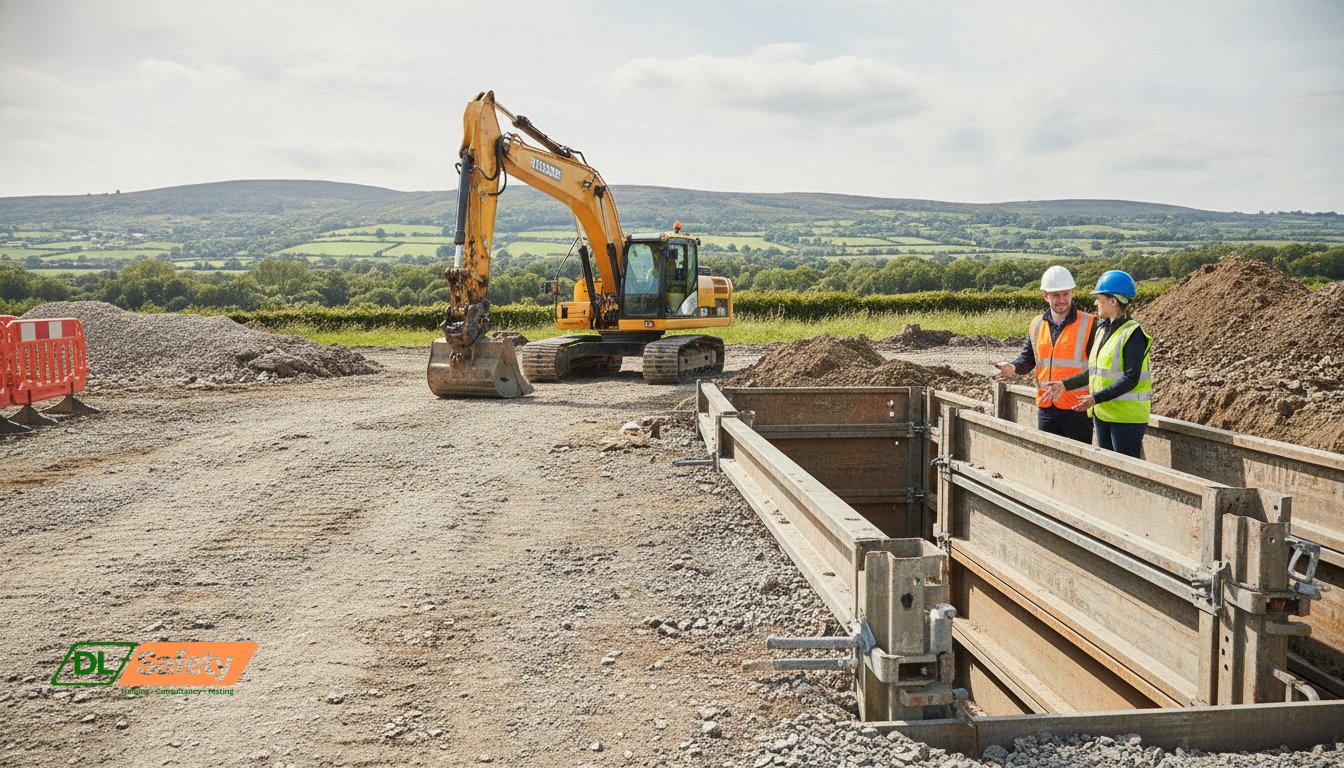
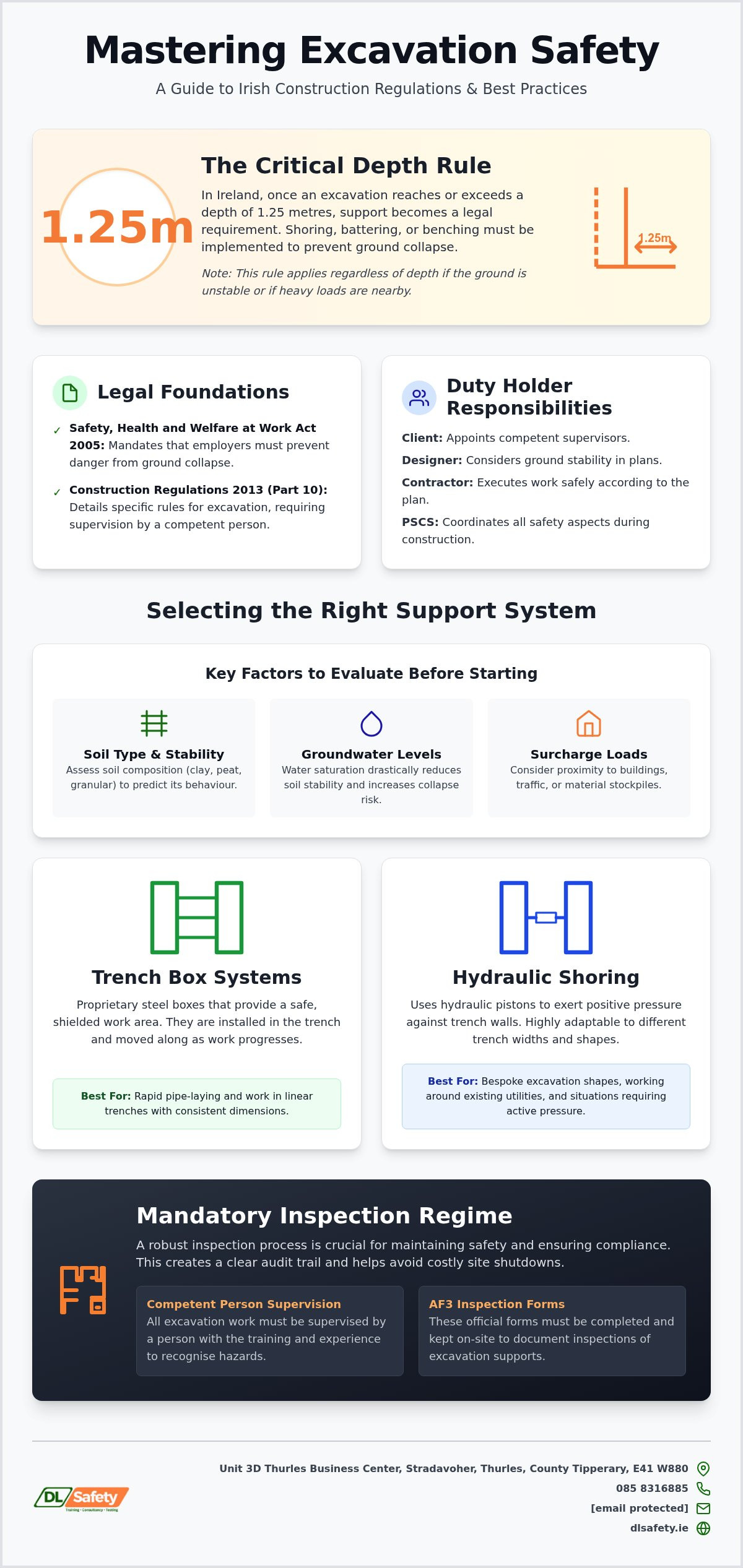
The 1.25-metre rule is perhaps the most famous benchmark in Irish construction. Once an excavation reaches a depth of 1.25 metres, the law is very clear: you must provide shoring, piling, or battering to prevent a collapse. However, depth isn’t the only factor. If the ground is unstable or if there are heavy loads nearby, these excavation safety and shoring requirements apply regardless of how shallow the trench is. You cannot break ground without a written Method Statement. This document acts as your roadmap, detailing the exact sequence of work and the specific safety equipment required to keep the site stable.
The Project Supervisor Construction Stage (PSCS) plays a pivotal role in this process. They are responsible for coordinating the safety aspects of the construction stage, which includes ensuring that the safety file is updated and that all contractors adhere to the established safety plan. If you’re struggling to keep these moving parts aligned, DL Safety provides monthly support packages to take the weight off your shoulders. Based at Unit 3D Thurles Business Center, Stradavoher, Thurles, County Tipperary, E41 W880, our team helps project supervisors stay on top of their legal obligations through honest, expert guidance.
The Legal Framework: 2013 Construction Regulations
Part 10 of the Safety, Health and Welfare at Work (Construction) Regulations 2013 is where the specific rules for excavations live. These regulations mandate that a competent person must supervise all excavation work. This person needs the right training and experience to recognise signs of ground movement or equipment failure. If a HSA inspector visits and finds a lack of supervision or missing AF3 inspection forms, the consequences can range from immediate work stop notices to significant legal penalties. It’s about more than just compliance; it’s about ensuring every worker goes home safely at the end of the shift.
Duty Holder Responsibilities
Safety is a shared responsibility across the site. The client must appoint competent supervisors, the designer must consider ground stability in their plans, and the contractor must execute the work safely. For complex projects, a formal temporary works design is often required to specify the exact Trench shoring methods needed for the specific soil conditions. Aligning these roles is essential for a smooth project. You can find more detail on these requirements in our guide to Health and Safety Compliance Ireland. For direct assistance with your site’s excavation safety and shoring requirements, contact us at 085 8316885 or email info@dlsafety.ie. You can also browse our full range of services at www.dlsafety.ie.
Selecting the Right Shoring and Support Systems
Choosing the correct method to support an excavation depends on a careful assessment of the environment. Whilst the 1.25m rule triggers the legal necessity for support, the choice between shoring, battering, or benching is dictated by soil type and available space. In Ireland, where we often deal with heavy clay, peat, or water-saturated ground, groundwater levels can turn a stable trench into a collapse hazard in minutes. You must also consider the proximity of existing structures; a heavy building nearby puts surcharge loads on your excavation walls that a simple trench box might not be designed to handle.
For rapid pipe-laying operations, the “Trench Box” system is often the most practical choice. These proprietary steel boxes provide a safe, shielded environment for operatives and can be moved along as work progresses. If you’re dealing with bespoke shapes or need to work around existing utilities, hydraulic shoring offers the flexibility to exert positive pressure against the trench walls. This active pressure prevents the initial soil movement that often leads to a total collapse, making it a highly reliable option for complex urban projects.
Shoring vs Battering: Which is Most Efficient?
Battering involves sloping the sides of the excavation back to a safe angle, whilst benching creates a series of steps. Both methods require a massive footprint, which isn’t always feasible. On urban sites with limited space, vertical shoring is usually the only viable choice. This decision has significant cost implications; whilst battering saves on equipment hire, the volume of soil to be removed and replaced can be far higher. This is where a Temporary Works Co-ordinator becomes essential to ensure the chosen system fits both the site constraints and the safety budget.
Common Types of Shoring Systems
- Timber shoring: Traditional methods remain useful for bespoke, smaller cuts where proprietary steel systems won’t fit, though they require high levels of skill to install correctly.
- Proprietary steel systems: Drag boxes and slide rail systems are the workhorses of modern sites, offering high strength and rapid installation for standard trench runs.
- Sheet piling: This is the go-to solution for deep excavations or when working in water-logged ground, as it creates a continuous barrier against both soil and water ingress.
Getting the selection right is a core part of the Excavation Safety training we provide to site teams across the country. If you need help selecting the right system or want to ensure your team is competent to use it, our experts at Unit 3D Thurles Business Center, Stradavoher, Thurles, County Tipperary, E41 W880 are ready to help. You can reach the DL Safety team at 085 8316885 or via email at info@dlsafety.ie to discuss your site’s specific needs.
Mandatory Inspection and Thorough Examination Protocols
Installing the correct support system is only the first step; maintaining its integrity through a rigorous inspection regime is what truly prevents site accidents. Under Irish law, a competent person must inspect any excavation where people are working at least once every day. If your trench is deeper than two metres, the requirements become even more stringent, necessitating an inspection at the start of every single shift before any operative enters the ground. These checks ensure that the excavation safety and shoring requirements you’ve implemented remain effective against the unpredictable nature of Irish soil.
The primary tool for documenting these checks is the AF3 form, also known as the Report of Inspection. This isn’t just a piece of paperwork; it’s a statutory record with significant legal weight during a HSA audit. You must also trigger an immediate inspection after any event that could compromise stability. This includes heavy rainfall, which can rapidly increase hydrostatic pressure, or any accidental fall of material from the trench face. Even if a site is inactive, you’re required to carry out a thorough examination at least once every seven days to ensure the ground hasn’t shifted whilst the site was closed.
The AF3 Inspection Process
A methodical approach to the AF3 process helps identify subtle risks before they become catastrophic failures. At DL Safety, we recommend a three-step routine for your competent person:
- Step 1: Inspect the support system itself, looking for signs of deflection in steel boxes, crushing in timber, or loose hydraulic struts that may have lost pressure.
- Step 2: Check the surrounding ground for “tension cracks” or subsidence, which often appear parallel to the excavation edge and signal an impending collapse.
- Step 3: Record every finding immediately in the site safety file, ensuring the AF3 form is signed and dated to maintain a clear compliance trail.
GA1 Testing for Excavation Plant
A common gap in site safety is the intersection between plant maintenance and ground support. If you’re using an excavator to lift trench boxes or heavy shoring equipment into place, that machine is legally classified as lifting plant. This means it must have a valid GA1 certificate, proving it has undergone a thorough examination by a competent person within the last 12 months. Without this certification, you’re not only risking equipment failure but also facing a major non-compliance issue during a site inspection.
Ensuring your excavators and lifting tackle are fit for purpose is a mandatory safety pillar. For a deeper look at these requirements, see our GA1 Testing Ireland Guide. If you’re unsure whether your plant meets the current standards, the team at DL Safety provides expert testing and monthly support packages from our office at Unit 3D Thurles Business Center, Stradavoher, Thurles, County Tipperary, E41 W880. Contact us at 085 8316885 or info@dlsafety.ie, or visit www.dlsafety.ie to book an inspection.
Managing High-Risk Factors: Underground Services and Access
Excavations are inherently hazardous environments where risks extend far beyond the threat of a cave-in. Whilst following excavation safety and shoring requirements is vital for ground stability, you must also account for the invisible dangers lurking beneath the surface and the logistical challenge of moving people and plant safely around the cut. A comprehensive Safe System of Work treats the excavation as a dynamic zone where utility strikes, falls from height, and environmental hazards like water ingress or toxic gases are constant possibilities. You’ve built the support system; now you must manage the environment around it.
Safe access and egress are non-negotiable. Operatives should never be expected to jump into a trench or climb up the shoring. Properly secured ladders, ramps, or stair towers must be provided and maintained throughout the project. In deeper or wider excavations, stair towers offer a much safer alternative for high-frequency access. You also need to monitor the atmosphere; excavations can quickly become confined spaces where heavier-than-air gases accumulate or where sudden water ingress creates a drowning risk. These factors require constant vigilance from the site supervisor to ensure the trench remains a safe place to work.
Avoiding Underground Service Strikes
Striking a buried cable or gas main is one of the most common causes of site shutdowns and serious injury. Before any ground is broken, you must consult the latest service drawings from providers like the ESB and Gas Networks Ireland (GNI). However, drawings are often only indicative. You must use cable avoidance tools (CAT and Genny) to scan the area thoroughly. In accordance with the HSA Code of Practice for Avoiding Danger from Underground Services, any digging within 0.5 metres of a known service must be done by hand with insulated tools. This methodical approach ensures that even if a service isn’t exactly where the map says it is, your team stays safe.
Edge Protection and Vehicle Exclusion Zones
The area surrounding an excavation is just as critical as the trench itself. You must implement robust physical barriers to prevent personnel from accidentally falling in. These barriers should be set back from the edge to avoid adding unnecessary weight to the trench walls. For vehicle plant, establishing exclusion zones is essential to prevent surcharge loads that could cause a collapse. We recommend using “Stop Blocks” or substantial earth bunds to ensure dumpers and excavators cannot overrun the edge. Managing these movements effectively is a core part of your Construction Site Traffic Management strategy.
At DL Safety, we help you manage these high-risk factors through our Monthly Safety Support Packages, which include regular site audits and support with Method Statements. Our team at Unit 3D Thurles Business Center, Stradavoher, Thurles, County Tipperary, E41 W880 is dedicated to keeping your site compliant and your workers protected. For expert advice on managing underground services or specific excavation safety and shoring requirements, call us on 085 8316885 or email info@dlsafety.ie. You can also find more information at www.dlsafety.ie.
Professional Support for Excavation Compliance and Training
Understanding the complex world of excavation safety and shoring requirements is one thing; implementing them consistently across multiple live sites is quite another. Many contractors feel the weight of potential HSA enforcement, but compliance shouldn’t be a source of stress. At DL Safety, we focus on demystifying these regulations, turning them into practical, everyday habits that protect your team and your business reputation. By integrating proactive health and safety site audits and detailed accident investigations into your routine, you move from a reactive approach to a robust safety culture that stands up to any inspection. This methodical transparency creates an atmosphere of trust with your clients and your crew.
A rigorous approach to safety is a significant competitive advantage in the Irish construction market. Principal contractors increasingly look for partners who can prove their commitment to zero-incident projects through documented competency and high standards. Compliance isn’t a hurdle to be cleared; it’s a foundation for sustainable growth and operational excellence. When your team is confident in their safety protocols, projects run more smoothly, delays are minimised, and your professional standing in the industry is strengthened.
Bespoke Excavation Safety Training
Generic, off-the-shelf training often fails because it doesn’t account for the unique variables of your specific project or the challenging Irish soil conditions. Our bespoke Excavation Safety training is designed to bridge this gap, ensuring that site operatives and supervisors don’t just hear the rules but understand how to apply them in the field. We cover everything from soil recognition and stability assessment to emergency rescue procedures and the correct installation of proprietary shoring systems. This ensures your team meets the legal definition of a competent person, giving them the practical skills to make safety-critical decisions on the ground every day.
Retained Safety Consultancy for Peace of Mind
Navigating shoring design reviews or managing a complex Temporary Works Register can be overwhelming for a busy project manager. Having a dedicated safety expert on call provides a layer of security that allows you to focus on production whilst we handle the technical details of compliance. Our Monthly Safety Support in Ireland packages are designed to provide this ongoing expertise, offering a cost-effective way to maintain high standards without the need for a full-time in-house safety department. We act as your trusted advisors, ensuring your excavation safety and shoring requirements are always met.
If you’re ready to master your site safety protocols, David and the team at DL Safety are here to provide honest, expert guidance. You can find us at Unit 3D Thurles Business Center, Stradavoher, Thurles, County Tipperary, E41 W880. For direct support or to book a training session, contact us on 085 8316885 or via email at info@dlsafety.ie. You can also explore our full range of safety services and courses at www.dlsafety.ie.
Securing Your Site for Long-Term Success
Mastering the 1.25m depth rule and selecting the right support systems are the first steps toward a safer construction site. By maintaining a rigorous inspection regime with AF3 forms and ensuring all plant has valid GA1 certification, you build a culture of reliability that protects both your team and your reputation. Aligning your project with current excavation safety and shoring requirements ensures you stay ahead of HSA inspections whilst maintaining operational efficiency. We’re here to help you navigate these complexities with honesty and expertise.
Contact DL Safety today on 085 8316885 or visit www.dlsafety.ie to organise your excavation safety training or site audit. You can also reach us at info@dlsafety.ie or visit our office at Unit 3D Thurles Business Center, Stradavoher, Thurles, County Tipperary, E41 W880. We provide expert GA1 testing and monthly safety support packages to keep your business moving forward. Let’s work together to achieve zero-incident excavation projects.
Frequently Asked Questions
At what depth is shoring legally required in Ireland?
Shoring or an equivalent support system is legally required once an excavation reaches a depth of 1.25 metres. However, you must implement support at shallower depths if the ground is unstable or if there are surcharges from nearby buildings or vehicle plant. Following these excavation safety and shoring requirements is mandatory under Regulation 55 of the Construction Regulations to prevent ground collapse and protect operatives working within the trench.
Who is considered a “competent person” for excavation inspections?
A competent person is someone with sufficient training, technical knowledge, and practical experience to recognise risks and assess the stability of an excavation. They must understand soil types, shoring systems, and the latest BS 5975:2024 standards. This individual needs the authority to stop work if they identify a hazard. DL Safety provides bespoke training to help your team members meet this legal definition and manage site safety effectively.
Do I need a specific permit for excavation work?
Yes, you should implement a “Permit to Dig” as part of your safe system of work before any ground is broken. This permit ensures that underground service drawings have been consulted, cable avoidance tools have been used, and a written Method Statement is in place. It acts as a final safety check to confirm that all excavation safety and shoring requirements are met before the project commences on-site.
What is the AF3 form and how often must it be completed?
The AF3 form is the statutory Health and Safety Authority (HSA) record for excavation inspections. A competent person must complete this form at least once every day whilst work is ongoing. For excavations deeper than two metres, the inspection must occur at the start of every shift. You also need to complete an AF3 after any event that might affect stability, such as heavy rain or a fall of material.
Can I use an excavator to lift shoring boxes without a GA1 certificate?
No, you cannot legally use an excavator for lifting operations unless it holds a valid GA1 certificate. When an excavator lifts trench boxes or shoring equipment, it is classified as lifting plant and must undergo a thorough examination by a competent person every 12 months. DL Safety provides national GA1 testing services to ensure your machinery is compliant and safe for these critical tasks on construction sites.
What should I do if I find underground services not on the drawings?
If you discover an unexpected service, you must stop work immediately and treat the utility as live. Drawings provided by ESB or Gas Networks Ireland are often only indicative and may not show every connection. You should use a CAT and Genny to trace the service, update your site drawings, and consult the relevant utility provider. Hand digging with insulated tools is required within 0.5 metres of any service.
How does heavy rain affect shoring requirements?
Heavy rain significantly increases the risk of a collapse by raising hydrostatic pressure and reducing the cohesion of the soil. If a significant weather event occurs, you must perform a mandatory inspection before work resumes, even if a daily check was already finished. The competent person should look for signs of tension cracks or water ingress that could undermine the support system, recording their findings in the site safety file.
Is Excavation Safety training a mandatory requirement for site workers?
Yes, the Safety, Health and Welfare at Work Act 2005 requires employers to provide adequate training and instruction to ensure the safety of employees. Anyone involved in excavating or installing shoring must be competent to perform their tasks safely. DL Safety offers specialized training courses that cover soil recognition and emergency rescue procedures, ensuring your operatives have the skills to maintain a zero-incident environment during complex groundworks.