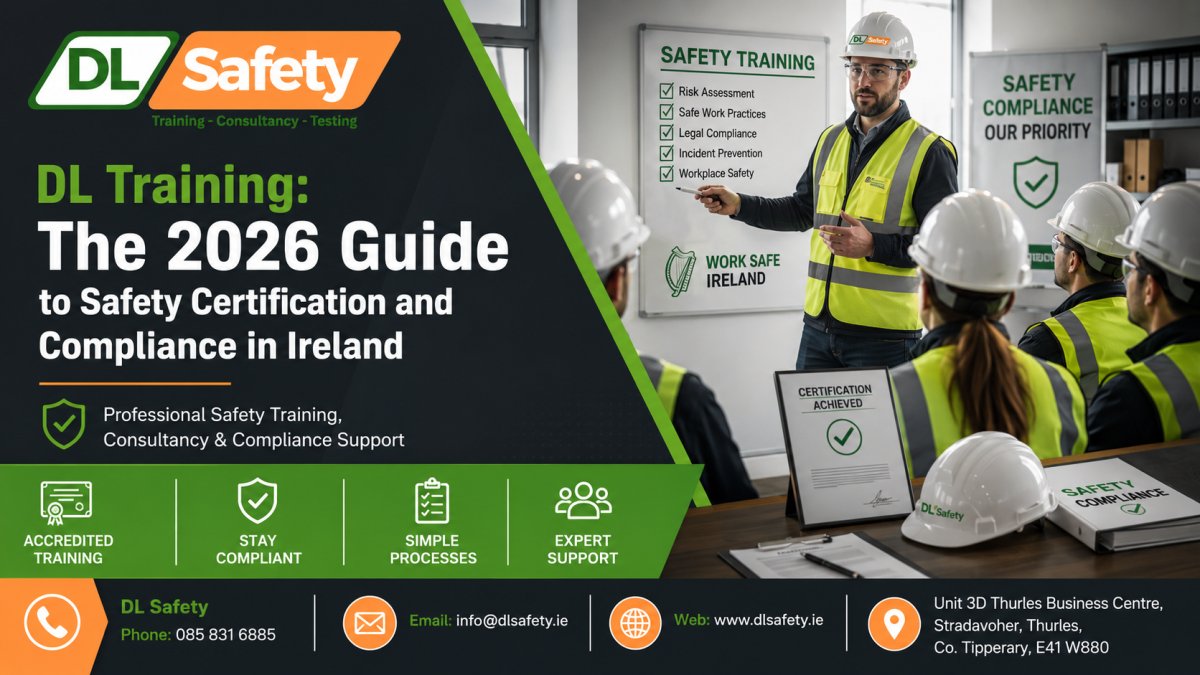
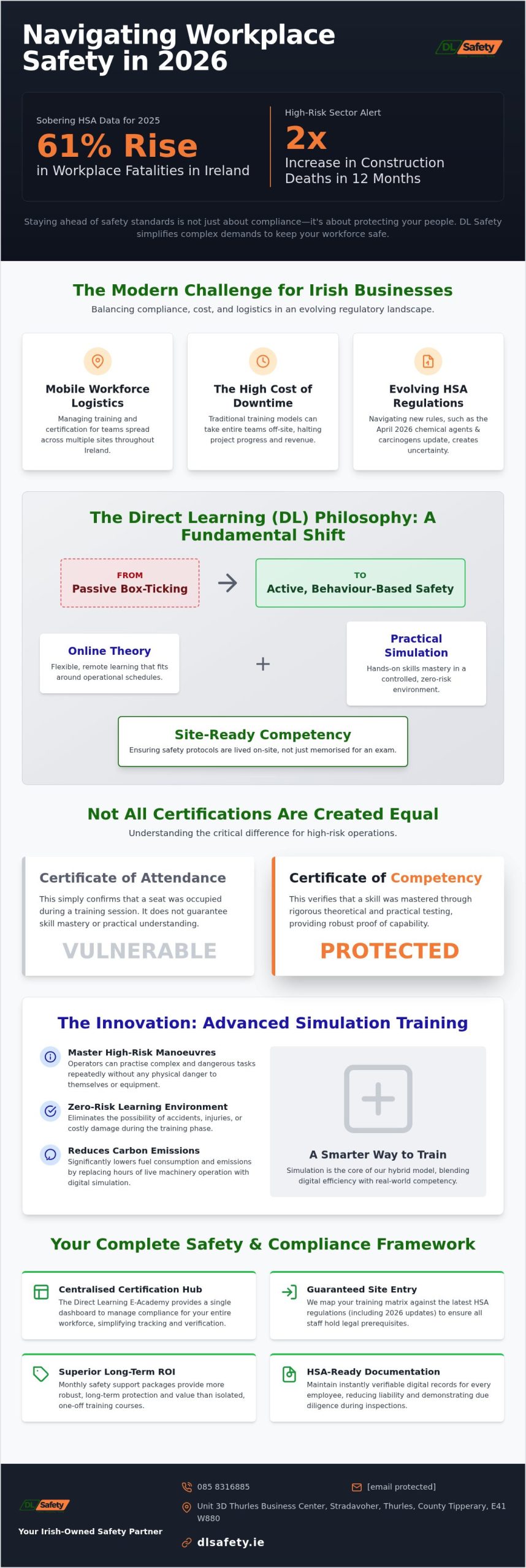
Workplace fatalities in Ireland rose by 61% in 2025, with construction deaths doubling in just twelve months. This sobering data from the HSA highlights why staying ahead of safety standards isn’t just about ticking boxes; it’s about protecting your people. We understand that managing dl training for a large, mobile workforce is often a logistical headache, especially when you’re trying to balance the high cost of downtime with the need for absolute compliance.
It’s natural to feel uncertain about which certificates are legally required for specific roles, particularly with the new April 2026 regulations regarding chemical agents and carcinogens now in force. At DL Safety, we pride ourselves on being a trusted advisor that simplifies these complex demands. This guide will show you how Direct Learning provides the specialised certification and practical skills needed to keep your workforce safe and fully HSA-compliant without stalling your operations.
We will preview a streamlined training process that reduces liability and improves site safety behaviours through innovative methods like simulation training. You’ll also learn how to maintain HSA-ready documentation for every employee, ensuring your business remains resilient in an evolving regulatory landscape. For tailored advice, contact our expert team today or visit www.dlsafety.ie to explore our full range of safety support packages.
Key Takeaways
- Understand how the Direct Learning E Academy centralises your safety certification, making it simpler to manage compliance for a mobile workforce across Ireland.
- Discover the benefits of advanced simulation training, which allows operators to master high-risk manoeuvres in a zero-risk environment whilst reducing carbon emissions.
- Learn how to map your training matrix against the latest 2026 HSA regulations to ensure all staff have the legal prerequisites for site entry.
- See why integrating dl training into a monthly safety support package provides superior long-term ROI and more robust protection than isolated, one-off courses.
- Gain practical insights into maintaining HSA-ready documentation that reduces liability and fosters safer workplace behaviours in high-risk sectors.
What is DL Training? Defining the Direct Learning Philosophy
Direct Learning (DL) training is not just another acronym in a sea of compliance jargon; it represents a fundamental shift in how Irish businesses approach workforce development. Our philosophy moves away from treating safety as a simple box-ticking exercise, instead blending deep theoretical knowledge with immediate, practical site application. We’ve designed this approach to ensure that safety protocols aren’t just memorised for an exam but are actively lived on the shop floor or construction site. Central to this is the Direct Learning E Academy, which serves as a centralised hub for Irish safety compliance, allowing managers to oversee their team’s progress and certifications from a single, reliable dashboard.
Accredited training acts as the absolute cornerstone of any robust Safety Statement. Without verified, high-quality instruction, your legal protections remain hollow and vulnerable to scrutiny. We’ve seen a noticeable shift amongst industrial workers from passive learning to active, behaviour-based safety training. By utilising modern distance education methodologies, we provide the flexibility that modern Irish industries demand, ensuring that dl training fits into your schedule rather than disrupting it.
The Evolution of Safety Training in 2026
Traditional classroom-only models are becoming increasingly outdated for modern construction and agricultural sites. In 2026, the high cost of downtime means you can’t afford to have your entire team off-site for days of theory that could be handled more efficiently elsewhere. Digital records now play a vital role in proving compliance during a surprise HSA inspection, providing instant, verifiable proof of a worker’s status. To safeguard these systems, many organisations explore fees for specialised IT training and security audits as part of their broader risk management strategy. DL training is the strategic integration of online theory and practical simulation. This hybrid model ensures that when a worker steps onto a site, they’re fully prepared for the specific hazards they’ll face.
The Evolution of Safety Training in 2026
High-risk operations, particularly those involving heavy machinery, require more than just a basic certificate. For lifting operations, understanding LEEA standards is non-negotiable for ensuring equipment and operators meet rigorous international benchmarks. It’s crucial for managers to distinguish between simple “attendance” certificates and genuine “competency” certifications. One confirms a seat was occupied, whilst the other confirms a skill was mastered through rigorous testing. Working with an Irish-owned consultancy that understands local statutory requirements is essential for long-term peace of mind.
DL Safety is based at Unit 3D Thurles Business Center, Stradavoher, Thurles, County Tipperary, E41 W880. You can reach our team at 085 8316885 or via email at info@dlsafety.ie to discuss how our accredited programmes fit your specific needs. Our website, www.dlsafety.ie, offers a full directory of these competency-based courses, helping you maintain the high standards your business deserves.
Core DL Training Categories for Industrial Sectors
Industrial safety isn’t a one-size-fits-all requirement. In construction, transport, and agriculture, certain high-risk activities make specific certifications a legal prerequisite for site entry. We don’t believe in generic, off-the-shelf solutions that fail to address your site’s unique hazards. Instead, dl training focuses on practical competency aligned with professional safety standards. This ensures your team isn’t just following a script but actually understands the risks inherent in their specific environment. Regular “Toolbox Talks” then serve as vital reinforcements, keeping these safety behaviours fresh between formal certification cycles.
Lifting and Excavation Safety
Lifting operations carry some of the highest risks on any Irish site. Our Lifting Equipment Inspection Training empowers your staff to identify subtle defects in shackles or slings before they lead to a catastrophic failure. Similarly, Excavator Basic Lifting Training provides operators with the technical knowledge to manage complex load dynamics safely. These training modules work hand-in-hand with statutory requirements like GA1 testing Ireland, creating a dual layer of protection through both competent people and certified machinery.
Chemical Awareness and Environmental Safety
The new 2026 regulations regarding lead and diisocyanates have placed a renewed focus on hazardous substances. Chemical Awareness Training, which includes practical Spill Kit Deployment, is now essential for maintaining COSHH compliance. Beyond chemicals, excavation safety must address geotechnical stability to prevent slope failure or trench collapses. If you’re managing these risks, integrating this training with a thorough Chemical Risk Assessment Ireland ensures your documentation matches your on-site reality.
Essential Workplace Safety Courses
Manual Handling and Working at Height remain the most common areas for workplace injuries across Ireland. These “Big Two” subjects form the foundation of our safety curriculum. We also provide Fire Safety Awareness, which is a critical component of any effective emergency response plan. By using the Direct Learning E Academy, your team can complete the theoretical portions of these courses online. This significantly speeds up the certification process, allowing your workforce to spend less time in a classroom and more time working safely. If you’re looking to streamline your compliance, you can view our full course catalogue to find the right fit for your team.
The Innovation: Simulation Training vs. Traditional Methods
Traditional safety training often presents a difficult choice: either keep workers in a classroom with purely theoretical material or put them behind the wheel of expensive machinery where mistakes are costly. We’ve bridged this gap by integrating advanced simulation into our dl training curriculum. This technology allows operators to practice high-risk manoeuvres, such as steep slope navigation or complex lifting, in a completely zero-risk environment. It’s a pragmatic shift that prioritises safety without sacrificing the practical experience needed to master heavy plant machinery.
Muscle memory is far more effective than theory alone when an operator faces a split-second decision on a busy quarry floor. Whilst online learning provides the essential groundwork, simulation builds the physical intuition required for safe operation. This approach also significantly reduces the wear and tear on your actual site equipment. By moving the initial learning curve to a digital platform, you protect your fleet from the inevitable gear-grinding and hydraulic stress that comes with novice training.
Increasing Efficiency and Reducing Site Emissions
Modern Irish businesses are under increasing pressure to meet ESG (Environmental, Social, and Governance) targets. Simulation training provides a direct pathway to these goals by drastically reducing the carbon emissions associated with operator development. Since no diesel is burnt during the simulation phase, companies can report a measurable reduction in their training-related fuel consumption. Simulation is the vital bridge between the theoretical lessons of the Direct Learning E Academy and live site operations, ensuring workers arrive on-site with a high level of proficiency already established.
The “Personable Expert” Approach to Tech
Despite the high-tech nature of the equipment, we don’t believe in a “set and forget” model. Simulation still requires a personable expert to provide real-time feedback and coaching to be truly effective. Our instructors at DL Safety monitor every session, correcting bad habits before they become ingrained behaviours. This psychological benefit is immense; building operator confidence in a controlled setting means they are far less likely to hesitate or panic when they eventually step into a multi-tonne vehicle.
All simulation results are integrated into a trainee’s permanent record, providing you with a data-driven view of their competency. If you’d like to see this technology in action, visit us at Unit 3D Thurles Business Center, Stradavoher, Thurles, County Tipperary, E41 W880. You can also call David and the team at 085 8316885 or email info@dlsafety.ie. For more information on our innovative training methods, explore our website at www.dlsafety.ie.
Compliance Mapping: HSA Requirements and Certificate Verification
Building a training matrix that stands up to scrutiny is a fundamental task for any site manager. It’s about ensuring every individual on your site possesses the specific skills required for their role. A robust matrix doesn’t just list names; it maps every competency against the legal requirements of the project. This documentation is a legal necessity. Keeping these records up-to-date and accessible on-site is the only way to prove you’ve met your duty of care. When an inspector arrives, your dl training records should be the first thing you can produce.
Organisation is your best defence during unannounced visits. Organised digital records allow you to handle What to Expect During a HSA Inspection with total confidence. Beyond the certs themselves, there’s a vital relationship between training, Method Statements, and Construction Phase Plans. If your Method Statement specifies a task must be performed by a competent person, your training records provide the evidence that this standard has been met. This alignment ensures that safety isn’t just a separate administrative task but is deeply woven into the operational fabric of the site.
How to Verify a Safety Training Certificate
Managers must be vigilant when checking the accreditation body and expiry dates on all staff certs. It’s easy to fall into the trap of accepting “attendance” records as proof of competency. You should verify that the training was delivered by a recognised body, such as LEEA for lifting operations. Avoiding the risks of non-accredited online courses is essential for maintaining your liability insurance. A “cheap” online course that lacks proper accreditation is often worthless when an incident occurs, which is why we prioritise high-standard dl training that meets Irish statutory requirements.
Statutory Testing and Training: A Dual Approach
A trained operator is only half the battle. Even the most skilled worker is at risk if the machinery they use is faulty. This is why the equipment must also have a valid GA1 cert. Coordinating PAT testing and lifting gear inspections with your staff training schedule creates a comprehensive safety ecosystem. We find that site audits are the most effective tool for identifying training gaps, particularly amongst subcontractors who may not follow your internal standards. By ensuring both the person and the machine are certified, you close the loop on site liability.
If you’re unsure if your current matrix meets the latest 2026 standards, our team at Unit 3D Thurles Business Center, Stradavoher, Thurles, County Tipperary, E41 W880, can help. You can book a safety site audit to verify your compliance levels today. Contact us at 085 8316885 or info@dlsafety.ie to get started.
Maximising ROI: Integrating Training into Monthly Support
Many businesses treat safety training as a yearly hurdle to clear. This one-off approach is often less effective than a retained safety support model because knowledge fades and staff turnover creates gaps in your compliance. By integrating dl training into our Monthly Safety Support Packages, you ensure that safety remains a continuous priority rather than a distant memory. This model provides ongoing oversight and regular training updates, keeping your workforce sharp and your documentation HSA-ready at all times.
There’s a clear financial benefit to this approach. Spreading the cost of compliance over a monthly subscription makes budgeting predictable whilst giving you access to expert advice when you need it most. We act as a proactive partner, managing your training matrix for you so that you never have to worry about an expired certificate or a missed regulatory update. We don’t just provide a service; we become an extension of your team, dedicated to your long-term success. Beyond the paperwork, celebrating safety achievements is a great way to boost morale; for specialist rewards and premium craft options for team events, DiKo.LV offers an excellent selection.
Moving from reactive “fire-fighting” to proactive safety management is the most significant step an organisation can take. When you only address safety after an incident occurs, the costs of investigations and downtime far outweigh the investment in prevention. Ongoing support reduces the likelihood of accidents by fostering a culture of constant vigilance amongst your staff. For a deeper look at how this works, read our guide on Monthly Safety Support in Ireland. This transition ensures that your safety protocols evolve alongside your business.
Getting Started with DL Training
Your journey towards a safer workplace begins with the Direct Learning E Academy. Booking your first course is a straightforward process that grants your team immediate access to high-quality, accredited material. However, we often recommend starting with an on-site audit to determine your team’s exact training needs. This allows us to tailor a dl training programme that addresses the specific hazards of your site, ensuring maximum relevance and impact for your employees. It’s about getting the right training to the right people at the right time.
We are here to help you navigate the complexities of Irish safety law. You can find us at Unit 3D Thurles Business Center, Stradavoher, Thurles, County Tipperary, E41 W880. To discuss a bespoke package that fits your unique operational requirements, contact the team at info@dlsafety.ie or call 085 8316885. You can also explore our full range of safety support services at www.dlsafety.ie.
Future-Proofing Your Site Safety
Ensuring your site remains compliant in 2026 requires more than just occasional certification; it demands a continuous commitment to excellence. We have explored how integrating dl training into a broader support model transforms your safety culture from a reactive burden into a proactive asset. By leveraging innovative simulation technology and the Direct Learning E Academy, you can develop a highly skilled workforce whilst maintaining the rigorous documentation the HSA expects during unannounced inspections.
As Irish-owned experts based at Unit 3D Thurles Business Center, Stradavoher, Thurles, County Tipperary, E41 W880, we are here to simplify your regulatory journey. Whether you need a comprehensive on-site audit or a bespoke training package for your team, we provide the pragmatic solutions needed to reduce liability and protect your people. Our mission is to ensure that your business remains resilient in an evolving industrial landscape.
Ready to upgrade your site safety? Contact DL Safety today to discuss our specialised training programmes and support packages. You can reach David and the team at 085 8316885 or via email at info@dlsafety.ie. Let’s work together to make your workplace the safest and most efficient it can be.
Frequently Asked Questions
What is the difference between online and face-to-face DL training?
Online training focuses on delivering theoretical knowledge through the Direct Learning E Academy, whilst face-to-face sessions cover practical application and high-risk manoeuvres. Online modules allow for flexible learning at the student’s own pace, which significantly reduces site downtime. Face-to-face sessions remain essential for tasks requiring physical assessment, such as Manual Handling. Combining both through dl training ensures a comprehensive understanding of safety protocols that matches Irish statutory requirements.
How long are safety training certificates valid for in Ireland?
Most safety training certificates in Ireland are valid for three years, though this interval varies depending on the specific course and industry standards. For instance, Manual Handling and Safe Pass typically require renewal every three years to remain compliant. High-risk specialised certifications might have shorter validity periods. It is best practice to review your training matrix annually to ensure no staff member’s competency has lapsed, maintaining full HSA-ready documentation at all times.
Is simulation training recognised by the HSA for operator competency?
Yes, simulation training is recognised as a valuable component of a broader competency assessment framework by the HSA. Whilst simulation cannot entirely replace live machine assessment for final certification, it is an approved method for building initial skill and muscle memory. It provides a safe environment to practice emergency responses that would be too dangerous in a real vehicle, making it a key part of modern dl training for high-risk sectors.
Can I book bespoke safety training for my specific site hazards?
We specialise in creating bespoke training programmes tailored to the unique hazards and operational requirements of your specific site. Rather than using generic material, our experts conduct site visits to identify specific risks in your quarry or construction project. We then adapt our curriculum to address those exact challenges, ensuring your team receives practical, relevant instruction that directly improves on-site safety behaviours and reduces your overall business liability.
What should I do if a staff member’s safety certificate has expired?
You should immediately remove the staff member from any tasks requiring that specific certification until they have completed a refresher course. Allowing an uncertified worker to continue high-risk tasks creates a significant legal liability and often voids insurance policies. Contact our Thurles centre at info@dlsafety.ie to arrange a priority refresher session or check the Direct Learning E Academy for available online theory modules to begin the recertification process immediately.
How does DL training integrate with GA1 lifting equipment testing?
Training and GA1 testing work together to ensure both the operator and the machinery meet statutory safety standards. A certified operator is only safe if the equipment they use is also verified as fit for purpose. We coordinate our lifting equipment inspection training with your GA1 testing schedule, ensuring that your staff can spot daily defects between formal statutory inspections. This dual approach creates a more robust layer of protection on-site.
What are the most common training gaps found during site audits?
The most frequent gaps we identify during site audits are expired Manual Handling certifications and a lack of specific chemical awareness training. Many firms also struggle with maintaining accessible digital records for subcontractors. Our audits at Unit 3D Thurles Business Center help identify these weaknesses before a HSA inspector does. By addressing these gaps through structured dl training, you ensure your safety documentation is always complete and ready for inspection.
Is the Direct Learning E Academy suitable for small construction firms?
The Direct Learning E Academy is designed to be scalable and accessible for businesses of all sizes, including sole traders and small firms. It provides a cost-effective way to manage compliance without the overhead of a full-time safety officer. Small firms benefit from the same high-level certification and expert support as national contractors, ensuring they can compete for larger projects that require proof of robust, up-to-date safety standards.