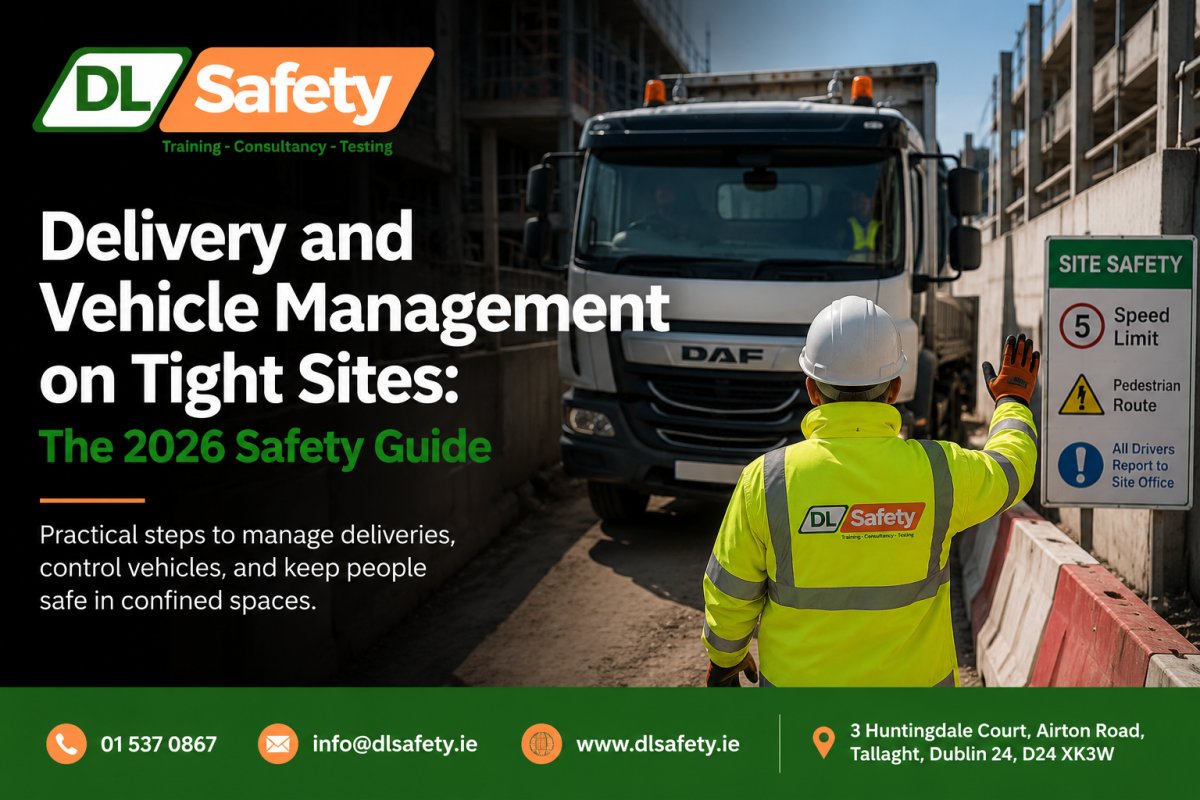
Imagine a Monday morning where a critical concrete pour is delayed because a delivery lorry is wedged at your site entrance, blocking a busy city street and drawing the immediate attention of a passing HSA inspector. It’s the kind of high-stakes pressure that keeps site managers awake at night, especially when every square metre of your project is already accounted for. You understand that on restricted urban projects, there’s simply no margin for error. A single mismanaged vehicle movement doesn’t just cause a logistical headache; it creates a genuine danger to pedestrians and risks a heavy fine that could derail your project’s profitability.
This guide provides you with a professional blueprint to master delivery and vehicle management on tight sites, ensuring your logistics are as lean as your site’s footprint. We’ll explore how to engineer safety into your layout from day one, implement zero-harm traffic management designs, and maintain strict HSA compliance whilst keeping your delivery schedule on track. By the end of this article, you’ll have a clear plan to transform your most congested entrances into centres of efficiency and safety.
Key Takeaways
- Identify high-risk pinch points and use swept path analysis to design one-way systems that eliminate the need for complex reversing.
- Standardise communication protocols and hand signals to ensure banksmen and drivers operate with total clarity at the pedestrian interface.
- Implement mandatory just-in-time booking systems to prevent site-entrance queues and maintain a steady, predictable flow of materials.
- Professional strategies for delivery and vehicle management on tight sites help reduce delays whilst maintaining zero-harm safety standards.
- Discover how regular site audits and GA1 testing for lifting equipment ensure your traffic management plan remains HSA-compliant as the project evolves.
The Core Challenges of Vehicle Management on Restricted Sites
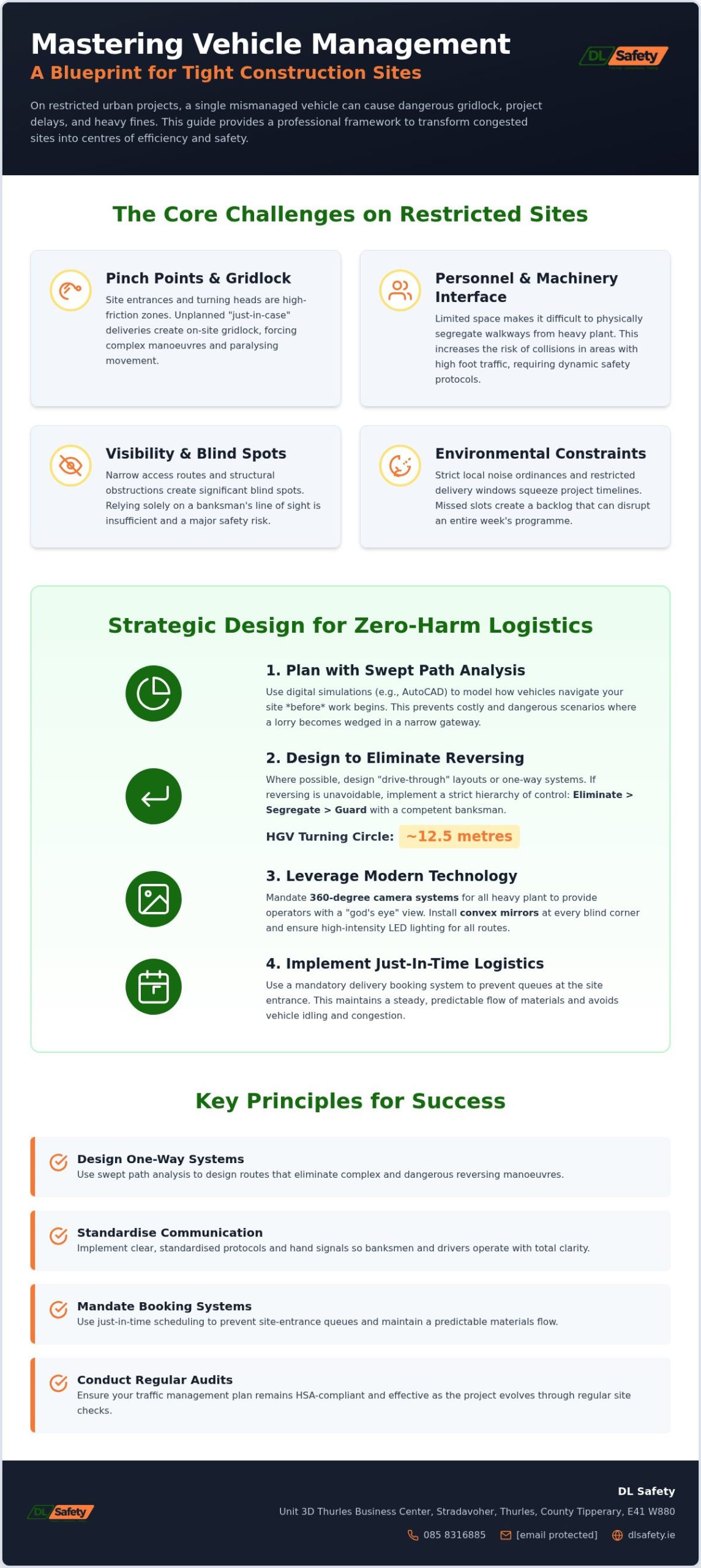
Most generic traffic plans are designed for sprawling greenfield sites where space is a luxury. On an urban infill project, you’re often working within inches of existing structures and public footpaths. This physical restriction makes delivery and vehicle management on tight sites a unique engineering challenge rather than a simple logistical task. Standard plans fail here because they don’t account for the “pinch points” where a single poorly positioned pallet can paralyse the entire site’s movement.
Identifying these pinch points early is essential. It’s usually the site entrance or the single turning head that causes the most friction. When subcontractors order “just-in-case” deliveries to avoid future shortages, they inadvertently create on-site gridlock. This clutter forces vehicles to perform multiple-point turns in areas with high foot traffic, significantly increasing the risk of a collision. It’s a domino effect that turns a minor delay into a full afternoon of wasted productivity.
Managing the interface between heavy machinery and site personnel is the most critical aspect of construction site safety principles. On restricted sites, you often can’t physically segregate walkways with permanent barriers. This lack of space requires a more dynamic approach to safety, relying on strict timing and high-visibility protocols rather than physical distance alone. You’re effectively orchestrating a complex dance where the dancers must never touch.
Congestion and Blind Spot Management
Visibility is your biggest enemy in narrow access routes. In 2026, relying solely on a banksman’s line of sight isn’t enough; we now integrate convex mirrors at every blind corner and mandate 360-degree camera systems for all heavy plant. These technologies provide the operator with a “god’s eye” view, which is vital when a pedestrian might step into a blind spot with only centimetres of clearance. A sterile zone is a clearly defined area where all pedestrian access is strictly prohibited whilst a vehicle is in motion or a delivery is being unloaded. Implementing these zones ensures that delivery and vehicle management on tight sites remains safe even when space is at an absolute premium.
Environmental and Noise Constraints
Operating in a tight urban environment means you’re constantly under the microscope of local residents and council officials. You have to balance the need for early-morning material arrivals with strict local noise ordinances that often forbid heavy engine noise before 8:00 am. Managing engine idling and emissions is equally important in confined spaces to protect worker health and maintain community relations. These restricted delivery windows can squeeze your project timeline, making every minute of your scheduled slot incredibly valuable. If you miss your window, the resulting backlog can disrupt your entire week’s programme.
Strategic Traffic Management Design for Tight Spaces
Effective delivery and vehicle management on tight sites begins at the drawing board long before the first excavator arrives. We use AutoCAD simulation to perform detailed swept path analysis, which allows us to model exactly how a standard 16.5-metre articulated lorry or a specialised urban delivery vehicle will navigate your specific site entrance. This digital foresight prevents the costly and dangerous scenario of a vehicle becoming wedged in a narrow gateway. By integrating professional construction site traffic management plan templates into your early site setup, you establish a predictable, disciplined environment from day one. It’s also vital to maintain clear signage and high-intensity LED lighting; this ensures your traffic routes remain visible and secure 24/7, which is particularly important during winter months or when night-time deliveries are required to meet local council constraints.
Turning Circles and Reversing Manoeuvres
Vertical Storage and Off-Site Holding
When ground-level real estate is non-existent, the best strategy is to move materials vertically or keep them off-site entirely. Utilising off-site consolidation centres allows you to break down large loads into smaller, more manageable deliveries, significantly reducing on-site vehicle dwell time. Once materials arrive, they should be moved to upper floors or gantries immediately to keep access routes clear. Safety is paramount here; ensuring all lifting equipment and hoists are compliant with GA1 testing Ireland standards is a legal necessity. If you’re struggling to balance these competing demands, our bespoke Traffic Management Design services can provide the clarity you need to keep your project moving safely. You can contact our team at Unit 3D Thurles Business Centre, Stradavoher, Thurles, County Tipperary, E41 W880, or email info@dlsafety.ie for expert guidance.
The Role of Banksmen and Communication Systems
The vehicle banksman is the critical human link between a theoretical traffic plan and the safe execution of a delivery. On a restricted project, they act as the driver’s eyes and ears, managing the high-risk zones where visibility is most compromised. Effective delivery and vehicle management on tight sites requires a banksman who does more than just wave their arms; they must actively control the sterile zone and possess the authority to halt movements the moment a pedestrian enters the interface. Confusion is a primary cause of site accidents, which is why standardising hand signals across every subcontractor on-site is non-negotiable. When different crews use conflicting gestures, the risk of a misunderstood instruction skyrockets, potentially leading to a crush injury or structural damage.
Ensuring your team is up to speed with these standards is easier than ever in 2026. Many contractors now utilise online safety courses Ireland to provide foundational banksman theory before personnel even set foot on a live project. This digital induction ensures that every operative understands the legal requirements and the specific “hierarchy of signals” used on-site. Once the theory is mastered, we recommend implementing strict two-way radio protocols. This ensures that the driver and banksman remain in constant vocal contact, providing an extra layer of safety that hand signals alone cannot offer in poor weather or low-light conditions.
Banksman Training and Competency
Competency isn’t just about having a certificate; it’s about the ability to stay alert under pressure. You should verify all training records during the initial site induction and conduct regular spot checks to ensure protocols are being followed. High-visibility PPE is a baseline requirement, but the banksman’s own safety is often overlooked. They must never stand directly behind a reversing vehicle or in a “crush zone” between the lorry and a fixed structure. Fatigue management is also a growing concern on busy urban sites. During high-frequency delivery windows, banksmen should be rotated frequently to ensure their concentration remains sharp and their decision-making stays sound.
Advanced Communication Technology
The industry is moving away from shouting over engine noise. In 2026, wireless headsets have become the gold standard for delivery and vehicle management on tight sites, allowing for clear, hands-free dialogue that isn’t drowned out by nearby piling rigs or traffic. We also see increased use of digital site boards at the main entrance, which update drivers on access route changes or bay availability in real-time. It’s a simple way to prevent lorries from entering a site that’s already at capacity. Finally, a zero-tolerance policy on mobile phone use during vehicle movements is essential. A distracted banksman is a liability, and a phone in the hand is the single biggest risk factor during complex vehicle guidance.
If you need to standardise your site’s traffic protocols or require a bespoke audit of your current banksman arrangements, our team at DL Safety is here to help. You can reach us at our office in Unit 3D Thurles Business Center, Stradavoher, Thurles, County Tipperary, E41 W880. For direct enquiries, call 085 8316885 or email info@dlsafety.ie. We also provide comprehensive support through our website at www.dlsafety.ie to help you maintain a zero-harm environment.
Managing Deliveries: Just-in-Time Logistics and Scheduling
When space is at a premium, a queue of heavy goods vehicles outside your gate is more than a nuisance; it’s a significant safety breach. Effective delivery and vehicle management on tight sites relies on a mandatory digital booking system. This ensures that every vehicle arriving has a pre-allocated slot, preventing the dangerous congestion that occurs when multiple lorries arrive simultaneously. By spreading deliveries across the day, you maintain a steady, predictable flow that doesn’t overwhelm your banksmen or site personnel. If a vehicle arrives without a booking, it shouldn’t be granted access. This might seem strict, but it’s the only way to protect the integrity of your safety plan.
The “Gate-Man” acts as your first line of defence at the perimeter. Their role is to verify that the driver is aware of site-specific hazards and that their Method Statement is current and relevant to the load being delivered. This is also the time to coordinate with local authorities for temporary road closures or designated loading bays on the public highway. These arrangements require early engagement to secure the necessary permits and ensure that public safety is maintained throughout the unloading process. If you need assistance designing a robust logistics schedule, our Traffic Management Design services provide the structure needed for a zero-harm site.
The Just-in-Time (JIT) Delivery Model
The JIT model is a powerful tool for restricted projects because it reduces the need for on-site material storage and the associated vehicle movements required to shift stock around. It’s an efficient way to keep your site lean, but it isn’t without risk. An early arrival can cause a tailback on a busy city street, whilst a late arrival can stall a critical work phase. To mitigate this, we recommend establishing “holding areas” or consolidation centres outside the immediate site vicinity where vehicles can wait safely until their exact slot is available. This buffering ensures that the site entrance remains clear for emergency access at all times.
Subcontractor Coordination
Successful logistics require active participation from every subcontractor on the project. Holding weekly logistics meetings allows you to look ahead at high-volume movements, such as concrete pours or steel deliveries, and deconflict them before they happen. It’s also vital to integrate your traffic rules into the initial site induction programme so that every operative understands the site’s flow from their first day. We’ve found that enforcing clear penalties for non-compliant delivery drivers is often necessary to maintain the discipline required on a high-stakes project. For more information on our support services, you can visit us at Unit 3D Thurles Business Center, Stradavoher, Thurles, County Tipperary, E41 W880, or email info@dlsafety.ie. You can also call us directly on 085 8316885 to discuss your specific site requirements.
Comprehensive Safety Support for Complex Site Logistics
A traffic management plan isn’t a static document; it’s a living strategy that must evolve as your project moves from excavation to fit-out. As site conditions shift, the original design for delivery and vehicle management on tight sites can quickly become outdated. This is where our monthly safety support in Ireland provides a vital safety net. We offer continuous oversight to ensure that your logistics remain compliant and efficient throughout the project lifecycle. This ongoing partnership allows us to manage the complexities of unloading and material movement with precision. We also ensure that all lifting gear, from slings to shackles used during deliveries, is GA1 certified and fit for purpose before it’s used to strike a load.
Should an incident occur, having a professional partner for accident investigation is essential for protecting your business and your workforce. We provide a methodical, transparent approach to identifying root causes and implementing corrective actions. This doesn’t just satisfy regulatory requirements; it builds a culture of honesty and continuous improvement on-site. By treating every vehicle-related incident as a learning opportunity, we help you refine your protocols and prevent a recurrence that could lead to more severe consequences. It’s a supportive approach that turns a high-stress situation into a clear path forward.
Proactive Site Audits and Inspections
The most effective way to prevent accidents is to identify “near-miss” trends before they escalate into something serious. Our regular site audits move beyond basic checklists to perform dynamic risk assessments of your current traffic flow. We look for subtle changes, such as new material storage areas encroaching on turning circles or banksmen becoming complacent with standard hand signals. These findings are reviewed during your monthly safety meetings, where we provide pragmatic solutions to keep your logistics running smoothly. It’s about looking at the big picture to ensure your safety standards never slip as the project reaches its peak intensity.
The DL Safety Advantage
Choosing DL Safety means you’re leveraging David’s extensive, hands-on experience in the Irish construction sector. We don’t just point out problems; we act as a proactive partner, offering tailored advice that respects the practical realities of a busy site. Whether you need bespoke simulation training to prepare your team for high-pressure deliveries or a comprehensive review of your delivery and vehicle management on tight sites, we’re here to help. Our goal is to alleviate the stress of compliance, allowing you to focus on delivering a successful project with total confidence.
Contact DL Safety today to discuss how we can support your next project. You can find us at Unit 3D Thurles Business Center, Stradavoher, Thurles, County Tipperary, E41 W880. Reach out via email at info@dlsafety.ie or call us on 085 8316885. For more information on our full range of services, visit our website at www.dlsafety.ie. We look forward to starting a conversation about how we can help you maintain a safe, efficient, and HSA-compliant construction site.
Building a Culture of Logistical Excellence
Mastering delivery and vehicle management on tight sites is a continuous process that demands both technical foresight and disciplined execution. By moving away from reactive “just-in-case” deliveries and embracing digital scheduling and swept path analysis, you create a site that is as efficient as it is safe. Remember that your banksmen are your most valuable on-site asset; supporting them with standardised communication and professional training ensures that the pedestrian interface remains secure even during high-pressure delivery windows. Professional traffic management design isn’t just about avoiding HSA fines; it’s about protecting your team and your project’s long-term reputation.
Logistical excellence is a hallmark of any successful transport operation, whether managing site deliveries or passenger commutes. To see how these principles are applied to premium inter-city travel in the UAE, you can check out GO Car Lift.
At DL Safety, we’re dedicated to helping you navigate these complexities with our expert Traffic Management Design and GA1 Testing services. Whether you’re based in Tipperary or operating across Ireland, we’re ready to provide the hands-on support you need. Secure your site with a professional Monthly Safety Support Package today to gain the peace of mind that comes with expert oversight. You can also reach us at Unit 3D Thurles Business Center, Stradavoher, Thurles, County Tipperary, E41 W880, or contact us directly at info@dlsafety.ie or 085 8316885. We look forward to helping you build a safer, more productive future on every project.
Frequently Asked Questions
Do I legally need a traffic management plan for a small construction site?
Yes, Irish safety regulations require all construction sites, regardless of their footprint, to have clear arrangements for safe vehicle and pedestrian movement. Under the Safety, Health and Welfare at Work (Construction) Regulations 2013, you must demonstrate that you’ve identified hazards and implemented controls. A formal plan is the best way to manage delivery and vehicle management on tight sites, ensuring you remain compliant and prepared for HSA inspections.
What are the specific training requirements for a vehicle banksman in Ireland?
A vehicle banksman must be competent and have completed a recognised training course that covers standardised hand signals and safe standing positions. It isn’t enough to simply appoint an operative; they must understand the legal hierarchy of signals and how to manage a sterile zone effectively. We recommend using our Online Safety Courses to provide the necessary theoretical foundation before any personnel take on this high-risk responsibility on-site.
How can I prevent delivery trucks from blocking public roads near my site?
Implementing a mandatory digital booking system is the most effective method to stop lorries from queuing on public highways. By allocating specific time slots and utilising off-site holding areas, you ensure vehicles only arrive when your site is ready to receive them. You should also engage with local authorities early to secure temporary loading permits, which provide a legal, managed space for unloading without disrupting local traffic flow.
What happens if a delivery driver refuses to follow on-site safety rules?
You have the authority and a legal obligation to refuse site access to any driver who fails to follow your safety protocols. If a driver ignores a banksman’s instructions or cannot provide a valid Method Statement for their load, they should be turned away at the gate. Consistent enforcement is vital for site discipline; it’s better to face a short material delay than a serious pedestrian-vehicle incident caused by a non-compliant driver.
Can I use technology to help manage vehicle movements on a tight site?
Yes, modern technology is a cornerstone of professional delivery and vehicle management on tight sites where physical space is at an absolute premium. We utilise AutoCAD for swept path analysis during the design phase to model vehicle movements before they happen. On the ground, wireless headsets and digital site boards provide real-time communication that reduces misunderstandings and ensures drivers are aware of access changes before they reach the site perimeter.
How often should a site traffic management plan be reviewed?
Your traffic management plan should be reviewed at least once a month or whenever a significant change occurs in the site’s layout or project phase. As you move from excavation to the structural build, the available turning space and the types of vehicles arriving will change. Regular reviews allow you to adjust your sterile zones and pedestrian walkways, ensuring the plan remains practical and effective as the project evolves toward completion.
What is the role of a GA1 certificate during site deliveries?
A GA1 certificate acts as statutory proof that lifting equipment, such as a lorry-mounted crane or a site hoist, is safe for use. Your site team must verify that any equipment used for unloading materials is GA1 certified and within its required inspection window. Using uncertified gear for unloading is a major breach of safety standards that could lead to equipment failure and would likely invalidate your insurance in the event of an accident.
How does a monthly safety support package help with vehicle management?
A monthly safety support package provides your project with continuous, professional oversight of evolving logistical risks. Instead of a static, one-off plan, you benefit from regular site audits that identify “near-miss” trends and help you adjust your traffic management design in real-time. This proactive approach ensures you stay HSA-compliant and allows our team at DL Safety to handle the complexities of compliance whilst you focus on the build.