If you believe that a lack of physical space is the primary cause of your logistics headaches, you might be surprised to learn that safety is actually a function of time and personnel. In an industry where construction-related fatalities doubled in 2025, the stakes for delivery and vehicle management on tight sites have never been higher. You’re likely all too familiar with the frustration of delivery bottlenecks that drain your budget and the constant, nagging worry of a vehicle-pedestrian collision in a cramped loading bay.
We understand that complying with HSA traffic management requirements feels like a moving target when you’re working on a restricted footprint. This guide provides a clear framework to master these complexities, offering expert strategies for scheduling and personnel safety that protect your team and your bottom line. We’ll examine how professional traffic management design and tools like the HSA’s online planning resources can reduce accident risks whilst significantly improving site efficiency. Whether you need a formal lift plan or a monthly safety support package, our team at DL Safety is here to help you navigate these challenges from our base at Unit 3D Thurles Business Centre, Stradavoher, Thurles, County Tipperary, E41 W880. You can reach us at info@dlsafety.ie or 085 8316885, or visit www.dlsafety.ie to discuss your specific site needs.
Key Takeaways
- Learn how to isolate high-risk zones using physical barriers to protect pedestrians from vehicle blind spots and reversing manoeuvres.
- Discover how to master delivery and vehicle management on tight sites by implementing one-way systems that eliminate hazardous turning requirements.
- Understand the essential roles of the Vehicle Banksman and how standardised communication protocols prevent collisions in constrained spaces.
- Explore how Just-in-Time delivery scheduling prevents site clutter and reduces the risk of traffic congestion on surrounding public roads.
- Find out how professional safety audits and support packages help you maintain a robust framework for long-term site compliance and efficiency.
The Challenges of Vehicle Management on Restricted Site Footprints
In the context of modern Irish urban development, “tight site” vehicle management refers to the complex coordination of logistics within constrained boundaries. These are environments where traditional turning circles are unavailable, forcing heavy goods vehicles to operate in spaces never designed for them. Effective delivery and vehicle management on tight sites requires a shift from reactive problem-solving to proactive planning. Without this, the primary risks, including large blind spots, hazardous reversing manoeuvres, and the constant threat of the pedestrian-vehicle interface, become almost impossible to control.
Poorly managed logistics don’t just lead to near-misses; they result in tangible structural damage to adjacent buildings and costly HSA enforcement notices. Under the Safety, Health and Welfare at Work (Construction) Regulations 2013, a site-specific Traffic Management Plan (TMP) isn’t a recommendation; it’s a legal requirement. Failure to produce a robust plan can halt work entirely, leaving project managers to explain avoidable delays to stakeholders. It’s a high-stakes environment where every centimetre and every second of the delivery window counts.
The Hidden Costs of Logistics Failures
The financial impact of a bottlenecked site goes far beyond the immediate delay. Idle machinery waiting for blocked deliveries represents a significant drain on project resources, as plant hire costs and labour wages continue to accrue regardless of productivity. Additionally, the reputational damage caused by blocking public highways or residential access can lead to strained community relations and local authority intervention. We often find that professional health and safety site audits are the most effective way to identify these hidden bottlenecks before they escalate into expensive operational crises. Our auditors look for the practical friction points that generic plans often overlook.
Regulatory Expectations for Restricted Sites
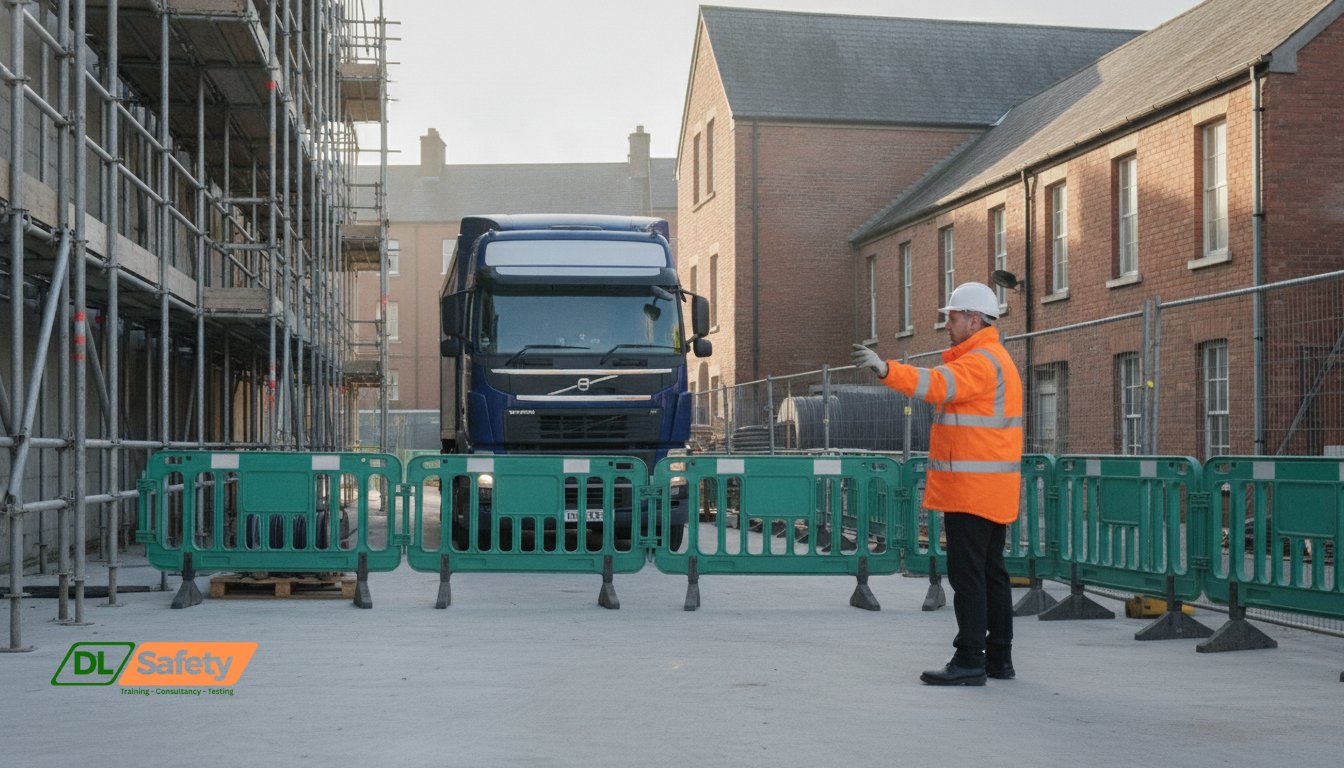
The Health and Safety Authority (HSA) expects clear, physical segregation between vehicles and people, even when space is at a premium. This high standard of Construction site safety must be defined within your Construction Phase Plan, outlining exactly how vehicles enter, move within, and exit the footprint. Central to this operation is the Banksman, who is a trained professional responsible for guiding vehicle movements and ensuring the safety of everyone in the vicinity.
If you’re struggling with a particularly challenging site layout, our team at DL Safety can help. Based at Unit 3D Thurles Business Centre, Stradavoher, Thurles, County Tipperary, E41 W880, we specialise in Traffic Management Design and practical safety solutions. You can contact us at info@dlsafety.ie or call 085 8316885 to discuss how we can support your next project and ensure your site remains both safe and efficient.
Designing a Traffic Management Plan (TMP) for Constrained Spaces
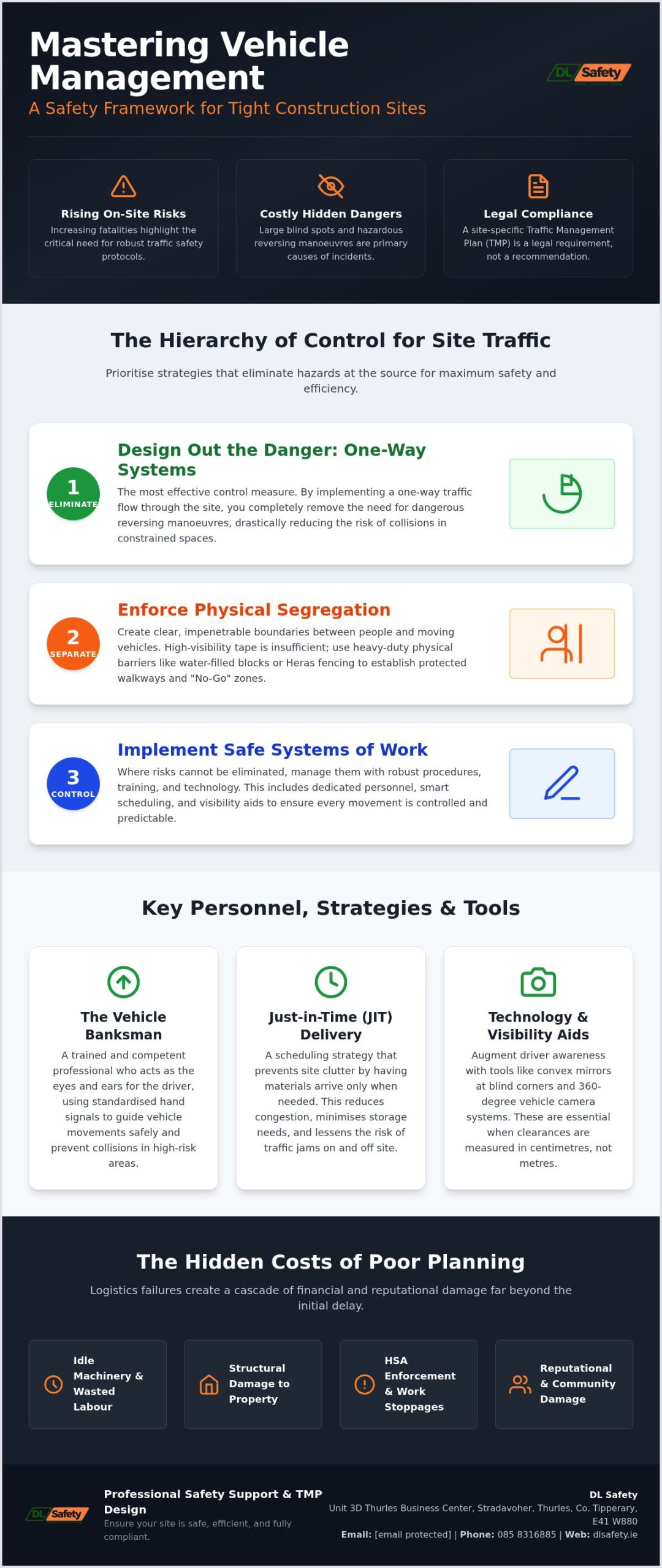
Designing a robust TMP for a restricted footprint begins with the hierarchy of control. The most effective way to manage delivery and vehicle management on tight sites is to eliminate reversing manoeuvres entirely through the implementation of one-way systems. When the physical boundaries of the site don’t allow for a through-road, you must establish clear “No-Go” zones for all non-essential personnel. In our experience, high-visibility tape is rarely sufficient in high-traffic areas. We always recommend using heavy-duty physical barriers, such as water-filled blocks or Heras fencing, to create an absolute segregation between workers and moving plant.
Technology plays a vital role in augmenting driver visibility in cramped conditions. Convex mirrors positioned at blind corners and 360-degree camera systems on site vehicles provide the operator with a comprehensive view of their surroundings. This is essential when clearances are measured in centimetres rather than metres. Integrating your traffic management design directly into the site safety statement ensures that these controls are not just theoretical suggestions but are enforceable site rules.
Mapping the Site Layout
A successful layout identifies “conflict points” where vehicles and workers are most likely to intersect, such as site entrances or narrow corridors between structures. You must designate specific loading and unloading bays that remain clear of emergency egress routes at all times. Effective mapping also extends to the site perimeter. By using temporary signage to organise driver behaviour before they enter the gates, you prevent the chaos of HGVs idling on public roads whilst waiting for access. This level of planning aligns with modern research on JIT delivery in construction, which demonstrates how precise scheduling reduces the need for on-site material storage and minimises site congestion.
Dynamic Risk Assessments for Daily Changes
A static TMP often fails because construction projects are inherently fluid. What worked during the excavation phase will not be fit for purpose during the structural steel or fit-out phases. We advocate for dynamic risk assessments and daily briefings to inform the workforce of scheduled high-volume deliveries or changes in traffic flow. It’s also critical to verify that any lifting equipment used for offloading, such as lorry-mounted cranes, carries a valid GA1 certificate to ensure mechanical integrity and statutory compliance.
If you need assistance refining your site layout, our team at DL Safety is available to provide expert guidance. You can find us at Unit 3D Thurles Business Centre, Stradavoher, Thurles, County Tipperary, E41 W880. For a tailored consultation, email info@dlsafety.ie or call 085 8316885 to discuss how we can support your next project and ensure your site remains both safe and efficient.
Personnel Roles: Training and Competency on Tight Sites
A plan is only as strong as the people who execute it. Whilst physical barriers provide a necessary boundary, the dynamic nature of a restricted footprint requires constant human vigilance and clear communication to prevent accidents. Effective delivery and vehicle management on tight sites relies heavily on the competence of the personnel on the ground. The most critical role in this environment is the Vehicle Banksman. This professional acts as the eyes and ears for the driver, navigating heavy goods vehicles through restricted turning spaces where clearances are often minimal.
To ensure safety, you must establish standardised communication protocols before any vehicle moves. This includes a universally understood set of hand signals and, where appropriate, the use of two-way radios with strict etiquette to avoid confusion. Every person involved in logistics must also be equipped with high-visibility clothing and appropriate PPE. This ensures they remain visible to operators at all times, even in low-light conditions or through rain-streaked mirrors. Furthermore, every delivery driver must undergo a site-specific induction. This briefing should highlight unique hazards, such as overhead obstructions or specific “No-Go” zones, before they are permitted to enter the loading area.
Banksman Training and Legal Requirements
A vehicle signaller must possess specific competencies to manage the risks associated with large vehicle movements. Relying on untrained “helpers” or whoever happens to be nearby is a dangerous practice that often leads to collisions. An untrained signaller may stand in a driver’s blind spot or give ambiguous signals that result in structural damage or injury. To build a foundation of theoretical knowledge, many contractors utilise online safety courses to ensure their team understands the legal requirements and safety principles of vehicle guidance. At DL Safety, we advocate for formal training to ensure every signaller is confident in their responsibilities.
Managing Driver Behaviour
Controlling the behaviour of visiting drivers is essential for maintaining site order. You should set and strictly enforce site speed limits, typically between 5 and 10 mph. High speeds on a cramped site leave no room for error and significantly increase the severity of any potential impact. Additionally, you must prohibit the use of mobile phones by drivers whilst their vehicle is in motion. The site foreman plays a vital role here, supervising unloading operations and ensuring that both the driver and the site team adhere to the agreed safety protocols.
If you require bespoke training or a review of your personnel’s safety competencies, our team at Unit 3D Thurles Business Center, Stradavoher, Thurles, County Tipperary, E41 W880, is ready to assist. You can contact DL Safety at info@dlsafety.ie or call us on 085 8316885. Our goal is to help you maintain a safe, compliant, and efficient workplace through professional guidance and support.
Implementing a Just-in-Time (JIT) Delivery Strategy
On a restricted site, material storage is a luxury you simply don’t have. Just-in-Time (JIT) delivery is a logistics strategy where materials arrive exactly when they’re needed for installation or immediate use. This approach is fundamental to effective delivery and vehicle management on tight sites because it prevents the build-up of on-site storage clutter that often leads to accidents. By using digital delivery booking systems, you can assign specific time slots to vendors, which prevents the dangerous practice of HGVs queuing on public roads and causing local traffic disruption.
For vehicles that arrive ahead of their scheduled slot, establishing off-site “holding areas” is a practical solution. This keeps the site entrance clear and ensures that the vehicle only approaches when the loading bay is ready and the banksman is in position. In sensitive urban areas, you may need to coordinate with local authorities to arrange “out of hours” deliveries. This reduces the risk of pedestrian-vehicle interface during peak footfall hours and allows for smoother manoeuvring when the surrounding streets are quieter.
Reducing On-Site Congestion
Site congestion is more than just an inconvenience; it’s a significant safety hazard. When a site is over-stocked, drivers are forced to perform more complex manoeuvres in even tighter spaces, increasing the likelihood of striking a worker or damaging a structure. Good housekeeping and a commitment to JIT principles ensure that travel routes remain unobstructed and that loading areas aren’t used as makeshift storage zones. Every square metre of saved space reduces the risk of a manoeuvring accident. By maintaining a clear footprint, you provide your plant operators with the visibility and room they need to work safely.
Liaising with Suppliers
Clear communication with your supply chain is essential for managing a constrained site. You should set strict requirements for vehicle sizes, often requesting rigid lorries instead of large articulated trailers that may struggle with local corner radii. To further enhance safety, ensure all delivery vehicles are equipped with white-noise reversing alarms, which are less intrusive in residential areas but highly effective at alerting nearby workers. Additionally, managing the prompt return of empty pallets and waste is vital to keeping loading bays clear for the next scheduled arrival.
If you’re struggling to balance complex logistics with safety requirements, contact DL Safety for a traffic management design consultation. Our team at Unit 3D Thurles Business Center, Stradavoher, Thurles, County Tipperary, E41 W880, can help you develop a robust JIT strategy tailored to your site’s unique constraints. Reach out to us at info@dlsafety.ie or call 085 8316885 to ensure your site remains both productive and compliant.
How Professional Safety Support Optimises Site Logistics
Managing a restricted footprint requires more than just a one-off plan; it demands ongoing vigilance and the ability to adapt to a changing environment. Our Monthly Safety Support Packages provide this continuous oversight, ensuring that your traffic management protocols stay relevant as the project evolves. Site teams often become accustomed to the risks they walk past every day, which is why independent safety audits are so valuable. These audits provide a fresh perspective, spotting the subtle bottlenecks in delivery and vehicle management on tight sites that might otherwise lead to a collision or a costly HSA enforcement notice.
Beyond design, we provide the technical testing required to keep your plant and equipment operational. For larger machinery, we integrate services like quarry vehicle brake testing to verify mechanical integrity under load. We also ensure that all lifting equipment used during offloading, including chains, slings, and shackles, has undergone rigorous GA1 testing. This methodical approach to equipment safety ensures that your logistics chain isn’t broken by a mechanical failure or a compliance gap during a busy delivery window.
Bespoke Traffic Management Design
Generic templates rarely account for the unique constraints of an urban construction site. We move beyond “off-the-shelf” solutions to create bespoke traffic management designs that consider your specific turning circles, loading bay locations, and emergency egress routes. These are live documents that we update as your project transitions through different phases, from the initial excavation to the final fit-out. If you’re planning a project with significant logistical challenges, contact our team at info@dlsafety.ie for a consultation on how to optimise your site layout.
Ensuring Long-Term Compliance
Retained safety consultants play a vital role in preparing your site for unannounced HSA inspections. By having a dedicated professional like David to manage your safety documentation and risk assessments, you can be confident that your site remains compliant without the administrative burden falling solely on your site manager. This partnership fosters a culture of safety that protects your workers and your reputation. For expert support in managing your site logistics, visit us at Unit 3D Thurles Business Center, Stradavoher, Thurles, County Tipperary, E41 W880, or call 085 8316885 to discuss your requirements. You can also find more information on our full range of services at www.dlsafety.ie.
Future-Proofing Your Site Logistics
Managing a restricted footprint doesn’t have to be a source of constant stress. By moving from reactive problem-solving to a structured approach involving one-way systems and Just-in-Time scheduling, you transform safety into a driver of efficiency. You’ve seen how delivery and vehicle management on tight sites relies on the synergy between precise traffic management design and the competency of your banksmen. Our role at DL Safety is to provide the professional oversight and technical testing required to maintain these high standards across every project phase. Whether you need a bespoke lift plan or regular site audits, we’re here to help you navigate the complexities of modern construction safely.
Secure your site with a professional Traffic Management Plan from DL Safety. Our team provides expert Traffic Management Design, nationwide Monthly Safety Support, and certified GA1 testing services. Visit us at Unit 3D Thurles Business Center, Stradavoher, Thurles, County Tipperary, E41 W880, or reach out to us at info@dlsafety.ie or 085 8316885. We look forward to helping you build a safer, more efficient site.
Frequently Asked Questions
What is a Construction Traffic Management Plan (TMP)?
A Construction Traffic Management Plan (TMP) is a formal document that details the procedures for managing vehicle and pedestrian movements on a site. It’s a legal requirement under the Safety, Health and Welfare at Work (Construction) Regulations 2013. The plan identifies specific entry and exit points, vehicle travel routes, and designated loading bays. By establishing these rules, you ensure that everyone on-site understands how to move safely without interfering with high-risk plant operations.
Is a trained banksman legally required on all Irish construction sites?
A trained banksman, or vehicle signaller, is legally required whenever vehicle movements cannot be safely managed through other means, such as one-way systems. Under Irish law, anyone acting as a signaller must be competent and have received appropriate training. Relying on untrained staff is a dangerous breach of safety regulations that significantly increases the risk of collisions. Professional training ensures that signallers use standardised hand signals and understand the blind spots of various vehicles.
How do I manage deliveries on a site with no on-site parking?
Managing delivery and vehicle management on tight sites with zero parking requires a strict Just-in-Time (JIT) delivery strategy. You should implement a digital booking system that assigns precise time slots to every supplier. This prevents vehicles from arriving simultaneously and queuing on public roads. If a vehicle arrives early, they should wait at a pre-arranged off-site holding area until their slot begins. This ensures that the loading area is always clear for the next scheduled arrival.
What are the most common accidents involving vehicles on tight sites?
The most common accidents involve vehicles striking pedestrians, particularly during reversing manoeuvres or when drivers are navigating blind corners. Structural damage to adjacent buildings and collisions between two moving vehicles are also frequent in cramped conditions. Many of these incidents are caused by a lack of physical segregation or poor communication between the driver and the banksman. Implementing clear “No-Go” zones and using physical barriers is the most effective way to prevent these accidents.
How often should a Traffic Management Plan be reviewed?
You should treat your Traffic Management Plan as a live document that requires regular review. It’s best practice to update the plan at every major phase change of the project, such as moving from excavation to structural steel. Additionally, any near-miss or accident involving a vehicle should trigger an immediate review of your existing controls. Regular site audits help identify if the current layout still effectively segregates pedestrians from the evolving vehicle travel routes.
Can I use a standard risk assessment for vehicle management on a restricted site?
A standard risk assessment is rarely sufficient for delivery and vehicle management on tight sites because it fails to account for unique spatial constraints. Every restricted footprint has specific conflict points, such as narrow entrances or overhead obstructions, that require bespoke controls. You must develop a site-specific assessment that details the exact hazards of your location. This ensures that your safety protocols are practical and address the real-world dangers your team faces daily rather than relying on generic templates.
What PPE is required for personnel managing site traffic?
Personnel managing site traffic must wear high-visibility clothing that meets EN ISO 20471 standards, typically a Class 3 high-vis jacket or waistcoat. This ensures they remain visible to drivers in all lighting conditions. Standard site PPE, including a hard hat, safety boots, and gloves, is also mandatory. In noisy environments, signallers should use two-way radios with noise-cancelling headsets to maintain clear, uninterrupted communication with drivers during complex manoeuvres or offloading operations.
How can technology improve vehicle safety on small construction sites?
Technology offers several ways to enhance safety, such as 360-degree camera systems and proximity sensors that alert drivers to nearby pedestrians. White-noise reversing alarms are also beneficial as they provide a directional warning that’s easier to locate than traditional beepers. Digital delivery booking systems are another vital tool, as they allow you to coordinate arrivals and prevent the congestion that leads to accidents. These innovations complement traditional banksman guidance to create a much safer working environment.