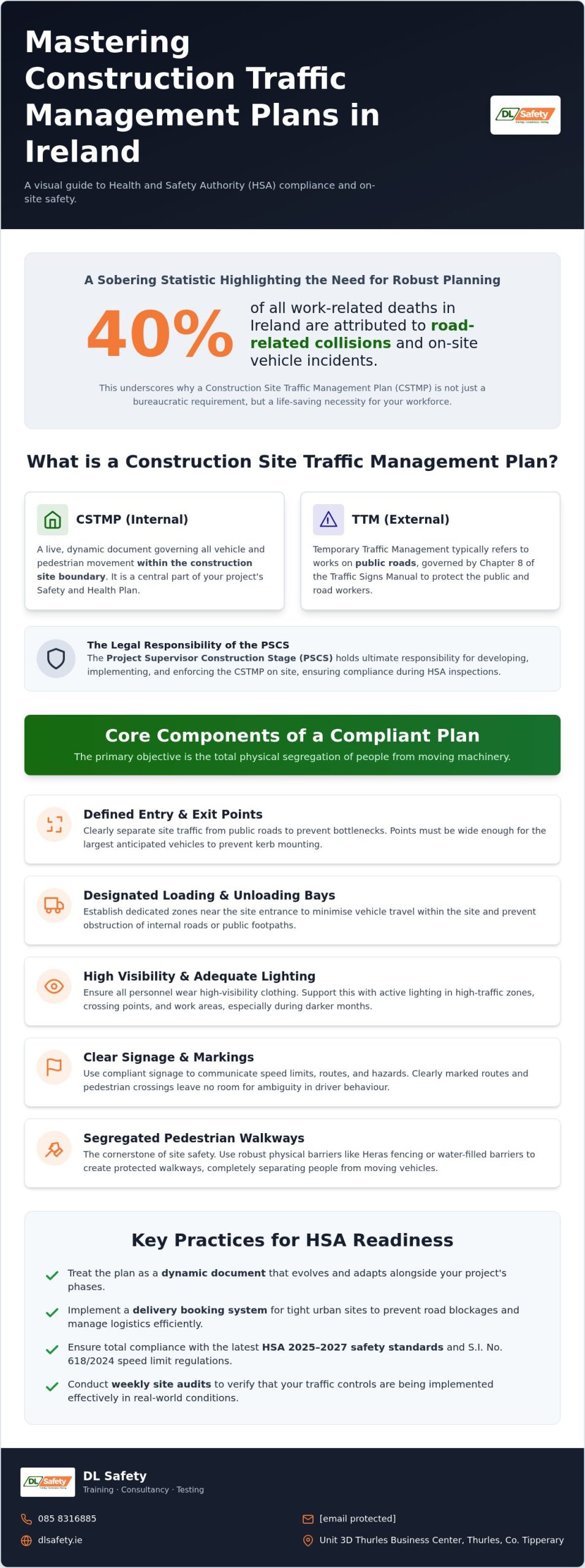
Did you know that road-related collisions account for up to 40% of all work-related deaths in Ireland? This sobering statistic highlights why a robust construction traffic management plan Ireland is far more than a bureaucratic hurdle; it’s the primary safeguard for your workforce and your professional reputation. We understand that managing high vehicle volumes on a constricted site feels like a constant balancing act, especially when you’re facing the rigorous standards of the 2025–2027 HSA Construction Safety Action Plan.
It’s natural to feel the pressure of potential HSA inspections or the confusion surrounding the specific duties of the PSCS regarding site traffic. You want a site that runs like clockwork, where safety protocols are clear and vehicle risks are minimised. This guide provides a definitive roadmap to mastering both the legal requirements and the practical implementation of your traffic strategy. We’ll walk you through the essential components of a compliant plan, the latest speed limit regulations from S.I. No. 618/2024, and how to maintain a safe, efficient site that stands up to the highest levels of scrutiny. For expert compliance support, contact our team at info@dlsafety.ie or visit www.dlsafety.ie.
Key Takeaways
- Understand the legal foundations under the 2013 Regulations and why your plan must be a dynamic document that evolves alongside your project.
- Learn how to prioritise physical segregation to protect pedestrians from vehicle movements, which is the cornerstone of any effective site safety strategy.
- Discover how to manage complex logistics on tight urban sites by implementing delivery booking systems that prevent road blockages and local congestion.
- Master the specific requirements for a construction traffic management plan Ireland to ensure total compliance with the latest HSA 2025–2027 safety standards.
- Identify the best practices for conducting weekly site audits to verify that your traffic controls are working effectively in real-world conditions.
What is a Construction Traffic Management Plan (CSTMP) in Ireland?
A construction traffic management plan Ireland is far more than a static drawing stored in a site office folder. It’s a live, breathing document that governs every vehicle and pedestrian movement on your project from commencement to completion. Under the Safety, Health, and Welfare at Work (Construction) Regulations 2013, this plan serves as the primary mechanism for reducing the risk of vehicle-related accidents. This is particularly vital given that road-related collisions and on-site vehicle movements remain a leading cause of workplace fatalities. By applying fundamental traffic engineering principles to the unique constraints of a building site, we can create a safer environment for everyone.
It’s vital to distinguish between Temporary Traffic Management (TTM) and your CSTMP. TTM typically refers to works on public roads, governed by Chapter 8 of the Traffic Signs Manual. In contrast, the CSTMP focuses on the internal logistics of the site itself. This plan must be a central part of your project Safety and Health Plan. It ensures that every person entering the site, from the site manager to the casual delivery driver, understands the rules of the road before they turn a wheel.
The Legal Responsibility of the PSCS
The Project Supervisor Construction Stage (PSCS) holds the ultimate responsibility for coordinating traffic safety. It’s their duty to develop the plan and ensure that every contractor and sub-contractor on site adheres to its rules. During a HSA inspection, the authority won’t just look for a document; they’ll look for evidence that the plan is being enforced in real-time. If there’s a disconnect between what’s on paper and what’s happening on the ground, the consequences can be severe. Non-compliance often leads to immediate site closures or heavy fines, creating significant delays and reputational damage for your business.
Who Needs a Traffic Management Plan?
Whether you’re managing a small urban renovation or a large-scale infrastructure project, a traffic plan is essential. For larger sites, the requirements are often detailed within the Preliminary Safety and Health Plan developed during the design phase. Even on smaller sites where space is at a premium, a formal approach is required to manage the risks of reversing vehicles and pedestrian interfaces. We provide expert Traffic Management Design services from our base at Unit 3D Thurles Business Center, Stradavoher, Thurles, County Tipperary, E41 W880. If you’re unsure about your specific requirements, you can reach our team at info@dlsafety.ie or call 085 8316885 to discuss your site needs.
Essential Components of an Effective Traffic Management Plan
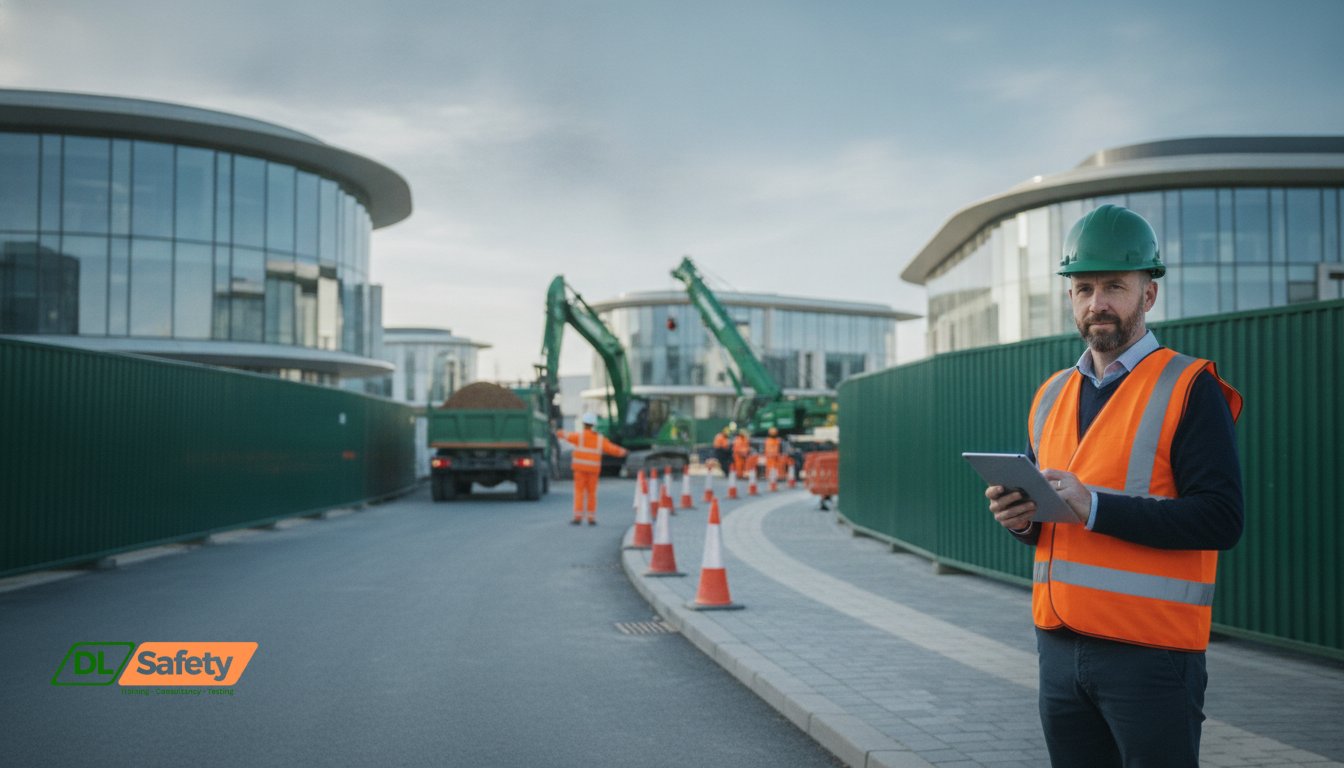
A successful construction traffic management plan Ireland must do more than just map out routes; it needs to actively influence driver and pedestrian behaviour through clear, physical cues. The primary objective is always the total physical segregation of people from moving machinery. This is achieved through robust barriers, such as Heras fencing or water-filled barriers, and clearly defined walkways that leave no room for ambiguity. When pedestrians and vehicles are forced to share space, the risk of a serious incident increases exponentially. Our goal is to design these risks out of the project before the first vehicle arrives on site.
- Defined Entry and Exit Points: Separating site traffic from public thoroughfares prevents bottlenecks and reduces the risk of collisions with passing commuters. These points must be wide enough to accommodate the largest anticipated vehicles without forcing them to mount kerbs.
- Loading and Unloading Bays: Establishing dedicated zones for deliveries ensures that heavy goods vehicles don’t obstruct internal site roads or block public footpaths. These areas should be located as close to the site entrance as possible to minimise vehicle travel within the site.
- Visibility and Lighting: In the dark winter months or during early morning starts, adequate site lighting is non-negotiable for identifying hazards. High-visibility clothing for all personnel is a basic requirement, but it must be supported by active lighting in high-traffic zones and crossing points.
Signage and Chapter 8 Compliance
Signage acts as the site’s voice. We recommend adhering to the Traffic Signs Manual, particularly Chapter 8, to ensure all warnings are universally understood by every driver. Signs should be placed at the driver’s eye level and maintained in a clean, legible condition. Standardising these visuals across the entire site prevents confusion, especially for new contractors who may be unfamiliar with the specific layout. If you need a comprehensive review of your site’s signage or layout, our Traffic Management Design service can help you identify and mitigate hidden risks before they lead to an accident.
Vehicle and Plant Management
Reversing is one of the most dangerous manoeuvres on any site. Implementing a one-way system is the most effective way to eliminate this risk entirely. Where reversing is unavoidable, trained banksmen must be present to coordinate the movement and keep pedestrians clear of blind spots. Speed calming measures, such as ramps or clear 5km/h limits, help maintain a controlled environment. Additionally, every piece of plant must have a valid GA1 testing certification to ensure it’s mechanically sound. At DL Safety, located at Unit 3D Thurles Business Center, Stradavoher, Thurles, County Tipperary, E41 W880, we specialise in creating these technical designs to keep your team safe. You can reach us at info@dlsafety.ie or call 085 8316885 to discuss your specific site requirements.
Managing Site Logistics: Deliveries and Tight Sites
Urban construction sites across the country present unique logistical nightmares that greenfield projects rarely encounter. In these built-up environments, every square metre of space is contested between plant, raw materials, and personnel. A construction traffic management plan Ireland must account for “the squeeze,” which is the reality that large vehicles often have no margin for error when navigating narrow site entrances or internal access roads. When space is at a premium, the risk of a vehicle striking a permanent structure or, worse, a person, increases significantly. We design these routes to ensure that even the tightest site maintains a logical, safe flow of traffic.
To prevent heavy goods vehicles (HGVs) from idling on public roads and causing local congestion, a rigorous delivery booking system is essential. This ensures that only one large vehicle is on-site or in a designated holding area at any given time. Managing “just-in-time” deliveries requires a proactive approach where safety isn’t sacrificed for the sake of a tight schedule. If a delivery arrives unscheduled, the plan must provide the authority to turn that vehicle away if its presence would compromise the safety of the site. This level of control is vital for maintaining discipline in high-pressure environments.
The vehicle banksman is the most critical person on a tight site. They act as the driver’s eyes, especially during high-risk movements like reversing into a blind loading bay. It’s their job to maintain the exclusion zone and ensure that no pedestrians wander into the vehicle’s path. Without a trained banksman, these movements aren’t just difficult; they’re dangerous. We help you categorise these risks and implement the correct level of supervision for every vehicle movement.
The Importance of Swept Path Analysis
We use digital swept path analysis to verify that the largest anticipated vehicles can actually navigate your site layout. This process identifies “pinch points” before the first vehicle ever turns a wheel on the project. By simulating vehicle movements during the design phase, we can adjust the plan for different stages of the build, ensuring that as the building footprint grows, the traffic routes remain viable and safe. This level of technical foresight is what separates a compliant site from a hazardous one, providing a clear visual guide for everyone involved in site logistics.
Communication Protocols for Drivers
Clear communication is the glue that holds site logistics together. Every visiting driver must receive a site-specific induction that covers the one-way system, speed limits, and designated unloading zones. We also establish radio communication standards for plant operators to ensure that instructions are clear and unambiguous. To keep these protocols fresh, we recommend using our toolbox talk topics during weekly safety briefings. Based at Unit 3D Thurles Business Center, Stradavoher, Thurles, County Tipperary, E41 W880, our team helps contractors manage these complex movements daily. You can reach us at info@dlsafety.ie or 085 8316885 for expert advice on your next project.
Implementing and Maintaining Your Plan for HSA Readiness
A construction traffic management plan Ireland is only as strong as its daily enforcement on the ground. It’s common for site layouts to shift overnight as new phases begin; therefore, your safety documentation must keep pace with these physical changes. We recommend conducting thorough weekly site audits to verify that the controls you’ve put on paper actually work in practice for your team. Are the barriers still positioned correctly after yesterday’s deliveries? Is the signage still visible and clean? These audits aren’t just a box-ticking exercise. They’re your first line of defence against vehicle-related accidents and costly site closures.
Documenting near-misses is equally vital for identifying emerging traffic hotspots before they result in an injury. If a vehicle almost strikes a barrier or a pedestrian is caught in a blind spot, it’s a clear signal that the plan needs immediate adjustment. This proactive approach is exactly what inspectors look for during unannounced HSA inspections. Demonstrating that you’ve identified a risk and updated your plan accordingly shows a level of safety leadership that commands respect. If you’re concerned about your site’s current compliance levels, our Health & Safety Site Audits provide the peace of mind you need to focus on the build.
Dynamic Risk Assessments for Traffic
Whilst your initial plan might have been perfect for the excavation phase, it could be entirely unfit for purpose once the structural steel arrives. Dynamic risk assessments allow you to adjust for seasonal changes, such as reduced daylight hours or increased surface water during the Irish winter. Involving your workforce in this process is highly effective; they’re the ones navigating the site daily and often spot hazards before management does. By fostering a culture where drivers and pedestrians feel comfortable reporting traffic issues, you create a safer, more disciplined environment for everyone on site.
Record Keeping and Statutory Forms
Maintaining a clean, updated site safety file is non-negotiable for regulatory compliance. This file should contain your current traffic drawings, records of site-specific inductions, and training logs for all banksmen and plant operators. You must also ensure that all PAT testing for site equipment is up to date to prevent electrical hazards in high-traffic zones. Our team at Unit 3D Thurles Business Center, Stradavoher, Thurles, County Tipperary, E41 W880, can assist in developing these dynamic protocols. You can reach us at info@dlsafety.ie or call 085 8316885, or visit www.dlsafety.ie to ensure your records are HSA-ready and your site remains fully compliant.
Professional Traffic Management Design from DL Safety
A generic template can’t account for the specific hazards of your site. At DL Safety, we believe that a truly effective construction traffic management plan Ireland must be as unique as the project it protects. Led by David, our team of experienced health and safety professionals specialises in creating bespoke traffic designs that do more than just meet legal minimums; they optimise your site’s flow and enhance overall productivity. By looking at the big picture, we help you anticipate logistical hurdles before they cause delays or accidents.
One of the most significant advantages of partnering with us is the seamless integration of traffic safety into our Monthly Safety Support Packages. We don’t just hand over a drawing and disappear. We stay involved, providing ongoing advice on complex site logistics and ensuring your traffic controls evolve alongside your build. This proactive problem-solving approach ensures your site consistently meets the highest Irish safety standards, regardless of the project’s scale or complexity. We position ourselves as your trusted advisor, helping you maintain a site that is both efficient and HSA-ready.
Why Outsource Your Traffic Planning?
Site managers are already stretched thin by the daily demands of a busy project. Outsourcing your traffic planning to a dedicated professional significantly reduces this administrative burden, allowing your team to focus on construction. When you work with DL Safety, you gain access to professional drafting and swept path expertise to verify that large vehicles can navigate your site safely. This provides the peace of mind that your plan is HSA-compliant, robust, and capable of withstanding the most rigorous inspections. We provide a clear roadmap for site safety, reducing the risk of vehicle-related incidents whilst maintaining total regulatory compliance.
Contact Us for Traffic Management Support
If you’re ready to secure your site with a professional traffic strategy, our team is here to help. We pride ourselves on being a reliable partner that alleviates the stress of compliance through transparency and expertise. Whether you’re managing a tight urban site or a large-scale infrastructure project, we have the technical proficiency to ensure your team stays safe. You can reach out to us directly to discuss your requirements or to learn more about our comprehensive range of safety services via the details below:
- Email: info@dlsafety.ie
- Telephone: 085 8316885
- Registered Office: Unit 3D Thurles Business Center, Stradavoher, Thurles, County Tipperary, E41 W880
- Website: www.dlsafety.ie
Securing Your Site for the Road Ahead
Managing construction logistics in 2026 requires a shift from reactive problem-solving to proactive, design-led safety. We’ve explored how a robust construction traffic management plan Ireland acts as a dynamic shield, protecting your team from vehicle-related risks whilst ensuring full compliance with the latest HSA standards. By prioritising physical segregation and maintaining rigorous site audits, you turn complex logistical challenges into a streamlined, disciplined operation that stands up to any inspection. Safety isn’t just a requirement; it’s the foundation of a productive project.
DL Safety is here to support you at every stage of this journey. Whether you need a bespoke Professional Traffic Management Design, comprehensive GA1 Testing & Site Audits, or the ongoing peace of mind provided by our Monthly Safety Support Packages, David and the team provide the expert guidance you need to succeed. We invite you to Get Professional Traffic Management Design from DL Safety today to ensure your project remains safe and compliant. Reach us at info@dlsafety.ie, call 085 8316885, or visit us at Unit 3D Thurles Business Center, Stradavoher, Thurles, County Tipperary, E41 W880. Let’s work together to build a safer industry for everyone.
Frequently Asked Questions
Is a Traffic Management Plan a legal requirement for all construction sites in Ireland?
Yes, a construction traffic management plan Ireland is a mandatory requirement under the Safety, Health and Welfare at Work (Construction) Regulations 2013. This law applies to all projects where vehicle movements pose a risk to personnel or the public. Failing to have a documented plan on-site is a major non-compliance issue that can lead to immediate work stoppages during a HSA inspection. It ensures that every movement is coordinated and risk-assessed from day one.
Who is responsible for creating the construction traffic management plan?
The legal duty to develop and coordinate the plan rests with the Project Supervisor Construction Stage (PSCS). Whilst the PSCS holds the ultimate responsibility, they often collaborate with specialists like DL Safety to produce the technical Traffic Management Design. This ensures the plan is robust, professional, and technically accurate. Ultimately, the PSCS must ensure that all contractors on the project understand their specific roles and adhere to the site rules established within the document.
What is the difference between a TMP and a CSTMP?
A TMP is a broad term often used for temporary measures on public roads, governed by Chapter 8 of the Traffic Signs Manual. A CSTMP (Construction Site Traffic Management Plan) is a specific, detailed document focused on the internal logistics and safety of the building site itself. Whilst they are related, the CSTMP addresses the unique interaction between site-specific plant, pedestrians, and delivery zones that general roadwork plans might overlook during the construction phase.
How often should a traffic management plan be reviewed or updated?
You should review your plan at least weekly or whenever a significant change occurs on the site. Construction sites are fluid environments where a new excavation or the arrival of a crane can instantly invalidate previous routes. If weather conditions deteriorate or daylight hours reduce, a dynamic risk assessment is necessary to update lighting and visibility requirements. Regular updates ensure the plan remains a practical safety tool rather than an outdated piece of paperwork.
What are the most common HSA findings regarding construction traffic?
HSA inspectors frequently identify inadequate physical segregation between pedestrians and moving plant as a primary safety failure. Other common findings include missing or poorly placed signage, the absence of trained banksmen for reversing manoeuvres, and a lack of documented site-specific inductions for delivery drivers. Inspectors also look for mechanical safety, so ensuring all machinery has valid GA1 testing certification is a critical part of maintaining a compliant and safe traffic environment.
Can a small contractor use a generic traffic management plan template?
Relying on a generic template is a high-risk strategy that often fails to address the specific “pinch points” of your project. Every site has unique geographic constraints and varying vehicle volumes that a standard form cannot account for. HSA inspectors expect to see a bespoke plan that reflects the real-world hazards of your specific location. A tailored design provides far better protection for your workforce and significantly reduces the likelihood of regulatory fines or site closures.
What training is required for a vehicle banksman in Ireland?
A vehicle banksman must be “competent,” which requires formal training in safe signalling and site-specific hazards. They need to understand the blind spots of plant machinery and maintain strict exclusion zones. At DL Safety, we provide Excavator Basic Lifting Training and Lifting Equipment Inspection Training to ensure your team is equipped with the necessary skills. Regular toolbox talks are also essential to keep these safety protocols fresh in the minds of all personnel.
Do I need a separate traffic plan for deliveries on a public road?
Yes, any work or deliveries that impact a public road usually require a separate Temporary Traffic Management (TTM) plan. This must comply with Chapter 8 of the Traffic Signs Manual and often requires a road occupancy licence from the local authority. Whilst your internal site plan manages movements behind the hoarding, the TTM plan ensures interaction with public commuters is safe. For expert support, contact DL Safety at info@dlsafety.ie or call 085 8316885. Our office is located at Unit 3D Thurles Business Center, Stradavoher, Thurles, County Tipperary, E41 W880.