Did you know that three out of every five people killed in confined space incidents are actually the would-be rescuers? It’s a sobering statistic from the Health and Safety Authority that highlights why understanding confined space entry requirements Ireland is about much more than just ticking a box. Whether you’re managing a utility vault or a storage silo, the line between a routine task and a life-altering tragedy often comes down to the quality of your preparation.
We understand that the 2001 Confined Spaces Regulations can feel like a maze of legal jargon; it’s common to feel overwhelmed by the pressure of drafting bespoke emergency rescue plans that must work when seconds count. This guide is designed to replace that uncertainty with a clear, professional roadmap. You’ll master the essential legal obligations and safety protocols required under Irish law to keep your workforce protected. We’ll walk through a definitive checklist for full compliance, ensuring your business stays on the right side of the law while fostering a culture of genuine safety.
Key Takeaways
- Learn the two-part test for identifying a confined space under the 2001 Regulations to ensure your site stays fully compliant.
- Discover the critical confined space entry requirements Ireland mandates for atmospheric monitoring and physical hazard control.
- Understand the mandatory roles within a Permit-to-Work system, from the person entering the space to the essential standby supervisor.
- Recognise why an on-site rescue plan is a legal necessity and why public emergency services cannot be your primary rescue strategy.
- Find out how bespoke RAMS and monthly support from our team at DL Safety’s Thurles centre can simplify HSA regulations and provide peace of mind.
Understanding Confined Space Entry Requirements in Ireland
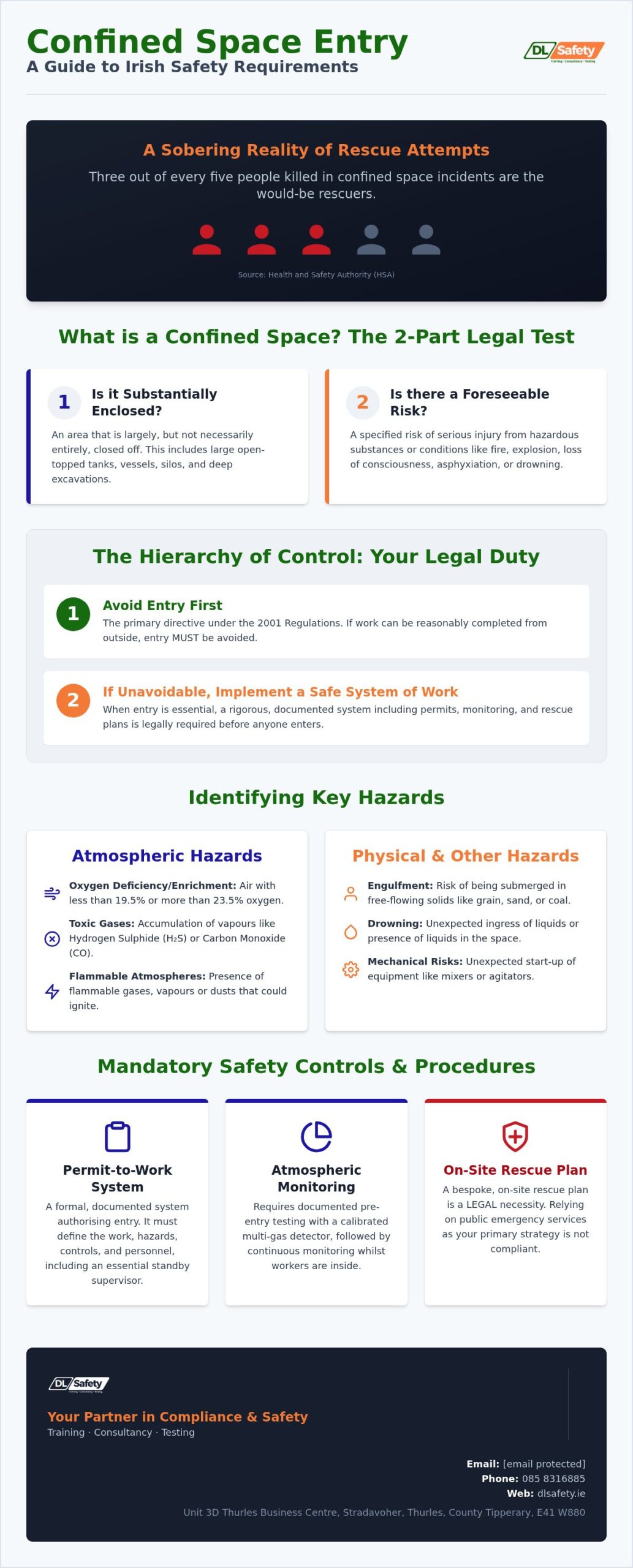
The Safety, Health and Welfare at Work (Confined Spaces) Regulations 2001 provide the legal foundation for all confined space entry requirements Ireland businesses must follow. It’s a common mistake to assume a space is only “confined” if it’s small or cramped. In reality, the law applies a two-part test to determine if a workspace falls under these strict rules. First, is the area substantially enclosed? Second, is there a foreseeable risk of serious injury from hazards like fire, explosion, or gas?
This definition of a confined space means that even large, open-topped tanks or deep excavations can be legally classified as confined spaces if they meet the risk criteria. Relying on a generic risk assessment is a dangerous gamble in these environments. High-risk tasks require a bespoke approach that starts with your company’s Safety Statement. This document shouldn’t just sit on a shelf; it must clearly outline the protocols for identifying and managing these zones before any worker sets foot on site. At DL Safety, we specialise in drafting comprehensive Safety Statements that demystify these obligations for your team.
The Legal Framework: 2001 Regulations
The 2001 Regulations place a heavy burden of responsibility on both employers and contractors. The primary directive is the hierarchy of control: you must avoid entry into a confined space if the work can be reasonably completed from the outside. If entry is unavoidable, you’re legally required to implement a rigorous system of work. Failing to meet these standards doesn’t just invite HSA fines or prosecution; it can also void your insurance cover in the event of an accident. We help businesses navigate these complexities through our Monthly Safety Support Packages, ensuring your documentation is always inspection-ready.
Common Examples in Irish Industry
Confined spaces are found across almost every sector in Ireland. In manufacturing, we frequently see storage tanks, silos, and pressure vessels that require regular maintenance. The construction industry faces different challenges, such as sewers, manholes, and deep excavations where oxygen levels can drop unexpectedly. We also encounter “hidden” confined spaces like unventilated basements or plant rooms. In these areas, hazardous gases like carbon monoxide or methane can accumulate over time, turning a seemingly safe room into a fatal trap.
If you’re unsure if your site meets the confined space entry requirements Ireland mandates, our team at Unit 3D Thurles Business Centre, Stradavoher, Thurles, County Tipperary, E41 W880, can provide expert guidance. You can reach us at 085 8316885 or via email at info@dlsafety.ie to discuss your specific safety needs.
Hazard Identification: The Foundation of Safety
Identifying hazards before a task begins is the most critical step in meeting the confined space entry requirements Ireland enforces. The Health and Safety Authority reported that 58 people died in work-related incidents in 2025, a significant increase from the previous year. This rise in fatalities underscores why we cannot afford a complacent attitude toward high-risk environments. Hazards in these spaces are often invisible, ranging from oxygen deficiency to the accumulation of toxic gases like hydrogen sulphide or carbon monoxide. Without rigorous identification, a routine maintenance job can quickly turn into a multi-fatality incident.
Physical hazards are equally diverse. Workers may face the risk of engulfment by free-flowing solids like grain or sand, or drowning in liquids that enter the space unexpectedly. In many Irish utility and agricultural settings, biological hazards such as Leptospirosis (Weil’s disease) are a constant threat, particularly in sewage systems or areas prone to rodent activity. Mechanical risks also exist; the unexpected start-up of internal mixers or agitators must be controlled through strict “Lock Out Tag Out” procedures. Following official Health and Safety Authority (HSA) guidance is the best way to ensure your hazard log is exhaustive and legally sound.
Atmospheric Monitoring Protocols
You cannot rely on your senses to detect a hazardous atmosphere. Compliance with confined space entry requirements Ireland mandates a documented monitoring strategy. This begins with pre-entry testing using a calibrated multi-gas detector to check oxygen levels and toxic concentrations. However, a single check isn’t enough; atmospheres can change rapidly once work begins or sludge is disturbed. Continuous monitoring whilst the team is inside the space is essential for safety. We often find that equipment calibration is overlooked; our Health & Safety Site Audits frequently identify gas detectors that haven’t been serviced, which can lead to false readings and catastrophic errors in judgement. Understanding your Lower Explosive Limit (LEL) and toxic gas parts-per-million (ppm) levels is a non-negotiable skill for every supervisor.
Environmental and Structural Risks
The space itself can present structural dangers. When working in old tanks or deep excavations, the integrity of the walls or ceiling must be assessed to prevent collapse. Restricted environments also amplify environmental stressors. Heat stress is a common issue, especially whilst wearing heavy, non-breathable PPE in a poorly ventilated area. Noise levels are often magnified in metallic vessels, making communication difficult and increasing the risk of accidents. Proper lighting is also a requirement; you must use intrinsically safe (Ex-rated) lighting in any area where flammable gases might be present to prevent a spark from causing an explosion. Managing these variables requires a methodical approach that balances technical proficiency with a commitment to worker well-being.
Essential Controls: Permits and Monitoring Systems
A Permit-to-Work system is the backbone of safe operations. It isn’t just a piece of paper; it’s a formalised management control that ensures every hazard identified in your risk assessment is actually addressed on the ground. Under the Confined Spaces Regulations 2001, an employer must not allow entry unless a safe system of work is in place. This documentation provides the vital audit trail required to prove compliance with confined space entry requirements Ireland. It bridges the gap between theoretical safety and the practical reality of a dangerous job site.
Effective control relies on clearly defined roles. The Entrant performs the task, but they depend entirely on the Standby Person. This guard remains outside the space at all times, maintaining constant communication and monitoring the environment for any changes. The Supervisor holds the ultimate responsibility, signing off the permit only when they’re satisfied that all isolations are secure. Isolation through Lock-out, Tag-out (LOTO) protocols is a non-negotiable part of meeting confined space entry requirements Ireland. It ensures that power sources, valves, or mechanical parts cannot be accidentally activated whilst someone is inside.
The Permit-to-Work Checklist
A robust permit follows a logical sequence. Before anyone crosses the threshold, the Supervisor must verify that all services are isolated and the atmosphere has been tested as safe. The checklist tracks the duration of the work and logs every person entering or leaving the zone. This prevents the “forgotten worker” scenario at the end of a shift. Once the job is finished, the permit is formally cancelled. This step confirms that all tools are removed, the space is sealed, and it’s safe to restore power or flow to the system.
Ventilation and PPE Requirements
Ventilation is your primary defence against atmospheric changes. Whilst natural airflow might suffice for low-risk areas, mechanical ventilation is often required to maintain a breathable atmosphere. Your choice of Respiratory Protective Equipment (RPE) must match the risk. Self-Contained Breathing Apparatus (SCBA) is used for entry into known hazardous environments, whilst escape sets are mandatory for emergency egress. Crucially, any lifting equipment used for man-riding or rescue must have a valid GA1 certificate. If you’re unsure about your equipment’s status, our team at Unit 3D Thurles Business Center, Stradavoher, Thurles, County Tipperary, E41 W880 can provide on-site inspections. Reach out at 085 8316885 or email info@dlsafety.ie to ensure your gear meets the highest standards.
Emergency Arrangements and Specialist Training
A common but dangerous misconception in Irish industry is that the emergency services act as the primary rescue team for on-site incidents. In reality, relying solely on a 999 or 112 call is often a direct breach of the confined space entry requirements Ireland enforces. The Fire Brigade may be miles away; they might not have the specific equipment or site-specific knowledge to navigate your particular vessel or trench immediately. Legal compliance requires a dedicated, trained on-site rescue team that can initiate a recovery within minutes. This is critical when you consider that three out of every five people killed in these incidents are the would-be rescuers who enter the space without proper gear or a plan.
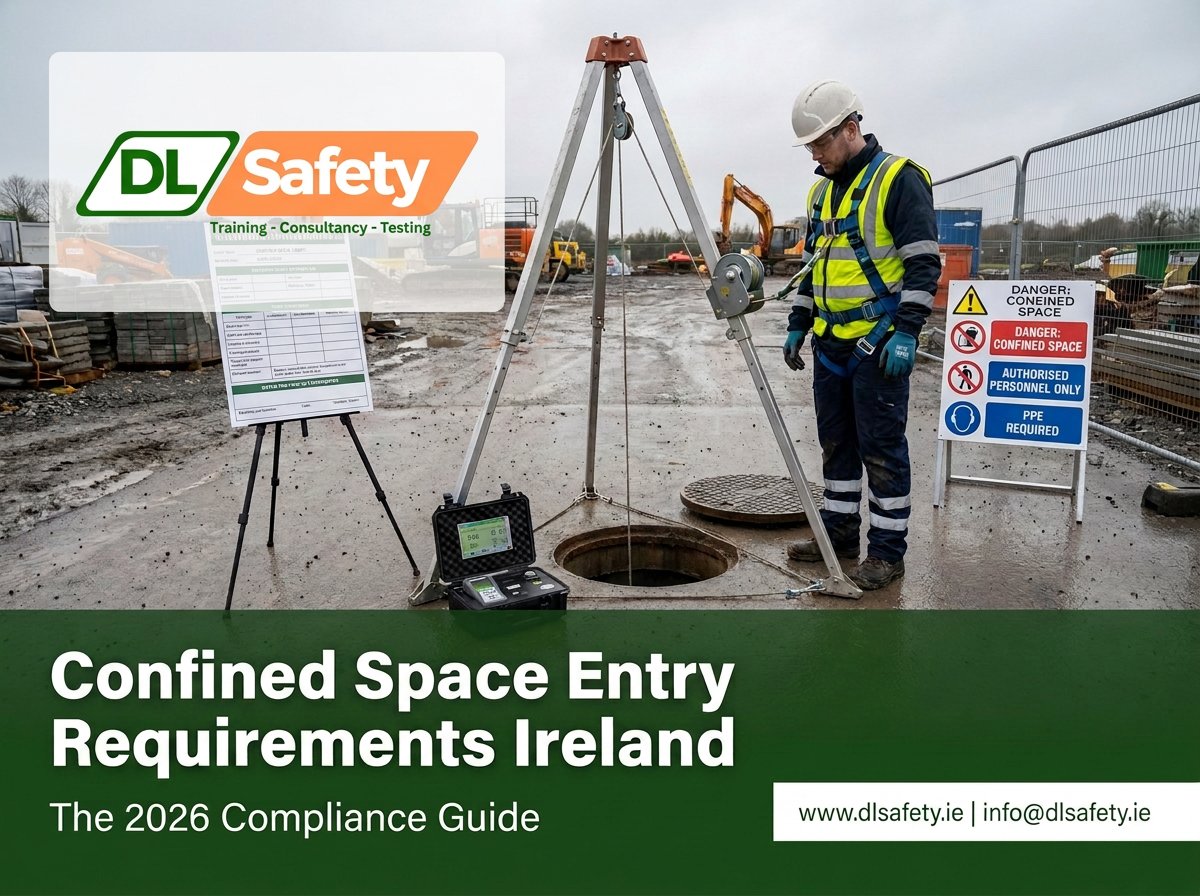
Your rescue team must have access to specialized equipment that is ready for immediate use. This typically includes GA1-certified tripods, winches, and recovery stretchers designed for tight vertical or horizontal exits. First aid considerations are also paramount; rescuers must be trained to handle injuries specific to confined spaces, such as crush syndrome or the effects of toxic gas inhalation. If you are struggling to draft a compliant rescue plan, our advisors at DL Safety can help you develop bespoke Safety Statements and Method Statements that protect your team and your business.
Developing a Rescue Plan
A rescue plan should never be a generic template. It must be a living document that follows a logical four-step process:
- Step 1: Identifying Scenarios. Determine the most likely rescue needs, such as an unconscious worker due to gas or a physical injury like a broken limb.
- Step 2: Selecting Equipment. Ensure you have the correct recovery winches and harnesses that allow for a non-entry rescue where possible.
- Step 3: Establishing Communication. Set up clear links with the emergency services to provide them with GPS coordinates and hazard details whilst your on-site team begins the initial recovery.
- Step 4: Regular Drills. Competency fades over time; conducting regular rescue drills ensures that your team can react instinctively during a real emergency.
Training and Competency
Training must be matched to the specific risk level of the space. Low-risk training usually covers basic entry and tool use, whilst medium-risk courses introduce escape breathing apparatus. High-risk training is the most intensive, often involving full working-duration breathing apparatus and complex rescue techniques. It is your responsibility to verify the training certificates of any subcontractors before they start work. For those looking to build a foundational understanding, integrating awareness into your online safety courses is an excellent way to ensure every staff member recognises the signs of a confined space. For more information on face-to-face training at our centre in Unit 3D Thurles Business Center, Stradavoher, Thurles, County Tipperary, E41 W880, please contact us at 085 8316885 or info@dlsafety.ie.
Managing Compliance with DL Safety Support
Meeting the ongoing confined space entry requirements Ireland demands isn’t a one-time event; it requires constant vigilance and an airtight management system. Whilst the technical aspects of gas detection and rescue plans are vital, the administrative burden of maintaining a compliant audit trail can be overwhelming for site managers. This is where our Monthly Safety Support Package provides a practical solution. We don’t just provide templates; we work alongside you to develop bespoke Method Statements and Risk Assessments (RAMS) that reflect the unique hazards of your specific location.
To ensure your Permit-to-Work systems are being followed correctly, we conduct regular on-site audits. These aren’t just box-ticking exercises; they’re professional evaluations designed to identify gaps in your protocols before they lead to an incident. By maintaining this level of oversight, your business is always ready for a HSA inspection, giving you the confidence that your documentation and site practices meet the highest legal standards. This proactive approach transforms safety from a source of stress into a streamlined part of your daily operations.
The Benefits of Retained Safety Consultancy
Engaging a retained safety consultant significantly reduces the pressure on internal resources. Instead of site managers spending hours researching regulatory updates, they can focus on project delivery whilst we provide consistent, professional oversight of high-risk activities. When planning complex entries, such as a multi-stage excavation or a large-scale industrial tank clean—tasks often requiring specialist support from firms like Distribution Hygiene Services Limited—having immediate access to expert advice ensures that your safety strategy is robust from day one. It’s about moving from reactive problem-solving to proactive risk management that protects both your staff and your reputation.
Contact DL Safety for Expert Guidance
We invite you to discuss your specific site requirements with David and the team to see how we can streamline your safety processes and ensure full compliance. DL Safety provides all the necessary documentation your business needs, from comprehensive safety statements to specialist GA1 lifting equipment inspections. Whether you’re based in Tipperary or operating nationwide, we’re here to act as your trusted advisor in all matters of workplace safety.
Contact Details:
Email: info@dlsafety.ie
Telephone: 085 8316885
Website: www.dlsafety.ie
Our Office:
Unit 3D Thurles Business Center, Stradavoher, Thurles, County Tipperary, E41 W880.
Securing Your Site for 2026 and Beyond
Navigating the complexities of high-risk environments doesn’t have to be a solo journey. We’ve explored how identifying risks through the two-part legal test and implementing a rigorous Permit-to-Work system form the bedrock of a safe workplace. It’s clear that meeting the confined space entry requirements Ireland mandates is as much about documented management as it is about physical safety equipment. By prioritising on-site rescue teams and specialist training, you move beyond mere compliance and into a space of genuine protection for your workforce.
As HSA Inspection Readiness Experts, we’re dedicated to helping you manage these pressures with ease and integrity. Whether you need a bespoke safety statement or a full site audit, our team is ready to support your long-term success. Contact DL Safety today for professional confined space safety support to discuss your specific site requirements. You can reach us at info@dlsafety.ie or call 085 8316885. Our office is located at Unit 3D Thurles Business Center, Stradavoher, Thurles, County Tipperary, E41 W880. Let’s work together to ensure every member of your team returns home safely at the end of every shift.
Frequently Asked Questions
Is a permit to work always required for confined space entry in Ireland?
Yes, a formal Permit-to-Work is a mandatory requirement for any entry into a space meeting the criteria of the 2001 Regulations. This document ensures that all confined space entry requirements Ireland mandates, such as atmospheric testing and isolation, are verified by a supervisor before work starts. It acts as your primary legal defence and audit trail, proving that you have assessed the risks and implemented necessary controls for every specific entry.
Can I rely on the Fire Brigade as my primary rescue team?
No, you cannot legally rely on the Fire Brigade as your primary means of rescue. Irish safety law requires employers to have suitable and sufficient emergency arrangements already in place on-site. Since emergency services may face delays or lack site-specific knowledge, you must have a trained team and recovery equipment ready to act immediately. Relying on public services alone is a common point of failure during HSA audits.
How often do gas detectors need to be calibrated for confined space work?
Gas detectors typically require professional calibration every six months to ensure their sensors remain accurate. However, you should also perform a “bump test” before every shift to verify that the sensors respond correctly to known gas concentrations. At DL Safety, we emphasise that using uncalibrated equipment is a major risk. Keeping a log of these calibrations is essential for maintaining your site’s safety standards and satisfying regulatory inspections.
What is the difference between a confined space and a restricted space?
A confined space is defined by the presence of a foreseeable risk, such as toxic gas or engulfment, whilst a restricted space merely has difficult access. Whilst both might be cramped, only a confined space triggers the strict confined space entry requirements Ireland enforces. If there is no risk of serious injury from the atmosphere or materials within the space, it may be classified as restricted, though a cautious approach is always recommended.
Do I need a specific GA1 cert for winches used in confined space rescue?
Yes, any winch or tripod used for man-riding or emergency rescue must have a valid GA1 certificate. Under Irish law, lifting equipment used to lift people requires a thorough examination by a competent person every six months. This certification proves the gear is structurally sound and capable of performing a rescue without failing. Our team at DL Safety provides comprehensive GA1 testing to ensure your rescue equipment is always compliant and ready for use.
What training is legally required for a standby person (top man)?
A standby person must be specifically trained in the emergency procedures and communication protocols outlined in your safe system of work. They need to understand how to operate rescue equipment and when to initiate the emergency plan without entering the space themselves. Simply having an untrained observer is insufficient; the standby person must be competent to monitor the entrants and the environment throughout the duration of the task.
How long must I keep records of confined space entry permits?
You should keep records of confined space entry permits for at least three years to satisfy HSA requirements. However, many businesses choose to retain these documents for longer to protect against future insurance or civil claims. These records prove that you consistently followed safe systems of work and met all legal obligations. Storing them centrally as part of your safety management system ensures they are easily accessible during a site audit.
What happens if a HSA inspector finds a team working without a rescue plan?
If a HSA inspector finds a team working without a rescue plan, they will likely issue a Prohibition Notice, stopping all work immediately. This can lead to significant project delays, heavy fines, or even criminal prosecution of the directors. A rescue plan is a non-negotiable legal requirement. Without it, you are essentially placing workers in a life-threatening situation with no means of escape, which the HSA treats with extreme severity.