
Most Irish businesses assume that buying a standard yellow bin satisfies their legal obligations, but in 2026, a generic approach is often the quickest route to an EPA prosecution. It’s understandable to feel overwhelmed by the recent Safety, Health and Welfare at Work (Chemical Agents) (Amendment) Regulations 2026, especially when the HSA and EPA are ramping up site inspections across the country. You want to protect your team and the environment, but the jargon surrounding ISO 14001:2026 and specific OELVs for substances like diisocyanates can make simple safety feel like a legal minefield.
This guide simplifies the chemical spill kit requirements Ireland needs to follow today, ensuring your workplace stays compliant and your staff remain safe. We’ll break down the 2026 Code of Practice, provide a practical checklist for kit contents, and explain how to turn your emergency response plan from a dusty folder into a confident, trained reality. Whether you’re managing a local workshop or a large industrial site, we’re here to help you move from confusion to complete confidence in your spill response strategy. By the end of this guide, you’ll have a clear roadmap to meet every HSA and EPA standard with total ease.
Key Takeaways
- Understand how the 2026 consolidated regulations and updated OELVs impact your legal obligations for on-site hazardous material management.
- Learn the pragmatic 7-step response procedure to ensure your team reacts with speed and safety during a chemical emergency.
- Master the calculation for “worst-case scenario” volumes to ensure your chemical spill kit requirements Ireland are precisely tailored to your site’s unique risks.
- Discover why Chemical Awareness Training is the vital link between having high-quality equipment and actually preventing environmental contamination.
- Identify the specific PPE and sorbent types required to protect your staff and meet HSA inspection standards with confidence.
Legal Framework for Chemical Spill Kit Requirements in Ireland
The primary legislation governing workplace safety in our country is the Safety, Health and Welfare at Work Act 2005. This Act places a clear duty on every employer to manage risks and prevent accidents, which includes having a robust plan for hazardous substance leaks. When assessing chemical spill kit requirements Ireland employers must start with the Safety, Health and Welfare at Work (Chemical Agents) Regulations 2001 to 2026. These regulations were recently updated on 9 April 2026 to introduce stricter exposure limits and more rigorous risk assessment protocols. The Health and Safety Authority (HSA) enforces these rules, and they expect to see that you’ve not only provided the right equipment but have also integrated it into your daily safety culture.
HSA Compliance and the Safety Statement
Your Safety Statement is the most important document in your compliance arsenal. It shouldn’t just mention that you have a kit; it must detail why you chose that specific type based on a formal chemical risk assessment. The HSA looks for kits that are easily accessible, clearly marked, and located near high risk areas like chemical stores or decanting stations. Whilst many multi-national firms look for COSHH compliance, the legal necessity for spill kits in Ireland is rooted specifically in the 2001 to 2026 Chemical Agents Regulations. Before you buy, it’s worth asking What is a Spill Kit? in the context of your specific chemicals, as a generic solution rarely meets the standard required during a professional site audit.
EPA Regulations and Environmental Liability
The Environmental Protection Agency (EPA) takes a different but equally vital perspective. Their focus is on the “Source-Pathway-Receptor” model. They want to ensure that if a “source” (a chemical drum) leaks, there’s no “pathway” (a drain or cracked concrete) to reach a “receptor” (groundwater or a local river). If your site operates under an EPA licence, your spill management must be impeccable. The financial cost of non-compliance is often staggering, frequently involving heavy fines and the massive expense of environmental remediation. Staying up to date with chemical spill kit requirements Ireland involves more than just hardware; it’s about a broader commitment to health and safety compliance Ireland businesses can trust to protect their reputation and the local ecosystem. We’ve found that documenting these procedures clearly is the best way to demonstrate your due diligence to inspectors.
Essential Components of a Compliant Chemical Spill Kit
Meeting the chemical spill kit requirements Ireland demands for workplace safety isn’t just about having a yellow bin on-site. It’s about the specific tools inside that bin. A compliant kit must serve three clear purposes: protection, containment, and disposal. If any of these elements are missing, your emergency response plan is effectively incomplete. We’ve found that many businesses focus solely on the absorbents, but without the right protective gear and containment tools, your staff are left vulnerable during those first critical minutes of a spill.
Absorbent Materials for Hazardous Substances
High-quality sorbents are the backbone of any response. In Ireland, chemical-specific absorbents are colour-coded yellow to distinguish them from grey maintenance or white oil-only versions. You need a strategic mix of formats to handle different spill dynamics. Socks are used to “bund” or encircle a spill to stop it spreading towards drains. Pads are ideal for wiping down surfaces or soaking up thin films, whilst pillows are designed for larger volumes or to plug leaks in machinery. It’s vital that these materials meet relevant EN standards for absorbency and chemical compatibility to ensure they don’t degrade when in contact with aggressive acids or alkalis.
PPE: Protecting the Responder
The responder’s safety is the absolute priority, yet this is a area where many off-the-shelf kits fall short. At a minimum, your kit should contain Nitrile or Neoprene gloves that provide a tested barrier against the specific chemicals you store on-site. Safety goggles are essential to prevent splash injuries; standard safety glasses often don’t provide enough lateral protection for volatile liquids. For more complex spills, you might also need disposable coveralls and respiratory protection. Following the UK & Ireland Spill Association guidance ensures your PPE selection aligns with best practices across the industry and protects your team from avoidable harm.
To prevent the “pathway” contamination mentioned in the previous section, your kit should also include polyurethane drain mats and sealing putties. These tools allow you to quickly block drains or plug punctured drums before the substance escapes your control. Once the spill is absorbed, you’ll need a safe way to remove the hazardous waste. Use hazard-rated disposal bags and heavy-duty ties to prevent secondary leaks during transport to a waste facility. Ensuring your kit is fully stocked and ready for action is much simpler with our Monthly Safety Support Packages, which provide the ongoing oversight needed for total peace of mind.
For personalised advice on your site’s specific needs, you can contact the team at DL Safety, Unit 3D Thurles Business Center, Stradavoher, Thurles, County Tipperary, E41 W880. We’re available at 085 8316885 or via email at info@dlsafety.ie to help you navigate the complexities of chemical spill kit requirements Ireland and ensure your workplace remains a safe environment for everyone.
Selecting the Right Kit: Hazard Types and Volume
Choosing the correct equipment is a strategic decision that depends entirely on your site’s specific inventory. You can’t rely on a one-size-fits-all approach when dealing with hazardous substances. To meet chemical spill kit requirements Ireland inspectors expect to see a tailored selection that matches the specific hazards and volumes present in your facility. Having the wrong kit is often as dangerous as having no kit at all, as it can lead to ineffective containment or even hazardous chemical reactions.
The Colour Coding System in Ireland
In Ireland, the industry follows a strict colour-coded system to ensure rapid, error-free identification during high-stress incidents. Yellow kits are the standard for chemicals; they’re designed to handle aggressive substances like acids, alkalis, and unknown liquids without degrading. Blue or white kits are specifically for oil and hydrocarbons. These are hydrophobic, meaning they repel water and only soak up oil-based products, making them essential for outdoor areas or near interceptors. Grey “maintenance” kits provide a universal application for non-aggressive liquids like coolants and mild detergents. Using a grey pad on a concentrated acid spill is a common mistake that can lead to the pad dissolving or failing to neutralise the hazard.
Sizing Your Response Capability
Sizing your response capability is about anticipating your “worst-case scenario.” If you store 200L drums, a 20L portable bag is insufficient for a total container failure. A practical approach involves assessing the largest single container on-site and ensuring your total absorbent capacity can manage a significant portion of that volume. This calculation is a core part of any Chemical Risk Assessment Ireland businesses must conduct to stay compliant with 2026 standards.
Location is just as vital as capacity. We advocate for the “30-second access rule”: a responder should be able to reach a kit and begin deployment within half a minute of a spill being spotted. For high-risk storage areas, static wheelie bin stations (ranging from 120L to 360L) are the gold standard. Conversely, portable kits are necessary for plant machinery and delivery vehicles to ensure compliance whilst on the move. At DL Safety, based at Unit 3D Thurles Business Center, Stradavoher, Thurles, County Tipperary, E41 W880, we help you calculate these volumes accurately. You can contact our team at 085 8316885 or info@dlsafety.ie to ensure your chemical spill kit requirements Ireland are fully met through our professional site audits.
Spill Response Procedure: Deployment and Best Practice
Having the right hardware is only effective if your team knows how to deploy it under pressure. When a leak occurs, panic is the biggest enemy of safety. A structured, practiced response ensures that chemical spill kit requirements Ireland mandates are translated into actual environmental protection. Following these steps ensures you meet the chemical spill kit requirements Ireland inspectors prioritise during site visits, moving your business from mere equipment ownership to true emergency readiness.
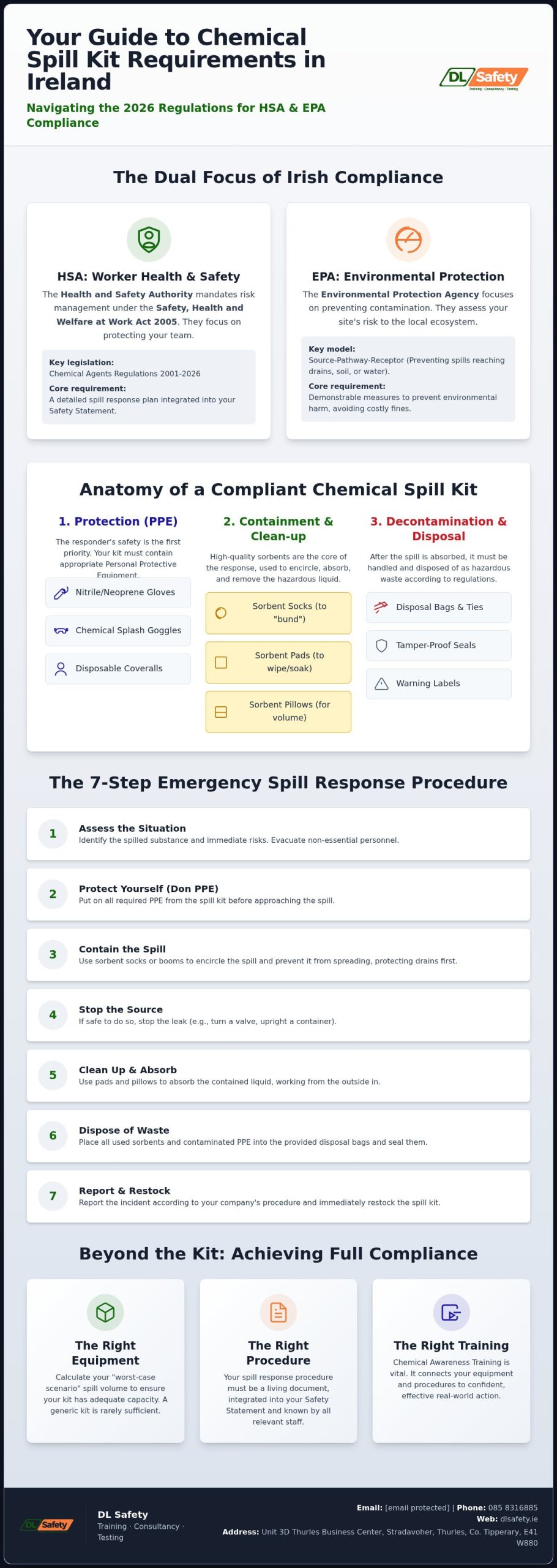
The 7-Step Response Protocol
A professional spill response follows a logical sequence to minimise risk to people and the environment. We recommend the following protocol for every workplace:
- Assessment: Before touching anything, identify the substance. Use the Safety Data Sheets (SDS) to understand the specific hazards and reactive properties.
- PPE: Don the correct protective gear identified in the assessment. Never attempt a clean-up without the right gloves and eye protection.
- Containment: Use socks to ‘dam’ the flow. Don’t just throw pads on the liquid; circle the spill first to protect drains and sensitive pathways.
- Stop the Source: If a drum has tipped, right it immediately. If it’s punctured, use sealing putty or emergency plugs to halt the leak.
- Absorption: Deploy pads and pillows to soak up the contained liquid, working from the outside in.
- Clean-up: Place all used materials into hazard-rated disposal bags and secure them with heavy-duty ties.
- Decontaminate: Clean the area and the responders’ gear to ensure no residual chemicals remain.
If a spill is large, volatile, or poses an immediate threat to health, you must trigger the site alarm and initiate evacuation protocols. You’re legally required to contact the EPA if there’s any risk of the substance reaching a watercourse, soil, or public sewer system. The HSA should also be notified if the incident qualifies as a “dangerous occurrence” under the 2005 Act, even if no one was injured.
Post-Spill Investigation and Documentation
Once the site is safe, the work isn’t finished. You must record every detail in the site accident book. This documentation isn’t just for insurance purposes; it’s a vital part of understanding what to expect during a HSA inspection. An inspector will check if you reviewed the root cause of the incident. Did a forklift puncture a drum? Was the shelving unstable? Addressing these underlying issues prevents recurrence and demonstrates a proactive safety culture to the authorities.
Managing these procedures can be daunting, but you don’t have to do it alone. Our team at Unit 3D Thurles Business Center, Stradavoher, Thurles, County Tipperary, E41 W880, can help you develop a bespoke response plan. You can contact us for a Health & Safety Site Audit to ensure your deployment strategy is watertight. Reach out to us at 085 8316885 or info@dlsafety.ie for expert support that keeps your business compliant and your staff safe.
Maintaining Compliance through Support and Training
Providing the physical hardware is only the first step toward a safe workplace. To truly meet the chemical spill kit requirements Ireland enforces, your staff must be competent in both the theory of hazardous substances and the practical application of the equipment. We’ve often seen sites where high-quality kits sit unused during an emergency because the team lacked the confidence to deploy them. Compliance is a living process that requires regular attention, ensuring that your emergency response remains as sharp as it was on the day you first drafted your safety statement.
Chemical Awareness and Deployment Training
Our Chemical Awareness Training incl. Spill Kit Deployment is designed to bridge the gap between owning equipment and using it effectively. We focus on practical drills that simulate real-world scenarios, allowing your staff to practice using socks, pads, and PPE under controlled pressure. It’s vital that employees understand how to read Safety Data Sheets (SDS) and recognise hazard symbols quickly, as these documents dictate the entire response strategy. During a HSA inspection, having a paper trail of certification and competency records for your team is just as important as having the kits themselves. These records prove that you’ve fulfilled your duty of care under the 2005 Act by providing adequate information and training to your workforce.
Professional Safety Audits and Retained Support
A common pitfall in industrial environments is the “empty bin” syndrome. A small spill occurs, the kit is used correctly, but the sorbents are never replenished. This leaves the site vulnerable to the next, potentially larger, incident. Regular safety audits are the most effective way to identify these compliance gaps before they lead to an EPA prosecution or an environmental disaster. By integrating spill management into a Monthly Safety Support Package, you ensure that your kits are always stocked, your staff are periodically refreshed on their skills, and your risk assessments remain up to date with the 2026 standards.
Our team at DL Safety provides expert consultancy and face-to-face training across Ireland from our base at Unit 3D Thurles Business Center, Stradavoher, Thurles, County Tipperary, E41 W880. If you’re unsure if your current setup meets the chemical spill kit requirements Ireland demands, we’re here to help. You can reach us at 085 8316885 or via email at info@dlsafety.ie to discuss your site’s specific needs or visit our website at www.dlsafety.ie for more information. Professional oversight doesn’t just satisfy the inspectors; it provides the genuine peace of mind that comes from knowing your business is fully prepared for any eventuality.
Future-Proof Your Workplace Safety
Managing chemical risks effectively requires a shift from simply owning a yellow bin to implementing a proactive, risk-based safety culture. We’ve explored how the 2026 consolidated regulations demand precise calculations of spill volumes and clear documentation within your Safety Statement. The most advanced equipment is only as effective as the person using it; therefore, combining the right hardware with practical drills is the only way to truly meet chemical spill kit requirements Ireland inspectors expect to see during a site visit.
At DL Safety, we simplify this journey by acting as your trusted advisor. You can secure your site’s compliance with DL Safety’s Monthly Support Packages, which provide the expert Chemical Awareness Training, comprehensive HSA-ready site audits, and professional Safety Statement development your business needs to thrive. For tailored support, contact us at Unit 3D Thurles Business Center, Stradavoher, Thurles, County Tipperary, E41 W880, call 085 8316885, or email info@dlsafety.ie. Transitioning from uncertainty to total confidence is a straightforward process when you have the right partner by your side. Let’s work together to make your workplace a benchmark for safety and environmental excellence.
Frequently Asked Questions
Are chemical spill kits a legal requirement in Ireland?
Chemical spill kits are a legal requirement under the Safety, Health and Welfare at Work (Chemical Agents) Regulations 2001 to 2026. These regulations mandate that every employer must provide suitable equipment for emergency response based on a site-specific risk assessment. Whilst the law doesn’t specify a “one-size-fits-all” kit, the HSA expects to see appropriate containment tools available wherever hazardous substances are stored. Failure to provide these can lead to prosecutions or significant fines during site inspections.
How often should I inspect my workplace spill kits?
You should inspect your workplace spill kits at least once a month to ensure they remain ready for immediate use. During these checks, verify that the security seals are intact and that no components, such as pads or gloves, have been removed for non-emergency tasks. PPE like nitrile gloves can degrade over time; checking for signs of brittleness or expiration is vital. Keeping a signed inspection log helps demonstrate your proactive safety management during a formal HSA audit.
What is the difference between a chemical and an oil spill kit?
The primary difference lies in the absorbent’s material properties and chemical compatibility. Chemical spill kits are typically colour-coded yellow and designed to handle aggressive liquids like acids and alkalis without dissolving. Oil-only kits, often white or blue, are hydrophobic; they repel water and only absorb hydrocarbons like diesel or hydraulic fluid. Using an oil kit on an acid spill is dangerous, as the material may not be compatible with the substance and could fail to contain the hazard.
Do I need specific training to use a chemical spill kit?
Yes, the Safety, Health and Welfare at Work Act 2005 requires employers to provide adequate information, instruction, and training to staff. Simply having the hardware isn’t enough; employees must understand how to safely deploy the contents under pressure. Professional Chemical Awareness Training ensures your team can identify hazards using SDS and follow the 7-step response protocol. Competency records from this training are essential evidence for satisfying the chemical spill kit requirements Ireland inspectors look for.
Where is the best place to locate a spill kit on a construction site?
On a construction site, you should locate spill kits near high-risk zones such as fuel bowsers, chemical stores, and plant maintenance areas. It’s best practice to follow the “30-second access rule,” ensuring a responder can reach the kit almost immediately after a leak is spotted. Ensure the kits are stored in highly visible, weatherproof wheelie bins that are clearly marked. Don’t hide them behind equipment or inside locked containers where they can’t be reached during an emergency.
What should I do with used absorbents after a chemical spill?
Used absorbents must be treated as hazardous waste because they now carry the properties of the substance they soaked up. You should place all used pads, socks, and contaminated PPE into the hazard-rated disposal bags included in your kit and secure them with heavy-duty ties. These bags must be stored in a designated hazardous waste area and collected by a licensed waste contractor. Never dispose of these materials in general waste bins, as this leads to environmental contamination and EPA fines.
How do I choose the correct size spill kit for my business?
To choose the correct size, you must identify the “worst-case scenario” volume on your site. This usually involves assessing the capacity of your largest single container, such as a 200L drum or a 1,000L IBC. Your kit should have enough absorbent capacity to manage a significant percentage of that volume before it reaches a drain. If you have multiple high-risk areas, it’s often more effective to have several medium-sized kits strategically placed rather than one massive station in a central location.
What are the common mistakes in spill response management?
One of the most common mistakes is using emergency spill kit components for general cleaning tasks, which leaves the kit empty when a real incident occurs. Other frequent errors include failing to wear the correct PPE before starting a clean-up and neglecting to block drains before applying absorbents. Many businesses also forget to review their risk assessments after a spill happens. Avoiding these pitfalls is much easier when you integrate your chemical spill kit requirements Ireland into a professional support package.