
Could a single misread label or a misplaced spill kit lead to a costly HSA enforcement notice on your site? With the introduction of the Chemical Agents Code of Practice 2026 on 9 April, the stakes for chemical awareness training for construction workers have never been higher. You’re likely already dealing with the headache of complex Safety Data Sheets and the challenge of keeping your team engaged with technical safety topics. It’s a lot to manage, especially when you’re trying to keep a project on schedule while ensuring every worker goes home safe at the end of the shift.
At DL Safety, we believe compliance shouldn’t feel like a barrier to productivity. We’ve built our reputation as a trusted advisor, helping firms across Ireland demystify these new regulations, including the updated Occupational Exposure Limits for substances like diisocyanates. This guide provides a clear roadmap to mastering chemical safety, from interpreting the latest SDS requirements to practical spill kit deployment. We’re dedicated to helping you reduce accident rates and maintain a site that meets the highest standards of the 2026 legal framework. Based at Unit 3D Thurles Business Center, Stradavoher, Thurles, County Tipperary, E41 W880, our team is ready to help via info@dlsafety.ie, 085 8316885, or www.dlsafety.ie.
Key Takeaways
- Align your site with the 2026 HSA Code of Practice to ensure full regulatory compliance and avoid costly enforcement notices.
- Learn to navigate the 16 sections of a Safety Data Sheet to quickly identify risks associated with fuels, solvents, and cement.
- Discover how bespoke chemical awareness training for construction workers transforms technical data into safer daily habits on the ground.
- Master the selection and deployment of spill kits to ensure your team can respond to emergencies with speed and precision.
- Shift from basic documentation to proactive safety leadership by implementing practical hazard recognition strategies across your project.
Understanding Chemical Hazards on Modern Construction Sites
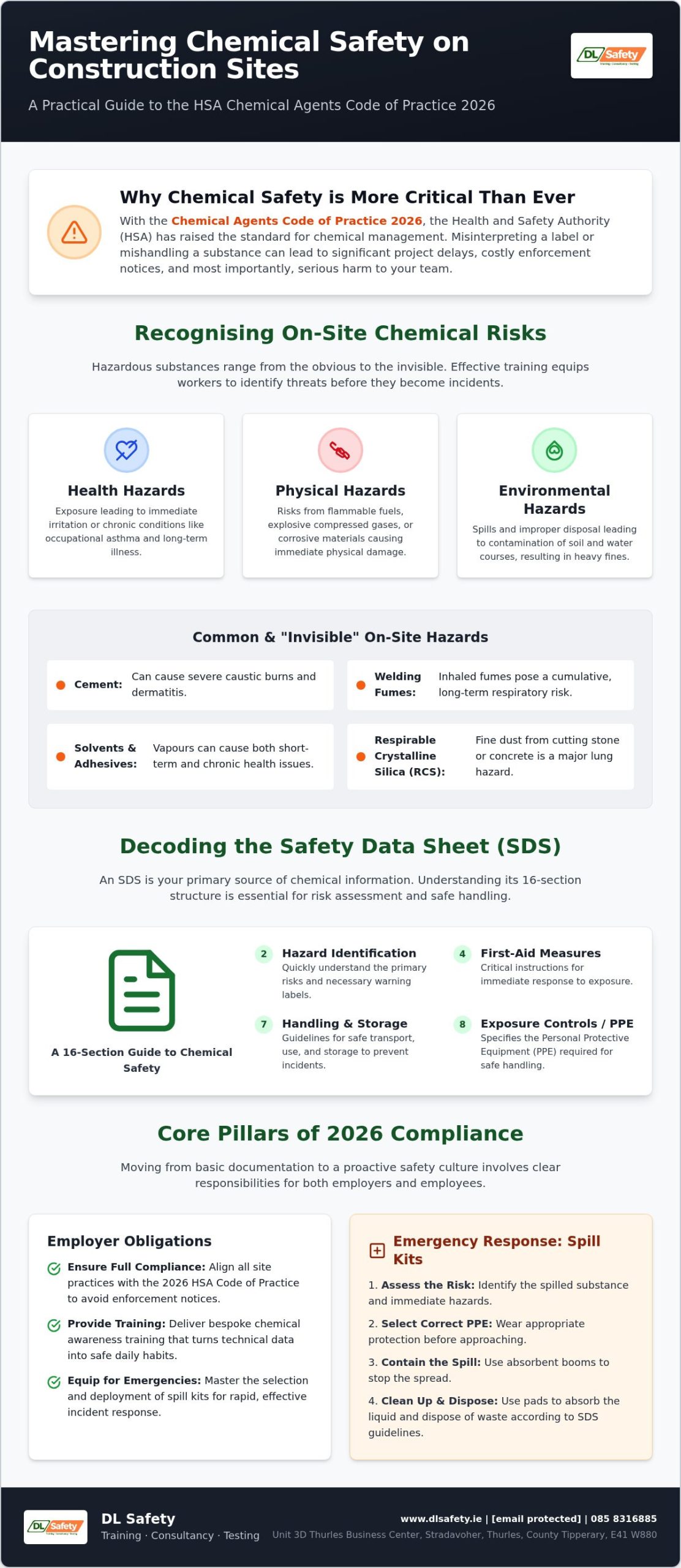
Hazardous substances on a building site aren’t always marked with bright orange labels or stored in reinforced drums. In the 2026 construction landscape, a hazardous substance is defined as any liquid, gas, or solid that can cause harm to a worker’s health or physical safety. This includes everything from the diesel fuel powering your plant to the adhesives used in fit-outs. Understanding Chemical Safety Principles is the first step in moving beyond basic compliance toward a culture of genuine site safety. Because these risks are so varied, chemical awareness training for construction workers has become a core competency rather than an optional extra. It ensures that every person on-site can identify a threat before it becomes an incident.
Common chemicals like solvents and cement are often overlooked because they’re so familiar. However, cement can cause severe caustic burns and long-term dermatitis if handled incorrectly. Beyond these visible liquids and solids, groundworks teams must remain vigilant about respirable crystalline silica (RCS). This fine dust, created when cutting or grinding stone and concrete, is a significant respiratory hazard that requires specific suppression techniques and awareness to manage effectively. At DL Safety, we help teams recognise these specific threats through bespoke on-site training that reflects the actual inventory of your project.
Primary Chemical Risks in Construction
- Health hazards: Exposure can lead to immediate issues like skin irritation or chronic conditions such as occupational asthma and cancer.
- Physical hazards: The flammability of fuels and the explosive potential of compressed gases like acetylene pose an immediate risk of fire or blast.
- Environmental hazards: A single poorly managed spill can lead to the contamination of local water courses and soil, resulting in heavy fines and environmental damage.
The “Invisible” Hazards
Some of the most dangerous substances are those you can’t easily see. Welding fumes and fine dust particles often linger in the air long after a task is finished. Without proper dust suppression and extraction, workers face a cumulative effect of low-level exposure that builds up over an entire career. It’s a silent threat that demands constant vigilance and proper PPE. The latency period for chemical-related illnesses can span decades; often, symptoms only surface long after the initial exposure has ceased. For expert guidance on managing these risks, contact us at Unit 3D Thurles Business Center, Stradavoher, Thurles, County Tipperary, E41 W880, or email info@dlsafety.ie. You can also reach our team at 085 8316885 or visit www.dlsafety.ie to learn more about our specialised safety packages.
The Legal Framework: HSA Compliance and COSHH Standards in 2026
The regulatory environment in Ireland has tightened significantly with the Safety, Health and Welfare at Work (Chemical Agents) (Amendment) Regulations 2026. These laws mandate that every substance on a building site is correctly classified and handled according to the CLP (Classification, Labelling and Packaging) standards. It’s no longer enough to just have the paperwork; you must demonstrate that your team understands the specific risks they face daily. Employers are legally bound to provide clear information and instruction, making chemical awareness training for construction workers a non-negotiable part of site induction and ongoing safety management.
Under the 2026 regulations, employers must meet several core obligations to remain compliant:
- Provide up-to-date safety data sheets for all hazardous materials.
- Ensure all containers are correctly labelled under CLP standards.
- Implement site-specific training that reflects current chemical inventories.
Employees also carry a significant burden of responsibility. They’re required to follow established safe systems of work and utilise personal protective equipment (PPE) correctly as instructed. Whilst Irish law is the primary focus, looking at international benchmarks like OSHA Chemical Hazard Standards provides a broader perspective on how hazard communication and control measures should function in a high-stakes environment. High-quality chemical awareness training for construction workers ensures these safety protocols are followed consistently.
Statutory Training Requirements
When a Health and Safety Authority (HSA) inspector arrives for an unannounced visit, they’ll look for evidence of competence rather than just a stack of certificates. They want to see an auditable training matrix that proves every worker has received relevant, up-to-date instruction. Understanding what to expect during a HSA inspection can help you prepare for these high-pressure moments. We recommend keeping these records digital and easily accessible to ensure you aren’t scrambling for paper files whilst the inspector waits. It’s about being proactive rather than reactive.
COSHH Assessments for Site Materials
Although “COSHH” is a UK term, the principles of controlling substances hazardous to health are deeply embedded in Irish safety culture through the Chemical Risk Assessment Ireland process. These assessments must be translated into practical construction phase plans that workers can actually use. Since site inventories change as a project progresses, dynamic risk assessments are essential to cover new chemicals as they arrive. If you’re struggling to keep your safety statements current, our team at DL Safety can help you organise your safety documentation to ensure you stay ahead of the curve. You can reach us at Unit 3D Thurles Business Center, Stradavoher, Thurles, County Tipperary, E41 W880, or via info@dlsafety.ie and 085 8316885.
Interpreting Safety Data Sheets (SDS) and Hazard Labelling
Every chemical arriving on a construction site must be accompanied by a Safety Data Sheet (SDS). Whilst these documents contain 16 detailed sections, the sheer volume of technical data can be overwhelming for those on the tools. Effective chemical awareness training for construction workers focuses on filtering this information so that life-saving details aren’t lost in the jargon. Managers need the full document for risk assessments, but workers need to know exactly where to look when a splash occurs or a seal breaks. It’s about turning a technical manual into a practical safety tool.
Recognising GHS pictograms is a universal skill that every site operative must master. Whether it’s the flame symbol for flammables or the corrosive symbol indicating a risk to skin and metal, these visual cues provide instant hazard recognition. You should also pay close attention to the “Signal Word” found on the label. A “Warning” indicates a moderate hazard, whilst “Danger” is reserved for the most severe risks. If you see “Danger” on a container, the margin for error is significantly smaller, and the required controls are much more stringent.
Keeping these documents in a dusty folder in the site office doesn’t meet modern safety standards. They must be accessible at the point of use. Many proactive sites now use QR codes on storage containers or digital tablets to ensure that HSE Guidance on Hazardous Substances is followed by providing immediate access to safety data. This ensures that if an incident occurs, the right information is in the right hands within seconds.
Section-by-Section Priority for Workers
When time is of the essence, workers should be trained to prioritise three specific sections of the SDS. Section 4 covers first-aid measures; it’s your immediate response guide for accidental ingestion or skin contact. Section 8 details exposure controls and PPE, telling you exactly which respirator or glove type is required for protection. Finally, Section 13 outlines disposal considerations, which is vital for preventing environmental incidents and ensuring your site remains compliant with waste regulations.
Labelling Requirements for Decanted Chemicals
One of the most common site hazards is the “improvised” container. Decanting fuel or solvents into unlabelled bottles or old water containers is a recipe for disaster. Best practice involves using pre-printed, durable labels that match the original SDS information for all decanted materials. This is particularly vital for fuel bowsers and smaller chemical stores where multiple trades interact with the same substances. Standardising these labels across a national fleet or multiple sites ensures that hazard communication remains consistent regardless of the project location. For help standardising your site’s hazard communication, contact DL Safety at Unit 3D Thurles Business Center, Stradavoher, Thurles, County Tipperary, E41 W880. Our team is available at info@dlsafety.ie or 085 8316885, or you can visit www.dlsafety.ie to view our bespoke training options.
Practical Spill Kit Deployment and Emergency Procedures
A spill on a construction site is a high-pressure moment where hesitation costs money and damages the environment. Having a bespoke spill response plan is essential because every project carries a unique chemical inventory. You wouldn’t use the same response for a hydraulic leak as you would for a bulk chemical spill. This is why chemical awareness training for construction workers must include practical, hands-on drills with the specific kits kept on-site. It ensures your team reacts with precision rather than panic.
Selecting the right kit is your first line of defence. Oil-only kits, usually colour-coded white, absorb hydrocarbons whilst repelling water, making them perfect for plant leaks on wet ground. Chemical kits are typically yellow and designed for aggressive liquids, whilst general maintenance kits are grey and handle non-hazardous fluids. Using the wrong kit isn’t just ineffective; it can be dangerous if the materials react poorly with the substance. When a spill occurs, we recommend the S.T.O.P. method: Stop work and eliminate ignition sources; Think about the substance and safety; Observe the spill’s path and any injuries; and Plan your response using the correct equipment.
If a spill enters a watercourse or exceeds your site’s containment capacity, you’re legally required to notify the EPA or local authorities immediately. Professional chemical awareness training for construction workers helps staff recognise these reporting thresholds. It’s about protecting both the environment and your company’s legal standing.
Step-by-Step Spill Kit Deployment
Begin by assessing the risk. You must identify the substance whilst maintaining a safe distance to avoid inhalation or skin contact. Once identified, contain the flow. Use booms and socks from your kit to create a physical barrier, protecting drains and soil from contamination. Only after the perimeter is secure should you move to absorb and clean. Use pads and granules for final recovery, working from the outside of the spill toward the centre to prevent spreading the liquid further.
Post-Incident Management
Your job isn’t finished once the liquid is gone. All contaminated materials must be bagged and disposed of as hazardous waste; they cannot go in a general skip. A thorough Chemical Spill Response and Kit Deployment review is vital to identify why the spill happened and how the team responded. This allows you to refine your procedures and prevent a recurrence amongst the crew. If your team needs practical experience in these procedures, you can book bespoke spill kit training with DL Safety today. We’re based at Unit 3D Thurles Business Center, Stradavoher, Thurles, County Tipperary, E41 W880, and you can reach us at info@dlsafety.ie or 085 8316885.
Organising Bespoke Chemical Awareness Training for Your Workforce
Generic online courses often fail because they don’t account for the specific reality of your site shed or storage yard. Whilst an eLearning module might explain global symbols, it won’t tell your team how to handle the specific resins, fuels, or additives currently sitting in your inventory. Choosing bespoke chemical awareness training for construction workers ensures that the curriculum is tailored to the exact hazards your staff face every day. This focused approach doesn’t just tick a compliance box; it builds a genuine culture of safety where workers feel confident handling hazardous materials because the training reflects their actual working environment.
When training is delivered on-site, it allows for a direct review of your current storage arrangements and PPE availability. We move beyond the theory of Safety Data Sheets to show your team exactly where their specific SDS are kept and how to use the equipment you’ve provided. This level of customisation significantly reduces your company’s liability by ensuring that instruction is both relevant and practical. Integrating this training into your wider safety strategy helps transform chemical safety from a technical hurdle into a standard daily behaviour across your project.
Why a “Trusted Advisor” Approach Matters
Safety shouldn’t be a cold, corporate exercise. We prefer to act as a proactive partner, moving away from “tick-box” sessions toward building real competency in your workforce. This partnership is most effective when chemical safety is viewed as part of a long-term strategy rather than a one-off event. Many of our clients find that incorporating these sessions into Monthly Safety Support in Ireland provides the most consistent results. Having David and the DL Safety team conduct site-specific audits ensures that your training remains aligned with your evolving site needs as the project moves through different phases.
Next Steps for Compliance
Securing your site’s safety for 2026 starts with a clear understanding of your current gaps. You can book a training session that fits your schedule, whether that’s traditional face-to-face instruction or using our advanced simulation training to replicate high-stakes scenarios in a controlled environment. It’s also a perfect time to ensure your Safety Statement reflects your current chemical risks and the updated Occupational Exposure Limits. For a comprehensive safety gap analysis or to organise your next training session, contact us at Unit 3D Thurles Business Center, Stradavoher, Thurles, County Tipperary, E41 W880. You can reach the team via info@dlsafety.ie, call 085 8316885, or visit www.dlsafety.ie to explore our full range of bespoke safety packages.
Future-Proofing Your Site Safety for 2026
Ensuring your project remains compliant with the Chemical Agents Code of Practice 2026 requires more than just a folder of documents in the site office. It demands a workforce that can confidently interpret Section 4 of an SDS and deploy a spill kit with precision when a leak occurs. By prioritising bespoke chemical awareness training for construction workers, you’re investing in a culture where safety is a standard behaviour rather than a reactive measure. This proactive approach doesn’t just satisfy HSA inspectors. It protects your most valuable assets and reduces the risk of environmental contamination.
At DL Safety, we’re dedicated to helping you manage these complexities through our specialised Monthly Safety Support Packages. Whether you need a comprehensive safety gap analysis or hands-on training on your project, we’re here as your trusted advisor. You can find us at Unit 3D Thurles Business Center, Stradavoher, Thurles, County Tipperary, E41 W880. Feel free to Book your Bespoke Chemical Awareness Training with DL Safety today. For direct enquiries, email info@dlsafety.ie or call 085 8316885. We look forward to helping you build a safer, more compliant site for the years ahead.
Frequently Asked Questions
Is chemical awareness training a legal requirement for construction workers in Ireland?
Yes, chemical awareness training for construction workers is a mandatory legal requirement under the Safety, Health and Welfare at Work (Chemical Agents) Regulations 2001 to 2026. Employers are duty-bound to ensure that any staff member exposed to hazardous substances receives adequate information, instruction, and training. This ensures they understand the specific risks associated with their tasks and the control measures required to stay safe whilst working with potentially harmful materials on-site.
How often should construction workers attend chemical safety refresher training?
Whilst Irish legislation doesn’t specify a fixed interval, best practice dictates that refresher training should occur every two to three years. However, you must provide immediate training if there are changes to the chemicals used on-site, new safety regulations like the 2026 Code of Practice, or if an incident occurs. Regular intervals ensure that safety protocols remain fresh in the minds of your workforce and that new hazards are addressed promptly to maintain compliance.
What should be included in a construction site chemical spill kit?
A standard construction site spill kit should include absorbent pads, socks or booms for containment, and granules for final recovery. It’s also vital to include hazardous waste disposal bags and cable ties to secure contaminated materials. Every kit must contain basic PPE, such as chemical-resistant gloves and goggles, along with a clear instruction card. Tailoring your kit to your specific site inventory, such as choosing oil-only or chemical-specific absorbents, is essential for an effective response.
Can I use a generic SDS for all types of cement or fuel on-site?
No, you cannot use a generic Safety Data Sheet (SDS) for all fuels or cements. Each manufacturer provides a specific SDS that contains unique chemical compositions and exposure limits tailored to their exact product. Using a generic version could lead to incorrect first-aid responses or inadequate PPE selection. You must ensure that the SDS on your site matches the brand and batch of the substance currently in use to meet HSA requirements and ensure worker safety.
What is the difference between a COSHH assessment and an SDS?
An SDS is a technical document provided by the manufacturer detailing the properties of a substance. In contrast, a Chemical Risk Assessment (often referred to as a COSHH assessment) is a site-specific document created by the employer. It explains how that substance will be used in your specific environment, who might be exposed, and what practical steps you’ll take to control those risks. The SDS provides the data, whilst the risk assessment provides the plan.
How do I manage chemical safety for subcontractors on my site?
Managing subcontractor safety starts with a robust induction process and a thorough review of their specific risk assessments before they begin work. You’re responsible for ensuring that all subcontractors are aware of the site’s general chemical hazards and emergency procedures. They must provide evidence of their own chemical awareness training for construction workers to ensure they can handle their specific materials safely. Regular site audits help verify that these teams are following your established safety protocols.
What are the consequences of failing a HSA inspection regarding chemical safety?
Failing a HSA inspection regarding chemical safety can result in several serious consequences, ranging from formal Improvement Notices to immediate Prohibition Notices that stop work on-site. These enforcement actions often lead to significant project delays and potential fines. In cases of severe or repeated non-compliance, the Authority may pursue criminal prosecution. Beyond the legal penalties, a failed inspection can damage your firm’s reputation and lead to increased insurance premiums and stricter future oversight.
Does chemical awareness training cover the use of respiratory protective equipment (RPE)?
Yes, comprehensive chemical awareness training typically covers the selection and correct use of Respiratory Protective Equipment (RPE). It teaches workers how to identify which mask is required based on the SDS and how to perform basic pre-use checks. However, it’s important to remember that RPE training is not a substitute for professional face-fit testing. Every worker required to wear a tight-fitting respirator must undergo a separate fit test to ensure the equipment provides an effective seal.