An HSA prohibition notice doesn’t just halt progress on your site; it can hold you personally liable for the safety failures of a subcontractor you might only see once a month. With 61 workplace fatalities recorded in Ireland in 2025, the HSA is sharpening its focus on high-risk sectors, meaning the traditional approach of simply filing paperwork is no longer enough. Effectively managing subcontractor safety compliance requires a move away from reactive chasing toward a proactive, defensible system. You likely feel the constant pressure of tracking down expired GA1 certs or worrying about inconsistent safety behaviours amongst different crews.
We agree that the administrative weight of oversight can feel overwhelming. This guide will help you master the legal requirements needed to ensure full HSA compliance whilst achieving a zero-accident culture. We’ll explore how to streamline documentation and implement a framework that shields your directors from fines exceeding €50,000. By the end, you’ll have a clear roadmap to build a system that stands up to any inspection. For expert support, contact DL Safety at info@dlsafety.ie or 085 8316885, based at Unit 3D Thurles Business Center, Stradavoher, Thurles, County Tipperary, E41 W880.
Key Takeaways
- Understand the legal “Duty of Care” for Principal Contractors in Ireland to shield your business from personal liability and HSA enforcement.
- Establish a rigorous pre-qualification process to verify subcontractor competency, insurance, and Safety Statements before site access is granted.
- Master the coordination of high-risk interfaces by managing subcontractor safety compliance through site-specific Method Statements (RAMS).
- Ensure all plant and lifting gear meets statutory requirements by overseeing GA1 and PAT testing schedules for every crew on your project.
- Discover how Monthly Safety Support Packages can streamline your administrative workload whilst maintaining a defensible, zero-accident safety system.
The Legal Framework: Principal Contractor Liability in Ireland
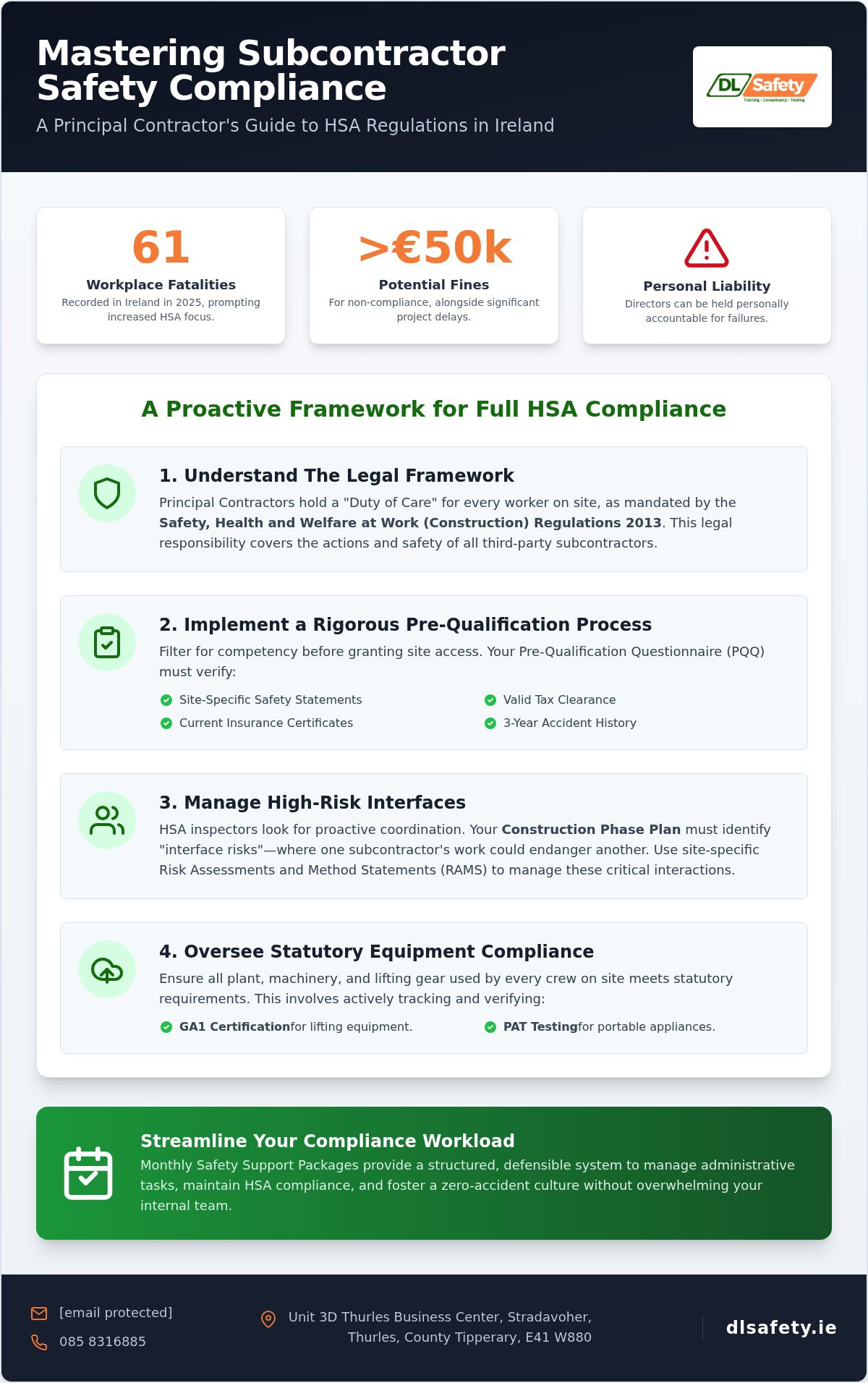
Under Irish law, the role of the Principal Contractor (PC) carries significant weight and responsibility. You aren’t just responsible for your own team; you hold a “Duty of Care” for every third-party worker who steps onto your site. This means that if a subcontractor’s crew is working at height without proper rails or using faulty lifting gear, the legal repercussions often rest on your shoulders. The Safety, Health and Welfare at Work (Construction) Regulations 2013 establish the mandatory legal standard for how principal contractors must coordinate site safety and verify the competency of every subcontractor involved in a project. Effectively managing subcontractor safety compliance is the only way to ensure that these shared responsibilities don’t turn into legal liabilities for your business.
The consequences of failing to oversee these standards are severe and immediate. The HSA has the authority to issue prohibition notices that can shut down a site instantly, leading to massive financial losses and reputational damage. In 2025, Ireland saw 61 workplace fatalities, a statistic that has prompted the HSA to increase its inspection frequency for 2026. Fines for non-compliance can exceed €50,000, and in cases of gross negligence, the legal system looks past the corporate entity to hold directors personally accountable. If you need assistance in structuring these complex duties, our team at Unit 3D Thurles Business Center, Stradavoher, Thurles, County Tipperary, E41 W880, can help you build a defensible system.
The HSA Expectations for Subcontractor Oversight
Inspectors in 2026 are moving away from checking simple “box-ticking” exercises. They now look for evidence of active, proactive coordination amongst different crews. When an inspector audits your site, they’ll examine your Construction Phase Plan to see how you’ve integrated subcontractor roles into the wider safety strategy. They want to see that you are applying fundamental Construction site safety principles by identifying “interface risks” where one crew’s work might endanger another’s. Simple document collection isn’t enough; you must demonstrate that you’ve verified the skills and behaviours of everyone on-site.
Directors Liability and Corporate Responsibility
Personal liability is perhaps the most daunting aspect of modern safety law. If an accident occurs due to poor subcontractor management, directors must prove they exercised “due diligence” to avoid prosecution. This involves showing a consistent, methodical approach to managing subcontractor safety compliance through regular audits and verification. A robust safety management system acts as your primary legal shield. To better prepare your leadership team for these challenges, you can read our detailed guide on What to Expect During a HSA Inspection. For direct support with your compliance framework, contact us at info@dlsafety.ie or call 085 8316885 today.
The Pre-Qualification Process: Verifying Competency Before Site Access
Setting the standard for your site begins long before the first van arrives at the gate. A robust Pre-Qualification Questionnaire (PQQ) for 2026 acts as your primary filter, ensuring only competent partners are invited to tender. This process isn’t just about collecting signatures; it’s about verifying that a subcontractor understands the legal duties of contractors under Irish law. When managing subcontractor safety compliance, you must scrutinise Safety Statements to ensure they are site-specific rather than generic templates. You’ll also need to verify up-to-date Tax Clearance and valid insurance certificates that match the precise scope of work.
Assessing past safety performance is equally vital for risk mitigation. Don’t be afraid to ask for accident history or HSA inspection records from the last three years to identify any patterns of negligence. If a subcontractor holds a Safe-T-Cert or ISO 45001 accreditation, it provides a level of reassurance that their internal systems already meet high standards. This can significantly streamline your vetting process, though it doesn’t replace the need for project-specific checks. If you find the administrative burden of vetting too high, our Monthly Safety Support Packages are designed to handle this heavy lifting for you.
Verifying Training and Competency
You must ensure every individual possesses a valid CSCS card relevant to their specific task. In 2026, the prevalence of sophisticated forgeries means your site team needs to know how to spot fraudulent or expired safety certifications. Always verify certs against the official SOLAS database or the issuing body to maintain integrity. For those needing to upskill quickly, we provide a range of Online Safety Courses Ireland can rely on for flexible, accredited training that meets national standards.
Insurance and Indemnity Requirements
Distinguishing between Public Liability (PL) and Employers Liability (EL) is a non-negotiable step in your vetting process. Whilst PL covers damage to third-party property or persons, EL is essential to ensure the subcontractor is responsible for their own staff’s welfare. Ensure their policy specifically covers high-risk activities like hot works or deep excavations if those are on the schedule. For industrial projects, we recommend setting minimum indemnity limits of at least €6.5 million for PL to protect your business from catastrophic claims.
Managing these details requires a methodical approach that leaves no room for error. If you’re struggling to keep track of expiring certs amongst multiple crews, reach out to us at info@dlsafety.ie or call 085 8316885. Our office at Unit 3D Thurles Business Center, Stradavoher, Thurles, County Tipperary, E41 W880, serves as a hub for helping Irish contractors maintain flawless compliance records.
Managing High-Risk Interfaces: Coordination and Method Statements
Accidents often occur at the “interface” where different crews overlap. When a steel erector is working above a groundwork team, or a delivery driver enters a zone where plant machinery is operating, the risk level spikes. Managing subcontractor safety compliance in these moments requires more than just a signed document; it demands active, physical coordination. You must identify these interface risks during the planning phase to ensure that one subcontractor’s activity doesn’t create a lethal hazard for another. Weekly coordination meetings are essential to de-conflict high-risk tasks and ensure that every crew on-site is working to a unified schedule.
A critical component of this coordination is the site-wide Traffic Management Design. Subcontractors often focus solely on their immediate workspace, but they must understand the broader site rules regarding vehicle movements, pedestrian exclusion zones, and loading areas. If you find yourself struggling to maintain order amongst multiple moving parts, our team at Unit 3D Thurles Business Center, Stradavoher, Thurles, County Tipperary, E41 W880, can provide professional Traffic Management Design and site-specific support to keep your project moving safely. You can reach us at info@dlsafety.ie or call 085 8316885 to discuss your project requirements.
Reviewing and Approving Method Statements
Generic “off-the-shelf” method statements are a major liability for any Principal Contractor. These templates rarely account for the unique constraints of your specific site, such as overhead lines, underground services, or proximity to the public. When you assess a subcontractor’s system of work, you are looking for a clear, step-by-step Method Statement (RAMS) that addresses real-world hazards. A safe system of work must be dynamic; if site conditions change, the RAMS must be updated to reflect the new reality. We specialise in developing bespoke Method Statements that provide a defensible legal shield whilst remaining practical for the crews on the ground.
Site Inductions and Communication
Consistency is the foundation of a strong safety culture. Standardised site inductions ensure that every worker, regardless of their employer, understands the site rules and emergency procedures from day one. To maintain this engagement, regular Toolbox Talks should be used to refresh knowledge and address emerging risks. These sessions are also vital for bridging language barriers amongst diverse workforces. Using visual aids and clear, plain English helps ensure that safety instructions are understood by everyone. Our Monthly Safety Support Packages include assistance with these communications, ensuring your safety message is heard and followed by every subcontractor on-site.
Statutory Compliance and Equipment: GA1 and PAT Testing Oversight
A Principal Contractor holds a non-negotiable duty to ensure that every piece of plant machinery and equipment on their site is fit for purpose. It is a common misconception that the responsibility for equipment safety lies solely with the subcontractor who owns the gear. In reality, allowing a third party to use faulty lifting accessories or uncertified excavators on your project creates a direct path to liability. Managing subcontractor safety compliance means implementing a rigorous verification process that happens before any machine is switched on. You must verify that all lifting gear has a valid Report of Thorough Examination, commonly known as a GA1 certificate, and that these records are kept up to date throughout the project’s duration.
Beyond heavy machinery, the oversight of smaller power tools is equally vital for site safety. Portable Appliance Testing (PAT) schedules must be managed to prevent electrical accidents, particularly on busy industrial sites where tools are subject to heavy wear and tear. Our expert team at Unit 3D Thurles Business Center, Stradavoher, Thurles, County Tipperary, E41 W880, provides comprehensive support in tracking these statutory requirements. For more information on how to manage these specific legal duties, you can explore our GA1 Testing Ireland definitive guide. If you’re ready to outsource the technical burden of equipment verification, contact us at info@dlsafety.ie or call 085 8316885.
Lifting Operations and Equipment Verification
Every lifting operation on your site should be governed by a Lift Plan that aligns with your overall site safety protocols. It isn’t enough for a subcontractor to have their own plan; you must review it to ensure it accounts for ground conditions and proximity to other site structures. When subcontractors bring lifting slings, chains, and shackles on-site, these must be inspected for physical damage and checked against their certification. We follow strict LEEA standards in our examinations to ensure every accessory meets the highest safety benchmarks. This methodical approach ensures that high-risk lifting tasks don’t become a point of failure in your safety system.
Quarry and Heavy Plant Compliance
Heavy site machinery, especially in quarrying or large-scale excavation environments, requires specialised oversight. You must verify that subcontractors are maintaining daily inspection logs and that critical safety features, such as braking systems, are functioning correctly. In 2026, the HSA is placing increased scrutiny on vehicle safety, making regular brake testing a priority for high-risk sites. You can learn more about these requirements in our guide to Quarry Vehicle Brake Testing Ireland. To ensure your subcontractors are meeting these standards without increasing your own administrative workload, book a comprehensive Health & Safety Site Audit with us today.
Streamlining Compliance: The Role of Monthly Safety Support
The administrative burden of overseeing multiple crews can quickly overwhelm even the most organised site teams. Whilst digital tools provide a basic framework for tracking dates, they cannot replace the critical eye of an experienced professional during a physical site walk. Managing subcontractor safety compliance is not a passive task; it requires active verification of work behaviours and equipment standards that software alone cannot provide. By partnering with an external safety consultant, directors can significantly reduce their personal administrative load whilst ensuring their site remains fully compliant with HSA expectations. This strategic approach allows your leadership team to focus on project delivery and operational efficiency, knowing that the technical details of safety oversight are being handled by experts.
Independent site audits act as a vital “second set of eyes,” identifying subcontractor non-compliance that might be overlooked due to daily site blindness. Should an incident occur, having access to professional accident investigation services provides a critical layer of protection for the Principal Contractor. We position our Monthly Safety Support Packages as a proactive asset that transforms safety from a source of stress into a streamlined, defensible system. For direct assistance, you can reach David and the team at info@dlsafety.ie or call 085 8316885.
Benefits of Outsourced Safety Management
Outsourcing your safety management grants you immediate access to a broad range of technical expertise under one roof. Instead of juggling different providers, you can rely on a single partner for GA1 testing, Traffic Management Design, and bespoke training. This model ensures continuous compliance without the high overhead costs associated with hiring a full-time Health and Safety manager. It’s an ideal solution for businesses that need high-level expertise on a flexible, consistent basis. You can learn more about how these services work in our Monthly Safety Support in Ireland buying guide.
Building a Defensible Safety Record
A robust safety record is a powerful tool for business growth. Professional reporting and regular audits provide the documented evidence required for Safe-T-Cert and ISO 45001 preparation, making your firm more attractive during project tendering. It’s about closing the loop; an audit finding is only useful if it leads to documented corrective actions that prevent future risks. This methodical approach demonstrates to clients and the HSA that you are proactive in managing subcontractor safety compliance. Our office at Unit 3D Thurles Business Center, Stradavoher, Thurles, County Tipperary, E41 W880, is dedicated to helping you build this culture of excellence. Contact us today to secure your site’s future.
Securing Your Site’s Future through Proactive Compliance
The landscape of construction safety in Ireland is shifting towards deeper accountability and more rigorous coordination. You’ve seen how the principal contractor’s duty of care extends to every third-party worker, making a robust pre-qualification process and site-specific RAMS essential for your legal protection. Effectively managing subcontractor safety compliance isn’t just about filing certificates; it’s about active oversight of high-risk interfaces and statutory requirements like GA1 testing. By implementing a strategic framework, you can reduce administrative overwhelm whilst building a defensible safety record that stands up to any HSA inspection.
Our team at Unit 3D Thurles Business Center, Stradavoher, Thurles, County Tipperary, E41 W880, provides the expert GA1 testing and accident investigation services you need to maintain excellence. Contact DL Safety today to secure your Monthly Safety Support Package and let us handle the technical burden of compliance. You can reach us at info@dlsafety.ie or call 085 8316885. We’re here to help you turn safety from a headache into a competitive advantage.
Frequently Asked Questions
Who is legally responsible for subcontractor safety on an Irish construction site?
Under the Construction Regulations 2013, the Principal Contractor (PC) and the Project Supervisor for the Construction Stage (PSCS) share legal responsibility for site safety. Whilst subcontractors have a duty to protect their own employees, the PC must coordinate their activities to ensure a safe environment for everyone. This shared responsibility model means you’re accountable for overseeing their standards. Failing to monitor these interfaces is a significant legal risk for your business.
What documents must a subcontractor provide before starting work?
Subcontractors must provide several key documents before site access is granted. These include a site-specific Safety Statement, valid Public and Employers Liability insurance, and a Method Statement (RAMS) for their specific tasks. You must also verify Tax Clearance and training certifications like CSCS cards. Collecting these documents is the first step in managing subcontractor safety compliance, ensuring that every crew meets the minimum legal and competency requirements for your project.
How often should I audit my subcontractors for safety compliance?
You should ideally audit subcontractors on a monthly basis, though high-risk activities may require more frequent inspections. For modern construction sites in 2026, the HSA expects ongoing risk control rather than occasional checks. Regular audits help identify inconsistent safety behaviours amongst different crews before they lead to accidents. Our Monthly Safety Support Packages provide independent site audits to ensure your compliance system remains robust and defensible against legal challenges.
Can a Principal Contractor be fined for a subcontractor’s safety failure?
Yes, a Principal Contractor can be fined for a subcontractor’s safety failure if they failed to exercise due diligence. The HSA can impose fines exceeding €50,000 and hold company directors personally liable for negligence. If you don’t actively coordinate site safety or verify that subcontractors are working safely, the legal system views this as a breach of your duty of care. This makes professional oversight a critical protective measure for your company.
What is a GA1 certificate and why must I check it for subcontractors?
A GA1 certificate is a Report of Thorough Examination for lifting equipment and accessories. You must check these for subcontractors because any lifting gear used on your site must be statutory compliant and fit for purpose. Equipment used for lifting people or accessories like slings must be examined every 6 months. Verifying these certs is a vital part of managing subcontractor safety compliance to prevent catastrophic mechanical failures during high-risk lifting operations.
How do I handle a subcontractor who consistently ignores site safety rules?
You should follow a clear, documented escalation process for subcontractors who ignore site safety rules. This typically begins with a formal warning and a requirement for immediate corrective action. If the behaviour persists, you may need to suspend their work or remove them from the site entirely. Documenting these interactions is essential for your legal defence, as it demonstrates that you took proactive steps to maintain safety standards despite subcontractor negligence.
Is a generic safety statement sufficient for a high-risk industrial site?
No, a generic safety statement is never sufficient for a high-risk industrial site. The HSA requires Safety Statements to be site-specific, reflecting the actual hazards and risks present on your project. Templates often fail to address unique interfaces, such as deep excavations or proximity to overhead lines. We specialise in developing bespoke safety statements that provide a practical roadmap for workers whilst ensuring your business meets the highest regulatory standards.
What are the benefits of using a Monthly Safety Support Package for contractor management?
A Monthly Safety Support Package significantly reduces the administrative burden on directors by outsourcing the heavy lifting of compliance. It provides regular site audits, accident investigation, and technical verification of GA1 and PAT testing certs. This ensures your site remains fully compliant without the need for a full-time safety manager. For expert assistance, contact us at info@dlsafety.ie or call 085 8316885 to secure a package tailored to your specific project needs.