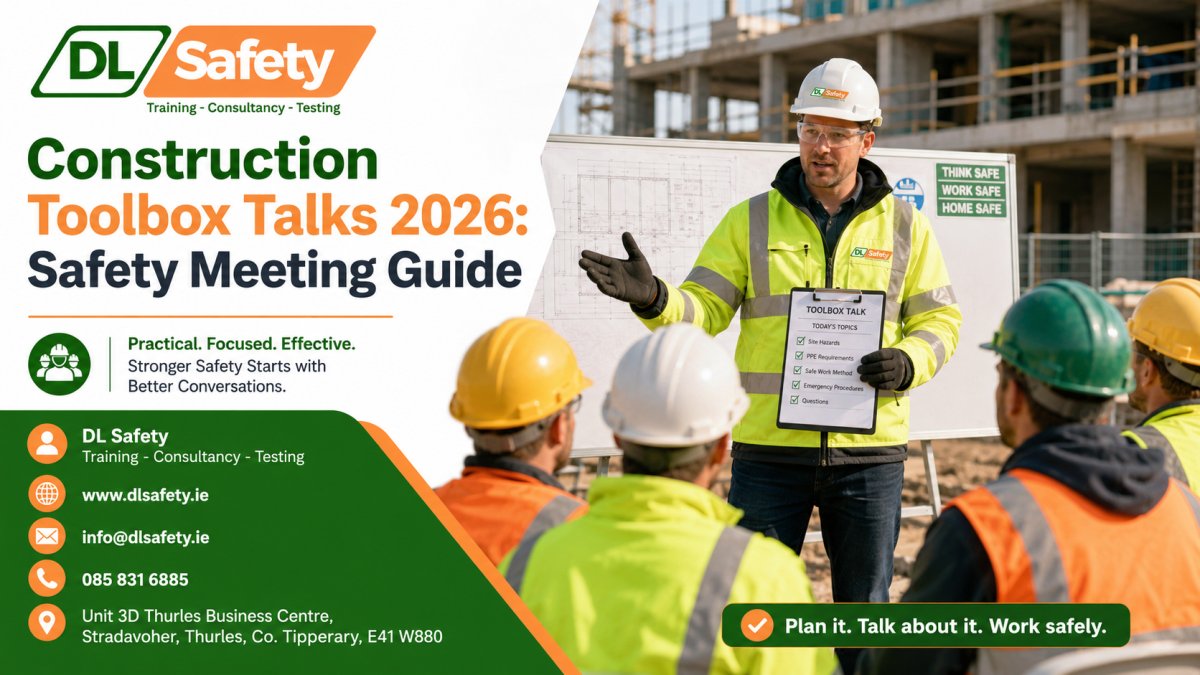
The most dangerous moment on your site isn’t always the high-wire act; it’s the ten minutes your crew spends staring at their boots while you read out a safety memo they’ve heard a dozen times before. We know how frustrating it is when workers switch off, especially when you’re trying to manage diverse teams and stay on the right side of evolving HSA standards. Finding the right toolbox talk topics for construction 2026 shouldn’t feel like a chore that’s only done to tick a box.
We’re here to help you master your 2026 safety huddles with a comprehensive library of high-risk and emerging topics designed to ensure compliance and genuine engagement. By moving from passive listening to active risk-based discussions, you’ll see improved site behaviour and have the documented proof needed for inspections. This guide provides a structured meeting plan covering everything from updated PPE standards to mental health. For expert assistance with site audits or GA1 testing, contact DL Safety at Unit 3D Thurles Business Center, Stradavoher, Thurles, County Tipperary, E41 W880, email info@dlsafety.ie, or call 085 8316885. You can also explore our full range of support services at www.dlsafety.ie.
Key Takeaways
- Learn how to transform passive safety huddles into high-impact briefings that satisfy HSA inspectors and improve on-site behaviour.
- Identify the most relevant toolbox talk topics for construction 2026, including emerging risks such as mental fitness and digital distractions.
- Understand the essential link between daily briefings and statutory requirements, such as GA1 testing and regular equipment inspections.
- Master a structured delivery method that uses real-world scenarios to ensure your crew remains engaged and compliant throughout the year.
- Contact DL Safety at Unit 3D Thurles Business Centre, Stradavoher, Thurles, County Tipperary, E41 W880, or via info@dlsafety.ie and 085 8316885 to learn more at www.dlsafety.ie.
The Role of Toolbox Talks in 2026 Construction Safety
Toolbox talks are short, focused safety briefings delivered directly on the job site to address specific hazards or upcoming tasks. They serve as the front line of your Occupational Safety and Health strategy. In the past, these meetings were often seen as a ten minute distraction from “real work.” However, as we look at the requirements for 2026, these huddles have evolved into a critical tool for risk management and regulatory compliance. Selecting the right toolbox talk topics for construction 2026 is no longer just about filling time; it’s about ensuring every person on site understands the specific dangers they face during their shift.
Meeting HSA Standards for Worker Consultation
Under Irish law, the HSA requires employers to consult with their workers on matters of safety. You can’t just dictate rules; you have to listen. Toolbox talks provide a documented forum for this essential exchange. When an inspector visits, they’ll look for more than just a signature on a page. They want to see evidence that workers were given the chance to ask questions, report “near misses,” and contribute to the site’s safety culture. This two-way communication is vital for maintaining high standards and avoiding costly penalties. Our team at DL Safety helps firms manage this through Monthly Safety Support Packages, ensuring your documentation stands up to the closest scrutiny.
Why Passive Listening is No Longer Enough
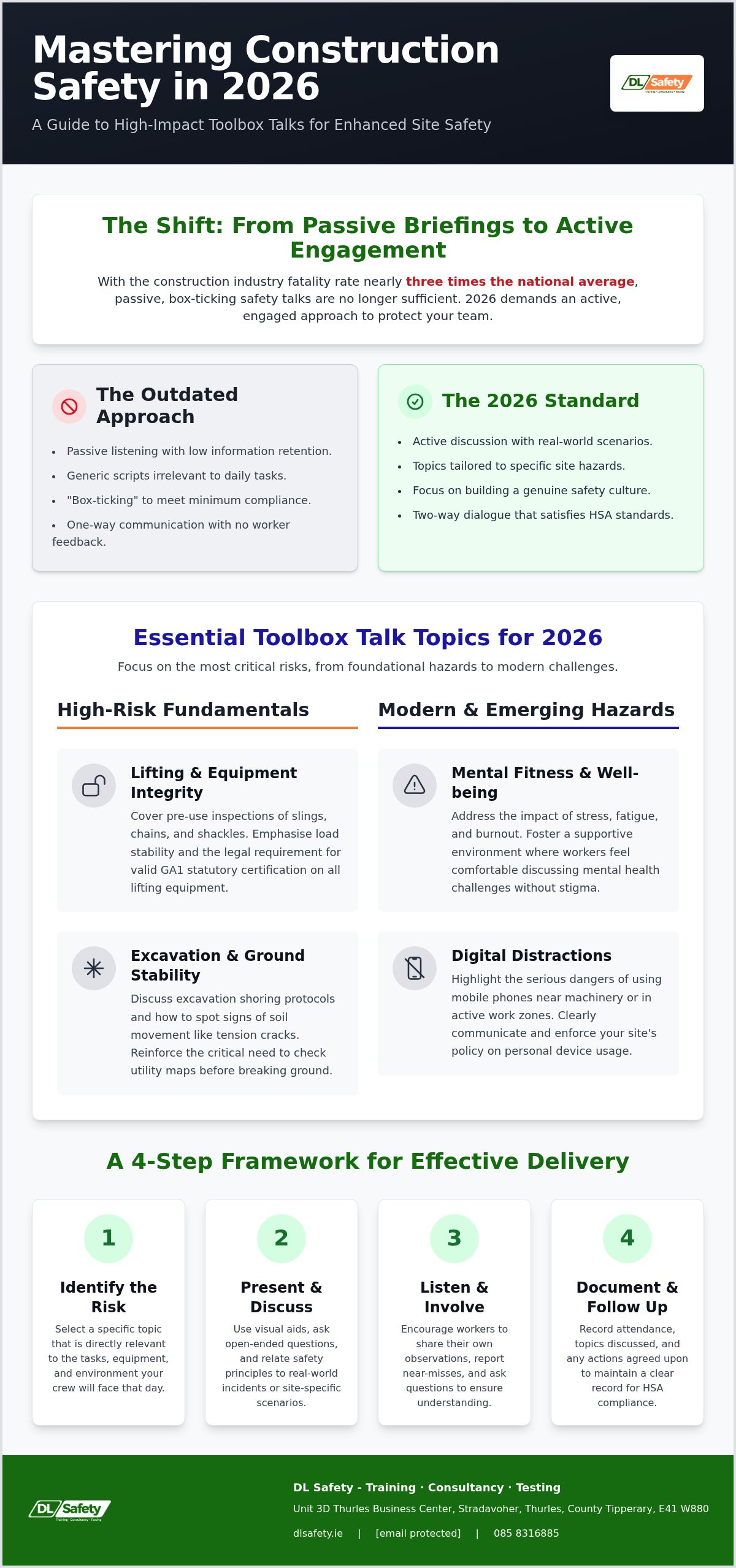
The days of reading from a generic script whilst the crew checks their watches are over. 2026 demands active engagement. With the construction industry facing a fatality rate nearly three times higher than the national average, the stakes are too high for “box-ticking” exercises. Modern briefings need to be interactive and relevant. When you choose toolbox talk topics for construction 2026, you should be asking questions, using visual aids, and relating the topic to the specific work happening that afternoon. If your team isn’t talking back, they probably aren’t taking the information in. A crew that is actively engaged is a crew that stays safe.
Building a positive safety culture amongst diverse site crews requires consistency and a professional touch. At DL Safety, we act as your “Personable Expert,” taking the heavy lifting out of safety documentation so you can focus on the build. Whether you need help with GA1 testing or a full site audit, we’re here to support your business. You can find us at Unit 3D Thurles Business Center, Stradavoher, Thurles, County Tipperary, E41 W880. For more information, visit www.dlsafety.ie, email info@dlsafety.ie, or call us on 085 8316885 to discuss your site safety needs.
Essential High-Risk Construction Topics for Your 2026 Calendar
Safety in construction isn’t a static target. With the industry accounting for nearly 20% of all workplace fatalities, choosing the right toolbox talk topics for construction 2026 is a matter of life and death. You need to focus on the most hazardous activities whilst also addressing technical compliance. Generic advice doesn’t save lives on a busy site; specific, actionable instructions do. We recommend prioritising topics that align with the high-risk tasks scheduled for your specific project phase.
Lifting Equipment and Statutory Inspections
Lifting operations are fraught with risk, particularly when equipment isn’t properly maintained or inspected. Your briefings should focus on the pre-use inspection of slings, chains, and shackles. It’s vital that your crew understands the legal necessity of GA1 testing Ireland. If a piece of equipment lacks a valid statutory certificate, it must be removed from service immediately. Referencing OSHA Construction Safety Standards can help your team understand global benchmarks for load stability and rigging safety, ensuring that every lift is planned and executed without incident.
Excavation Safety and Ground Stability
Groundwork remains one of the most hazardous phases of any project. Your 2026 safety calendar must include detailed talks on excavation shoring and the risks of slope failure. Workers need to be trained to spot the early signs of soil movement, such as tension cracks or bulging. Additionally, managing underground services is a priority; every briefing should reinforce the need to cross-reference utility maps before breaking ground. This proactive approach prevents strikes and protects the health of your team, especially on congested sites where services are often poorly mapped.
Plant Maintenance and Brake Testing
Heavy machinery and site vehicles require constant vigilance to ensure they remain safe for operation. Beyond simple daily walk-around checks, you should dedicate time to discussing the importance of specialised maintenance and testing. For those operating in high-intensity environments or quarries, quarry vehicle brake testing Ireland is a crucial topic to cover. Ensuring that brakes are tested under load conditions can prevent catastrophic failures and runaway vehicle accidents. Documenting these discussions provides essential proof of engagement for HSA inspections.
Managing these high-risk areas can be overwhelming, but you don’t have to do it alone. If you need a partner to help organise your safety documentation or conduct audits, consider our Monthly Safety Support Packages. We operate from Unit 3D Thurles Business Center, Stradavoher, Thurles, County Tipperary, E41 W880. You can reach the DL Safety team at info@dlsafety.ie or by calling 085 8316885. Our full range of professional safety services is available at www.dlsafety.ie.
Modern Hazards: Emerging Safety Meeting Ideas for 2026
As we move through 2026, the definition of a “hazard” on a construction site is expanding beyond physical obstacles. Whilst traditional risks like falls and plant movements remain, we’re now seeing the rise of invisible threats that impact a worker’s focus and long-term health. When you’re planning your toolbox talk topics for construction 2026, it’s essential to include these modern challenges to ensure your safety culture remains relevant. A crew that feels their specific, contemporary concerns are being addressed is far more likely to stay engaged during your morning huddle.
Mental Health and Fatigue Management
The construction industry is finally embracing the “Mental Fitness Revolution.” It’s no longer enough to just mention awareness; your briefings need to offer practical on-site support. A worker struggling with burnout or high stress is just as much of a risk as a faulty piece of equipment. Use your safety meetings to discuss fatigue management, especially during intensive project phases. Encourage your team to recognise the signs of exhaustion in themselves and their colleagues. This approach transforms the toolbox talk from a lecture into a genuine support system that protects everyone on the site.
Respiratory Health and Silica Dust Control
Silica dust, or Respirable Crystalline Silica (RCS), remains a silent killer that demands updated guidance. Your 2026 briefings should focus on the latest on-tool extraction technologies and the non-negotiable requirement for high-standard respiratory protective equipment (RPE). We also need to address chemical spill response. Ensure your crew knows the exact location of spill kits and understands the deployment protocols to prevent environmental contamination. These “invisible killers” require a disciplined approach to ensure long-term worker health and HSA compliance.
Digital Safety and Site Distractions
Mobile phones and wearable tech are becoming significant site distractions. A split-second glance at a notification whilst operating machinery or walking near active plant can have devastating consequences. Your safety meetings should establish clear boundaries for “no-phone zones” and the safe use of technology. Additionally, we must prepare for environmental shifts. Managing heat stress and extreme weather events is now a core part of outdoor work. Your crew needs to understand the protocols for hydration, mandatory rest, and acclimatisation during periods of high temperature.
Managing these emerging hazards requires a proactive and expert approach. At DL Safety, we act as your trusted advisor, helping you navigate complex regulations with ease. Whether you need bespoke training or a comprehensive health and safety audit, we’re here to help. You can find us at Unit 3D Thurles Business Center, Stradavoher, Thurles, County Tipperary, E41 W880. To discuss your safety needs, email info@dlsafety.ie, call 085 8316885, or visit www.dlsafety.ie to explore our Monthly Safety Support Packages.
Organising and Delivering High-Impact Safety Briefings
The best safety plan is useless if it’s trapped in a folder in the site office. Delivering high-impact briefings is about leadership and communication, not just reading from a sheet. When selecting your toolbox talk topics for construction 2026, you need a delivery method that ensures the message actually sticks. We’ve developed a five-step framework to help foremen and supervisors move beyond the “box-ticking” mentality and foster a genuine culture of safety on site.
- Step 1: Preparation. Don’t pick a topic at random. Choose the briefing based on the day’s high-risk activities. If your crew is preparing for a large pour, focus on concrete safety and plant movement.
- Step 2: The Hook. Start with a real-world scenario or a “near miss” that happened recently. This grabs attention immediately and makes the risk feel personal rather than theoretical.
- Step 3: The Content. Keep it brief and site-specific. Focus on the three most important things the crew needs to do to stay safe during their shift.
- Step 4: Participation. Ask open questions to get the crew talking. When workers are amongst the conversation, they’re more likely to take ownership of the safety protocols.
- Step 5: Documentation. Signatures and feedback are non-negotiable. Proper records are essential for HSA inspection readiness and provide proof that you’ve consulted with your team.
The 5-Minute Delivery Framework
Brevity is your best friend on a busy site. A five-minute talk is often more effective than a twenty-minute lecture. Focus on three core points: the hazard, the control measure, and the emergency procedure. This keeps the information digestible and ensures the crew remembers the vital details whilst they’re working. If you find your briefings are dragging on, you’re likely losing the interest of your team.
Using Visual Aids and Simulation Training
Don’t just tell; show. Use physical examples of worn-out lifting slings or damaged PPE to illustrate your points. For more complex tasks, simulation training can bridge the gap between theory and practice. This hands-on method is also a hallmark of professional driver training; for instance, SAMZ Automatic Driving School uses practical instruction to ensure safety standards are met in their automatic driving lessons and instructor courses. Visual aids are particularly helpful when you’re managing diverse teams with varying levels of safety awareness. It makes the technical requirements of the job much easier to understand for everyone involved.
When demonstrating proper equipment use, referencing the specifications of high-quality tools from specialists like Springwell Industries Pte Ltd can help workers identify what safe, well-maintained machinery looks like.
Diverse sites are the norm in 2026. If workers don’t fully understand the briefing, the risk increases for everyone. Use diagrams, translated materials, and “buddy systems” where experienced workers can help explain concepts to those who might struggle with technical English. This proactive approach ensures that safety isn’t lost in translation.
If you want to streamline your safety meetings and ensure full compliance, consider our Monthly Safety Support Packages. At DL Safety, we pride ourselves on being a reliable partner for construction firms across Ireland. You can find us at Unit 3D Thurles Business Center, Stradavoher, Thurles, County Tipperary, E41 W880. For expert advice, email info@dlsafety.ie, call 085 8316885, or visit www.dlsafety.ie to see how we can support your business.
Scaling Site Safety with Monthly Support Packages
Whilst a well-delivered briefing is a powerful tool, it shouldn’t exist in a vacuum. Effective health and safety compliance requires a holistic approach where daily huddles, professional audits, and technical inspections work in harmony. Many firms struggle to maintain a consistent safety message as a project scales. This is where a more structured oversight model becomes invaluable. Choosing the right toolbox talk topics for construction 2026 is only the first step towards a culture of excellence; the second is ensuring those topics are backed by a robust management system.
The Value of Retained Safety Consultancy
Having a retained safety consultant allows you to move away from reactive “firefighting” and towards a proactive annual safety calendar. We work with our clients to curate a schedule of toolbox talk topics for construction 2026 that reflects the specific risks of their upcoming project phases. This means your site team doesn’t have to spend hours researching regulations or searching for relevant content. By delegating this to a “Personable Expert,” you ensure that the information delivered is accurate, HSA-compliant, and tailored to the actual work happening on the ground. This level of professional oversight builds trust with your crew and demonstrates a high-level commitment to their welfare.
Linking Daily Huddles to Statutory Compliance
A daily huddle is the perfect time to reinforce the findings of your latest health and safety site audits. If an auditor identifies a trend in poor harness storage or skipped plant checks, that should become the focus of the next morning’s briefing. At DL Safety, we help you close this loop. Our Monthly Safety Support Packages integrate these elements, linking your daily talks directly to statutory requirements like GA1 testing and quarry vehicle brake testing. If an accident does occur, having this documented chain of engagement is vital for a thorough accident investigation. It proves that you didn’t just have the right paperwork; you actually communicated the risks to the people doing the work.
Our mission is to demystify complex regulations and take the stress out of compliance for construction firms across Ireland. Whether you need bespoke training, lift plans, or dedicated safety oversight, we’re here to support your success. You can find us at Unit 3D Thurles Business Center, Stradavoher, Thurles, County Tipperary, E41 W880. To find out how we can help your business scale safely, contact the DL Safety team at info@dlsafety.ie or call 085 8316885. You can also explore our full range of services and support packages at www.dlsafety.ie.
Transforming Your Site Safety Culture for 2026
Mastering your site briefings is about more than just reading a script; it’s about building a culture where every worker takes ownership of their safety. By selecting the right toolbox talk topics for construction 2026, you move beyond mere box-ticking to create an environment that satisfies HSA standards whilst genuinely protecting your crew. We’ve explored how a five-minute delivery framework and a focus on emerging risks like mental health can transform your daily huddles into high-impact sessions.
At DL Safety, we’re dedicated to helping you handle the heavy lifting of compliance. From specialised GA1 and PAT testing services to expert accident investigation and comprehensive site audits, we provide the professional oversight your business needs to scale safely. You can find our team at Unit 3D Thurles Business Center, Stradavoher, Thurles, County Tipperary, E41 W880. If you’re ready to simplify your safety management and improve site behaviour, explore our Monthly Safety Support Packages at DL Safety or reach out at info@dlsafety.ie and 085 8316885. Let’s work together to make 2026 your safest and most productive year yet.
Frequently Asked Questions
How often should I conduct toolbox talks on a construction site in 2026?
You should conduct toolbox talks at least once a week, but daily briefings are recommended during high-risk project phases. Regularity ensures that safety remains at the forefront of every worker’s mind. If the site environment or the task changes significantly, a fresh briefing is essential. Consistent huddles help build a proactive safety culture where risks are managed before they lead to accidents or project delays.
What are the most important construction safety topics for HSA compliance?
The most important toolbox talk topics for construction 2026 for HSA compliance include working at height, excavation stability, and lifting operations. You must also address health-related risks like respirable crystalline silica (RCS) and mental health. These topics align with the HSA’s focus on high-risk activities. Our team at DL Safety can help you curate a compliant calendar that covers these essential areas through our Monthly Safety Support Packages.
How long should a typical toolbox talk huddle last?
A typical toolbox talk huddle should last between five and ten minutes. Keeping the session brief ensures that the crew remains focused and doesn’t “switch off” during the delivery. The goal is to provide punchy, actionable information that workers can apply immediately to their shift. If a topic requires more time, it’s often better to split it into two shorter sessions rather than one long lecture.
Can I use digital signatures to document my safety briefings?
Yes, you can use digital signatures to document your safety briefings, provided the system is secure and provides a clear audit trail. The HSA accepts digital records as proof of worker consultation if they are timestamped and clearly identify the participant. This modern approach simplifies documentation and makes it easier to present evidence during a site audit. It’s a highly efficient way to manage compliance across multiple sites.
What happens if a worker refuses to engage with safety talks?
If a worker refuses to engage with safety talks, it should be treated as a serious disciplinary matter. Safety compliance is a legal requirement and a fundamental condition of employment on any construction site. You should first try to understand the reason for their disinterest and re-explain the importance of the briefing. If the behaviour continues, formal warnings may be necessary to protect the individual and their colleagues from harm.
How do I choose the right topic for a specific site task?
You should choose the right topic by reviewing the Risk Assessment and Method Statement (RAMS) for the specific tasks scheduled for that day. Aligning your toolbox talk topics for construction 2026 with the afternoon’s work makes the information feel relevant and useful rather than just a generic safety reminder. If the crew is moving into a new phase, such as steel erection, the briefing must reflect those specific hazards.
Are toolbox talks a legal requirement in Ireland?
Toolbox talks are a practical way to meet the legal requirement for worker consultation under the Safety, Health and Welfare at Work Act 2005. Whilst the law doesn’t specifically use the term “toolbox talk,” it mandates that employers must consult with employees on safety matters. These briefings provide documented proof that this consultation has occurred, which is vital for staying on the right side of the law during HSA inspections.
How can I make my safety meetings more interesting for the crew?
You can make safety meetings more interesting by using real-life examples, physical props, and open-ended questions. Instead of just reading a list of rules, show the crew a damaged lifting sling or discuss a recent “near miss” on another site. Encouraging workers to share their own experiences makes the session more interactive. This approach helps to prevent the team from switching off and ensures the safety message is actually understood.