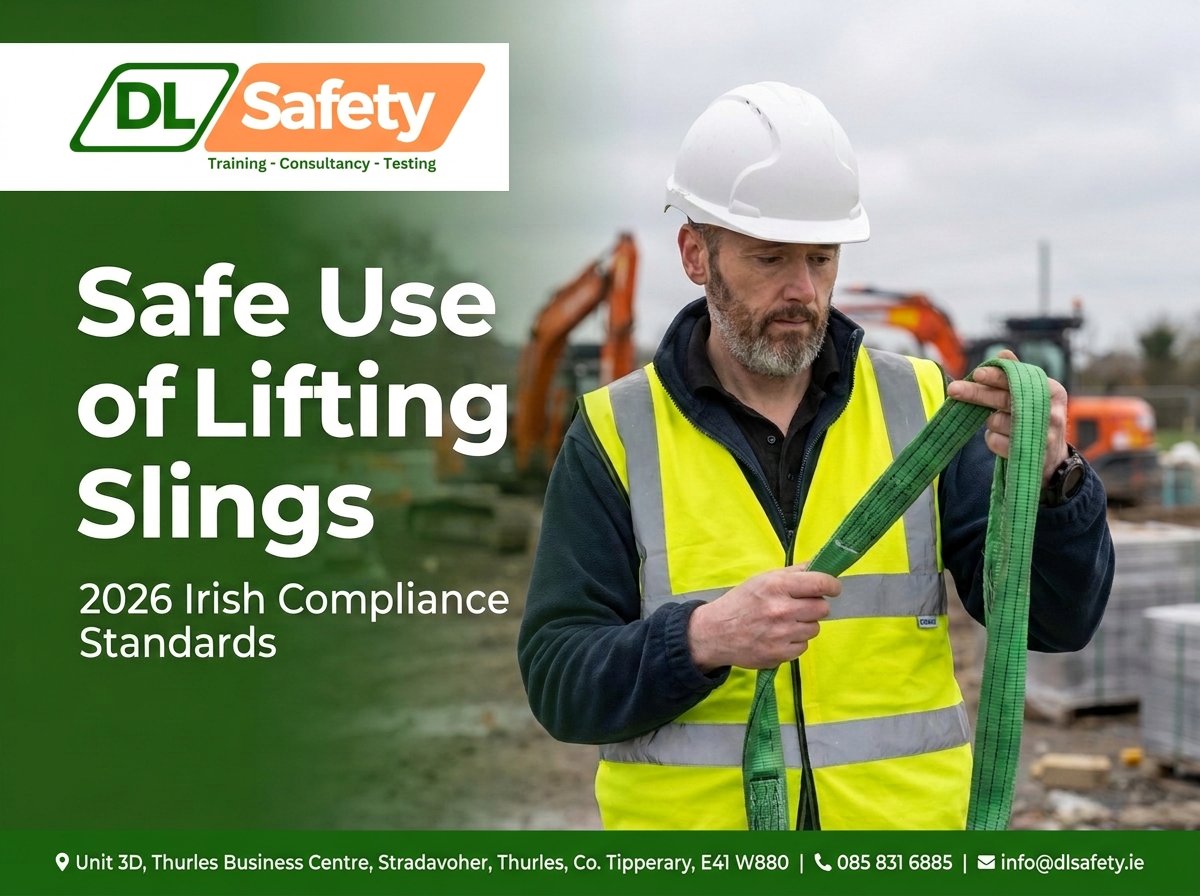
Lifting safety is never just about the strength of the gear; it is a precise calculation where material science meets statutory GA1 compliance. You likely know the common frustration of chasing subcontractors for consistent inspection records or the sudden worry when a sling shows signs of wear just before a complex lift. Ensuring every piece of equipment is fit for purpose is a heavy responsibility that requires more than just a quick glance. This safe use of lifting slings guide is designed to help you navigate the 2026 Irish compliance standards with total confidence, ensuring your site remains both safe and productive.
We agree that the confusion surrounding GA1 certification frequency and HSA requirements can be a significant hurdle for site managers. Our promise is to demystify these protocols, giving you a clear understanding of sling types and the practical knowledge to perform rigorous pre-use checks. We will preview the essential statutory testing cycles and the specific criteria that determine whether gear should be used or sidelined. As your trusted advisors at DL Safety, we’re here to support your compliance journey. For expert guidance on your lifting equipment, feel free to contact us at info@dlsafety.ie or call 085 8316885 to discuss your specific site needs.
Key Takeaways
- Identify the specific material properties of polyester and wire rope to ensure you select the most stable and secure sling for every unique lift.
- Use this safe use of lifting slings guide to master the “Mode Factor” and understand how different hitch types fundamentally alter your equipment’s load capacity.
- Establish a robust pre-use inspection routine and a visual “Colour of the Month” system to ensure all gear is verified before it leaves the ground.
- Clarify your statutory obligations regarding GA1 certification and the essential six-month thorough examination interval required by the HSA in Ireland.
- Learn how to maintain impeccable inspection records amongst subcontractors to eliminate confusion and protect your site from the risks of gear failure.
Understanding Lifting Slings: The Foundation of Safe Lifting Operations
A lifting sling serves as the critical link between your load and the lifting machine. It’s the component that translates the power of a hoist or crane into a controlled, secure movement. Without a reliable sling, even the most advanced machinery is ineffective. Because of this, establishing a safety-first culture across Irish industrial sites is essential for protecting both personnel and high-value assets. This safe use of lifting slings guide highlights that every successful lift begins with a decision made by a “Competent Person.” This individual possesses the technical expertise and practical experience to evaluate the weight, centre of gravity, and environmental conditions before approving any piece of gear for use.
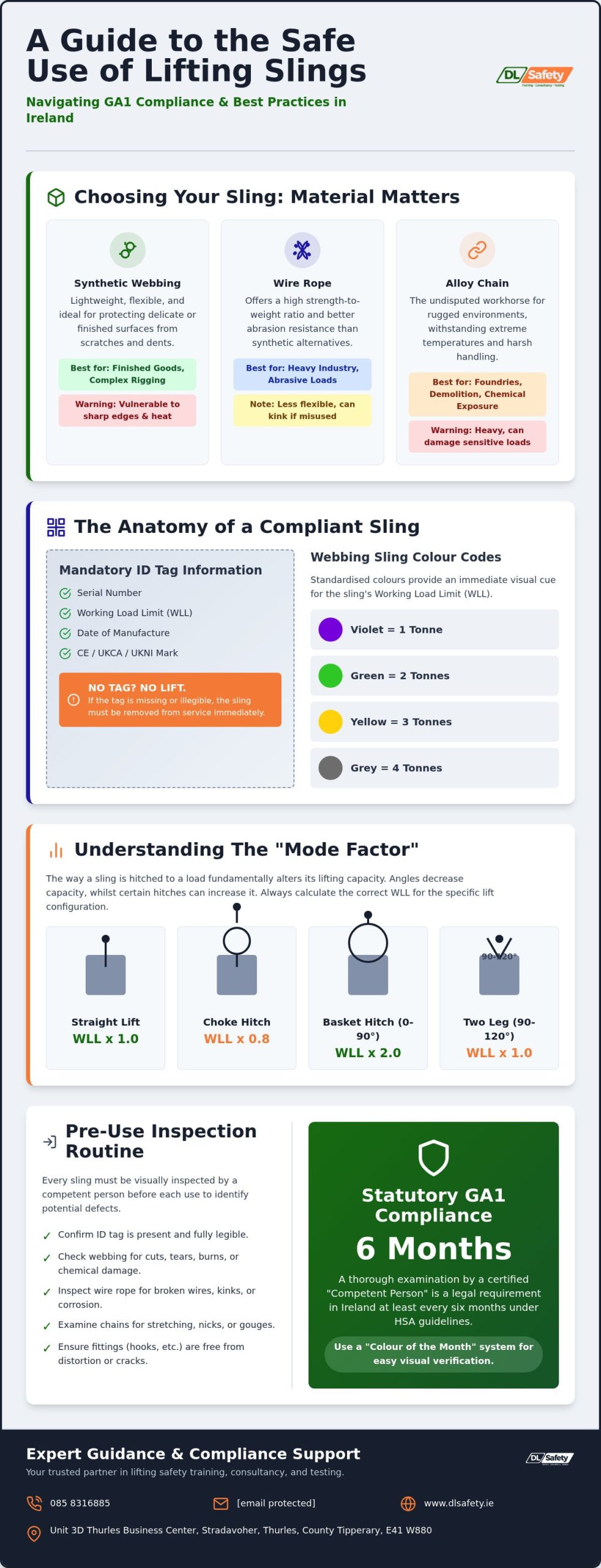
Primary materials for these links include synthetic webbing, wire rope, and alloy chains. Each material offers distinct benefits depending on the task at hand. Selecting the wrong material doesn’t just risk the load; it can lead to catastrophic equipment failure if the environmental factors aren’t properly accounted for during the planning stage.
The Anatomy of a Compliant Lifting Sling
A compliant sling is easily identified by its permanent identification tag. This isn’t just a label; it’s a legal requirement that must clearly list the Serial Number, Working Load Limit (WLL), and the date of manufacture. For synthetic webbing, colour-coding provides an immediate visual cue for capacity amongst site workers. For instance, violet typically signifies a one-tonne limit, whilst green represents two tonnes. In the current post-Brexit market, you’ll see the CE mark as the primary standard in Ireland, though UKCA or UKNI marks may also be present on equipment sourced through various supply chains. If a tag is missing or illegible, the sling must be removed from service immediately.
Lifting Slings vs. Lifting Chains: When to Use Which?
Choosing between a synthetic sling and a Grade 80 or 100 alloy chain depends largely on your working environment and the nature of the load. Synthetic slings are the favourite for finished or delicate surfaces because they won’t scratch, mar, or dent the material being moved. They’re lightweight and flexible, which makes them easy to handle during complex rigging. However, they’re vulnerable to sharp edges and extreme heat. Conversely, alloy chains offer superior durability in harsh conditions, such as foundries or sites with significant chemical exposure. Protecting delicate loads requires the soft touch of webbing, whilst rugged industrial environments often demand the resilience of steel.
If you’re unsure which equipment suits your specific project, the team at DL Safety provides expert advice and high-quality gear. You can visit us at Unit 3D Thurles Business Center, Stradavoher, Thurles, County Tipperary, E41 W880, or reach out via email at info@dlsafety.ie. For direct enquiries, our team is available at 085 8316885 to ensure your site stays compliant and safe.
Selecting the Right Sling: Material Properties and Load Dynamics
Choosing the correct equipment is a technical exercise that balances load requirements with the realities of your site environment. This safe use of lifting slings guide emphasises that selection starts with a thorough evaluation of the load itself. You must determine the total weight, locate the centre of gravity, and identify the most secure attachment points before any gear is rigged. If the centre of gravity is ignored, the load will shift during the lift, potentially overloading one leg of your sling and creating a dangerous imbalance.
Polyester webbing slings are often the first choice because they’re lightweight and exceptionally versatile. They’re easy to store and won’t damage sensitive surfaces. For heavy industrial applications where a high strength-to-weight ratio is required, wire rope slings provide a more rigid alternative that resists abrasion better than synthetics. However, for the most rugged environments, chain slings remain the undisputed workhorse. They withstand extreme temperatures and harsh handling that would quickly destroy other materials, making them essential for foundries or heavy demolition sites.
Polyester Webbing Slings: Flat vs. Round
Flat webbing slings are designed with a wide bearing surface to distribute the load’s weight evenly, which helps maintain stability during the lift. Conversely, endless round slings provide superior flexibility, allowing them to adapt to various hitch types and rotate the wear points more effectively. A Z-fold eye is a reinforced connection point where the webbing is folded into a narrower, triple-layered profile to ensure it fits securely into shackles while maintaining maximum strength. When you’re sourcing gear for a specific project, checking our range of lifting equipment ensures you have the right material for the environment.
Environmental Selection Criteria
Environmental factors can degrade a sling’s integrity long before its official expiration date. UV degradation is a common issue on Irish sites; if a synthetic sling looks faded or feels brittle, its load-bearing capacity is likely compromised. Chemical resistance is equally specific. Polyester handles acids well but can be severely damaged by alkalis. Temperature also dictates your choice, as synthetic slings generally shouldn’t be used in environments exceeding 100°C. For any questions regarding material suitability or to organise a site audit, the team at DL Safety is available at Unit 3D Thurles Business Center, Stradavoher, Thurles, County Tipperary, E41 W880. You can also reach us at info@dlsafety.ie or call 085 8316885 for expert support.
Critical Safety Factors: SWL, WLL, and the Geometry of the Lift
Understanding technical terminology is the first step toward a secure site. Working Load Limit (WLL) refers to the maximum load a piece of equipment is designed to carry by the manufacturer under ideal conditions. Safe Working Load (SWL), however, is the maximum load the gear can safely handle in a specific configuration or environment. A competent person determines the SWL by considering factors like wear, age, and the safe use of lifting slings guide protocols. Using the WLL as a default without considering the “Mode Factor” is a common mistake. This factor accounts for how the hitch type, whether vertical, choke, or basket, fundamentally changes the sling’s capacity. For example, a choke hitch typically reduces the effective capacity of a sling by 20% because of the stress placed on the material at the point of the choke.
The Physics of Sling Angles
Lifting geometry is often the most overlooked risk on a busy site. You should never exceed a 90-degree included angle between the legs of a multi-leg sling. As this angle widens, the tension on each leg increases dramatically because of horizontal force components. When you move from a vertical lift to a 60-degree angle from the horizontal, the load on each leg increases by approximately 15%. This means a load that weighs 1,000kg effectively “feels” like 1,150kg to the gear. Professional lift plans are essential here; they provide the precise calculations needed to ensure angles remain within safe limits before the crane starts to move.
Hitching Best Practices
Proper execution of hitches prevents premature wear and sudden failure. When using a Choke Hitch, avoid forcing the eye down towards the load, as this creates an acute angle that can damage the internal fibres of a synthetic sling. Basket Hitches are excellent for stability, provided the load is balanced and the slings are secured so they can’t slide together. If you’re dealing with loads that have an offset centre of gravity, using multiple slings of different lengths or adjustable chain slings is the best way to maintain a level lift. This ensures that no single leg is carrying more than its share of the weight.
Managing these complex variables is part of our commitment to site safety at DL Safety. Our team is based at Unit 3D Thurles Business Center, Stradavoher, Thurles, County Tipperary, E41 W880. If you need assistance with lift planning or GA1 testing, contact us at info@dlsafety.ie or call 085 8316885 to discuss your project requirements.
Pre-Use Inspection and Maintenance: A Step-by-Step Safety Protocol
Maintaining the integrity of your rigging gear is a continuous process that begins long before the crane hook is lowered. This safe use of lifting slings guide highlights the distinction between a standard pre-use check and a statutory thorough examination. A pre-use check is a visual and tactile assessment conducted by the operator at the start of every shift to identify obvious defects. In contrast, a thorough examination is a detailed, documented inspection required by law, typically every six months for lifting accessories. Implementing a “Colour of the Month” system is a highly effective way to manage compliance amongst subcontractors. By attaching a specific coloured tag to gear that has passed its most recent inspection, site managers can instantly verify that every sling in use is within its valid certification period.
Meticulous record keeping is your most robust legal defence in the event of an incident. A dedicated site inspection log should track serial numbers, the date of the last GA1, and the results of daily checks. If you need assistance setting up these systems, you can book a health and safety site audit to ensure your documentation meets HSA expectations.
Discard Criteria: When to Take a Sling Out of Service
Knowing exactly when to retire a sling is critical for preventing gear failure. For synthetic webbing, you must look for snags, nicks, or friction burns that indicate the internal fibres have been compromised. Wire rope requires a different approach; look for “bird-caging,” where the strands have opened up, or any sign of broken wires exceeding the manufacturer’s limits. A lifting chain link must be removed from service immediately if it shows any permanent elongation or stretch exceeding 5% of its original internal dimension. Any gear failing these criteria should be quarantined and destroyed to prevent accidental reuse.
Storage and Care of Lifting Gear
The lifespan of your equipment is often determined by how it’s treated when not in use. Slings should never be left on the ground where they can be crushed by vehicles or contaminated by dirt. Damp containers are equally dangerous, as they encourage rot in synthetic fibres and corrosion in steel. Oil and grease can significantly degrade the chemical integrity of polyester webbing over time, leading to hidden weaknesses. Organising a dedicated “Lifting Gear Store” on-site, ideally a dry, ventilated area with hooks for hanging slings, ensures your equipment remains in peak condition. For expert advice on maintaining your inventory, contact DL Safety at Unit 3D Thurles Business Center, Stradavoher, Thurles, County Tipperary, E41 W880. You can reach our team at info@dlsafety.ie or call 085 8316885.
Ensuring Statutory Compliance: GA1 Testing and Professional Safety Support
Statutory compliance in Ireland is governed by the Safety, Health and Welfare at Work (General Application) Regulations. For any site manager or business owner, understanding the GA1 (Report of Thorough Examination) requirement is the final, most critical step in this safe use of lifting slings guide. In Ireland, all lifting accessories, including slings, chains, and shackles, must undergo a thorough examination by a competent person every six months. This isn’t a suggestion; it’s a legal mandate designed to catch microscopic fatigue or structural weaknesses that a daily pre-use check might miss. Failing to produce a valid GA1 form during an HSA inspection can lead to immediate work stoppages and significant legal liability.
Managing these cycles across a large inventory of gear can be overwhelming. To simplify this, many firms integrate their equipment management into a Monthly Safety Support Package. This proactive approach ensures that your safety statements are updated and your inspection schedules are never missed, allowing you to focus on project delivery whilst we handle the regulatory burden.
The Role of the GA1 Certificate
When an HSA inspector arrives on-site, they look for a clear, unbroken chain of documentation. They specifically verify that the serial number on the sling’s identification tag matches the one listed on your GA1 certificate. If you’re using equipment with expired or missing forms, you’re essentially operating without a safety net. At DL Safety, we’ve modernised this process by providing digital tracking for all your equipment certifications. This means you can access your reports instantly from any device, providing immediate proof of compliance during audits or site inductions. Our specialised GA1 testing services are designed to give you peace of mind that your gear is not only legal but genuinely safe for your crew.
Comprehensive Lifting Support from DL Safety
Our commitment to your site extends beyond just testing. We provide a full-circle service that includes the supply of high-quality, pre-certified lifting slings, chains, and shackles. For more complex operations, such as tandem lifts or loads with awkward centres of gravity, our team offers professional lift planning to ensure every variable is accounted for before the weight is taken. We believe in being a trusted advisor rather than just a service provider.
If you’re ready to audit your current lifting gear or need to organise a thorough examination, our experts are ready to help. Visit us at Unit 3D Thurles Business Center, Stradavoher, Thurles, County Tipperary, E41 W880. You can also reach out to our team directly at info@dlsafety.ie or call 085 8316885 to ensure your operations meet the highest Irish safety standards.
Elevating Your Site Safety Standards
Mastering the safe use of lifting slings guide principles ensures that your operations remain efficient and legally sound. By balancing material selection with a deep respect for the physics of sling angles, you eliminate the guesswork that leads to gear failure. Compliance isn’t just about the physical equipment; it’s about the rigorous documentation and the six-monthly GA1 thorough examinations that protect your team and your business from liability. Whether you’re managing complex lifts or daily site rigging, having a dedicated partner makes all the difference in maintaining high standards.
At DL Safety, we pride ourselves on being GA1 testing specialists who simplify the complexities of HSA regulations. Our team at Unit 3D Thurles Business Center, Stradavoher, Thurles, County Tipperary, E41 W880, is ready to support your next project. You can secure your site with a Monthly Safety Support Package from DL Safety, or reach us directly at 085 8316885 or info@dlsafety.ie. We look forward to helping you build a culture of safety that lasts and keeps your site moving with confidence.
Frequently Asked Questions
How often do lifting slings need to be inspected in Ireland?
Under the Safety, Health and Welfare at Work Regulations in Ireland, lifting slings must undergo a thorough examination every six months. This statutory requirement results in a GA1 certificate. In addition to this six-month rule, operators must perform a visual pre-use check at the start of every shift to ensure no immediate damage has occurred since the last lift. Consistent inspections are the only way to maintain a safe working environment.
What is the difference between SWL and WLL for lifting gear?
Working Load Limit (WLL) is the maximum load the manufacturer guarantees the equipment can handle under ideal, vertical conditions. Safe Working Load (SWL) is the maximum weight the gear can safely lift in its current configuration, taking into account wear, environment, and the hitch type used. A competent person uses the WLL as a baseline to determine the SWL for your specific site task and conditions.
Can I use a lifting sling if the identification tag is missing or illegible?
You must never use a lifting sling if the identification tag is missing, painted over, or illegible. The tag provides essential information like the serial number and load limit, which are required for statutory compliance. Without this data, you cannot verify if the gear matches its GA1 certificate. Remove any untagged equipment from service immediately and quarantine it to prevent accidental use on your site.
What is a GA1 certificate and who can issue one?
A GA1 certificate is the official Report of Thorough Examination required by the HSA for all lifting equipment in Ireland. Only a “Competent Person” with the necessary training, knowledge, and experience can issue this document. Our team at DL Safety provides these professional examinations to ensure your site stays compliant and your personnel remain safe. You can reach us at info@dlsafety.ie to organise your next inspection.
How do I calculate the capacity of a sling when using a choke hitch?
A choke hitch typically reduces the lifting capacity of a sling to 80% of its rated Working Load Limit. This reduction happens because the geometry of the hitch creates significant stress at the point where the sling wraps around itself. Always refer to your safe use of lifting slings guide or manufacturer’s charts to apply the correct “Mode Factor” before calculating if the gear is suitable for the load.
Are synthetic webbing slings better than chain slings for construction?
Neither material is universally better; the choice depends entirely on the environment and the load being lifted. Synthetic webbing slings are the favourite for protecting finished or fragile surfaces from scratches and dents. However, alloy chain slings are the workhorse for rugged construction environments where sharp edges, chemical exposure, or high temperatures would quickly degrade synthetic fibres. Selecting the right material is a balance of durability and load protection.
What are the main reasons for a lifting sling to be discarded immediately?
A sling should be discarded immediately if it shows signs of structural damage like snags, nicks, friction burns, or chemical degradation in webbing. For wire rope, “bird-caging” or broken wires are clear fail points. Chain slings must be retired if any link shows stretch exceeding 5% of its original length. These defects indicate that the equipment’s integrity is compromised, making it unsafe for any further lifting operations.
Does DL Safety provide GA1 testing for subcontractors on my site?
Yes, DL Safety provides comprehensive GA1 testing for both main contractors and subcontractors to ensure site-wide compliance. Managing multiple sets of records amongst different crews can be difficult, so we offer digital tracking and site audits to centralise your safety documentation. Contact us at 085 8316885 or visit our centre at Unit 3D Thurles Business Center, Stradavoher, Thurles, County Tipperary, E41 W880, to discuss your requirements.