What if the “human error” you just recorded in your incident log is actually the least important part of the story? It’s a common frustration for many Irish managers that despite filling out endless forms, the same near-misses keep happening on the shop floor or the site. When you’re staring down the possibility of an HSA inspection or heavy fines, it’s natural to feel overwhelmed by the sheer volume of paperwork required. However, conducting a thorough root cause analysis for accident investigation isn’t just about ticking a box for compliance; it’s about uncovering the systemic failures that make accidents feel inevitable.
At DL Safety, we aim to demystify these complex requirements by acting as your trusted advisor. In this guide, we’ll help you master a systematic framework that moves beyond assigning blame and starts identifying the hidden factors, such as equipment fatigue or flawed procedures, that actually drive risk. You’ll learn how to transform your investigation process into a tool for genuine operational learning, ensuring your business meets the latest 2026 Irish regulatory standards whilst significantly reducing the chance of recurring incidents. For expert support, you can reach our team at info@dlsafety.ie or 085 8316885, visit www.dlsafety.ie, or find us at Unit 3D Thurles Business Centre, Stradavoher, Thurles, County Tipperary, E41 W880.
Key Takeaways
- Learn to identify the latent systemic failures within your organisation rather than simply attributing workplace incidents to individual human error.
- Master the most effective methodologies for root cause analysis for accident investigation to ensure your findings are evidence-based and legally robust.
- Understand your specific obligations under the Safety, Health and Welfare at Work Act 2005 to maintain full HSA compliance and avoid costly penalties.
- Discover how Monthly Safety Support Packages provide the continuous monitoring necessary to prevent “safety drift” and ensure long-term workplace safety.
- Partner with DL Safety for expert guidance at Unit 3D Thurles Business Centre, Stradavoher, Thurles, County Tipperary, E41 W880; contact us at 085 8316885 or info@dlsafety.ie or visit www.dlsafety.ie.
Understanding Root Cause Analysis in Workplace Accident Investigations
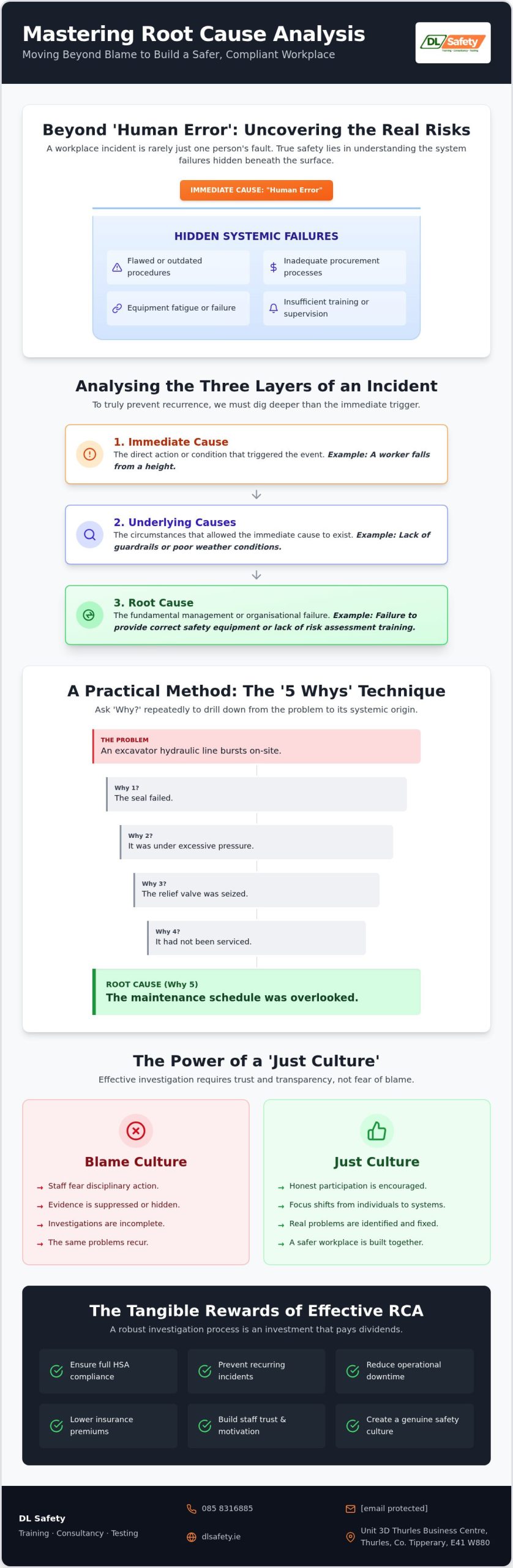
At its core, Root-cause analysis is a methodical process designed to dig beneath the surface of an incident to find out why it actually happened. It isn’t just about what went wrong in the moment; it’s about identifying the latent failures that have been sitting quietly in your organisational systems, waiting for the right set of circumstances to trigger an accident. When we perform a root cause analysis for accident investigation, we shift our focus from the person who made the mistake to the system that allowed the mistake to occur. Human error is rarely the end of the road; it’s usually just the starting point for a much deeper conversation about site safety.
Under the Safety, Health and Welfare at Work Act 2005, Irish employers have a clear legal duty of care to provide a safe working environment. Failing to perform a thorough investigation doesn’t just leave you vulnerable to HSA prosecution; it misses a vital opportunity to protect your business’s bottom line. Effectively identifying root causes leads to tangible commercial rewards, such as reduced operational downtime and lower insurance premiums. Perhaps most importantly, it builds a sense of trust amongst your staff. Employees who see that their safety is taken seriously through methodical investigation are far more likely to remain motivated and engaged with your safety culture.
The Difference Between Immediate, Underlying, and Root Causes
To prevent a recurrence, you must distinguish between the different layers of causality. The immediate cause is the direct action or condition that triggered the event, like a worker falling from a height. Underlying causes are the factors that allowed that situation to exist, such as a lack of guardrails or poor weather conditions. However, the root cause is the fundamental management failure at the top of the chain. This might be an inadequate procurement process that failed to provide the correct safety equipment in the first place or a lack of training on risk assessment. Addressing only the immediate cause is like pulling a weed without removing the root; it’s only a matter of time before the problem returns.
Why a “No-Blame” Culture is Essential for Effective RCA
If your team fears disciplinary action every time something goes wrong, they’ll naturally suppress evidence or stay quiet during interviews. This leads to incomplete investigations that fail to fix the real problem. A “just culture” on an Irish construction site is one where individuals aren’t punished for honest mistakes but are held accountable for reckless behaviour. By focusing on systems rather than individuals, you encourage honest witness participation. This transparency allows us to build a safer workplace together. For support in implementing these frameworks, you can reach DL Safety at info@dlsafety.ie, call 085 8316885, or visit us at Unit 3D Thurles Business Center, Stradavoher, Thurles, County Tipperary, E41 W880. You can also find more information at www.dlsafety.ie.
Proven RCA Methodologies for Construction and Industrial Sites
Success in any investigation relies on moving away from “gut feelings” or assumptions and towards evidence-based data. When you are tasked with a root cause analysis for accident investigation, the tool you choose should match the complexity of the event. A minor trip might only require a quick sit-down, whilst a significant plant collision demands a more rigorous, structured approach. By using formal methodologies, you ensure that every contributing factor is documented, making your final report much more resilient if challenged by the HSA or insurers. It’s about being methodical and transparent from the start.
The 5 Whys Technique: A Simple Tool for Rapid Investigation
For straightforward incidents, the 5 Whys is an excellent starting point. You begin with the final problem and ask “why” until you reach the systemic failure. Imagine an excavator hydraulic line bursts on-site. Why did it burst? The seal failed. Why? It was under excessive pressure. Why? The relief valve was seized. Why? It hadn’t been serviced. Why? The maintenance schedule was overlooked. The root cause isn’t the burst pipe; it’s a failure in your maintenance management system. Whilst highly effective for linear problems, this method can be too simplistic for multi-factor accidents where several things went wrong simultaneously.
The Fishbone (Ishikawa) Diagram for Complex Incidents
When an incident involves multiple layers, a Fishbone diagram provides the visual clarity needed to see the big picture. This tool categorises contributing factors into five main “bones”: People, Methods, Equipment, Environment, and Management. It allows you to see how a wet site (Environment) combined with a rushed deadline (Management) and a faulty sensor (Equipment) led to a single incident. DL Safety utilises these comprehensive visual tools during our detailed site audits to help clients identify hidden risks before they manifest as accidents.
Involving your site workers in this analysis process is vital. They understand how work is actually performed on the ground and often spot practical issues that a manager in an office might miss. Conducting a robust root cause analysis for accident investigation ensures your process remains focused on identifying these systemic gaps rather than individual blame. Following OSHA accident investigation guidelines provides a reliable framework for this depth of inquiry. For professional assistance with your next investigation, contact us at info@dlsafety.ie or 085 8316885. Our team is based at Unit 3D Thurles Business Centre, Stradavoher, Thurles, County Tipperary, E41 W880, and you can explore our services at www.dlsafety.ie.
Beyond the Surface: Identifying Latent Failures and Systemic Issues
To truly protect your workforce, you must look past the immediate trigger of an incident and identify what we call latent failures. These are dormant conditions within your organisation that may sit quietly for months or even years before a specific set of circumstances activates them. Whilst an operator’s mistake might be the spark, the fuel is often found in systemic issues like flawed procurement processes or a supply chain that prioritises low costs over equipment durability. When we conduct a root cause analysis for accident investigation, we often find that the real failure started in an office weeks before the event occurred.
Production pressure is perhaps the most common latent factor in the Irish construction and quarrying sectors. When deadlines are tight, there’s a natural tendency for “safety drift” to occur, where small deviations from protocol become the new norm. For instance, skipping a statutory inspection to keep a machine running might seem like a minor shortcut, but outdated GA1 testing is a significant systemic failure that directly leads to equipment-related accidents. Utilising structured RCA methodologies helps management teams see that “human error” is often just a worker trying to succeed within a broken system.
The Impact of Training and Competence
It’s vital to distinguish between a worker who hasn’t been trained and a system that failed to verify their competence. A root cause might not be the lack of a certificate, but rather a failure to ensure that the knowledge was actually applied on-site. Whilst our online safety courses provide a robust foundation for compliance, we also use simulation training to address deeper behavioural root causes. This proactive approach ensures that staff don’t just know the rules; they understand the “why” behind them, reducing the likelihood of intentional workarounds.
Communication Gaps and Site Supervision
Poor handovers and unclear Method Statements are frequently cited as underlying factors in workplace incidents. If the safety message isn’t reaching the person on the tools, the system has failed. Site supervision plays a critical role in identifying when work starts to drift away from the safe system of work. Our Monthly Safety Support Packages are designed to provide the consistent oversight needed to close these communication gaps before they result in a reportable event. For expert help in strengthening your systems, contact DL Safety at info@dlsafety.ie, call 085 8316885, or visit us at Unit 3D Thurles Business Center, Stradavoher, Thurles, County Tipperary, E41 W880. You can also learn more at www.dlsafety.ie.
Accident Investigation and HSA Compliance in Ireland
Under the Safety, Health and Welfare at Work Act 2005, every Irish employer has a strict legal obligation to investigate workplace accidents. This isn’t just a best-practice suggestion; it’s a statutory requirement that forms a core part of your duty of care. When an incident occurs that results in an employee being unable to perform their normal work for more than three consecutive days, you must report this to the Health and Safety Authority (HSA) using the official IR1 form. An inspector won’t just look at the report itself; they’ll look for evidence that you’ve dug deep enough to prevent it from happening again. Performing a thorough root cause analysis for accident investigation ensures you can prove you’ve taken every reasonable step to secure your site.
Immediately following an incident, your priority is site safety and scene preservation. Don’t tidy up or move equipment unless it’s absolutely necessary to prevent further injury or to save a life. Preserving the “as-is” state of the site is critical for an accurate investigation, as it allows for the collection of untainted evidence. If a HSA inspector arrives, they’ll want to see that you’ve maintained the integrity of the scene whilst you began your internal enquiries.
Step-by-Step Guide to the Investigation Process
A structured approach prevents vital details from slipping through the cracks. We recommend following these four essential steps to ensure your investigation is both robust and compliant:
- Step 1: Immediate Response. Secure the area, provide first aid, and ensure no further danger exists to other staff or the public.
- Step 2: Evidence Collection. Gather everything whilst it’s fresh. This includes photos, CCTV footage, witness statements, and checking technical records like GA1 certs.
- Step 3: Analysis. Use a formal methodology to conduct your root cause analysis for accident investigation. This moves the focus from “who” to “why” the system failed.
- Step 4: Action Plan. Develop a Corrective and Preventive Action (CAPA) plan that addresses the systemic failures identified, rather than just treating the symptoms.
Preparing for a HSA Inspection Post-Accident
If the HSA decides to visit, they’ll expect to see a proactive response. Presenting your findings clearly demonstrates that you’ve taken the event seriously and are committed to improvement. It’s also the perfect time to review and update your Safety Statement to reflect any new controls or procedural changes. Understanding what to expect during a HSA inspection can alleviate much of the stress involved in the process. If you’re feeling overwhelmed by the legal implications, we can help. You can book a professional accident investigation with DL Safety to ensure total compliance. Contact us at info@dlsafety.ie or 085 8316885, or visit our office at Unit 3D Thurles Business Center, Stradavoher, Thurles, County Tipperary, E41 W880. More information is available at www.dlsafety.ie.
Implementing Prevention Strategies through Monthly Safety Support
An investigation is only truly successful if it leads to permanent, positive change on your site. Once the final report is signed, the real work begins to ensure that the same systemic failures don’t creep back into your daily operations. This is where many businesses struggle; they treat safety as a one-off task rather than a continuous process. By utilising a root cause analysis for accident investigation, you’ve identified the “why,” but maintaining those new standards requires constant vigilance to prevent “safety drift.”
Our approach at DL Safety is to transform your RCA findings into robust, practical Method Statements and Risk Assessments that actually work for your team. We don’t believe in safety manuals that sit on a shelf gathering dust. Instead, we focus on proactive problem-solving. Third-party site audits are a vital part of this strategy, allowing us to identify potential root causes before they ever lead to an injury. It’s about being a dedicated professional who is deeply invested in your long-term success.
Closing the Loop: From RCA to Site Compliance
Communicating your investigation findings to the wider workforce is essential for building a transparent safety culture. Toolbox Talks provide a simple, conversational way to share lessons learned without creating an atmosphere of blame. We also integrate technical solutions to eliminate equipment-related risks. For example, regular brake testing ensures that machinery failures are caught long before they become a contributing factor in a root cause analysis for accident investigation. David, our lead expert, provides this personalised support directly to Irish business owners, ensuring your specific site challenges are met with practical, grounded solutions.
The DL Safety Advantage: Professional Support and Peace of Mind
A Monthly Safety Support Package ensures your systems remain up to date with the latest 2026 regulations whilst alleviating the stress of compliance. We handle the heavy lifting of investigation and auditing, giving you the confidence to focus on your core business. If you need expert assistance, you can call us on 085 8316885 or email info@dlsafety.ie. Our office is located at Unit 3D Thurles Business Center, Stradavoher, Thurles, County Tipperary, E41 W880. We invite you to contact DL Safety for professional accident investigation and safety support and discover how we can help you build a safer, more resilient workplace through our committed partnership.
Building a Resilient Safety Culture for the Future
Mastering the systematic process of root cause analysis for accident investigation is about more than just satisfying the HSA; it’s about protecting your team and your livelihood. By shifting your focus from individual errors to latent systemic failures, you can identify the dormant risks that threaten your daily operations. We’ve explored how structured methodologies like the 5 Whys and Fishbone diagrams provide the evidence needed to implement lasting prevention strategies that go beyond surface-level fixes.
At DL Safety, we pride ourselves on being your trusted advisor, providing specialised technical safety testing and audits nationwide. Whether you require a one-off investigation or a Monthly Safety Support Package, we’re here to handle the heavy lifting of compliance. You can reach our team at Unit 3D Thurles Business Center, Stradavoher, Thurles, County Tipperary, E41 W880, or contact us directly at 085 8316885 or info@dlsafety.ie. For more information on our services, visit www.dlsafety.ie.
Get Expert Accident Investigation Support from DL Safety
You don’t have to face the complexities of regulatory compliance alone; with the right partner, a safer and more efficient workplace is well within your reach.
Frequently Asked Questions
What is the primary goal of root cause analysis in an accident investigation?
The primary goal is to identify the underlying systemic failures that allowed an incident to occur so that you can implement permanent preventative measures. Instead of merely addressing the immediate trigger, a root cause analysis for accident investigation digs into organisational factors like procurement, training, or management oversight. This ensures that the same set of circumstances doesn’t lead to another injury or near-miss next month.
When should I report a workplace accident to the HSA in Ireland?
You must report an accident to the Health and Safety Authority if an employee is unable to perform their normal work duties for more than three consecutive days. This three-day period does not include the day of the accident itself. Reporting is done via the IR1 form on the HSA website. Fatalities and certain dangerous occurrences must be reported immediately by the quickest means possible, usually by telephone.
Is human error considered a valid root cause in a safety investigation?
Human error is almost always a symptom of a deeper issue rather than a root cause itself. Whilst an operator might make a mistake, a robust investigation asks why the system allowed that mistake to happen or failed to catch it. Factors such as inadequate training, poor equipment maintenance, or excessive production pressure are the true root causes that management must address to ensure long-term site safety. Addressing these systemic gaps involves investing in high-quality professional development; for example, Core Elements provides accredited training for those specialising in clinical therapy and sports massage, supporting a more holistic approach to employee well-being.
How long should I keep records of an accident investigation and RCA?
You should keep your investigation records for at least ten years to protect your business against potential civil personal injury claims. Whilst the HSA focuses on immediate compliance and reporting, the Statute of Limitations in Ireland allows for claims to be initiated within specific timeframes. Maintaining thorough documentation, including witness statements and evidence, ensures you have a strong defence if legal action is taken years after the event.
Can a small business perform its own root cause analysis, or do I need a consultant?
Small businesses can certainly perform their own analysis if they have the internal expertise and time to be objective. However, many Irish employers choose to partner with a consultant to ensure the process is legally robust and free from internal bias. At DL Safety, we provide expert support from our Thurles base at Unit 3D Thurles Business Center, Stradavoher, helping you navigate complex 2026 regulatory requirements with confidence.
What happens if a HSA inspector finds my investigation report to be inadequate?
If an inspector deems your report insufficient, they may issue an Improvement Notice or a Prohibition Notice, depending on the severity of the risk. In serious cases, an inadequate investigation can lead to prosecution and heavy fines if it’s proven that you failed to identify and rectify known hazards. A professional root cause analysis for accident investigation demonstrates to the HSA that you are taking a proactive, serious approach to workplace safety.
How often should I review my safety statement following an accident?
You must review and, if necessary, amend your Safety Statement immediately following any significant workplace accident or near-miss. This review ensures that the new controls identified during your investigation are formally documented and integrated into your safe systems of work. Even without an accident, your Safety Statement should be reviewed at least annually to account for changes in legislation, personnel, or site equipment.
What are the most common root causes found in Irish construction accidents?
Common root causes include inadequate supervision, poor communication during site handovers, and a lack of specific training for high-risk tasks. Systemic failures in equipment procurement and failing to maintain statutory testing schedules also frequently appear in investigation findings. By addressing these management-level issues, businesses can move beyond “safety by luck” and establish a disciplined, predictable environment for their workforce. For assistance, contact us at info@dlsafety.ie or 085 8316885.