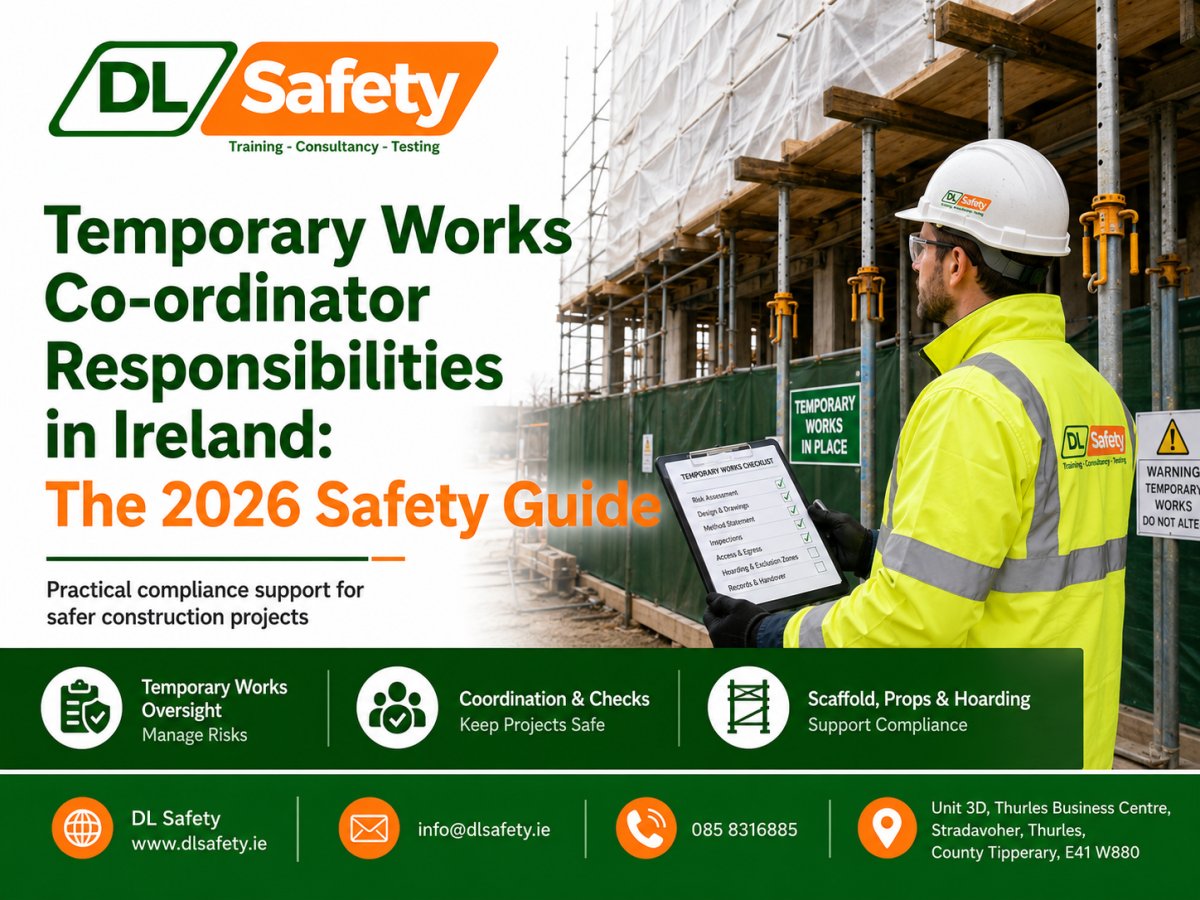
Could a minor misunderstanding of where a temporary prop ends and a permanent beam begins be the hidden crack in your site’s safety culture? For many professionals in the Irish construction sector, the pressure of managing complex structural interfaces whilst keeping a project on schedule is a constant source of anxiety. It’s understandable to feel concerned about liability if a temporary structure fails, particularly as the Health and Safety Authority (HSA) continues to tighten its focus on high-risk activities. Understanding the full scope of temporary works coordinator responsibilities Ireland expects is no longer just a “best practice” suggestion; it’s the foundation of a resilient, compliant site.
We’ve designed this 2026 guide to help you move from uncertainty to total control. You’ll gain a clear, actionable masterclass in the essential duties and legal requirements that define the TWC role under the updated BS 5975:2024 standards. We’ll show you exactly how to set up an accurate Temporary Works Register and maintain the rigorous verification processes needed to keep your team safe. By the time you finish reading, you’ll have the confidence to bridge the gap between design theory and site execution with the authority of a trusted advisor.
Key Takeaways
- Learn how the 2026 standards distinguish between temporary structures and plant equipment to avoid common compliance gaps on busy sites.
- Clarify the legal obligations of the PSCS and Principal Contractor in appointing a competent person for the TWC role under current Irish regulations.
- Master the core temporary works coordinator responsibilities Ireland requires, including the essential management of the site’s master Temporary Works Register.
- Identify specific oversight protocols for high-risk tasks such as complex scaffolding designs and ground stability in deep excavations.
- Discover how independent site audits and technical support from DL Safety (www.dlsafety.ie) can verify your compliance and reduce the anxiety of structural liability.
What Are Temporary Works in the Irish Construction Sector?
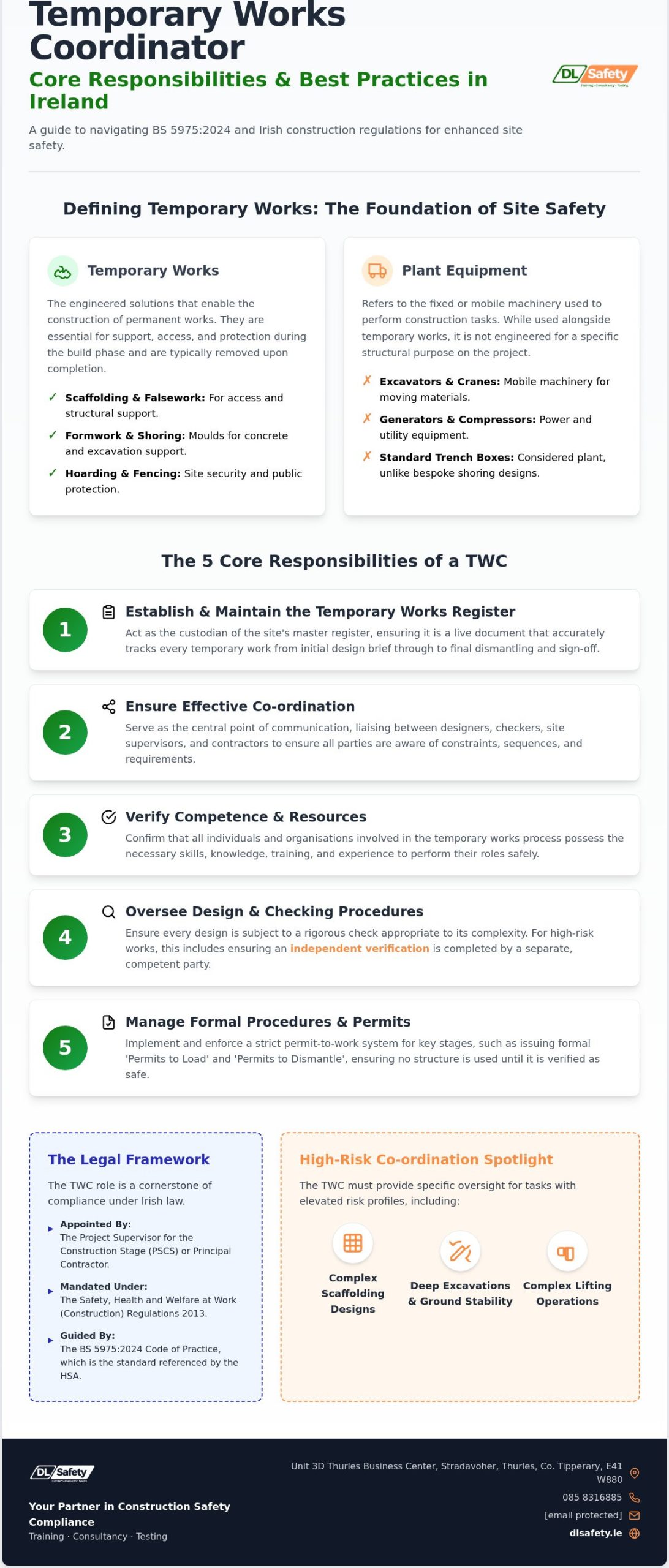
To understand the full scope of temporary works coordinator responsibilities Ireland projects require, we must first establish exactly what constitutes a “temporary work” on a modern site. In simple terms, temporary works are the parts of a construction project that allow the permanent structure to be built. Whilst the permanent works remain in place once the keys are handed over, temporary works are removed, dismantled, or occasionally left in the ground after they’ve served their purpose. According to the updated BS 5975:2024, these structures are the “enabling” elements of a build, providing the necessary support, access, and protection during the construction phase. For those completing new residential builds, you can visit Snag My Home to ensure the final quality of the permanent structure before handover.
It’s easy to confuse temporary works with standard plant equipment, but there’s a vital distinction. Plant usually refers to fixed or mobile machinery like excavators or cranes. Temporary works, however, are often bespoke designs created for a specific site condition. A trench box is plant, but the engineered system of shoring that holds back a complex excavation is a temporary work. As a personable expert in the field, I often tell clients that temporary works deserve the same engineering respect as the permanent build. They’re frequently higher risk because they’re often pushed to their design limits in a changing environment; if a permanent beam fails, it’s a tragedy, but if a temporary prop fails during a concrete pour, the results are immediate and catastrophic.
Common Examples of Temporary Works in Ireland
On any Irish site, from a small housing development in Tipperary to a major infrastructure project in Dublin, you’ll see these systems in action. Scaffolding is perhaps the most visible example, providing essential access and fall protection. We also manage falsework, which supports a structure whilst it’s not yet self supporting, and formwork, which acts as the mould for fresh concrete. Site hoarding and fencing are also included, as they must be designed to withstand wind loads and protect the public. In groundworks, we rely on excavation shoring and trench boxes to ensure the safety of workers below the surface.
The Critical Role of BS 5975:2024
The release of BS 5975:2024 has refined how we manage these risks in the 2026 landscape. This standard provides the procedural code of practice for the management of temporary works, and it’s what the Health and Safety Authority (HSA) looks for during inspections. It works alongside the Safety, Health and Welfare at Work (Construction) Regulations 2013 to ensure a clear chain of command. A key takeaway from the 2024 update is the emphasis on “independent” verification. This means that for complex designs, someone other than the original designer must check the calculations to ensure there’s no room for error. At DL Safety, located at Unit 3D Thurles Business Center, Stradavoher, Thurles, County Tipperary, E41 W880, we help teams implement these rigorous checks through our Monthly Safety Support Packages. You can reach our expert team at 085 8316885 or via info@dlsafety.ie to discuss how these standards apply to your specific project at www.dlsafety.ie.
The Legal Framework: Appointing a Temporary Works Co-ordinator
The appointment of a Temporary Works Co-ordinator isn’t just a box-ticking exercise; it’s a vital safety pillar mandated by the Project Supervisor Construction Stage (PSCS) or the Principal Contractor. Whilst the Safety, Health and Welfare at Work (Construction) Regulations 2013 don’t explicitly use the title “TWC,” the Health and Safety Authority (HSA) expects this level of robust coordination as part of your general duty to provide a safe system of work. The responsibility for making this appointment rests squarely with the PSCS or the contractor in control of the site, who must ensure that the individual chosen has the authority to carry out the role without being overruled by commercial pressures.
In 2026, a “competent person” for this role must possess a strategic blend of formal training and practical, site-specific experience. A certificate from an IOSH training programme is the industry baseline, but true competency is measured by an individual’s ability to understand the specific risks of the project at hand. The role is fundamentally about process control, as highlighted in the UK Health and Safety Executive (HSE) guidance, which is widely regarded as the gold standard for defining temporary works coordinator responsibilities Ireland projects must adhere to. The TWC carries the legal liability for the management process; they ensure that designs are checked, permits are issued, and nothing is loaded until it’s safe to do so.
TWC vs. TW Supervisor: Understanding the Hierarchy
Think of the TWC as the architect of the safety process and the Temporary Works Supervisor (TWS) as the eyes on the ground. The TWC manages the register and coordinates the design, whilst the TWS monitors the actual installation to ensure it matches the approved drawings. To keep the site running smoothly, you must organise clear communication channels that allow the TWS to report issues back to the TWC immediately. This structure is particularly important for maintaining accountability amongst multiple sub-contractors, ensuring that no one takes shortcuts with shared temporary structures.
Regulatory Alignment with HSA Standards
During a site audit, a HSA inspector will look for a formal letter of appointment and a documented competency assessment for the TWC. They’ll also expect to see a clear paper trail that proves the TWC is actively managing the risks on-site. If you’re looking to strengthen your broader safety culture, our guide on Health and Safety Compliance Ireland offers a comprehensive look at your legal obligations. At DL Safety, we help businesses simplify this process through our Monthly Safety Support Packages, acting as a technical resource for your team. You can find us at Unit 3D Thurles Business Center, Stradavoher, Thurles, County Tipperary, E41 W880, or reach us at info@dlsafety.ie and 085 8316885 to discuss your project requirements at www.dlsafety.ie.
Core Temporary Works Co-ordinator Responsibilities
The Temporary Works Co-ordinator acts as the site’s master conductor, ensuring that every enabling structure is designed, installed, and removed with absolute precision. Whilst previous sections explored the legal necessity of the role, the daily temporary works coordinator responsibilities Ireland projects demand are deeply technical and procedural. The TWC is the primary point of contact between the design office and the site team, responsible for ensuring that a suitable Temporary Works Design Brief is prepared for every single element, no matter how small it might seem. This brief serves as the technical foundation, detailing the loads, site conditions, and specific requirements that the designer must address.
Once a design is produced, the TWC must verify that it has undergone the correct level of scrutiny. In accordance with best practice highlighted by Engineers Ireland, this involves categorising the “category of check” based on the complexity of the structure. A simple trench box might only require a basic check, whereas a bespoke facade retention system would demand a full independent verification by a third party. The TWC doesn’t necessarily perform these checks themselves, but they are the gatekeeper who ensures they happen before any work begins on the ground.
Managing the Temporary Works Register
The Temporary Works Register is the site’s master log and the first thing an inspector will ask to see. In the 2026 landscape, we’ve seen a significant shift toward digital registers that allow for real-time updates amongst multiple sub-contractors. Your register should categorise risks into Class 1 (low risk, such as standard site fencing), Class 2 (medium risk, like standard scaffolding), and Class 3 (high risk or bespoke designs). This classification determines the level of oversight required. A well-maintained register tracks the entire lifecycle of an item, from the initial design brief to the final “Permit to Unload” after the structure is no longer needed.
The Permit System: Loading and Unloading
The most critical “gatekeeper” function of the TWC is the administration of the permit system. A “Permit to Load” should only be issued once the TWC is satisfied that the structure has been built exactly as the design intended. This involves a physical inspection to ensure every bolt, brace, and prop is in the correct position. Crucially, if the temporary work involves lifting or supporting heavy equipment, the TWC must verify all statutory certifications. For instance, you must ensure that any lifting equipment used has a valid certificate for GA1 Testing Ireland before allowing it to be placed on a temporary platform. At DL Safety, located at Unit 3D Thurles Business Center, Stradavoher, Thurles, County Tipperary, E41 W880, we provide these essential testing services to give TWCs the data they need to sign off with confidence. You can reach our team at 085 8316885 or info@dlsafety.ie for support with your site verification at www.dlsafety.ie.
High-Risk Coordination: Scaffolding, Excavations, and Lifting
While the administrative side of the role is vital, the true test of temporary works coordinator responsibilities Ireland professionals face is found in high-risk coordination. Scaffolding, deep excavations, and heavy lifting operations represent the most significant structural risks on any Irish site. The TWC must ensure that these elements aren’t managed in silos. For instance, a traffic management plan that directs heavy plant too close to the edge of an un-shored excavation creates a risk of collapse that only a coordinated approach can prevent. It’s about seeing the site as a living, interconnected system where every temporary structure affects the stability of the next. You must ensure that construction site traffic management plan template designs don’t compromise the integrity of adjacent shoring or scaffolding bases through vibration or surcharge loading.
Scaffolding Inspection and Compliance
Scaffolding is often the most complex temporary structure on-site, requiring a rigorous 7-day inspection cycle to remain compliant under Irish law. The TWC’s role isn’t necessarily to climb the tubes themselves, but to verify that the scaffolding supervisor has conducted these inspections and recorded them accurately in the statutory GA3 form. You must also ensure that any modifications made to the scaffold after the initial permit was issued are re-checked against the original design brief. If you’re looking to streamline your safety checks, our Working at Height Risk Assessment Checklist provides a clear framework for these daily verifications. We often find that a disciplined review of tie-patterns and loading bays prevents the minor oversights that lead to structural failure.
Lifting Operations and Temporary Bases
Lifting operations introduce massive point loads that can easily exceed the ground bearing capacity if not managed with absolute precision. The TWC must work closely with the Appointed Person (Lifting) to ensure that crane outrigger pads are sized correctly for the specific ground conditions of the site. It’s your job to verify that temporary access roads and crane hardstandings are engineered to support the weight of the plant whilst in operation. This coordination is particularly challenging on confined urban projects where space is at a premium. Ensuring that all operators working at height on Mobile Elevating Work Platforms have completed a recognised MEWP operator online theory course is another critical compliance checkpoint the TWC must verify before granting a permit to load. Our guide on Expert Delivery and Vehicle Management on Tight Sites explores how to balance these competing logistical demands safely. At DL Safety, based at Unit 3D Thurles Business Centre, Stradavoher, Thurles, County Tipperary, E41 W880, we offer professional site audits to help verify your TWC’s effectiveness in these high-stakes areas. Reach out to us at 085 8316885 or info@dlsafety.ie to ensure your site’s structural integrity is never in doubt at www.dlsafety.ie.
How DL Safety Supports the Temporary Works Co-ordinator
Managing the full spectrum of temporary works coordinator responsibilities Ireland requires is a significant undertaking that often pushes internal resources to their limit. At DL Safety, we don’t just provide a list of rules; we act as a proactive extension of your project team. Our role is to demystify complex regulatory requirements, such as those found in BS 5975:2024, and provide the technical backup your TWC needs to make confident, safe decisions. Whether it’s reviewing a complex Method Statement or verifying the accuracy of your Temporary Works Register, we provide a grounded, expert perspective that prioritises site safety above all else.
Monthly Support: Your Retained Safety Partner
Our Monthly Safety Support Packages are designed to offer ongoing peace of mind for site managers and TWCs alike. Instead of waiting for a problem to arise, we provide regular, proactive engagement that keeps your site ahead of HSA expectations. Having a personable expert only a phone call away means that technical queries regarding structural propping or excavation shoring can be resolved quickly; this prevents costly delays whilst maintaining the highest safety standards. This retained service includes professional Health & Safety Site Audits, which serve as an independent check on your TWC’s processes, ensuring that every permit to load is backed by rigorous verification.
A critical component of this verification process is the technical testing of equipment used within temporary structures. We provide specialised GA1 testing for lifting equipment, ensuring that every hoist, sling, or shackle is fit for purpose and carries the necessary statutory certification. By integrating this testing into your broader management system, we help your TWC close the gap between design theory and site execution. We also offer expert guidance on refining Risk Assessments for high-risk activities, ensuring that your documentation is as robust as the structures themselves. This holistic approach allows your team to focus on the build, knowing the enabling works are under expert scrutiny.
Get in Touch for Professional Safety Support
If you’re ready to strengthen your site’s safety culture and ensure you’re fully meeting your legal obligations, David and the team are here to help. We pride ourselves on being easy to work with whilst maintaining a disciplined commitment to excellence. You can visit our centre at Unit 3D Thurles Business Center, Stradavoher, Thurles, County Tipperary, E41 W880, to discuss your project in person. Alternatively, reach out to us at 085 8316885 or via email at info@dlsafety.ie. Explore our full range of services, including online safety courses and bespoke training, at www.dlsafety.ie. We look forward to helping you navigate the complexities of site safety with clarity and confidence.
Securing Your Site’s Structural Integrity for the Future
The 2026 construction landscape in Ireland demands a proactive approach to enabling works. We’ve explored how the TWC acts as the critical link between engineered design and high-risk execution, ensuring that every scaffold tie and excavation prop is verified before it’s put to work. By mastering the temporary works coordinator responsibilities Ireland projects require, you’re not just avoiding HSA scrutiny; you’re building a culture of structural reliability. The key is to move away from reactive safety and embrace a methodical system of permits and registers.
Whether you’re navigating the complexities of BS 5975:2024 or managing tight urban sites, having a trusted advisor makes the process seamless. At DL Safety, we support Irish businesses through Specialist GA1 Testing and our comprehensive Monthly Safety Support Packages. Our expert Irish construction knowledge allows us to demystify technical requirements and provide the practical backup your team needs to succeed. David and the team at Unit 3D Thurles Business Center, Stradavoher, Thurles, County Tipperary, E41 W880 are ready to help. Reach us at 085 8316885 or info@dlsafety.ie to discuss your next project at www.dlsafety.ie.
Contact DL Safety for Expert Temporary Works Support
Together, we can ensure your temporary structures are as robust as your permanent vision.
Frequently Asked Questions
Is a Temporary Works Co-ordinator a legal requirement in Ireland?
Whilst the specific title isn’t explicitly written into the 2013 Construction Regulations, appointing a competent person to oversee temporary works coordinator responsibilities Ireland requires is a de facto legal necessity. The Health and Safety Authority (HSA) expects a robust management system under your general duty of care to provide a safe system of work. Following the procedures in BS 5975:2024 is the recognised industry method for proving you’ve met these legal obligations during an inspection.
What is the difference between a Temporary Works Co-ordinator and a Supervisor?
The TWC holds the primary management role, focusing on the master register, design briefs, and the administration of the permit-to-load system. In contrast, the Temporary Works Supervisor (TWS) acts as the eyes on the ground. The TWS monitors the physical installation to ensure it matches the approved drawings exactly, reporting any site-level discrepancies back to the TWC before any loading takes place.
Does a Temporary Works Co-ordinator need specific training like IOSH or CIF?
Yes, a TWC must be able to demonstrate their competency through a combination of formal training and practical experience. Completing a recognised IOSH or CIF Temporary Works Co-ordinator course is the industry standard for establishing this baseline knowledge. However, competency is also project-specific; a person might be competent to manage standard scaffolding but require further experience for complex facade retention or deep basement shoring.
How often should the Temporary Works Register be updated?
The Temporary Works Register should be treated as a live, digital document and updated in real-time as site activities progress. Every time a design brief is issued, a category check is completed, or a permit to load is signed, the register must reflect that change. Waiting even a few days to update the log creates a dangerous information gap that can lead to unauthorised loading or the use of unverified structures.
Can a Site Manager also act as the Temporary Works Co-ordinator?
A Site Manager can act as the TWC on smaller, low-risk projects, provided they have the specific training and sufficient time to manage the paperwork. On larger or more complex sites, this dual role is often discouraged because the pressure of project deadlines can conflict with the rigorous safety checks required for temporary works. A dedicated TWC ensures that safety remains the priority, independent of the daily push for production.
What happens if temporary works fail on an Irish construction site?
If a temporary structure fails, the HSA will conduct a thorough accident investigation to determine if the management process was followed. This often results in a complete stop-work order, significant fines, and potential criminal prosecution for the PSCS or the contractor. Beyond the legal and financial fallout, the human cost of a structural collapse is often the most devastating impact on a firm’s reputation and workforce.
Does the TWC need to be a qualified structural engineer?
No, the TWC doesn’t need to be a qualified structural engineer, but they must be “engineering literate” enough to understand design drawings and check categories. Their primary responsibility is to coordinate the process and ensure that a qualified engineer has designed the works and that a second competent person has checked them. They act as the manager of the safety process rather than the person performing the structural calculations.
How do I ensure sub-contractors comply with the TWC’s permit system?
Compliance is best achieved through clear contractual requirements and a firm “gatekeeper” policy during site inductions. You must make it clear that no temporary structure is to be loaded until a physical permit has been signed by the TWC. Regular site audits and technical support from an external partner like DL Safety can help reinforce these standards amongst sub-contractors, ensuring that nobody takes shortcuts that could compromise the site’s structural integrity.