
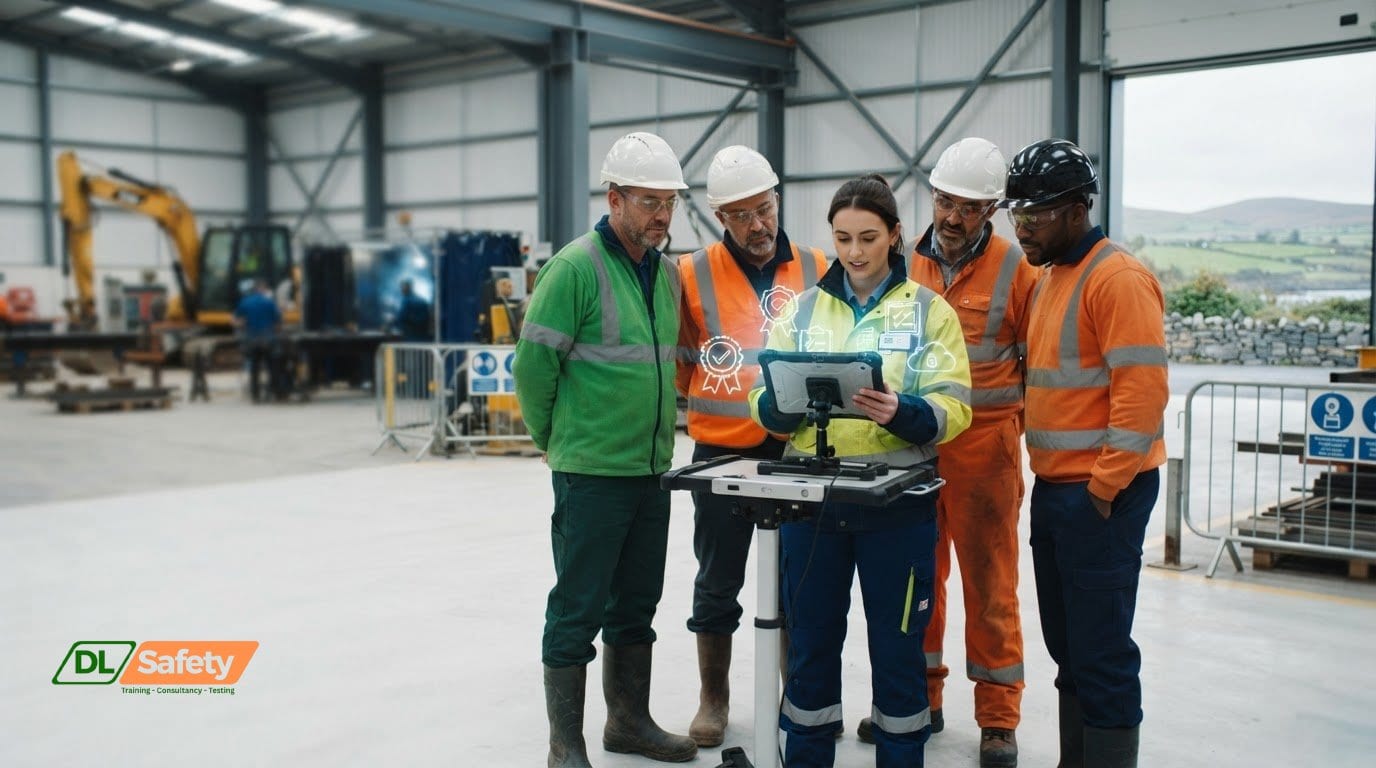
What if fulfilling your statutory safety duties didn’t require pulling vital staff off site for hours at a time? For businesses managing tight project schedules alongside rigorous regulatory standards, the practical benefits of online safety training for employers have transformed mandatory training into an operational asset. Most managers recognise the disruption of losing productive crew members to rigid classroom sessions, the administrative headache of chasing certificate expiries across rotating shifts, and the genuine worry of facing a statutory inspection with patchy paperwork.
You shouldn’t have to choose between keeping projects moving and maintaining a safe, compliant workplace. Modern digital learning solves this dilemma directly, cutting overheads, ensuring full compliance under the Safety, Health and Welfare at Work Act 2005, and safeguarding your workforce. In this 2026 guide, we unpack how moving safety education online protects your bottom line, automates audit readiness, and establishes a scalable foundation for ongoing staff competency.
Key Takeaways
- Discover how replacing rigid classroom sessions with flexible e-learning eliminates site downtime whilst significantly reducing travel, venue, and indirect labour overheads.
- Explore the core benefits of online safety training for employers, focusing on how automated record-keeping and instant certification streamline statutory audit readiness.
- Understand how digital courseware satisfies legal employer duties under the Safety, Health and Welfare at Work Act 2005 to withstand formal regulatory inspections.
- Learn an objective framework to distinguish pure risk awareness topics from hands-on tasks that demand blended or practical competency assessments.
- Gain a practical five-step vetting checklist to select accredited training providers capable of integrating seamlessly into your wider safety management framework.
The Strategic Shift: Why Employers Are Modernising Workplace Safety Training
Workplace health and safety management has moved far beyond dusty binders and chaotic sign-in sheets. Historically, training meant pulling an entire shift off a live site, booking external instructors, and absorbing massive productivity losses while staff sat through slide presentations. Today, the operational benefits of online safety training for employers centre on transitioning from disruptive events to an integrated digital framework that supports broad occupational safety and health standards. Modern digital training unites course delivery, comprehension assessment, and statutory tracking inside a unified, accessible environment.
Industry expectations have fundamentally shifted. Digital safety compliance can be defined as “the systematic delivery, monitoring, and algorithmic verification of statutory occupational health and safety instruction through web-based platforms that generate real-time audit trails.” This structure eliminates the scheduling friction of traditional training while offering modern workforces the self-paced, flexible learning experience they now expect.
Eliminating Productive Downtime on Busy Sites
When you pull ten workers off a construction floor or manufacturing line for an off-site lecture, the cost extends far beyond the instructor’s fee. Deadlines slip, plant machinery sits idle, and project milestones are missed. Modular e-learning breaks this gridlock by letting employees complete rigorous training during planned operational lulls or before arriving on site. For organisations managing split shifts, evening work, or mobile maintenance teams, this flexibility means essential training occurs without halting production or triggering overtime costs.
Standardising Quality Across National Operations
Relying on different face-to-face trainers across multiple operational locations creates dangerous inconsistencies. One regional group might receive a comprehensive overview of chemical exposure risks, while another gets an abbreviated session depending on the instructor’s personal focus. Centralised online platforms remove this variability entirely. Every employee, whether working in Dublin, Cork, or Galway, completes identical, vetted content aligned with national statutory duties. This consistency delivers vital operational outcomes:
- Parity of safety culture: Subcontractors, apprentices, and senior managers receive the same core instructions on site hazard controls.
- Defensible corporate standards: Policies on risk reporting and machine operation remain uniform across all regional divisions.
- Reliable baseline competency: Site managers can trust that new transfers possess verified knowledge before undertaking high-risk work.
Financial and Operational Dividends: The Tangible Employer Returns
Assessing safety education purely through invoice costs overlooks the heavier financial burdens of traditional training. When evaluating the total cost of ownership, physical classroom delivery routinely piles on indirect expenditures, from travel mileage and printing handouts to renting off-site venues. Exploring the commercial benefits of online safety training for employers reveals that the most substantial returns stem from protecting operational uptime while creating an integrated learning framework linked to comprehensive workplace compliance.
Direct Cost Reductions vs Indirect Savings
Direct course fees represent only a small fraction of what legacy delivery methods actually cost a business. Consider the hidden line items that quietly drain working capital:
- Travel and lodging: Fuel reimbursements, fleet vehicle wear, and overnight accommodation for regional workers travelling to training hubs.
- Administrative overheads: Hours spent manually logging attendance, archiving paper assessments, and cross-checking spreadsheet expiries across rotating staff.
- Production backfills: Paying overtime rates to replacement personnel while primary operatives attend mandatory safety briefings.
Digital platforms automate enrolment and store certifications instantly, slashing administrative labour. Over time, maintaining robust, verifiable digital instruction lowers workplace incident frequencies, helping demonstrate the systematic risk control underwriters look for during commercial insurance evaluations.
Accelerating Safe Time-to-Productivity for New Hires
Delays during recruitment often stall high-value projects. Waiting weeks for a third-party classroom provider to gather enough delegates leaves newly hired staff or specialist sub-contractors waiting at the gate. Digital learning resolves this bottleneck through structured pre-commencement inductions.
Workers can complete vital safety awareness modules on a computer or tablet before setting foot on site. Much like global standards outlined in established OSHA training requirements, front-loading theoretical safety fundamentals ensures every operative arrives with an understanding of critical hazards. This cuts onboarding lag from days to hours, ensuring statutory duty-of-care obligations are met without delaying plant operations or construction schedules.
If you want to modernise your workforce education while containing training expenses, partnering with DL Safety helps you introduce practical digital solutions tailored directly to your operational demands.
Regulatory Rigour: Satisfying Statutory Duties and Inspection Scrutiny
Irish occupational health and safety legislation places a direct duty on employers to provide adequate instruction, training, and supervision. Under Section 10 of the Safety, Health and Welfare at Work Act 2005, that instruction must be delivered in a form, manner, and language likely to be understood by the employee. A central concern for leadership teams is whether digital courseware withstands formal scrutiny when an inspector walks through the door. Far from being a soft compliance shortcut, the regulatory benefits of online safety training for employers lie in establishing an objective, timestamped standard of proof that conventional methods struggle to match.
Modern e-learning platforms ensure accountability through granular verification protocols. Each module logs exact completion times, user IP addresses, periodic engagement checks, and passing thresholds on competency quizzes. As demonstrated by evidence-based frameworks like wider NIOSH training initiatives, systematically structured learning validated through testing creates measurable knowledge retention. Knowing your staff have completed accredited digital modules gives management genuine confidence when reviewing what to expect during an inspection by statutory authorities.
Building an Indisputable Digital Audit Trail
Traditional paper records are inherently fragile. Wet-signature attendance rosters get misplaced in site cabins, damaged by water, or challenged during legal proceedings regarding who actually sat in the room. A secure cloud registry replaces that vulnerability with an unalterable history of compliance. The evidential advantages are practical and immediate:
- Tamper-resistant verification: Digital logs record precise start times, pause intervals, quiz scores, and unique certificate serial numbers.
- Automated renewal warnings: Automated alerts notify management sixty and thirty days before certifications expire, preventing inadvertent compliance lapses.
- Instant audit retrieval: When an inspector requests training profiles for a machine operator, records can be produced on a screen in seconds rather than hunted down in physical filing cabinets.
Aligning Course Content with Statutory Authorities
Legislation rarely stands still. With updates to occupational regulations, such as amendments governing chemical agent exposure limits or carcinogens, static paper training programmes quickly become obsolete. Vetted online courses provide dynamic syllabus updates managed centrally by accredited safety professionals. When statutory guidelines evolve, the digital course material adapts automatically. This ensures your workforce receives current instruction that aligns fully with Health and Safety Authority expectations without requiring internal teams to rewrite training manuals from scratch.

Evaluating the Delivery Models: Online, In-Person, and Blended Approaches
Adopting digital education isn’t an all-or-nothing choice. Selecting the right delivery method depends on whether a training topic centres on theoretical understanding or physical execution. Purely digital instruction satisfies statutory duties when the regulatory objective is risk perception and procedural knowledge, whereas tasks carrying physical mechanical risks demand practical, demonstrable verification. Maximising the operational benefits of online safety training for employers requires balancing digital delivery against practical on-site assessments.
Purely Digital Courses: Best Suited for Knowledge-Based Compliance
Purely digital formats excel when teaching awareness, statutory responsibilities, and procedural guidelines. Typical subjects that thrive entirely online include Display Screen Equipment (DSE) assessments, general fire awareness, environmental safety protocols, and company-wide induction modules. Instead of forcing staff into fatiguing six-hour seminars, digital platforms deliver micro-learning units in focused fifteen-to-twenty-minute intervals. This bite-sized structure sharpens knowledge retention, minimises mental fatigue, and allows employers to run rapid refresher cycles without disrupting daily operations.
The Blended Paradigm: Combining Digital Theory with Practical Assessment
Certain high-consequence duties cannot be signed off purely behind a computer screen. High-risk activities like manual handling, working at height, chemical spill responses, and operating heavy plant machinery require hands-on physical evaluation. For these operational disciplines, the blended model represents industry best practice. Workers complete the foundational legislative theory and hazard identification online beforehand, arriving on site fully prepared for the practical phase.
Employers gain substantial efficiencies through this hybrid framework:
- Reduced off-tool hours: Classrooms are eliminated, leaving only the essential hands-on assessment to be completed on site.
- Advanced scenario exposure: Innovative formats like technical simulation training bridge the gap between classroom theory and operating high-tonnage quarry or industrial machinery safely.
- Robust documentation: Theoretical quiz scores merge with practical assessment sign-offs inside a single, unified employee record.
To align your training matrix with national regulatory expectations, review our full range of accredited online safety courses. You can also explore how DL Safety helps businesses integrate blended training solutions with practical site audits across nationwide operations.
Selecting the Right Partner: Integrating Training into Your Safety Management System
Buying isolated digital courses off the shelf rarely builds a resilient workplace culture. When training exists in a silo, detached from actual site practices, companies end up with certified workers who still take unmanaged operational risks. To unlock the full benefits of online safety training for employers, e-learning must integrate directly into a broader safety management system. Achieving verifiable compliance requires more than a digital checkout cart; it demands an advisory partner who connects course outcomes directly to statutory policies and on-site realities.
Many businesses find that pairing digital training with ongoing professional guidance delivers the highest degree of regulatory protection. Exploring retained monthly safety support provides leadership teams with dedicated expertise, ensuring training programmes adapt alongside evolving legislative duties and changing workforce requirements.
Essential Vetting Criteria for Employers
Before committing to an external e-learning provider, leadership teams should systematically evaluate vendors using a clear five-step vetting framework:
- Accreditation and content authority: Confirm that course modules are authored and reviewed by qualified occupational safety professionals rather than generic software developers.
- Syllabus maintenance: Verify that content updates occur automatically whenever statutory codes of practice change, preventing obsolete procedural instruction.
- Platform security and reporting: Ensure the portal offers role-based administrative dashboards, automated expiry alerts, and exportable audit logs that safeguard worker data.
- HR and workforce integration: Check whether the system accommodates easy batch enrolments, sub-contractor tracking, and seamless record exports for company files.
- Practical escalation paths: Determine whether the provider can deliver face-to-face training, practical assessments, or technical testing when high-risk tasks demand physical verification.
The DL Safety Advantage: Training Backed by Professional Consultation
DL Safety bridges the gap between digital convenience and hands-on operational rigor across nationwide sites. Instead of offering detached courseware, our online safety courses connect directly with real-world consultancy, including site audits, Safety Statements, and GA1 machinery inspections. By aligning digital theory with practical simulation training and tailored support packages, we ensure your safety documentation reflects actual shop-floor practices.
Whether you require bespoke induction modules, technical testing, or a complete review of your safety infrastructure, DL Safety provides practical, professional guidance. Contact our nationwide team via our website at www.dlsafety.ie, email info@dlsafety.ie, or call 085 8316885 to discuss custom corporate training solutions tailored to your operational needs.
Building a Safer, More Compliant Workforce in 2026
Modernising your health and safety infrastructure is no longer merely about passing an audit; it’s about building operational resilience. The tangible benefits of online safety training for employers extend far beyond basic convenience. By replacing disruptive classroom lectures with flexible digital learning and targeted practical assessments, you eliminate unproductive downtime, rein in travel overheads, and establish an indisputable cloud audit trail that easily withstands statutory scrutiny.
At DL Safety, we combine flexible digital education with hands-on industrial and construction sector expertise. Our nationwide services unite accredited online safety courses and advanced simulation training with comprehensive monthly support packages covering site audits, GA1 testing, and statutory documentation. Speak with the DL Safety team at www.dlsafety.ie to streamline your workplace compliance today. You can contact our dedicated advisors directly at info@dlsafety.ie, call 085 8316885, or visit our registered office at Unit 3D Thurles Business Center, Stradavoher, Thurles, County Tipperary, E41 W880. Taking proactive control of your compliance safeguards your bottom line and protects the people who keep your business running.
Frequently Asked Questions
Are online health and safety training certificates legally recognised by enforcement authorities?
Yes, online training certificates are legally recognised across Ireland provided the course syllabus covers statutory duties outlined in the Safety, Health and Welfare at Work Act 2005. Enforcement officers look for proof of verified learning, structured content, and demonstrable understanding rather than the physical delivery format alone. Digital records must be verifiable, showing course details, completion dates, and assessment scores.
How do employers verify that the enrolled employee actually completed the online assessment?
Modern e-learning systems employ strict verification controls, including unique employee logins, monitored time-on-page metrics, randomised question banks, and identity attestation before issuing certification. These measures ensure the enrolled worker completed each module personally. Realising the true benefits of online safety training for employers depends on using robust platforms that log digital timestamps and completion records that stand up to regulatory audit.
Which health and safety courses can be completed entirely online versus requiring practical training?
Awareness-based subjects like Display Screen Equipment (DSE), basic fire safety, and general risk awareness can be completed entirely online. Conversely, safety disciplines involving physical mechanics or plant operations, such as manual handling, working at height, or excavator safety training, require a blended approach. For those subjects, theoretical modules are completed digitally, followed by in-person practical competency assessments or simulation training.
How does online safety training help reduce employer liability and commercial insurance premiums?
Underwriters evaluate claims histories and demonstrable risk management protocols when pricing commercial liability policies. Comprehensive digital training creates an indisputable audit trail showing that workers received timely, relevant instruction before exposure to site hazards. By lowering incident rates and proving active statutory compliance, companies present a lower risk profile to insurers, directly protecting against costly civil liability claims.
Can online safety training be integrated into existing corporate HR systems and safety statements?
Yes, leading e-learning platforms easily integrate with internal HR databases through automated reporting, allowing managers to track workforce competency centrally. When paired with comprehensive Monthly Safety Support Packages, digital training records feed directly into company Safety Statements and Method Statements. This ensures that training data reflects current operational risk assessments and site audits across all operational divisions nationwide.
What happens if an employee fails their online safety training assessment module?
When an employee fails an online module, the system typically requires them to review the relevant learning material before attempting a reassessment with alternate questions. Administrative dashboards immediately flag the failed attempt so supervisors can address specific knowledge gaps. This immediate feedback loop ensures workers achieve verified comprehension before receiving certification or entering high-risk operational environments.
How frequently should employers mandate online refresher training for their workforce?
Refresher cycles vary by operational risk, but industry best practice mandates reviewing statutory training every two to three years. However, refresher training should occur immediately if workplace procedures change, new plant equipment is introduced, or an accident investigation identifies a safety gap. One of the major benefits of online safety training for employers is deploying targeted micro-learning refreshers quickly without halting live operations.
