
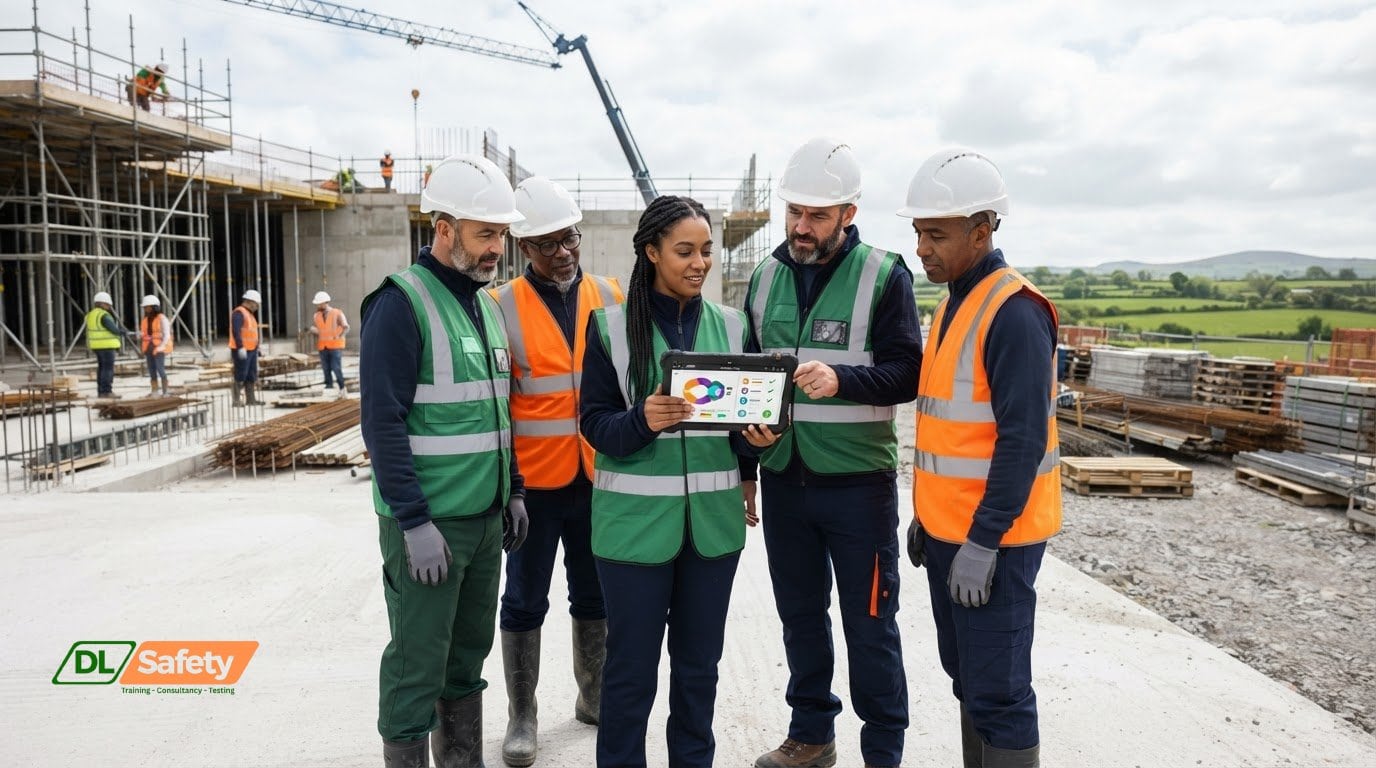
Did you know that construction fatalities in Ireland doubled to ten deaths in 2025, representing over 17% of all workplace fatalities recorded by the HSA? It’s a sobering reality that proves keeping your team’s skills sharp is a moral imperative rather than just a legal box-ticking exercise. You’re likely familiar with the high costs of traditional classroom sessions and the administrative nightmare of tracking expiry dates for a workforce with varying tech-savviness. Effective online safety training for construction workers offers a pragmatic solution to these hurdles, provided you choose the right approach for your specific site needs.
In this 2026 guide, you’ll discover how to select, implement, and manage digital learning to ensure your workforce remains compliant and protected whilst on-site. We’ll show you how to reduce your administrative burden and potentially lower insurance premiums through proven competency. If you need direct support, the team at DL Safety is based at Unit 3D Thurles Business Center, Stradavoher, Thurles, County Tipperary, E41 W880. You can reach us at info@dlsafety.ie, call 085 8316885, or visit www.dlsafety.ie to explore our full range of safety courses and monthly support packages designed to keep your projects running safely.
Key Takeaways
- Understand how to integrate online safety training for construction workers into a modern hybrid model that balances digital theory with practical site requirements.
- Learn the essential distinction between safety information and legal competency to ensure your workforce meets the latest HSA regulatory standards.
- Master a step-by-step implementation strategy that organises training expectations clearly whilst maintaining high levels of worker engagement.
- Discover how to transition from reactive “tick-box” exercises to proactive oversight using monthly support packages that manage your training matrix automatically.
Why Online Safety Training is Essential for Modern Construction
Online safety training for construction workers is no longer a luxury for the tech-savvy; it’s a fundamental pillar of modern site management. With workplace fatalities in Ireland reaching 61 in 2025, and construction deaths doubling within a single year, the pressure from the Health and Safety Authority (HSA) has never been higher. At DL Safety, based at Unit 3D Thurles Business Center, Stradavoher, Thurles, County Tipperary, E41 W880, we’ve seen how digital-first approaches transform compliance from a heavy administrative burden into a streamlined, proactive process. By defining workforce competency through flexible modules, firms ensure their teams are prepared for construction site safety hazards without the logistical nightmare of traditional scheduling.
The Shift to Digital Learning in 2026
The industry is moving away from the rigid, day-long classroom sessions that once defined safety education. In 2026, the hybrid model is the standard. This involves using micro-learning modules for theoretical instruction, which workers can complete on their own devices whilst travelling or during downtime. It’s practical. It respects the worker’s time. These platforms also cater to varying literacy levels and language needs, ensuring that safety information is truly understood rather than just heard. You don’t need to stop work for eight hours when a twenty-minute mobile module can cover the same ground more effectively.
Key Benefits for Construction Firms
Adopting a digital strategy offers more than just convenience; it builds a robust legal shield. Automated tracking and reporting significantly reduce administrative overheads. You won’t find yourself scrambling for paper records during one of the 2,845 annual HSA construction inspections. Key advantages include:
- Consistency: Every worker receives identical, high-quality safety instruction every time.
- Immediate Access: New hires can be onboarded with essential safety knowledge before they set foot on-site.
- Cost Efficiency: Minimising site downtime directly protects your bottom line whilst maintaining rigorous standards.
Digital records provide an indisputable trail of compliance. When you can show an inspector exactly when a worker completed their training, you satisfy the burden of proof instantly. This transparency builds trust with regulators and insurers alike. To learn more about how we support these efforts, visit www.dlsafety.ie or contact our team at info@dlsafety.ie or 085 8316885. Our goal is to help you maintain a fully compliant workforce with zero site accidents.
Evaluating Training Formats: Online vs. Face-to-Face Resources
Choosing between digital and physical classrooms shouldn’t be a matter of “either/or” but rather “where and when”. For many firms, online safety training for construction workers provides the heavy lifting for theoretical knowledge, while face-to-face sessions handle the practical, hands-on competency checks. This hybrid or “blended learning” approach is the gold standard in 2026. It ensures that workers aren’t just sitting through a lecture; they’re engaging with material at their own pace before proving their skills on-site. By separating theory from practice, you maximise site productivity without sacrificing the depth of instruction.
Some argue that digital learning lacks the rigour of a traditional classroom. However, modern platforms use interactive simulations and mandatory knowledge checks that prevent passive scrolling. While international standards like those for OSHA-authorized online training providers offer a baseline for digital delivery, the most effective Irish programmes are those built specifically for our legislative environment. High-quality online modules use branching scenarios that force workers to make safety-critical decisions, reflecting the unpredictable nature of a busy site.
Core Training Modules Suitable for Online Delivery
Certain topics are perfectly suited for remote delivery. Manual Handling theory, for instance, allows workers to learn the mechanics of safe lifting and spinal health before a physical assessment. Working at Height awareness provides the vital background on fall protection and equipment safety. Similarly, Chemical Awareness modules can teach COSHH and spill kit protocols effectively through visual, interactive scenarios. These modules ensure that when a worker arrives for practical training, they already possess a solid foundation, making the hands-on time far more efficient.
Evaluation Criteria for Quality Resources
Not all digital courses are created equal. When selecting a provider, you must look beyond the price tag. We recommend assessing resources based on three key pillars:
- Accreditation: Ensure courses align with HSA requirements or industry bodies like LEEA and SOLAS.
- User Experience: The interface must be intuitive for a diverse workforce with varying tech-savviness and language requirements.
- Local Relevance: Verify the content covers Irish legislation, such as the Safety, Health and Welfare at Work Act 2005, rather than generic global advice.
At DL Safety, we bridge the gap between theory and practice. Our online safety courses are designed to be accessible yet thorough, ensuring your team is prepared for the realities of the site. If you’re unsure which format suits your needs, our team at Unit 3D Thurles Business Center, Stradavoher, Thurles, County Tipperary, E41 W880 is ready to help. You can reach us at 085 8316885 or info@dlsafety.ie to discuss a bespoke training plan that keeps your project on track.
Navigating Compliance: Regulatory Standards for Digital Training
Compliance isn’t a static target; it’s an evolving standard that requires constant vigilance. In 2026, the Health and Safety Authority (HSA) has maintained a clear position: e-learning is a robust tool for theoretical instruction, but it cannot replace practical competency for high-risk tasks. When implementing online safety training for construction workers, you must distinguish between providing information and ensuring competency. Information is the delivery of facts, such as COSHH symbols or fire exit locations. Competency, however, involves the practical application of those facts under the watchful eye of a competent person. For site managers, the challenge lies in proving that both have occurred during an inspection.
With the HSA conducting 2,845 construction sector inspections in 2025 alone, having a digital paper trail is vital. However, these records are only as strong as the programmes they document. We recommend looking for evidence-based construction safety training programs that align with Irish statutory requirements. Simply handing a tablet to a worker isn’t enough; you must be able to demonstrate that the training was understood and that the worker can safely perform the task on-site. If you’re unsure how your current records would hold up, you should read our guide on What to Expect During a HSA Inspection to identify any potential gaps in your documentation.
Meeting HSA Standards in Ireland
Under the Safety, Health and Welfare at Work Act 2005, employers are legally bound to provide instruction in a form that workers can understand. Online modules support your Safety Statement by providing timestamped, documented evidence of this instruction. A safety consultant can help bridge the gap between this digital theory and live site practice, ensuring your Safety Statement isn’t just a dusty folder in the office but a living document that guides daily operations. This proactive oversight is a core component of our service at DL Safety, where we help firms translate regulatory jargon into practical site behaviours.
Verifying Training Authenticity
The rise of digital delivery has unfortunately seen a corresponding rise in sub-standard or fraudulent certificates. To protect your firm from liability, site managers should follow a strict verification protocol:
- Check for Unique Identifiers: Every valid certificate should have a unique ID number that can be verified against the provider’s database.
- Validate the Provider: Ensure the training organisation is reputable and their content is mapped to current Irish legislation.
- Maintain a Training Matrix: Don’t rely on individual PDFs; keep a centralised, live matrix that flags upcoming expiry dates before they become a compliance risk.
Maintaining this level of detail can be an administrative burden, which is why many firms partner with us. Our team at Unit 3D Thurles Business Center, Stradavoher, Thurles, County Tipperary, E41 W880, provides the expert oversight needed to keep your project compliant. You can contact us at 085 8316885 or info@dlsafety.ie, or visit www.dlsafety.ie to see how we can streamline your safety management.

Implementing a Digital Training Strategy for Your Workforce
Rolling out online safety training for construction workers requires more than just a login and a laptop. It’s a strategic shift that needs a clear roadmap to succeed without causing friction on-site. Start by conducting a thorough gap analysis to see who needs what. Once you’ve identified the training requirements, the next step is communication. You’ve got to explain to your team that this isn’t about monitoring them; it’s about making sure they get home safely every evening. Clear expectations prevent the “tech-fear” that often stalls digital adoption amongst older or less tech-savvy workers. When budgeting for this transition, considering the Cost of a Health and Safety Consultant is a smart move, as professional guidance ensures your investment meets every legal requirement from the start.
Selecting the Right Course Provider
Choosing a partner who understands the Irish construction landscape is critical. Generic, off-the-shelf courses often miss the nuances of HSA regulations or local site customs. At DL Safety, we focus on bespoke training options that reflect the actual challenges your team faces. A good platform shouldn’t just deliver content; it must provide detailed reporting for management oversight. This transparency allows you to see exactly who has completed their modules and who might need a little extra support to cross the finish line.
Managing Refresher Training Cycles
The real value of a digital strategy is how it handles the long game. Managing refresher cycles manually is a recipe for missed expiries and legal liability. A robust system should:
- Automate Alerts: Set up notifications for certificate expiries, such as Working at Height or GA1 inspection training, at least 30 days in advance.
- Integrate Toolbox Talks: Use short, on-site briefings to reinforce the digital modules, ensuring the theory stays fresh in a practical context.
- Promote CPD: Encourage a culture where continuous professional development is seen as a badge of honour amongst tradespeople.
Effective implementation reduces the administrative burden and keeps your project timelines on track. If you’re ready to modernise your approach, you can book your online safety courses through our portal today. For personalised advice on building your strategy, visit us at Unit 3D Thurles Business Center, Stradavoher, Thurles, County Tipperary, E41 W880, or contact our team at info@dlsafety.ie or 085 8316885. We’re here to ensure your workforce remains compliant, protected, and productive.
Beyond the Screen: Enhancing Safety with Monthly Support Packages
Safety isn’t a “set and forget” activity. While online safety training for construction workers builds a necessary foundation, it’s only one component of a dynamic, living safety culture. A digital certificate proves a worker was exposed to information; a Monthly Safety Support Package ensures that information is actually protecting them whilst they’re on-site. By integrating training records with live site audits and technical testing, you close the gap between theoretical knowledge and practical site safety. This holistic approach is what separates a compliant firm from a truly safe one, reducing the administrative burden on your office staff whilst ensuring zero site accidents remains a realistic goal.
The DL Safety Advantage
We don’t just sell courses; we partner with you to manage your entire safety ecosystem. Our approach involves integrating Online Safety Courses Ireland into your daily operations, ensuring that digital learning isn’t a standalone silo. This means David and our team of experts handle the technical heavy lifting, such as GA1 testing for lifting equipment and on-site quarry vehicle brake testing, alongside your training matrix management. If an incident occurs, our accident investigation service provides a thorough, honest analysis to prevent recurrence and protect your reputation. This transition from a reactive, “emergency-only” mindset to a proactive, “peace of mind” model allows business owners to focus on project delivery, knowing their compliance is in expert hands.
Get Started with DL Safety Today
Managing safety shouldn’t be a source of constant stress for site managers or directors. We’re here to demystify the regulations and provide pragmatic, human-led solutions that work in the real world. Whether you need a bespoke training plan, Safe T Cert preparation, or a full safety management retainer, our team is ready to support your success. We believe in transparency and commitment, looking at the big picture to ensure your business thrives long-term through reduced insurance premiums and proven competency.
You can call us directly on 085 8316885 to discuss your specific workforce requirements. Alternatively, email info@dlsafety.ie to request a tailored quote for our training and support services. If you’d prefer a face-to-face chat, you’re always welcome at our office: Unit 3D Thurles Business Center, Stradavoher, Thurles, County Tipperary, E41 W880. Let’s work together to ensure your site remains productive, compliant, and, most importantly, safe. You can also visit our website at www.dlsafety.ie to explore our full range of technical services and safety courses.
Building a Safer Future for Your Construction Site
Transitioning to a digital-first approach doesn’t mean losing the human touch that keeps a site safe. By adopting online safety training for construction workers, you’ve taken the first step towards a more efficient, compliant, and transparent operation. The most successful firms in 2026 are those that treat digital modules as one part of a wider safety management system. This involves combining flexible theory with rigorous on-site audits and technical testing to ensure every worker is truly competent and every piece of equipment is fit for purpose.
At DL Safety, we’re dedicated to helping you navigate these complex requirements with ease. Our expertise as a leading Irish consultancy ensures you receive national coverage and industry-standard technical testing that stands up to any inspection. Whether you’re based in Tipperary or operating across the country, we’re here to provide the pragmatic, solution-oriented support your business deserves. Secure Your Site’s Compliance with DL Safety’s Online Training and Support today. Let’s work together to build a culture of safety that protects your team and your reputation for years to come.
Frequently Asked Questions
Is online safety training legally recognised by the HSA in Ireland?
Online safety training is legally recognised by the HSA for delivering theoretical instruction and safety information. Under the Safety, Health and Welfare at Work Act 2005, employers must provide training in a form likely to be understood by their team. Whilst digital modules are perfect for awareness topics like COSHH or fire safety, they cannot replace practical assessments required for high-risk tasks. We recommend a hybrid approach where digital theory is validated by on-site competency checks.
Which construction safety courses can be completed entirely online?
Theoretical modules such as Chemical Awareness, Working at Height awareness, and Asbestos Awareness can be completed entirely online. However, it’s vital to remember that the initial SOLAS Safe Pass requires a one-day classroom session. Since 2026, Safe Pass renewals are completed via computer-based tests at Pearson VUE centres. Online safety training for construction workers is highly effective for these theoretical subjects, ensuring your team stays compliant without the need for unnecessary site downtime.
How often should construction workers refresh their online safety training?
Most construction safety certifications require refreshing every two to four years, depending on the specific module. For instance, Safe Pass cards are valid for four years. However, best practice suggests more frequent refreshes for high-risk topics to combat “knowledge fade.” Using micro-learning modules annually helps maintain a high level of hazard awareness. Our monthly support packages at DL Safety help you track these dates automatically, ensuring no worker’s certification ever lapses across your national projects.
Can online training replace site-specific safety inductions?
Online training cannot replace site-specific inductions. Whilst digital courses provide a broad foundation of safety knowledge, an induction must address the unique hazards of a specific project, such as local traffic management or emergency assembly points. A site-specific induction is a legal requirement that ensures workers understand the exact environment they are entering. Online modules should be used to supplement this by providing the prerequisite theoretical knowledge before workers actually arrive on-site.
How do I verify if an online safety certificate is genuine and valid?
To verify a certificate’s validity, you should check for a unique identification number that can be cross-referenced against the training provider’s online database. Ensure the course is mapped to Irish statutory requirements rather than generic international standards. Sub-standard certificates lack these verification trails and can lead to significant liability issues during a HSA inspection. At DL Safety, we provide fully transparent certification that stands up to the most rigorous legal and regulatory scrutiny.
What are the technical requirements for workers to access online training?
Technical requirements are minimal for modern digital learning. Most online safety training for construction workers is designed to be mobile-friendly, requiring only a smartphone, tablet, or laptop with a standard web browser and a stable internet connection. This accessibility is crucial for a mobile workforce that may need to complete modules whilst travelling or during site breaks. No specialised hardware or complex software downloads are typically required to access our secure training portal.
How does online training affect my company’s insurance liability?
Implementing a robust digital training programme can positively impact your insurance liability and potentially lower your premiums. Insurers look for evidence of a proactive safety culture and a clear audit trail of worker competency. By maintaining digital records, you provide indisputable proof that you have met your duty of care as an employer. This documentation is vital for defending against personal injury claims and demonstrating compliance during mandatory Health and Safety Authority site audits.
Can DL Safety provide bespoke online training tailored to our specific site risks?
Yes, we specialise in bespoke training solutions that reflect the unique risks of your operations. Our team, led by David, works nationally across Ireland to develop training that integrates directly with your Safety Statement and Method Statements. We combine these bespoke modules with our Monthly Safety Support Packages to provide ongoing oversight. Contact us at info@dlsafety.ie or 085 8316885 to discuss how we can tailor our services to your specific project needs.
