
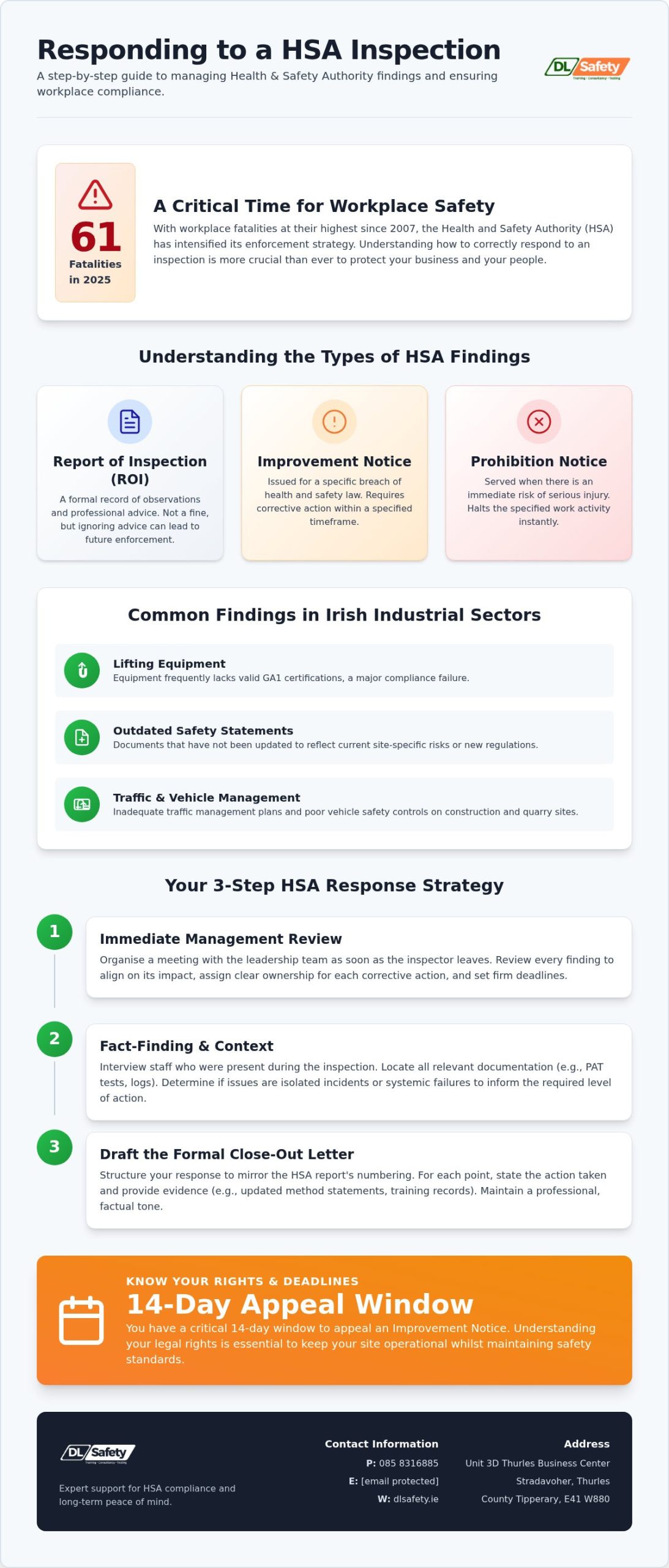
With workplace fatalities reaching 61 in 2025, the highest number recorded since 2007, the Health and Safety Authority has intensified its enforcement strategy for 2026. It’s completely understandable to feel a sense of dread when an inspector leaves a report on your desk. Between the fear of heavy fines and technical safety jargon, learning how to respond to a HSA report of inspection whilst running a busy site can feel like an impossible task. You aren’t alone in feeling overwhelmed by the pressure of maintaining a perfect safety record.
This guide shows you exactly how to address HSA findings to protect your business and your people. We’ll walk you through a step-by-step plan to manage findings, address enforcement notices within the 14-day appeal window, and secure your workplace compliance. You’ll discover how to turn a daunting report into a clear roadmap for safety to avoid Prohibition or Improvement Notices that can bring your operations to a standstill. For expert support, contact us at Unit 3D Thurles Business Center, Stradavoher, Thurles, County Tipperary, E41 W880, via info@dlsafety.ie, or call 085 8316885. Our team at www.dlsafety.ie is here to provide the peace of mind you need to focus on your work.
Key Takeaways
- Learn to distinguish between a standard Report of Inspection and serious enforcement notices to ensure your response is proportionate, timely, and legally sound.
- Master the step-by-step process of how to respond to a HSA report of inspection by organising immediate management reviews and assigning clear ownership for every corrective action.
- Understand your legal rights and critical deadlines, such as the 14-day window to appeal an Improvement Notice, to keep your site operational whilst maintaining safety standards.
- Use inspection findings as a catalyst to update your 2026 Safety Statement and Risk Assessments, ensuring your documentation reflects current regulatory requirements and site-specific hazards.
- Discover how professional support, including Monthly Safety Support Packages, can simplify the liaison process with the HSA and provide long-term compliance peace of mind.
What is a HSA Report of Inspection?
A Report of Inspection (ROI) is far more than just a summary of a site visit. It’s the formal record generated by the Health and Safety Authority (HSA) that outlines exactly what an inspector observed on your premises. During the visit, the inspector usually seeks to interview the most senior person in charge. This isn’t to catch anyone out; it’s because the HSA recognises that safety culture starts at the top. They want to ensure the person with the power to allocate resources and make changes understands the risks present on the ground.
Understanding the document’s structure is the first step in learning how to respond to a HSA report of inspection. A standard ROI typically lists “areas for safety improvement” and provides professional advice. However, if the inspector finds a specific breach of health and safety law, they may issue an Improvement Notice. If there’s an immediate risk of serious injury, a Prohibition Notice will be served, which halts work instantly. While the ROI itself isn’t a fine, it’s a legal document that sets the stage for your future compliance relationship with the authority.
The Difference Between Advice and Enforcement
It’s a mistake to view the advice section of a report as merely optional. While advice doesn’t carry the immediate legal weight of a notice, ignoring it is a fast track to future enforcement. Inspectors use a sampling approach; they don’t look at every single bolt or document, but they use what they see to gauge your overall management system. If they provide advice on a specific hazard and find it unaddressed during a follow-up, it shows a lack of commitment that often leads to a statutory notice. Treating advice as a precursor to a requirement helps you stay ahead of the regulator.
Common Findings in Irish Industrial Sectors
In our experience at DL Safety, certain issues appear more frequently than others in Irish workplaces. Lifting equipment often lacks valid GA1 certifications, which is a major red flag for inspectors. We also see many Safety Statements that haven’t been updated to reflect current site-specific risk assessments or new 2026 regulations. On construction and quarry sites, poor traffic management and inadequate vehicle safety controls remain high priorities for the HSA. Addressing these common pitfalls proactively is the best way to ensure your report of inspection remains a list of advice rather than a list of penalties.
Developing Your HSA Response Strategy
Once the inspector leaves your site, the clock starts ticking on your response. You should organise a management meeting immediately to review every point raised in the report. This ensures that the leadership team is aligned on the findings and understands the potential impact on operations. During this meeting, assign clear responsibility and deadlines for each corrective action identified. Developing a structured internal plan is the most effective way to learn how to respond to a HSA report of inspection without feeling overwhelmed by the technical requirements.
Your goal is to draft a formal response letter that addresses every numbered point in the HSA report. This letter should be supported by documentary evidence, such as updated Method Statements or training records. It’s vital that your response remains factual and professional; avoid defensive or argumentative language, as this can lead to further scrutiny. If you find the process too complex to manage alongside daily operations, our Monthly Safety Support Packages can provide the expert guidance needed to close out these findings efficiently.
Step 1: The Initial Fact-Finding Mission
Before putting pen to paper, you must understand the context of the findings. Interview the staff present during the inspection to get a first-hand account of the observations. You may need to locate documentation the inspector found lacking, such as PAT testing records or equipment logs. Determine if the issues are isolated incidents or represent systemic process failures, as this distinction determines the level of corrective action required by the HSA.
Step 2: Drafting the Formal Close-Out Letter
When drafting your document on how to respond to a HSA report of inspection, structure the letter to mirror the HSA report’s own numbering system exactly. For each point, state clearly what has been done, what is in progress, and provide realistic completion dates. Conclude with a single sentence confirming your commitment to the Safety, Health and Welfare at Work Act 2005. For support with this process, email info@dlsafety.ie, call 085 8316885, or visit us at Unit 3D Thurles Business Center, Stradavoher, Thurles, County Tipperary, E41 W880.
Managing Improvement and Prohibition Notices
While a Report of Inspection is a request for improvement, receiving a formal statutory notice shifts the situation into a legal timeframe. An Improvement Notice typically allows you to continue your operations whilst you carry out specific remedial works. In contrast, a Prohibition Notice is far more severe; it stops a specific activity immediately because the inspector has identified a risk of serious personal injury. Understanding the difference is central to knowing how to respond to a HSA report of inspection effectively.
Legally, you have a statutory window to appeal these notices to the District Court. For an Improvement Notice, this window is 14 days from the date of service, whereas a Prohibition Notice must be appealed within 7 days. However, for most businesses, the most efficient path is not litigation but structured compliance. Maintaining open, honest communication with your inspector throughout this period often leads to a smoother resolution than a confrontational legal battle. If you’re unsure of your position, reach out to us at www.dlsafety.ie for a professional review of your findings.
Responding to an Improvement Notice
When served with an Improvement Notice, you must outline the specific remedial works you intend to undertake to satisfy the inspector’s concerns. This might involve updating your Safety Statement or conducting mandatory GA1 testing on lifting equipment. Once these improvements are fully implemented, you must submit a formal ‘Notice of Compliance’ to the HSA. This document confirms that the breach has been rectified. For a deeper look at the inspector’s mindset, read our guide on What to Expect During a HSA Inspection.
The Gravity of a Prohibition Notice
A Prohibition Notice requires you to cease the prohibited activity immediately. Ignoring this is a criminal offence and can lead to heavy fines or prosecution. To have the notice lifted, you must implement high-level safety controls. This could range from installing shoring for excavations to ensuring all lifting chains and shackles have valid inspection certificates. Once the risk is removed, you must request a follow-up visit. Only when the inspector is satisfied will they formally lift the notice in writing. If you need urgent assistance managing a notice, contact DL Safety at Unit 3D Thurles Business Center, Stradavoher, Thurles, County Tipperary, E41 W880, email info@dlsafety.ie, or call 085 8316885.
Updating Your Safety Documentation Post-Inspection
A HSA report of inspection often reveals that a company’s safety documentation has become stagnant. It’s easy for paperwork to fall behind the reality of a busy site, but the inspector’s findings provide a perfect diagnostic tool to fix these gaps. Treat the 2026 findings as a catalyst to review your entire Safety Statement. This document should never be a “set and forget” folder; it must be a living guide that reflects your current operations and the latest 2026 regulatory updates, such as the new Safety, Health and Welfare at Work (Quarries) Regulations.
Specific Risk Assessments need immediate attention if the inspector highlighted particular hazards like silica dust exposure or working at height. Similarly, your Method Statements must be reviewed to ensure they accurately describe the safe systems of work actually being performed by your team. If your equipment was flagged, ensure all lifting gear has valid LEEA-standard GA1 certificates. If your documentation needs a professional overhaul to satisfy the authority, our experts can help you draft compliant Safety Statements tailored to your specific industry.
Closing the Gap in Site Audits
One of the most effective ways to prevent future enforcement is to implement a regular schedule for internal health and safety site audits. These audits allow you to catch issues before a HSA inspector does. You should cross-reference the advice found in your recent report with your daily site checklists and vehicle brake testing logs. This proactive approach proves to the authority that you’ve taken their advice seriously. For more information on statutory equipment inspections, see our GA1 Testing Ireland Guide.
Evidence of Training and Competency
Documentation is only half the battle; you must also provide evidence of staff competency. Verify that all operators have completed relevant online safety courses or face-to-face training that matches their roles. If the HSA identified specific behavioural issues, document recent toolbox talks that address these points directly. Keeping a clear record of bespoke training provided as a corrective action is a vital part of knowing how to respond to a HSA report of inspection. For assistance with training records or to book a site visit, contact DL Safety at Unit 3D Thurles Business Center, Stradavoher, Thurles, County Tipperary, E41 W880, or call 085 8316885.
How DL Safety Manages Your HSA Close-Out
Navigating the complexities of a regulatory response whilst trying to maintain site productivity is a difficult balancing act. At DL Safety, we bridge that gap by providing a solution-oriented approach that demystifies the inspector’s findings. Our Monthly Safety Support Packages are tailored to take the pressure off business owners, offering a clear framework on how to respond to a HSA report of inspection with confidence and professional authority. We don’t just point out problems; we partner with you to implement the solutions that keep your site operational.
We provide more than just advice; we deliver the technical results needed to satisfy the authority. From on-site GA1 testing for lifting gear to thorough accident investigations, our services are geared towards rapid compliance. We specialise in making sure your Safety Statement is a living document that actually reflects your site’s behaviour, ensuring it stands up to any follow-up inspection without further issues. This proactive methodology transforms a stressful report into a streamlined process of improvement.
The Value of a Retained Safety Consultant
The return on investment for a retained consultant is found in the avoidance of Prohibition Notices and the removal of the administrative burden from your management team. We focus on providing the peace of mind that comes from continuous safety oversight, which is often the difference between a compliant site and a prosecuted one. Our expertise also extends to Safe T Cert and ISO preparation, helping you build a culture of excellence that supports your business’s long-term growth and reputation amongst clients and regulators alike.
Contacting DL Safety for Support
To begin your close-out process, you can send your HSA report directly to us for a confidential review. We provide national coverage for site audits and technical testing, bringing high standards of safety directly to your project regardless of your location in Ireland. Contact our team at Unit 3D Thurles Business Center, Stradavoher, Thurles, County Tipperary, E41 W880, or reach out via info@dlsafety.ie and 085 8316885. For a full list of our services and support options, visit www.dlsafety.ie. We are ready to act as your trusted advisor and secure your workplace compliance.
Securing Your Workplace Future
Receiving a Report of Inspection is a significant moment for any business, but it doesn’t have to be a source of constant stress. By categorising findings, meeting with your team immediately, and updating your Safety Statement, you demonstrate a proactive commitment to your staff’s welfare. Mastering how to respond to a HSA report of inspection allows you to turn technical advice into a robust safety culture that prevents future enforcement. Our team specialises in the construction and industrial sectors, providing national coverage across Ireland for expert GA1 and technical testing services.
Whether you need a detailed accident investigation or a complete overhaul of your site-specific risk assessments, we are here to simplify the process. You can find us at Unit 3D Thurles Business Center, Stradavoher, Thurles, County Tipperary, E41 W880, or contact us via info@dlsafety.ie and 085 8316885. Secure your site’s compliance with a DL Safety Monthly Support Package today. Let’s work together to make your workplace a safer, more compliant environment for everyone.
Frequently Asked Questions
How long do I have to respond to a HSA Report of Inspection?
Understanding how to respond to a HSA report of inspection involves acting quickly; you should typically aim to provide a written response within four weeks. While there is no single statutory deadline for the report itself, this timeframe demonstrates proactive management. If the report includes an Improvement Notice, you must address the issues within the period specified by the inspector, which is usually at least 14 days. Prompt action helps maintain a positive relationship with the authority.
Can I continue working if I receive an Improvement Notice?
Yes, an Improvement Notice generally allows you to continue your work activities whilst you make the necessary safety changes. The notice will specify a deadline by which the improvements must be completed. It’s vital to meet this deadline to avoid further enforcement action or potential prosecution. If you feel the requirements are unreasonable, you have a 14-day window from the date of service to lodge an appeal with the District Court.
What happens if I ignore the advice in a HSA report?
Ignoring advice in a report is a significant risk that often leads to the escalation of enforcement measures. While advice isn’t immediately legally binding like a notice, failing to act shows a lack of safety commitment. During a follow-up visit, an inspector who finds the same issues unaddressed is far more likely to issue a formal Improvement or Prohibition Notice. This escalation can result in site closures, heavy fines, or criminal proceedings.
Do I need a solicitor to respond to a HSA inspector?
You don’t strictly need a solicitor to draft a response, as the process is primarily about demonstrating technical and operational compliance. Most businesses find that a specialist safety consultant is better equipped to handle the technical jargon and safety documentation required. However, if you intend to appeal a notice in the District Court or face a prosecution, legal representation is highly recommended. Specialist advice ensures your response is factual, professional, and legally sound.
What is the difference between a Report of Inspection and an Enforcement Notice?
A Report of Inspection is the formal record of an inspector’s findings and includes advice for safety improvements. In contrast, an Enforcement Notice is a legally binding order. Learning how to respond to a HSA report of inspection correctly can often prevent these more serious notices from being issued. While the report suggests changes, a notice mandates them under the threat of legal penalty, requiring immediate attention to avoid further sanctions.
How can a safety consultant help with a Prohibition Notice?
A safety consultant provides the rapid technical response needed to have a Prohibition Notice lifted so you can resume work. We can immediately conduct mandatory GA1 testing, design traffic management plans, or update risk assessments. By acting as an expert liaison, we ensure your remedial actions meet legal standards. This professional oversight gives the HSA confidence that risks are removed. Visit www.dlsafety.ie to learn how our support packages can protect your business.
Is a HSA inspection always unannounced?
Most HSA inspections are unannounced to ensure the inspector sees the site in its everyday state. However, they may occasionally schedule a visit if they need to speak with a specific director or review complex technical documentation. Regardless of the visit type, you must grant the inspector access to all areas of your workplace. Maintaining inspection-ready documentation, such as valid training records and equipment certs, is the best way to manage these visits.
Will a Report of Inspection lead to a prosecution?
A Report of Inspection itself is not a prosecution, but it can provide evidence for one if serious breaches are identified. Most prosecutions arise from fatal accidents or a persistent failure to comply with previous notices. Implementing the required changes professionally significantly reduces your risk. For support, contact DL Safety at Unit 3D Thurles Business Center, Stradavoher, Thurles, County Tipperary, E41 W880, info@dlsafety.ie, or 085 8316885.