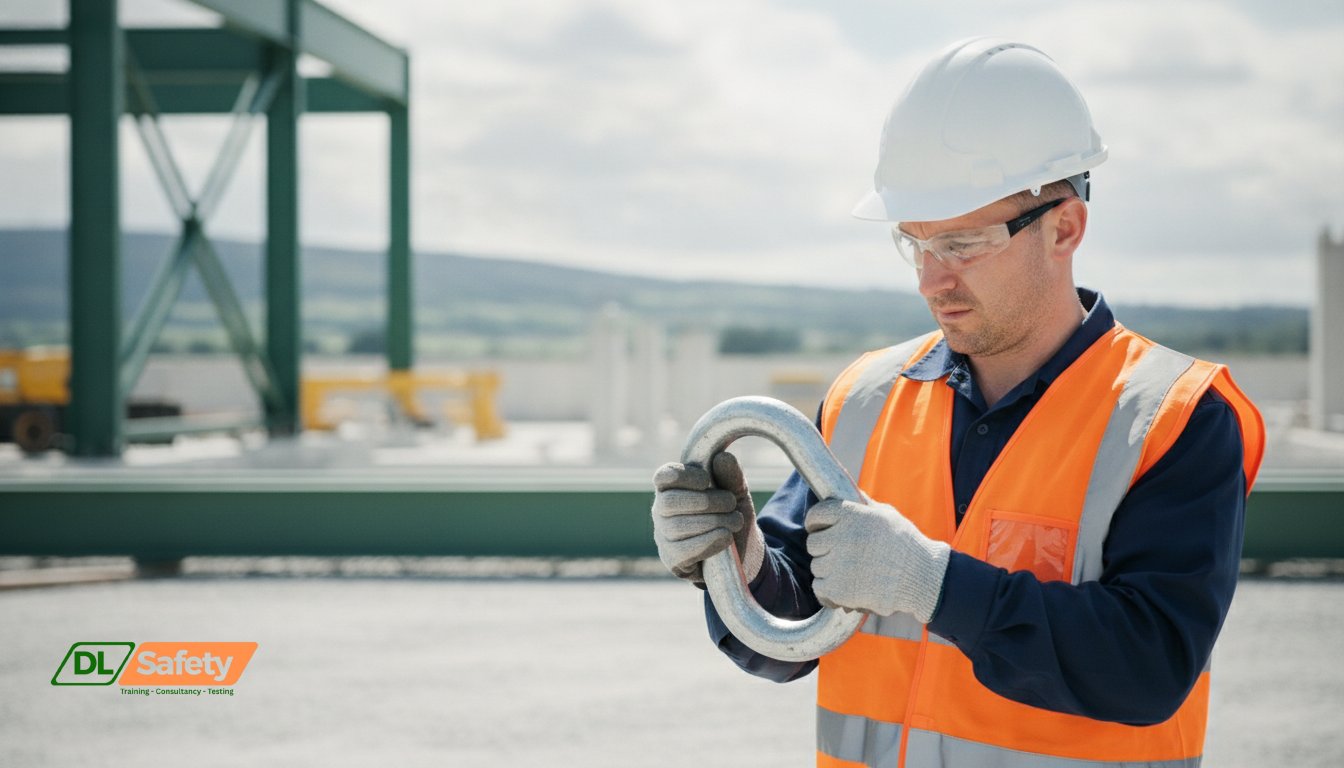
What if the only thing standing between a successful lift and a catastrophic site failure is a single, hairline fracture hidden beneath a layer of grease? It’s a sobering thought for any site manager or safety officer in Ireland. You likely already know that keeping your gear in order is vital, but the pressure of a busy project can make it difficult to stay on top of every minute detail. Whether you’re worried about an unannounced HSA inspection or simply want to protect your team, having a robust lifting shackle inspection checklist is the best way to move from uncertainty to total confidence.
We understand that the legalities surrounding GA1 certification and statutory examinations can feel like a heavy administrative burden. Our goal is to demystify these requirements and provide you with a practical framework that ensures your lifting operations remain safe and fully compliant with Irish health and safety legislation. In this guide, we’ll walk you through the specific wear thresholds that demand an immediate discard, how to spot invisible fatigue, and the documentation you need to satisfy an inspector’s rigorous standards. By the end, you’ll have a clear, expert-led roadmap to keep your site running smoothly and your personnel protected.
Key Takeaways
- Understand the mechanical differences between Bow and Dee shackles to ensure you select the correct accessory for your specific rigging environment.
- Use our professional lifting shackle inspection checklist to identify critical defects like 10% crown wear or illegible ID tags that require immediate gear quarantine.
- Learn why side-loading a shackle can reduce its capacity by up to 50% and how to correctly distinguish between WLL and SWL in a site context.
- Master essential pre-lift protocols, including the correct method for seating pins, to avoid the common safety risks associated with over-tightening.
- Ensure full alignment with Irish health and safety legislation by scheduling statutory GA1 thorough examinations for all lifting accessories every six months.
Understanding Lifting Shackle Types and Selection
Choosing the right shackle isn’t just about grabbing what’s available in the stores; it’s the first line of defence in your rigging strategy. In Ireland, the industry standard for lifting accessories typically involves Grade 80 high-tensile steel, which provides the necessary strength-to-weight ratio for heavy-duty construction and industrial use. Before you even consult your lifting shackle inspection checklist, you must ensure the gear is fit for the specific geometry of the lift. Every shackle should clearly display its Safe Working Load (SWL) and a manufacturer’s mark. If these are missing, the item is non-compliant and unsafe to use.
Bow Shackles vs Dee Shackles
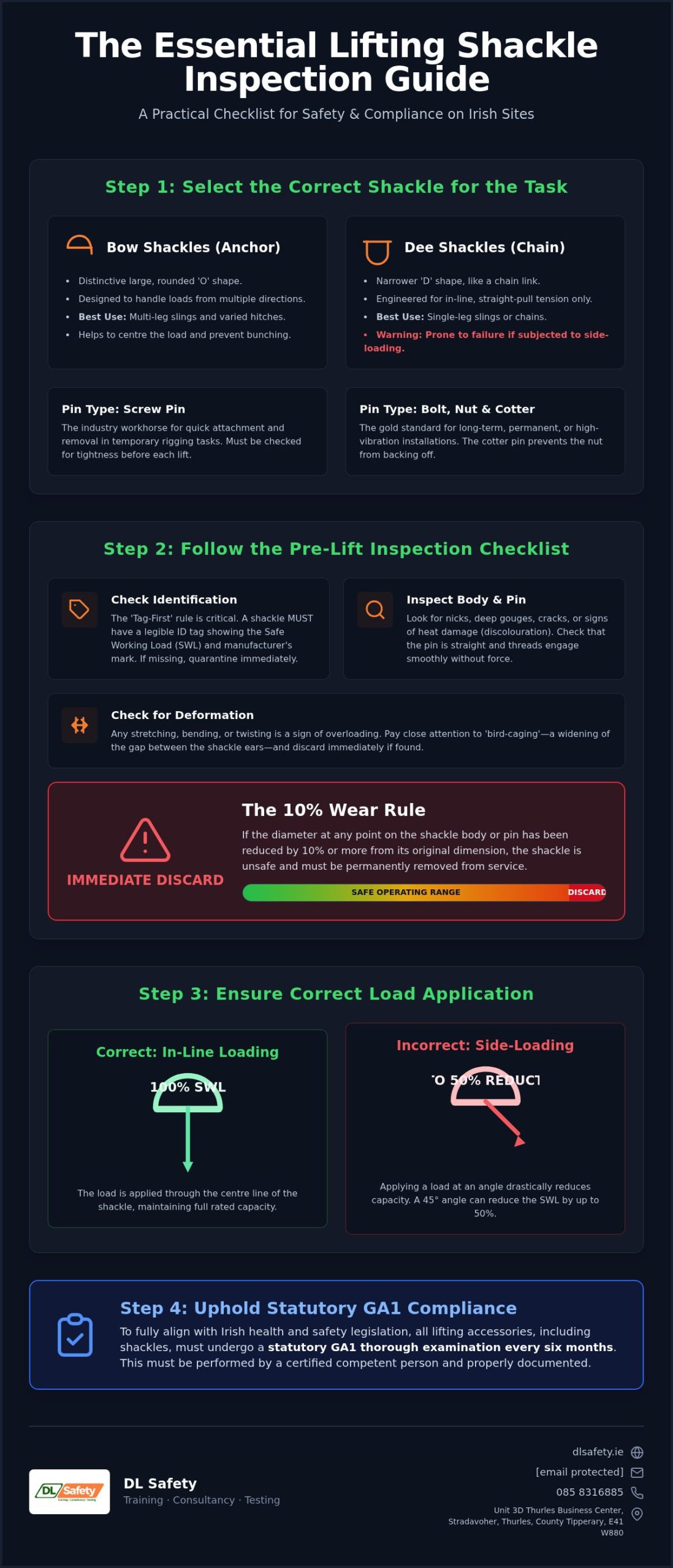
The physical profile of a shackle determines how it handles tension. Bow shackles, often called anchor shackles, feature a larger, rounded “O” shaped body. This design is crucial because it allows for multi-leg hitches and prevents the load from bunching. It also helps in Shackle Types and Components identification, as the bow shape naturally centres the load, reducing the risk of dangerous side-loading. Conversely, Dee shackles (or chain shackles) are designed for straight-line pulls. Their narrower profile is perfect for connecting to single-leg slings or chains but can fail if subjected to lateral forces.
Pin Types and Security
Security at the connection point is where many site incidents begin. Screw pin shackles are the workhorses of the industry because they allow for quick attachment and removal during temporary rigging tasks. However, they aren’t a “set and forget” solution. For long-term installations or permanent lifts, bolt-type shackles are the gold standard. These utilise a nut and a cotter pin to ensure the bolt cannot vibrate loose over time. You should never substitute rated pins with standard commercial bolts. Non-rated hardware lacks the metallurgical integrity to handle sudden shocks, making them a primary red flag during any thorough site audit.
At DL Safety, we provide LEEA-standard lifting equipment that meets these rigorous specifications. Understanding these distinctions is the first step toward a safer site. Once you have the correct gear, the next phase is ensuring it remains in peak condition through a structured inspection regime. Using a detailed lifting shackle inspection checklist ensures that every component, from the crown to the pin, is scrutinized for the invisible wear that precedes a failure.
The Lifting Shackle Inspection Checklist: The Inspector’s Eye
A comprehensive Shackle Inspection Checklist should always begin with the ‘Tag-First’ rule. If the ID tag or manufacturer’s markings are missing, illegible, or painted over, the shackle must be quarantined immediately. In the high-stakes environment of an Irish construction site, traceability is non-negotiable. Without a clear indication of the Safe Working Load (SWL), you’re essentially guessing the capacity of your rigging. This simple check often saves site managers from the heavy fines associated with unannounced HSA inspections.
Beyond the tag, you must examine the physical body for nicks, gouges, and cracks. These surface defects act as stress concentrators where a failure is most likely to initiate. Even a small nick, if deep enough, can significantly compromise the structural integrity of the steel. You’re looking for a smooth, uniform surface. Any shackle that shows evidence of ‘stretching’ at the crown or distortion in the ears has been overloaded and is no longer safe for service.
Mechanical Integrity of the Pin and Body
The pin is the most vulnerable component of any shackle. During your audit, verify that the pin is not bent and that it seats fully into the shackle ear without force. If you find yourself needing a tool to start the threads, the pin or the body is likely deformed. We recommend the ‘10% Rule’ for wear: if the diameter at any point on the pin or body has decreased by 10% or more compared to its original size, the item must be scrapped. You should also watch for ‘bird-caging’ or any widening of the gap between the shackle ears, which indicates the metal has reached its elastic limit.
Metallurgical Red Flags
Steel tells a story through its colour. Discolouration often points to chemical burns or heat damage, both of which can alter the molecular structure of the alloy and make it brittle. Similarly, whilst light surface rust is common, deep pitting or heavy corrosion is a sign that the shackle’s load-bearing capacity is compromised. Any shackle showing signs of weld repairs, grinding, or heat-based modifications must be discarded immediately without exception. Attempting to ‘fix’ a lifting accessory is a dangerous practice that bypasses all safety protocols.
Maintaining a rigorous lifting shackle inspection checklist is a full-time commitment to site safety. If your team is stretched thin, our health and safety site audits provide an independent, expert eye to ensure your gear remains fully compliant. It’s often better to catch a defect during a routine check than to discover it during a critical lift.
Safe Working Loads (SWL) and the Physics of Shackle Loading
Understanding the mechanical limits of your gear is just as important as spotting a physical crack. On Irish sites, you’ll often see the terms WLL (Working Load Limit) and SWL (Safe Working Load) used interchangeably, but they represent different stages of safety. The WLL is the maximum mass the manufacturer guarantees the shackle can handle when new. The SWL, however, is the capacity determined by a competent person after considering the specific site environment and the current condition of the gear. When you’re working through your lifting shackle inspection checklist, you’re essentially verifying that the item still meets the requirements to maintain its SWL status.
Physics dictates that shackles are strongest when the tension is applied in a straight line. Side-loading, which occurs when the load pulls at an angle to the shackle’s centreline, introduces bending stresses the component wasn’t designed to handle. This lateral force can reduce a shackle’s capacity by up to 50%, turning a safe lift into a high-risk event in seconds. To ensure you’re following best practices, always consult Columbus McKinnon’s 6-point inspection checklist for a deeper look at how loading geometry affects structural integrity.
Calculating Capacity for Angled Lifts
If your rigging plan requires an angled pull, you must apply reduction factors to your capacity calculations. At a 45-degree angle, a shackle’s capacity drops to roughly 70% of its rated WLL. If that angle increases to 90 degrees, the capacity is slashed to 50%. For example, a 5-tonne bow shackle subjected to a 90-degree side-load is only safe for 2.5 tonnes. Crucially, you should never use a shackle if the load angle exceeds 120 degrees, as the risk of the body deforming or the pin shearing becomes unacceptably high.
Hitch Types and Shackle Alignment
Symmetry is your best friend in rigging. When using lifting slings, ensure they are seated squarely within the bow of the shackle rather than bunched to one side. You must also avoid pin-to-sling contact. If a synthetic sling sits on the pin, the friction during the lift can actually cause a screw-pin to rotate and unscrew. The load should always rest on the shackle body, with the pin connected to the hook or a fixed point. This alignment maintains the 6:1 factor of safety standard for high-quality Grade 80 shackles, ensuring your lifting shackle inspection checklist remains a tool for prevention rather than an autopsy of a failed lift.
Extreme environments also play a role in metallurgy. Whilst Ireland rarely sees the heat of a foundry, sub-zero winter temperatures can make high-tensile steel more brittle. If you’re operating in unusual conditions, always check the manufacturer’s temperature-reduction charts to ensure your SWL remains accurate for the task at hand.
Operational Best Practices for Rigging and Storage
Practical rigging begins the moment you pick up the accessory. Even if a shackle has passed its statutory GA1 examination, a rigger’s last-minute check is the final barrier against a site accident. This informal pre-use review is a vital extension of your primary lifting shackle inspection checklist. You’re ensuring the pin is correct for the body and that no debris has entered the threads since it was last used. A clean, well-maintained thread is essential for a secure connection.
There’s a common ‘Finger-Tight’ myth in the industry that can lead to disaster. Whilst a screw-pin must be fully seated so the shoulder contacts the shackle ear, it shouldn’t be over-tightened with a wrench to the point of deformation. If the pin is too loose, it can vibrate out; if it’s over-torqued, you risk stripping the threads or causing a stress fracture. For bolt-type shackles, always ensure the nut is secured with a split cotter pin. This mechanical lock is non-negotiable for any lift involving movement or vibration, as it provides a secondary layer of security.
Once the connection is made, the ‘Trial Lift’ is your best diagnostic tool. Lift the load just 100mm off the ground and pause. This allows the rigger to check for balance, sling alignment, and any unexpected pin movement before the load reaches a dangerous height. During this phase, clear communication is essential. Standardised hand signals between the rigger and crane operator prevent the confusion that leads to shock loading. A steady, predictable pace is always safer than a rushed lift, particularly in congested Irish construction environments.
Executing a Secure Connection
Rigging integrity relies on avoiding point loading on the pin. The load should be distributed across the centre of the pin to prevent bending or shearing forces. Never replace a lost shackle pin with a standard hardware bolt. As previously discussed, these lack the metallurgical strength required for lifting and will fail under tension. When the task is finished, follow safe removal protocols by ensuring the load is fully supported before unscrewing the pin to avoid sudden releases of energy.
Storage and Maintenance Post-Inspection
Correct storage is what keeps your gear compliant between inspections. Organise a dedicated ‘Lifting Store’ where shackles are kept off the ground and away from moisture. Dirt, grit, and oil can hide cracks, so cleaning your equipment post-lift is a practical necessity for future visual checks. We also recommend a robust ‘Quarantine System’. If a shackle fails your lifting shackle inspection checklist, it should be colour-coded red or locked in a secure bin to prevent accidental reuse by another crew.
If you’re looking to professionalise your site protocols and reduce the risk of gear failure, our lifting equipment inspection training provides your team with the hands-on skills needed to manage these accessories safely and effectively.
Statutory Compliance: GA1 Testing and Site Safety Audits
In Ireland, the legal framework for lifting operations is governed by the Safety, Health and Welfare at Work (General Application) Regulations 2007. Under these rules, lifting shackles are classified as lifting accessories, meaning they must undergo a thorough examination every six months. This is not a mere recommendation; it is a statutory requirement that culminates in the issuance of a GA1 Certificate. Whilst your internal lifting shackle inspection checklist is vital for daily safety, it does not replace the need for an independent, competent person to verify the equipment’s integrity. Failing to produce a valid report during a Health and Safety Authority (HSA) inspection can lead to summary conviction fines of up to €5,000 per offence.
Managing a fleet of accessories across multiple sites can be an administrative headache. Many proactive firms now integrate their hardware checks into a broader Construction Site Traffic Management Plan to ensure that lifting zones are clearly defined and gear is properly tracked. To simplify this process, our Monthly Safety Support Packages are designed to automate your equipment compliance. We take the burden of scheduling GA1 testing Ireland requirements off your desk, allowing you to focus on project delivery whilst we maintain your digital safety records.
Professional Lift Plans and Risk Assessments
Every complex lift requires a bespoke, written Lift Plan that identifies specific hazards like overhead power lines or ground instability. A shackle is only as safe as the plan it supports. You must ensure that all personnel involved in the rigging process have completed relevant online safety courses to stay updated on the latest 2026 HSA guidance. These plans should account for the total weight of the load, including the weight of the rigging gear itself, to ensure you never exceed the Safe Working Load (SWL) established during your last thorough examination.
Site Audits and Accident Prevention
Regular health and safety site audits are the most effective way to identify systematic failures in equipment care. These audits look beyond the individual lifting shackle inspection checklist to examine how gear is stored, quarantined, and tracked. As a site manager, you hold the legal liability for any failed accessory used on your project. If you are unsure about the compliance status of your current inventory, contact DL Safety for expert GA1 testing and safety consultancy. Our team operates nationally to provide comprehensive support across the country. You can reach us at info@dlsafety.ie or by calling 085 8316885 to ensure your site remains a benchmark for safety and statutory alignment.
Securing Your Site with Proactive Lifting Standards
Maintaining a safe lifting environment requires more than just high-quality hardware; it demands a culture of constant vigilance and technical precision. By consistently applying a rigorous lifting shackle inspection checklist, you move beyond mere regulatory checkboxes to achieve genuine accident prevention. You now understand that the geometry of a lift, the physics of side-loading, and the integrity of a single pin are just as critical as the statutory GA1 reports that keep your business compliant with Irish law. These small details are the foundation of a resilient safety strategy.
If managing these technical audits and maintenance schedules feels like a heavy administrative burden, our team is ready to support you. Contact DL Safety today for expert GA1 testing and lifting safety support. Our certified inspectors operate from Unit 3D Thurles Business Center, Stradavoher, Thurles, County Tipperary, E41 W880. You can reach us at info@dlsafety.ie or call 085 8316885 to discuss how we can streamline your site compliance. Taking these proactive steps today ensures your team stays protected and your projects remain firmly on schedule.
Frequently Asked Questions
How often do lifting shackles need GA1 testing in Ireland?
Lifting shackles must undergo a GA1 thorough examination every six months in Ireland. As they’re classified as lifting accessories under the Safety, Health and Welfare at Work (General Application) Regulations 2007, this semi-annual frequency is a legal requirement. General lifting appliances, like cranes or forklifts, only require inspection every twelve months. Keeping your gear aligned with this schedule ensures your site remains compliant with HSA standards and prevents costly summary conviction fines.
Can I use a shackle if the pin is a different colour than the body?
You should generally avoid using a shackle where the pin colour doesn’t match the manufacturer’s original specification. Manufacturers often colour-code pins to indicate specific grades or batches. A mismatched pin suggests that a replacement’s been sourced from a different shackle, which may have a different load rating or metallurgical composition. This practice invalidates the original certification and should be flagged immediately during your lifting shackle inspection checklist review to prevent mechanical failure.
What is the maximum allowable wear on a lifting shackle body?
The maximum allowable wear on any part of a lifting shackle body or pin is 10% of the original diameter. Once the metal’s worn down beyond this threshold at any point, the structural integrity’s considered compromised and the item must be discarded. It’s vital to measure the crown and the pin specifically, as these are the primary contact points that experience the highest levels of friction and tension during rigging operations.
What is the difference between a Bow shackle and a Dee shackle for inspections?
During an inspection, the primary difference lies in checking for deformation based on their intended use. Bow shackles are designed for multi-leg hitches and angled pulls, so you must scrutinize the rounded shape for any widening or distortion. Dee shackles are strictly for straight-line pulls, meaning any lateral bending in the body’s an immediate sign of misuse. Both require a thorough check of the pin-to-ear interface for thread integrity and full seating.
Is it legal to use a shackle if the SWL markings are worn away?
It’s not legal to use a shackle if the SWL markings or manufacturer’s ID tags are illegible or missing. Traceability’s a cornerstone of Irish health and safety legislation; without clear markings, a rigger can’t verify the accessory’s capacity. Any item with worn-away markings must be quarantined immediately. This is a critical step in your lifting shackle inspection checklist because it prevents the accidental overloading of gear that’s lost its documented history.
What should I do if a shackle is accidentally shock-loaded during a lift?
If a shackle’s accidentally shock-loaded, it must be removed from service immediately for a thorough examination by a competent person. Shock loading involves a sudden release of energy that can cause internal metallurgical fractures not visible to the naked eye. Even if the body appears straight, the molecular structure may be compromised. You should record the incident in your safety log and only return the item to service once a new GA1 certificate’s issued.
Does a GA1 certificate cover all shackles in a lifting set or individual items?
A GA1 certificate typically covers individual items, each with its own unique identification number. Whilst some certificates might list a set of identical shackles, every single component must be physically inspected and accounted for in the report. If you add new shackles to your inventory, they require their own documentation before use. Maintaining individual records ensures that if one item fails, you don’t have to quarantine your entire fleet of accessories unnecessarily.
Can I replace a lost shackle pin with a high-tensile bolt?
You must never replace a lost shackle pin with a standard high-tensile bolt, regardless of its grade. Shackle pins are specifically engineered to handle the unique shear and bending stresses of lifting operations. A standard bolt lacks the correct shoulder design and thread precision required to seat fully into the shackle ear. Using non-rated hardware’s a major safety violation that can lead to catastrophic failure and significant legal liability for the site manager.