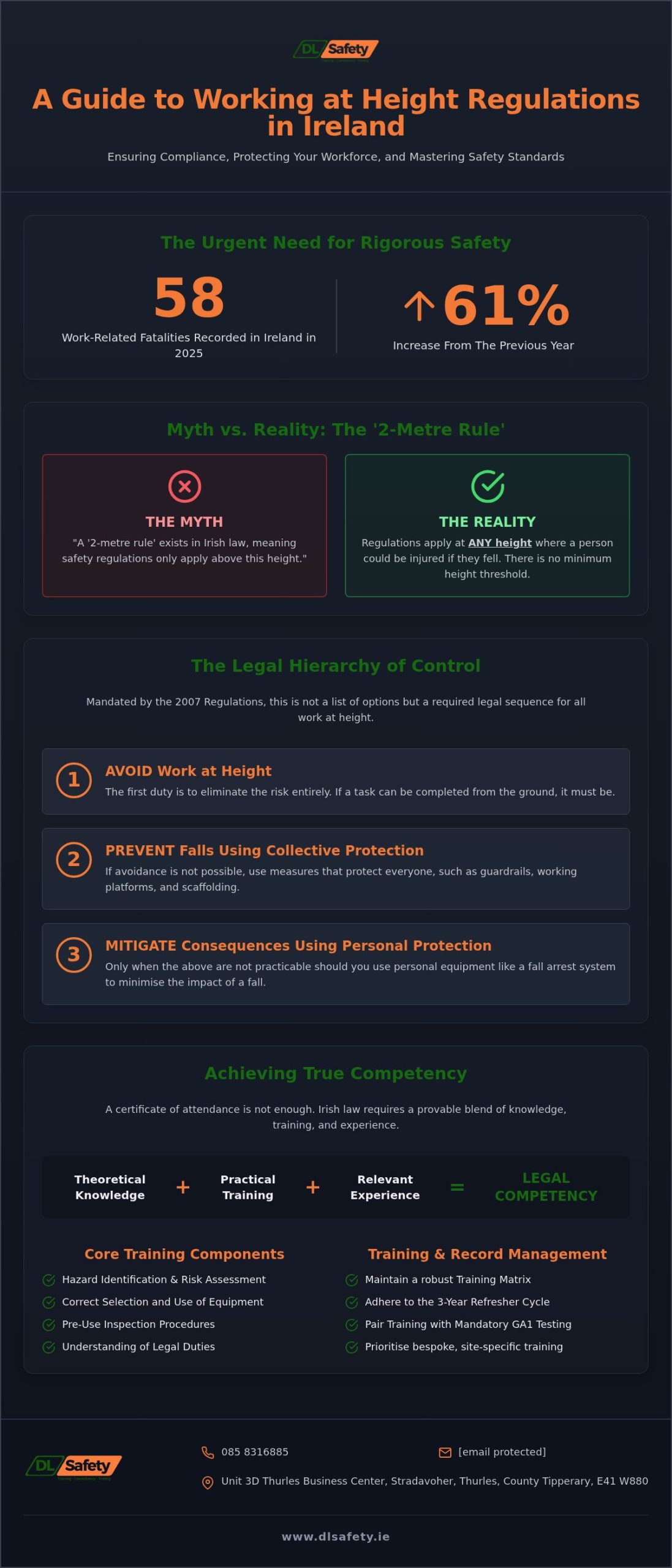
With 58 work-related fatalities recorded in Ireland in 2025, representing a 61% increase from the previous year, the pressure to maintain rigorous safety standards has never been higher. Many businesses still struggle with the dangerous myth of a ‘2-metre rule’ that doesn’t exist in Irish law, leading to confusion and potential liability. Understanding the specific working at height training requirements Ireland mandates is the only way to ensure your workforce stays protected and your business remains fully compliant with the 2007 Regulations.
It’s natural to feel concerned about tracking training expiry dates or facing an unexpected HSA inspection. We’re here to demystify these requirements and provide a clear roadmap for achieving workforce competency. This guide previews everything from the ‘competent person’ standard to the necessity of GA1 testing for your equipment. For tailored assistance, contact DL Safety at Unit 3D Thurles Business Center, Stradavoher, Thurles, County Tipperary, E41 W880, or reach out via info@dlsafety.ie and 085 8316885. You can also visit www.dlsafety.ie to learn how our monthly safety support packages can take the stress out of your compliance journey.
Key Takeaways
- Dispel the common ‘2-metre rule’ myth by understanding how the 2007 Regulations apply to any height where a fall could cause injury.
- Master the specific working at height training requirements Ireland demands to move beyond basic attendance and ensure your team achieves genuine competency.
- Learn why training must be paired with mandatory GA1 testing and thorough examinations of equipment to remain fully compliant with HSA standards.
- Establish a robust training matrix to manage certificate expiry dates and maintain the industry-standard three-year refresher cycle for your workforce.
- Explore how bespoke face-to-face and simulation training can be tailored to your specific site risks, offering far greater protection than generic online alternatives.
Navigating the Legal Framework: Working at Height Regulations in Ireland
Two pieces of legislation form the backbone of every employer’s duty to protect workers operating at elevation. The Safety, Health and Welfare at Work Act 2005 establishes the primary obligation: employers must, so far as is reasonably practicable, ensure the safety, health, and welfare of all employees. Sitting beneath that is the more granular instrument, the Safety, Health and Welfare at Work (General Application) Regulations 2007, Part 4, which translates that broad duty into specific, actionable rules for work at height. Together, they create a framework that is both principled and practical, and understanding both is the starting point for any business taking working at height training requirements Ireland seriously.
The legal gold standard within Part 4 is a clear hierarchy of control, which demands that employers approach every elevated task in sequence. First, avoid work at height entirely where it’s reasonably practicable to do so. If avoidance isn’t possible, prevent falls through collective protection measures such as guardrails and working platforms. Only when prevention alone is insufficient should you move to mitigation, using equipment like a personal fall arrest system to limit the consequences of a fall. This isn’t a menu of options; it’s a legal sequence, and skipping steps exposes employers to serious liability.
Employer vs. Employee Duties Under Irish Law
Employers carry the heavier burden. They must provide adequate information, instruction, and training before any worker operates at height, and that training must be appropriate to the specific task and equipment involved. Employees, in turn, are legally required to follow the safety systems put in place, use equipment correctly, and report any defects without delay. Critically, liability doesn’t stop with the business entity. Directors and site managers can face personal prosecution under the 2005 Act where a breach is attributable to their consent, connivance, or neglect.
Defining ‘Work at Height’ in 2026
For 2026 purposes, the HSA’s position remains consistent with the Regulations: work at height means any work in a place where a person could be injured if they fell from it, regardless of whether that place is above, at, or below ground level. This deliberately broad definition captures work near unprotected edges and openings, on fragile surfaces such as roof lights, and on equipment including ladders, scaffolding, and Mobile Elevating Work Platforms (MEWPs). There is no minimum height threshold. If a fall could cause injury, the Regulations apply, and the obligation to provide adequate working at height training requirements Ireland demands is fully in effect.
Defining Competency: What Must Working at Height Training Include?
Possessing a certificate of attendance is not the same as being legally competent. In the eyes of Irish enforcement bodies, competency is a blend of theoretical knowledge, practical training, and relevant experience. To meet the working at height training requirements Ireland enforces, a programme must do more than tick boxes; it has to equip workers with the ability to identify hazards in real time and react correctly to changing site conditions. A worker who understands the physics of a fall is far less likely to take risks than one who has simply watched a presentation.
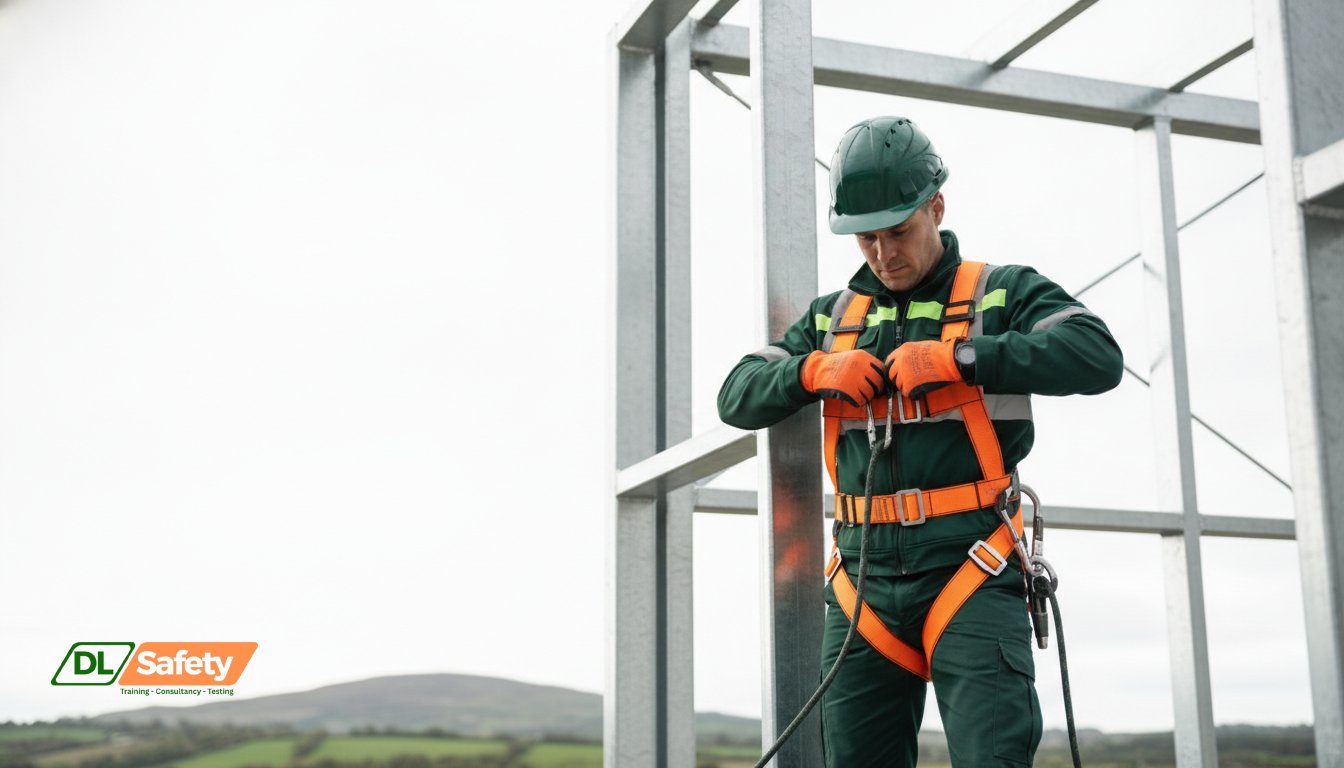
High-quality training must bridge the gap between classroom theory and on-site reality. Whilst online modules provide a helpful foundation for basic awareness, high-risk roles often demand a hands-on approach where participants can physically inspect equipment and practice secure attachment points. This practical demonstration is vital because it allows instructors to correct dangerous habits, such as improper harness fitting, before they lead to a workplace incident. According to the Work at Height Regulations, the goal is to ensure that every person involved in the planning, supervision, and execution of work at height is fully capable of performing their duties safely.
Core Components of a Compliant Training Programme
A robust syllabus begins with hazard identification and dynamic risk assessment. Workers shouldn’t just follow a static checklist; they must be trained to recognise new risks, such as deteriorating weather or shifting ground. The programme must also cover the proper selection and pre-use inspection of Personal Protective Equipment (PPE). This includes understanding the critical functional differences between fall arrest systems, which stop a fall in progress, and fall restraint systems, which prevent the worker from reaching a leading edge in the first place. Emergency procedures and rescue plans must also be included, as a fall is only half the crisis if the team isn’t trained to perform a timely recovery.
The Role of the Competent Person
The “competent person” is a central figure in Irish safety law, responsible for supervising work and ensuring that all equipment is fit for purpose. This individual must have the authority to halt work if they observe unsafe practices. Part of their role involves the Verification of Safety Training Certificates to ensure every operative’s credentials are valid, current, and issued by a recognised body such as QQI or RoSPA. If you need to verify your team’s compliance levels, our specialists at Unit 3D Thurles Business Center, Stradavoher, Thurles, County Tipperary, E41 W880, can help you audit your records. You can also reach out to us at info@dlsafety.ie or 085 8316885 to discuss how our bespoke training solutions can be tailored to your specific site hazards.
Beyond the Certificate: Integrating Equipment Inspection and GA1 Testing
Even the most comprehensive training is rendered ineffective if the equipment used is structurally compromised. True compliance with working at height training requirements Ireland mandates requires a dual approach: ensuring the operative knows how to use the gear and ensuring the gear itself is safe. Under the Safety, Health and Welfare at Work (Work at Height) Regulations 2006, employers are legally bound to provide equipment that is both suitable for the task and maintained in a safe condition. A certificate in a file does little to protect a worker if they are clipped into a frayed lanyard or operating a faulty scissor lift.
Training serves as the essential bridge to formal inspections through the medium of daily pre-use checks. A worker trained to Irish standards should be able to identify immediate red flags, such as hydraulic leaks in a lift or UV damage on harness webbing, before work begins. This daily vigilance ensures that the high standards established during a training course are maintained on the shop floor or construction site every single day.
Statutory Requirements for Lifting Equipment (GA1)
Lifting equipment used to provide access, such as MEWPs, scissor lifts, and cherry pickers, falls under strict statutory examination rules. In Ireland, any equipment used for lifting persons must undergo a thorough examination by a competent person every six months. This results in a Report of Thorough Examination, commonly known as a GA1 certificate. Failing to produce a valid GA1 during an HSA inspection can lead to immediate prohibition notices. For a deeper dive into these technical obligations, see our GA1 Testing Ireland: The 2026 Definitive Guide.
Inspecting Personal Fall Protection Systems
Personal fall protection systems, including harnesses, lanyards, and inertia reels, require a similar level of scrutiny. These items must be inspected regularly, and the results should be recorded using the GA3 form as per the Safety, Health and Welfare at Work Regulations. If equipment shows signs of significant wear, chemical staining, or has been involved in a fall, it must be discarded immediately without hesitation. There is a vital synergy between our Monthly Safety Support Packages and equipment compliance. We help businesses manage these records, ensuring that your equipment is as ready for work as your personnel. If you need assistance with your equipment register, contact our team at Unit 3D Thurles Business Center, Stradavoher, Thurles, County Tipperary, E41 W880, or email info@dlsafety.ie to keep your site fully compliant.
Organising Your Site: Refreshers, Record Keeping, and Risk Management
Managing the working at height training requirements Ireland enforces involves more than just booking a course; it’s about the ongoing rhythm of your site’s safety culture. Whilst the 2007 Regulations don’t specify a hard expiry date for training, a three-year refresher cycle is the recognised industry standard across Ireland. Relying on a five-year-old certificate is a gamble that rarely pays off during an audit or, worse, an accident investigation. You need a live training matrix that flags upcoming expiries months in advance, allowing you to organise renewals without disrupting site progress.
General height training is only one piece of the puzzle. You must also provide site-specific inductions that address the unique geography of your current project. A worker might be competent with a harness, but they still need to know where the specific leading edges are on your roof or how to navigate the particular fragile surfaces they’ll encounter today. This transition from general knowledge to site-specific application is where many businesses fall short.
Developing a Working at Height Risk Assessment
Your risk assessment must be a living document, not a forgotten file in the van. It needs to identify high-risk zones like fragile roofs, leading edges, and proximity to overhead power lines. Crucially, a rescue plan is a legal requirement under the 2007 Regulations, yet it’s often the most overlooked element. If a worker is suspended in a harness, you don’t have time to wait for emergency services; you need an immediate, on-site recovery method. Use our Working at Height Risk Assessment Checklist to ensure you haven’t missed these critical safety steps.
Record Keeping for HSA Inspections
Unannounced inspections are a reality of the industry. To survive one, your safety files must be organised, accessible, and current. In 2026, many Irish businesses are moving away from battered ring binders in favour of digital records. Digital systems allow for instant retrieval of training certs and GA1 reports, which is vital when an inspector is standing on-site. Maintaining clear records is a core part of the working at height training requirements Ireland site managers must follow to demonstrate due diligence. For more on this, read our guide on What to Expect During a HSA Inspection.
If you’re struggling to keep your safety files up to date, our Monthly Safety Support Packages provide a hands-off solution for total compliance. Based at Unit 3D Thurles Business Center, Stradavoher, Thurles, County Tipperary, E41 W880, our team is ready to help. Contact us at info@dlsafety.ie or call 085 8316885 to secure your site’s future.
Professional Safety Support: Bespoke Training and Consultancy Solutions
Generic, one-size-fits-all online courses often leave site managers with a false sense of security. Whilst they might satisfy a basic audit, they rarely prepare a team for the unique physical challenges of a specific Irish construction site or industrial facility. Meeting the working at height training requirements Ireland mandates is about more than just ticking a box; it’s about ensuring your staff can apply safety principles to the actual scaffolding, MEWPs, or roof structures they use every day. Face-to-face and simulation training provide the critical context that digital modules lack, allowing for real-time feedback and the immediate correction of dangerous habits.
Our approach focuses on demystifying complex regulations through practical, high-level instruction. By choosing a personable expert over a faceless training platform, you ensure that your workforce isn’t just “certified” but is genuinely competent and confident. This investment in quality training pays dividends through reduced incident rates and a more disciplined, professional site culture.
Bespoke Training for Construction and Industry
Customising course content is the most effective way to reflect the actual hazards found on your site. We don’t just teach general theory; we integrate specific site risks, such as fragile roof lights or complex leading edges, directly into the curriculum. For plant and machinery operators, simulation training offers a massive advantage by allowing them to practice high-risk manoeuvres in a controlled environment before performing them for real. We also believe in a continuous improvement loop, where findings from our accident investigation services are fed back into your training programmes to prevent repeat incidents. This proactive approach transforms safety from a reactive chore into a strategic business asset.
Partnering with DL Safety for Total Compliance
Maintaining a safe workplace is a full-time commitment that can easily overwhelm internal resources. Our Monthly Safety Support Packages are designed to act as your outsourced safety department, handling the headache of compliance management so you can focus on your core business. From GA1 testing of lifting equipment to the development of complex lift plans and traffic management designs, we provide the technical expertise needed to keep your operations running smoothly across Ireland. We specialise in construction and industrial sectors, offering national coverage from our registered office in County Tipperary.
If you’re ready to move beyond basic certification and build a robust safety culture, we’re here to help. You can reach out to our team at Unit 3D Thurles Business Center, Stradavoher, Thurles, County Tipperary, E41 W880, to discuss a tailored safety support proposal. For expert training and support, Contact DL Safety today by emailing info@dlsafety.ie or calling 085 8316885. Our commitment to integrity and high standards ensures that your business remains compliant and your workforce stays safe.
Elevating Your Site Safety Standards for 2026
Achieving total compliance with working at height training requirements Ireland mandates is a continuous journey rather than a one-time event. It requires a disciplined approach to both personnel competency and the statutory GA1 testing of your lifting equipment. By integrating bespoke training with rigorous site audits, you move beyond mere paperwork to create a genuine culture of safety that protects your workforce and your business reputation. This proactive strategy ensures that your site remains ready for any inspection whilst fostering a professional environment where safety is second nature.
Managing these moving parts doesn’t have to be a source of stress for your management team. Our specialists at Unit 3D Thurles Business Center, Stradavoher, Thurles, County Tipperary, E41 W880, are ready to provide the professional oversight you need. You can Secure your site with DL Safety’s Monthly Support Packages to ensure every harness is inspected and every certificate is current. Reach out to us at info@dlsafety.ie or 085 8316885 to start your journey towards hands-off compliance. With the right partner, you can focus on your core operations whilst we ensure your safety standards remain beyond reproach.
Frequently Asked Questions
Is working at height training mandatory for all employees in Ireland?
Training is mandatory for any employee whose role involves working at height where a fall could cause injury. Under the 2005 Act, employers must provide adequate instruction and training to ensure safety. This isn’t just for construction workers; it applies to anyone using ladders, platforms, or working near excavations. Failing to meet these working at height training requirements Ireland mandates leaves a business vulnerable to HSA enforcement and significant legal liability.
How often does working at height training need to be refreshed in 2026?
Whilst the 2007 Regulations don’t state a specific expiry date, the industry standard for refresher training is every three years. This cycle ensures that staff remain familiar with current safety standards and equipment developments. In high-risk environments or following a site incident, more frequent refreshers might be necessary to maintain competency. Keeping a live training matrix is the best way to track these dates and avoid gaps in your site’s compliance.
Does a ‘safe pass’ cover working at height training requirements?
No, a Safe Pass card does not fulfil the specific working at height training requirements Ireland demands for specialised tasks. Safe Pass provides general health and safety awareness for construction sites but doesn’t offer the technical depth required for operating at elevation. If your employees use harnesses, MEWPs, or scaffolding, they must receive dedicated training that covers the specific risks and equipment associated with those tasks to be legally compliant.
What is the legal definition of ‘height’ under the 2007 General Application Regulations?
There is no minimum height threshold under the 2007 Regulations. The legal definition covers any place where a person could fall a distance liable to cause personal injury. This includes working above ground level, at ground level near an opening, or even below ground level near an excavation. The old ‘2-metre rule’ is a myth; if the risk of injury from a fall exists, the work at height rules apply immediately.
Can working at height training be completed entirely online?
Online courses are excellent for theoretical awareness, but they often fall short for high-risk roles requiring practical equipment use. For tasks involving harnesses or complex machinery, face-to-face or simulation training is usually necessary to demonstrate genuine competency. A blended approach ensures that workers understand the law whilst also proving they can correctly inspect and use their safety gear under the supervision of a qualified instructor who can correct dangerous habits in person.
What happens if a HSA inspector finds untrained staff working at height?
If an inspector identifies untrained staff, they have the authority to issue an immediate Prohibition Notice, stopping all work on-site until the issue is rectified. This can lead to costly project delays, heavy fines, and potential prosecution of directors or managers under the 2005 Act. Beyond the financial impact, it significantly damages your business reputation and increases your insurance premiums due to the documented safety breach and lack of due diligence.
Do I need a separate rescue plan for every working at height task?
Yes, a rescue plan is a legal requirement for any work where a fall protection system is used. You can’t rely solely on the emergency services; you must have an on-site plan to recover a suspended worker quickly to prevent suspension trauma. This plan should be specific to the task and location, ensuring that the necessary rescue equipment and trained personnel are immediately available to perform a recovery if a fall occurs.
What is the difference between a competent person and a trained person?
A trained person has completed a course and holds a certificate, but a competent person possesses the necessary combination of training, knowledge, and experience to perform a task safely. Competency includes the ability to identify hazards and the authority to stop unsafe work. Whilst training is a prerequisite, it’s only one part of the competency puzzle. Employers must verify that staff can apply their training effectively in real-world site conditions and equipment configurations.