Could your current safety records withstand the scrutiny of a 2026 HSA inspection, or are you still relying on documentation designed for a previous era? Since the Safety, Health and Welfare at Work (Quarries) Regulations 2025 came into effect on January 1, 2026, the margin for error has effectively disappeared. We understand that managing a busy site whilst keeping up with complex geotechnical requirements and heavy machinery maintenance is a massive undertaking. It’s often the unannounced nature of inspections that causes the most stress for operators, making compliance feel like a moving target rather than a manageable process.
This guide provides a definitive quarry safety audit checklist Ireland managers can rely on to ensure every statutory box is ticked. At DL Safety, based in our Thurles centre, we’ve developed this framework to help you master the latest 2026 compliance standards. We’ll cover everything from electronic HSA notifications to the rigorous new demands for on-site vehicle brake testing and GA1 certification. By following this structured approach, you can reduce the risk of site accidents, protect your workers, and finally gain the peace of mind that comes from knowing your legal liabilities are fully managed.
Key Takeaways
- Understand the critical shifts in the Safety, Health and Welfare at Work (Quarries) Regulations 2025 and how they impact your 2026 compliance obligations.
- Utilise a comprehensive quarry safety audit checklist Ireland managers can apply to evaluate geotechnical stability and traffic management systems effectively.
- Distinguish between standard maintenance and statutory requirements like GA1 testing for excavators and specialised on-site vehicle brake testing for heavy plant.
- Learn how to organise your safety documentation and physical site inspections to create a defensible safety culture that stands up to HSA scrutiny.
- Discover the practical advantages of integrating monthly safety support packages to manage complex audit schedules and specialised training requirements.
The Regulatory Framework for Quarry Safety in Ireland
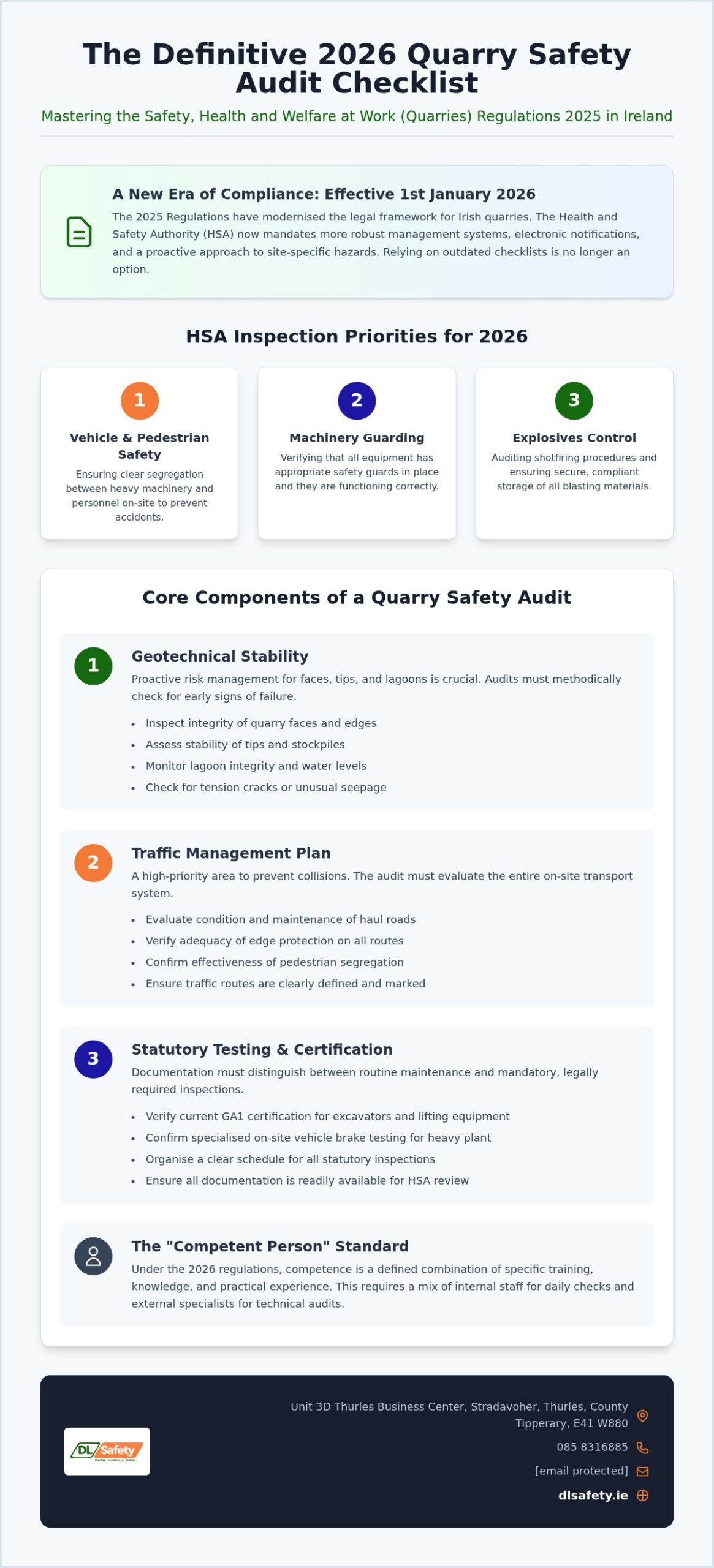
The legal landscape for Irish quarries changed significantly on January 1, 2026. Whilst the 2008 and 2013 regulations provided a solid foundation, the new Safety, Health and Welfare at Work (Quarries) Regulations 2025 have consolidated these into a modernised framework. This isn’t just a paperwork exercise; the Health and Safety Authority (HSA) now requires more robust management systems, including the ability to submit notifications electronically. If you’re still using a generic construction safety list, you’re likely missing site-specific hazards like face stability or lagoon integrity. A dedicated quarry safety audit checklist Ireland operators use must account for these high-risk environments where failure can be catastrophic.
Failing to maintain a formal inspection scheme carries heavy legal weight. Under the 2025 regulations, the operator must notify the HSA of their identity and even report temporary cessations of activity. Without a structured audit process, you risk more than just fines. You risk immediate closure orders and personal liability for directors. At DL Safety, we help clients navigate these hurdles from our base at Unit 3D Thurles Business Center, Stradavoher, Thurles, County Tipperary, E41 W880. You can reach our team at info@dlsafety.ie or call 085 8316885 if you’re concerned about your current level of readiness.
Defining the Competent Person in 2026
A “competent person” isn’t just someone who’s been on-site for a long time. In the 2026 regulatory environment, competence is defined by a combination of specific training, knowledge, and practical experience. Your supervisors might be perfectly capable of conducting daily walk-arounds, but technical audits often require external eyes. Internal auditors need to understand the nuances of the 2025 regulations, whilst external specialists are typically brought in for complex tasks like geotechnical assessments or statutory plant testing. Using a mix of both ensures that your internal team stays sharp and your compliance remains objective and thorough.
HSA Focus Areas for Quarry Inspections
What triggers a visit? It’s often a pattern of minor incidents or a failure to update the Safety Statement to reflect the 2026 standards. The HSA is currently prioritising vehicle-pedestrian segregation, machinery guarding, and explosives control. If you’re unsure where you stand, it’s helpful to review What to Expect During a HSA Inspection to see how inspectors approach these high-risk zones. Integrating these focus areas into your quarry safety audit checklist Ireland ensures you’re looking at your site through the same lens as an inspector, catching issues before they become formal non-conformances.
Core Components of a Quarry Safety Audit Checklist
Moving beyond the legal theory discussed in the previous section, a robust quarry safety audit checklist Ireland operators implement must focus on the physical realities of a working site. The Safety, Health and Welfare at Work (Quarries) Regulations 2025 place a heavy emphasis on proactive risk management. This means your audit needs to look closely at geotechnical stability, specifically the integrity of faces, tips, and lagoons. These areas are prone to shifting, particularly during the wet Irish winters, and require methodical observation to spot early signs of failure like tension cracks or unusual seepage.
Traffic management is another high-priority area. Your audit should evaluate the condition of haul roads, the adequacy of edge protection, and the effectiveness of pedestrian segregation. We often see sites where “near misses” occur because traffic routes aren’t clearly defined or maintained. Similarly, the audit must cover explosives and blasting protocols. This includes verifying that shotfiring procedures are followed to the letter and that storage facilities remain secure and compliant with the latest 2026 standards. If you feel overwhelmed by these technical requirements, our team at Unit 3D Thurles Business Center, Stradavoher, Thurles, County Tipperary, E41 W880 can help you organise your safety systems more effectively.
Face and Edge Protection Standards
Inspecting faces and edges is a daily necessity that becomes a formal audit point every month. You should specifically check for loose ground or “hanging” rock after periods of heavy rain or recent blasting operations. Haul roads require consistent bunding; the berm height must be sufficient to stop the largest vehicle on-site from overrunning the edge. We also look for the stability of stockpiles to prevent slope failures that could endanger staff or machinery working below.
Dust and Noise Control Measures
Occupational health is just as critical as physical site safety. Your quarry safety audit checklist Ireland should include a review of water suppression systems and the integrity of cab filtration in heavy plant to manage Respirable Crystalline Silica (RCS). Noise levels must be monitored regularly, with hearing protection zones clearly marked and signage maintained. Integrating respiratory protective equipment (RPE) fit testing into your audit schedule ensures that your team isn’t just wearing masks, but that the masks are actually providing the intended protection. For ongoing support with these health benchmarks, you can contact us at info@dlsafety.ie or call 085 8316885 to discuss our Monthly Safety Support Packages.
Statutory Testing: Integrating GA1 and Brake Testing
A common pitfall in safety management is confusing routine maintenance with statutory thorough examinations. Whilst your on-site mechanics might keep the fleet running smoothly, they cannot replace the legal requirement for independent technical testing. A comprehensive quarry safety audit checklist Ireland operators follow must distinguish between these two activities. Statutory testing is a rigorous, third-party verification that equipment meets specific safety standards, providing a level of assurance that daily checks simply cannot match. Failing to integrate these examinations into your audit schedule leaves a significant gap in your compliance framework and increases the risk of catastrophic machinery failure.
Managing the documentation for these tests is just as critical as the physical inspections themselves. During an HSA visit, an inspector will immediately ask for your GA1 certificates and brake test reports. If these are missing or out of date, it’s considered a major non-conformance. At DL Safety, we help clients organise these records through our base at Unit 3D Thurles Business Center, Stradavoher, Thurles, County Tipperary, E41 W880. You can reach our technical team at info@dlsafety.ie or call 085 8316885 to ensure your statutory testing programme is up to date.
GA1 Certification for Quarry Plant
GA1 testing is the “gold standard” for lifting equipment and is a mandatory component of any quarry safety audit checklist Ireland. This certification isn’t just for cranes; it applies to a wide range of common quarry machinery. Equipment requiring a GA1 Certificate of Thorough Examination includes:
- Excavators used for lifting operations.
- Telehandlers and forklifts.
- Lifting tackle, such as chains, slings, and shackles.
- Man-baskets and work platforms.
These examinations must be carried out every 6 or 12 months, depending on the equipment type and its use. For a deeper dive into these requirements, see our GA1 Testing Ireland: The 2026 Definitive Guide. Following LEEA standards ensures that your lifting equipment is inspected by a competent professional who understands the specific stresses of a quarry environment.
Quarry Vehicle Brake Testing Requirements
Standard road-worthiness tests are insufficient for the heavy plant used in Irish quarries. Loading shovels and dump trucks operate on steep gradients and uneven terrain, placing extreme demand on braking systems. The 2025 regulations mandate a formal inspection scheme for the brakes of all rubber-tyred vehicles. This requires specialised on-site decelerometer testing to measure actual stopping distances and efficiency. Relying on “pedal feel” or internal workshop checks isn’t enough to satisfy an inspector. Our Quarry Vehicle Brake Testing Ireland: 2026 Compliance Guide explains why these on-site tests are the only way to prove your fleet is safe for the unique challenges of the quarry floor.
Conducting the Audit and Organising Remedial Actions
Recording a finding on your quarry safety audit checklist Ireland is only the beginning of the process. The true value of any safety inspection lies in how you manage the data once you step off the quarry floor. Effective auditing starts with thorough preparation. Before beginning your walkthrough, gather previous inspection reports, current risk assessments, and maintenance logs to identify recurring patterns or areas that have been flagged for monitoring. This historical context ensures your physical walkthrough is targeted and efficient, rather than a generic exercise in box-ticking.
When conducting the physical inspection across large sites, use structured observation techniques. Don’t just look at the machinery; observe the behaviour of operators and the flow of traffic at peak times. Once the audit is complete, findings must be categorised by risk level. High-risk items require immediate intervention, whilst medium and low-risk findings can be scheduled for remedial work within a defined timeframe. To ensure these actions aren’t forgotten, assign a specific person responsible for the fix and set a firm deadline for close-out. If you need assistance in structuring these workflows, you can book a Health & Safety Site Audit with our expert team today.
Developing a Robust Inspection Scheme
A defensible safety culture relies on the “Plan, Do, Check, Act” cycle. Your inspection scheme should be a tiered system that includes daily operator checks, weekly supervisor walk-arounds, and comprehensive monthly audits. One area where many operators fail is the documentation of “Nil Findings”. If you inspect a quarry face and find no tension cracks, you must record that the inspection took place and no issues were found. This provides vital legal protection by proving that you are proactive and methodical, rather than only recording information when something goes wrong.
Managing Non-Conformance
Knowing when to stop production is a critical decision for any quarry manager. If a high-risk non-conformance is identified, such as a failure in edge protection or a critical fault in a braking system, work in that area must cease until the danger is removed. Tracking these remedial works to completion is essential; an open finding on an audit is a significant liability during an HSA visit. We recommend using toolbox talks to communicate audit findings back to the crew. This ensures the entire team understands the “why” behind safety changes and encourages a proactive approach to hazard spotting across the site. For professional guidance on managing these complex safety cycles, contact DL Safety at info@dlsafety.ie or call 085 8316885. Our office is located at Unit 3D Thurles Business Center, Stradavoher, Thurles, County Tipperary, E41 W880.
Professional Support: Monthly Safety Packages for Quarries
Managing a quarry in the current regulatory climate is a high-stakes balancing act. Between meeting production targets and navigating the technicalities of the 2025 and 2026 regulations, the administrative burden on managers can feel overwhelming. This is exactly where outsourcing safety oversight to a dedicated consultant becomes a strategic advantage. By choosing a partner who understands the specific nuances of the Irish quarrying industry, you’re not just hiring a service; you’re gaining a professional extension of your management team. This collaborative approach ensures that your quarry safety audit checklist Ireland requirements are met with precision and consistency, rather than being a source of constant stress.
At DL Safety, we’ve designed our Monthly Safety Support Packages to streamline compliance. We integrate regular audits, statutory testing, and bespoke training into a single, manageable framework. This holistic method removes the friction of scheduling different contractors for GA1 testing or vehicle brake inspections. Instead, you have a single point of contact who understands your site’s history and long-term safety goals. We operate nationally from our base at Unit 3D Thurles Business Center, Stradavoher, Thurles, County Tipperary, E41 W880, bringing high-level expertise directly to your quarry floor.
Why Choose a Monthly Support Package?
Consistency is the backbone of any defensible safety culture. Monthly support ensures that your safety standards remain high throughout the year, preventing the “compliance dip” that often occurs between major inspections. Having a personable expert on call is invaluable during accident investigations or unannounced HSA visits, providing you with immediate, expert guidance when you need it most. It’s also a highly cost-effective solution. You get the benefit of a senior safety advisor’s expertise without the significant overheads associated with a full-time senior hire, allowing you to allocate resources more efficiently elsewhere in the business.
Getting Started with DL Safety
Our process begins with a preliminary site safety audit to establish a clear baseline of your current operations. From this starting point, we develop personalised safety statements and method statements that reflect the actual risks on your site. We don’t believe in “off-the-shelf” documentation; every quarry has unique faces, traffic flows, and plant requirements that must be addressed specifically. To take the first step towards a more secure and compliant site, contact David and the team at info@dlsafety.ie or call 085 8316885. You can also learn more about our specialised services at www.dlsafety.ie. Let us help you turn compliance from a burden into a pillar of your operational success.
Securing Your Quarry’s Future in 2026
Achieving total compliance in the current regulatory environment requires a shift from reactive fixes to a proactive, structured methodology. By implementing a rigorous quarry safety audit checklist Ireland managers can effectively bridge the gap between daily site observations and mandatory technical examinations. This systematic approach doesn’t just satisfy HSA inspectors; it builds a genuine culture of safety that protects your team and your plant from avoidable risks.
At DL Safety, we’re committed to simplifying this journey for you. From our base at Unit 3D Thurles Business Center, Stradavoher, Thurles, County Tipperary, E41 W880, we provide national support through our specialised Monthly Safety Packages. Our team of GA1 certified inspectors and on-site brake testing specialists ensures that every technical requirement is met with professional precision. You don’t have to manage the complexities of 2026 compliance alone.
Contact DL Safety for a Comprehensive Quarry Safety Audit to start your transition today. We’re here to turn your safety obligations into a manageable, transparent process that gives you back your peace of mind.
Frequently Asked Questions
How often should a quarry safety audit be conducted in Ireland?
A comprehensive quarry safety audit checklist Ireland operators use should be reviewed at least quarterly, though many high-output sites opt for monthly professional audits. Whilst the Safety, Health and Welfare at Work (Quarries) Regulations 2025 mandate daily inspections of faces and plant, a full safety audit is a deeper dive into your management systems. Regular scheduling ensures that your safety statement and risk assessments remain live documents rather than static paperwork that fails to reflect site changes.
What is the difference between a daily inspection and a safety audit?
Daily inspections are operational checks focused on immediate hazards, such as checking quarry faces for tension cracks or performing pre-shift vehicle walk-arounds. In contrast, a safety audit is a systemic evaluation of your entire health and safety framework. It examines whether your daily records are being kept correctly, verifies the validity of statutory testing like GA1 certificates, and ensures that your long-term safety objectives are being met to satisfy HSA requirements.
Who is legally responsible for safety in an Irish quarry?
The primary legal responsibility for safety lies with the quarry operator, who must be formally notified to the Health and Safety Authority (HSA). Under the 2025 regulations, the operator is responsible for appointing competent persons to oversee specific duties, including explosives control and geotechnical management. Whilst duties can be delegated to supervisors or external consultants like DL Safety, the ultimate accountability for site-wide compliance and worker safety remains with the designated operator at all times.
Do I need a geotechnical assessment for my quarry stockpiles?
Yes, stockpiles are classified as “tips” and require regular inspection to ensure slope stability and prevent failure. The 2025 regulations place a strong emphasis on the management of all excavated materials. Your audit should verify that stockpiles are maintained at safe heights and gradients, particularly after heavy rainfall. If a stockpile poses a significant risk to workers or machinery, a formal geotechnical assessment by a competent professional is essential to mitigate the danger effectively.
What equipment in a quarry requires a GA1 certificate?
Any equipment used for lifting operations requires a GA1 Certificate of Thorough Examination. In a quarry environment, this includes excavators used for lifting, telehandlers, and forklifts, alongside all lifting accessories like chains, slings, and shackles. These certificates must be renewed every 6 or 12 months. Keeping these records updated is a core component of a professional quarry safety audit checklist Ireland managers use to avoid non-compliance during unannounced inspections by the authorities.
How is quarry vehicle brake testing performed on-site?
On-site brake testing is performed using a calibrated decelerometer to measure the actual braking efficiency of rubber-tyred vehicles like loading shovels and dump trucks. This test is conducted on the quarry floor to reflect real-world operating conditions, such as gradients and surface types. Unlike standard road-worthiness checks, this specialised testing provides concrete data on stopping distances, ensuring your heavy plant can operate safely in the high-demand environment of an active Irish quarry site.
What should I do if an HSA inspector finds a fault during an audit?
If an HSA inspector identifies a fault, you should immediately acknowledge the finding and take corrective action based on the risk level. For high-risk issues, such as faulty machinery guarding or unstable faces, you must stop work in that area until the hazard is removed. It’s vital to document the remedial steps taken and communicate these changes to your team. Proactive communication and a clear timeline for close-out can often prevent more severe enforcement actions.
Can I use a digital checklist for quarry safety inspections?
You can certainly use digital checklists, and the 2025 regulations specifically support the electronic submission of notifications and record-keeping. Digital systems can improve the accuracy of your safety data by allowing for real-time reporting and photo evidence of site conditions. However, you must ensure that these digital records are easily accessible for review by an inspector and that they are backed up securely to maintain your statutory documentation trail for legal protection.