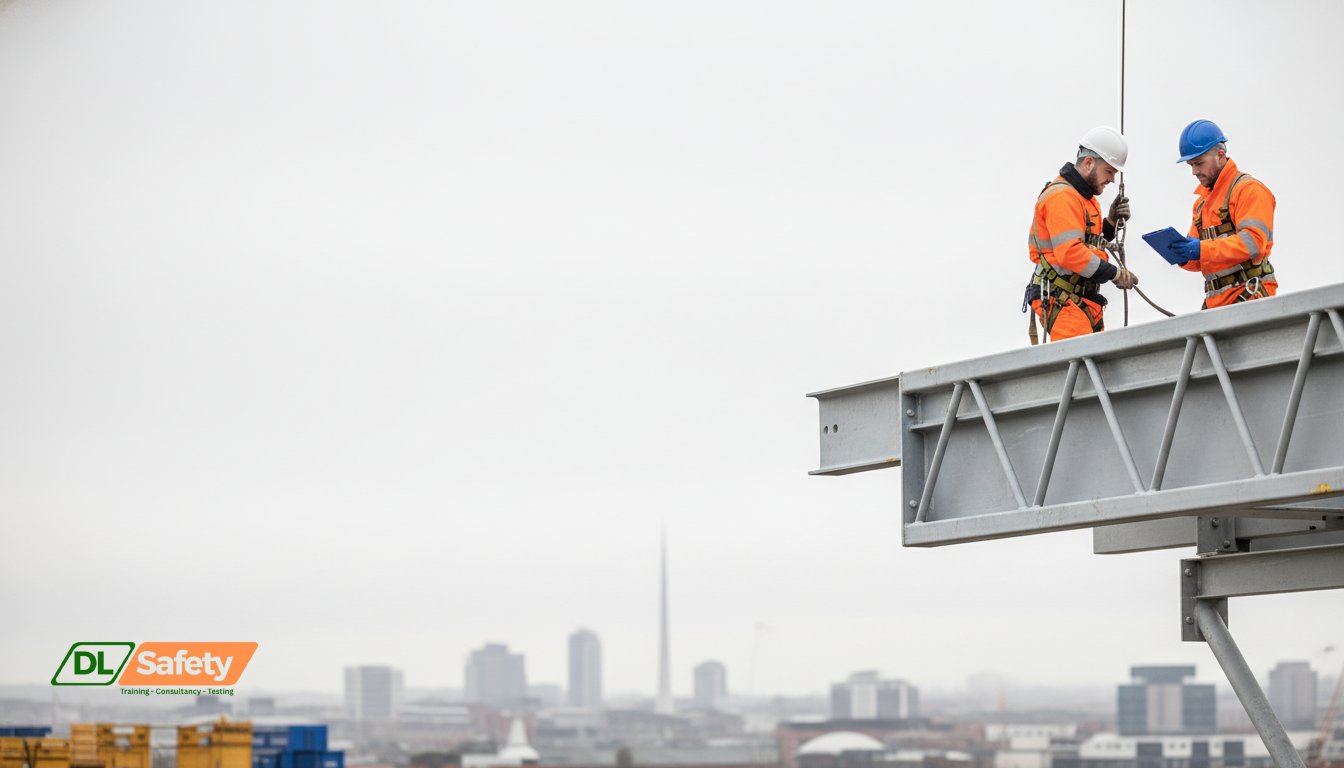
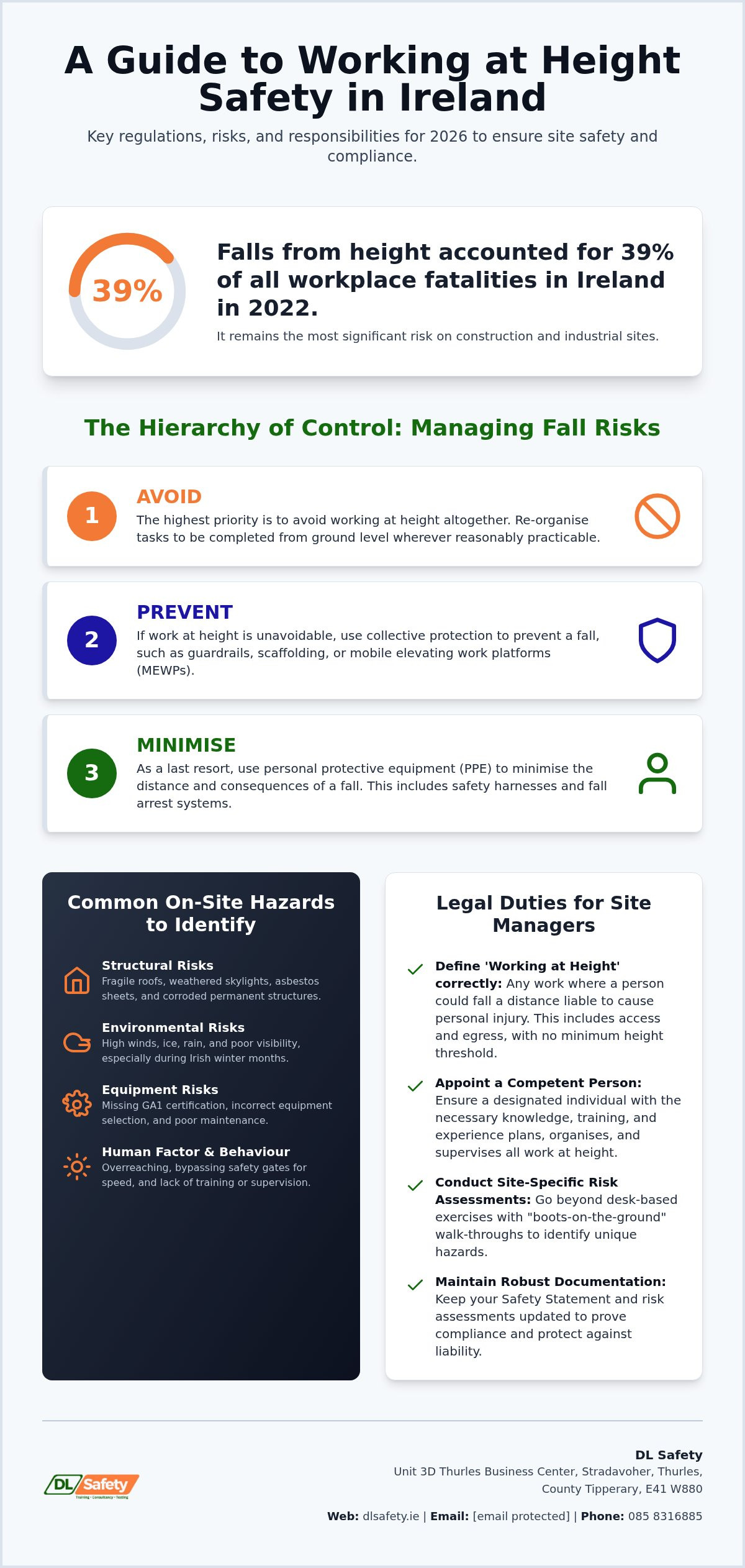
Did you know that falls from height accounted for 39% of all workplace fatalities in Ireland in 2022? It remains the most significant risk on our sites, and the pressure to master the working at height training requirements Ireland mandates has never been higher. You’re likely all too familiar with the stress of managing multiple subcontractors or the constant worry that a single piece of lifting equipment might be missing its GA1 certification during a surprise HSA inspection. It’s a complex balancing act that requires constant vigilance to ensure everyone returns home safely at the end of every shift.
Our 2026 guide is here to provide a clear, actionable roadmap covering everything from site-specific risk assessments to the technical nuances of equipment maintenance. By the end of this article, you’ll have a practical checklist to streamline your daily operations and the absolute certainty that you’re meeting every legal standard. For bespoke support, contact DL Safety at www.dlsafety.ie, email info@dlsafety.ie, or call 085 8316885.
Key Takeaways
- Understand the legal definition of working at height and why safe access and egress are critical components of your site safety strategy.
- Master the “Avoid, Prevent, Minimise” framework to prioritise collective protection over individual gear, ensuring a higher standard of safety.
- Use our actionable checklist to verify that your team meets all working at height training requirements Ireland mandates whilst confirming valid GA1 certification for all lifting equipment.
- Learn how to conduct thorough site-specific hazard walk-throughs that account for both physical risks and worker behaviour.
- Discover how professional support packages can remove the administrative burden of compliance, allowing you to focus on your core operations with absolute certainty.
Understanding Working at Height Regulations in 2026
The foundation of site safety in Ireland rests upon the Safety, Health and Welfare at Work (General Application) Regulations 2007. Under Part 4 of these regulations, working at height is defined as any work activity where a person could fall a distance liable to cause personal injury. This isn’t just about the task itself; it includes the time spent getting to and from the work position whilst on site. Access and egress are often overlooked, yet they represent a significant portion of height-related accidents. By aligning your site protocols with broader Occupational safety and health principles, you create a culture where safety is proactive rather than reactive.
Meeting the working at height training requirements Ireland mandates starts with the appointment of a competent person. This individual must possess the knowledge, training, and experience to plan and organise work effectively. It’s their job to ensure that every task is properly supervised and that the right equipment is selected for the specific environment. A competent person doesn’t just check boxes; they look at the big picture to identify risks before they become incidents.
What Constitutes Working at Height?
A common misconception amongst trades is that “height” only refers to multi-storey scaffolding or high-reach platforms. In reality, Irish regulations no longer apply a minimum height threshold. If there is a risk of a fall that could cause injury, the regulations apply. This includes working on trestles, flat roofs, or even near open excavations where a fall into a trench could be just as damaging as a fall from a ladder. Many site managers fail to realise that even ground-level work with fall potential requires a formal risk assessment. Whether your team is using a hop-up or a complex scaffolding system, the duty of care remains identical.
Legal Responsibilities for Irish Site Managers
Under the 2005 Act, employers and contractors hold a strict legal duty to protect their workforce. This means work must be planned in advance to avoid risks wherever possible. If you are facing a HSA inspection, the inspector will look for evidence of this planning through your Safety Statement and site-specific risk assessments. Non-compliance can lead to heavy fines or work stop orders, but the personal stakes are higher. Robust documentation doesn’t just satisfy the law; it protects directors from personal liability by proving that every reasonable step was taken to prevent an accident. Understanding the working at height training requirements Ireland expects is the first step in building that legal shield and ensuring your team stays safe.
Identifying Hazards: The Core of Your Risk Assessment
A thorough risk assessment isn’t a desk-based exercise; it requires a boots-on-the-ground approach to identify specific threats within the unique environment of an Irish construction site or industrial facility. For 2026, a site-specific hazard identification walk-through is the gold standard. This involves more than just spotting obvious gaps. You must evaluate the interplay between physical structures and the human factor. Worker behaviour, such as the temptation to overreach or bypass safety gates for speed, often accounts for incidents even when physical barriers are present. By integrating health and safety compliance into your daily hazard spotting, you move beyond mere box-ticking and into proactive protection.
Distinguishing between immediate hazards, like an oily spill on a gantry, and long-term structural risks, such as corrosion on a permanent fire escape, is vital. Both require different management strategies but equal attention. To ensure your team is fully equipped to spot these nuances, meeting the working at height training requirements Ireland mandates is essential. If you’re unsure where to start, our team can help you organise a professional site audit by calling 085 8316885 to pinpoint hidden vulnerabilities and ensure your documentation is airtight.
Environmental and Structural Risks
Fragile roofing materials remain the single biggest cause of fatal falls in Ireland. Whether it’s weathered skylights or asbestos cement sheets, these surfaces can fail without warning. Beyond the structure itself, the Irish climate presents its own set of challenges. High wind speeds can make MEWP operation dangerous, whilst ice and poor visibility during winter months increase the risk of slips. You must also account for those working below, as unprotected edges aren’t just a risk to the person at height; they are a hazard for anyone in the drop zone of falling tools or materials.
Equipment and Mechanical Failures
Mechanical integrity is the backbone of safe work at height. Faulty work platforms, malfunctioning MEWPs, or poorly erected scaffolding can lead to catastrophic failures. This is where GA1 testing becomes indispensable. It identifies hidden defects in lifting gear and work platforms that a visual check might miss. Whilst complex machinery often gets the most attention, don’t overlook the simple tools. Improper use of ladders or using kick stools on uneven ground are common triggers for non-fatal but life-altering injuries. Always refer to the Irish Working at Height Regulations to ensure your equipment and training standards are up to date for 2026.
The Hierarchy of Control: Managing Fall Risks
Safety at height is governed by a strict logic known as the hierarchy of control. This isn’t just a best-practice suggestion; it is a legal obligation detailed in the Work at Height Regulations 2006. The framework follows a simple “Avoid, Prevent, Minimise” sequence. Every site manager must justify their choice of equipment in a written risk assessment. If you choose a ladder over a mobile elevated work platform (MEWP), you need a robust reason why a safer alternative wasn’t feasible. This structured approach ensures that the most effective safety measures are considered first, rather than relying on the easiest or cheapest option available.
Collective protection must always take priority over personal protection. Measures like guard rails, scaffolding, or permanent barriers protect everyone in the vicinity without requiring individual workers to take specific action. In contrast, personal protection like harnesses only protects the individual wearer and relies heavily on correct usage and equipment integrity. Meeting the working at height training requirements Ireland expects is about ensuring your team understands this distinction. A trained operator knows that a harness is the last line of defence, not the first, and that technical safety is only as strong as the competency of the person using the gear.
Training plays a vital role in ensuring this hierarchy is followed on-site. It empowers workers to speak up if a task can be done more safely from the ground or if a collective barrier is missing. This is where technical testing and training converge. For example, using a MEWP is an excellent prevention strategy, but it’s only effective if the machine has a valid GA1 certificate and the operator is fully trained to use it. Without this synergy, the hierarchy of control is merely a theoretical exercise rather than a practical safety tool.
Avoidance and Prevention Strategies
The most effective way to manage a fall risk is to avoid it entirely. Can the work be done from the ground? Using extendable water-fed poles for cleaning or long-reach cameras for inspections can eliminate the need for someone to leave the ground. When work at height is unavoidable, prevention becomes the priority. This involves using physical barriers such as toe boards and guard rails to stop a fall from happening in the first place. Organising your site layout to reduce the need for height work, such as pre-assembling components on the ground, significantly lowers the overall risk profile of the project.
Minimising Consequences: Fall Arrest Systems
When avoidance and prevention aren’t possible, you must focus on minimising the distance and consequences of a potential fall. Collective measures like safety nets or airbags provide a soft landing for anyone who falls. Personal fall protection, such as harnesses and lanyards, should be the final resort. These systems require rigorous oversight; all personal protective equipment (PPE) must be fit for purpose and inspected daily by the user. It’s also vital to remember that fall arrest gear requires a documented rescue plan. Simply stopping the fall isn’t enough; you must ensure the worker can be brought to safety quickly to avoid further injury.
The Working at Height Risk Assessment Checklist
A checklist transforms legal theory into a practical shield for your workforce. It ensures that no detail is overlooked before the first person leaves the ground. To master the working at height training requirements Ireland enforces, your documentation must reflect a methodical approach to safety. This five step process provides the absolute certainty you need to protect your team and satisfy any HSA inspector who arrives on site.
- Step 1: Competency Check. Verify that every operator has valid, up to date training certificates. Do not take verbal assurances at face value; check the expiry dates and ensure the training matches the specific equipment they are using.
- Step 2: Equipment Inspection. Confirm there is a valid GA1 certificate for all lifting gear and work platforms. This technical verification is a non negotiable legal requirement in Ireland.
- Step 3: Site Assessment. Identify fragile surfaces, such as skylights or old roofing sheets, and locate any overhead power lines. These environmental hazards require specific exclusion zones.
- Step 4: Collective Protection. Ensure all guard rails, toe boards, and working platforms are secure and correctly installed. Scaffolding must be tagged to show it is safe for use.
- Step 5: Emergency Planning. Confirm a site specific rescue plan is in place. Every worker involved must know exactly what to do if someone becomes suspended in a harness.
Pre-Operational Safety Checks
Daily checks are the heartbeat of a safe site. Scaffolding must be inspected every seven days or after any event likely to affect its stability, such as a period of high winds. When using MEWPs or outriggers, you must verify that ground conditions are stable and capable of supporting the point loads. Poorly compacted soil or hidden voids can lead to a machine overturning. Similarly, overhead power lines require a minimum clearance distance; never assume a line is dead or safe to work near without formal confirmation from the utility provider.
Emergency and Rescue Planning
Relying on a “call 999” policy is not a sufficient rescue plan for work at height. Suspension trauma can set in within minutes, meaning you cannot wait for emergency services to arrive. You must have the necessary equipment on site for an immediate assisted rescue or self rescue. This might include a dedicated rescue kit, a spare MEWP, or specialized ladders. Crucially, this plan is useless if it stays in a folder in the site office. You must communicate the rescue procedure to every worker during the morning toolbox talk to ensure a fast, coordinated response.
If you want to ensure your site meets every standard and your team is fully protected, book a professional health and safety site audit with DL Safety today. We can review your checklists and rescue plans to ensure they are fully compliant with 2026 standards.
Beyond the Checklist: Professional Support with DL Safety
Managing a busy site involves juggling countless moving parts, and the administrative weight of safety can often feel overwhelming for even the most experienced managers. Whilst the checklists provided in this guide offer a solid foundation, achieving absolute certainty in your operations requires a more integrated, professional approach. At DL Safety, we act as your trusted advisor, bridging the gap between basic compliance and operational excellence. By meeting the working at height training requirements Ireland mandates through our bespoke programmes, you ensure your workforce isn’t just certified, but truly competent in real world scenarios.
Our expertise extends beyond the classroom into the technical heart of your operations. Expert technical testing, specifically GA1 certification, is essential for identifying the hidden defects in lifting gear and work platforms that a standard visual check might miss. We don’t just point out problems; we provide the practical, solution oriented advice needed to keep your project moving safely. From drafting bespoke safety statements that actually reflect your site’s reality to conducting deep dive audits, we take the headache out of regulation. This allows you to lead with confidence, knowing that every piece of equipment and every worker is backed by professional standards.
Monthly Safety Support for Construction
For many businesses in the Irish construction and industrial sectors, the most effective way to manage risk is through our Monthly Safety Support Packages. These packages provide ongoing oversight, ensuring your risk assessments and safety documentation are always current and reflective of the latest 2026 standards. We offer expert guidance on complex lift plans and traffic management design, ensuring that even the most challenging site layouts are managed with precision. This proactive approach significantly reduces the stress of surprise HSA inspections, as your professional documentation is always organised and ready for review.
Get in Touch with DL Safety
If you are ready to simplify your compliance journey and protect your workforce with expert support, we invite you to start a dialogue with our team. Our office is located at Unit 3D Thurles Business Center, Stradavoher, Thurles, County Tipperary, E41 W880. To discuss your specific training or testing needs, you can call 085 8316885 or email info@dlsafety.ie. We also encourage you to visit www.dlsafety.ie to explore our full range of safety support packages and discover how we can help your business thrive whilst staying safe.
Future-Proofing Your Site Safety for 2026
Achieving total compliance doesn’t have to be a solo effort. By integrating certified training with rigorous GA1 technical testing and site-specific risk assessments, you build a safety culture that protects both your people and your business reputation. Mastering the working at height training requirements Ireland mandates is a continuous process, but one that yields significant peace of mind when handled with expert oversight. Our team in Thurles is ready to help you navigate these complexities with clarity and integrity.
Whether you need a one-off audit or ongoing guidance, we provide the practical tools to remove the burden of safety administration. You can secure your site with a DL Safety Monthly Support Package today by visiting our website. For direct assistance, reach us at Unit 3D Thurles Business Center, Stradavoher, Thurles, County Tipperary, E41 W880, or contact David and the team at info@dlsafety.ie or 085 8316885. Let’s work together to ensure your site is a model of safety and efficiency for 2026 and beyond.
Frequently Asked Questions
Is a risk assessment legally required for all work at height?
Yes, a written risk assessment is a strict legal requirement for all work at height in Ireland. There is no longer a minimum height threshold; if a fall could result in an injury, the task must be formally assessed. This document should detail the hazards identified and the specific control measures implemented to protect workers. Failing to provide a site-specific assessment can lead to significant fines or work stoppages during a surprise inspection.
How often should a working at height risk assessment be reviewed?
You should review your risk assessment whenever there is a significant change to the work environment, personnel, or equipment. It’s also vital to update the document if you suspect it is no longer valid, such as after an incident or a “near miss”. For long-term projects, regular intervals are recommended to ensure all controls remain effective. Scaffolding specifically requires a re-inspection every seven days or following extreme weather events like high winds.
What is the difference between collective and personal fall protection?
Collective protection measures, such as guard rails or scaffolding, protect everyone in the work area without requiring individual action. Personal fall protection, like harnesses and lanyards, only protects the wearer and relies on correct usage. Under Irish law, you must always prioritise collective measures over personal ones. This is a core part of the working at height training requirements Ireland expects site managers to understand and implement on every project.
Do I need a separate rescue plan for working at height?
Yes, a dedicated rescue plan is essential for any task involving fall arrest equipment. Relying on emergency services is insufficient because suspension trauma can become life-threatening in just a few minutes. Your plan must include the specific equipment needed for a rescue and identify the trained staff members who will carry it out. This procedure should be clearly communicated to the entire team during their initial site induction and subsequent toolbox talks.
Can I use a ladder for work at height in 2026?
Ladders are still permitted, but their use is restricted to low-risk tasks of short duration. You must be able to demonstrate that using more stable equipment, such as a mobile tower or a MEWP, is not justified due to the nature of the work or site constraints. If you choose to use a ladder, it must be fit for purpose, inspected regularly, and used by a competent person who has received appropriate training.
Who is considered a “competent person” for height safety?
A competent person is someone who possesses sufficient training, knowledge, and experience to perform a specific safety role. In the context of height safety, this individual must be able to identify existing and predictable hazards and have the authority to take prompt corrective measures. Ensuring your supervisors meet the working at height training requirements Ireland mandates is the most effective way to verify competency and maintain high safety standards across your site.
What equipment requires a GA1 certificate for working at height?
Any machinery used for lifting persons or loads, such as MEWPs, scissor lifts, and hoists, requires a valid GA1 certificate. This also applies to lifting accessories like slings, chains, and shackles. These certificates prove that the equipment has undergone a thorough technical examination by a competent person. Keeping these records up to date is a critical part of your legal duty and is one of the first things an inspector will check.
What should I do if I identify a fragile roof during an assessment?
If you identify a fragile roof, you must treat it as a high-risk area and prevent anyone from walking directly on the surface. Use collective protection such as stagings, crawling boards, or safety nets to manage the risk. You should also install prominent warning signage at all access points to the roof. Since fragile surfaces are the leading cause of fatal falls in Ireland, these precautions are vital for protecting your workforce from catastrophic injury.