If an alarm sounds, will everyone know where to go, who needs assistance and who is responsible for checking that people are safe? A workplace emergency plan Ireland employers can use needs to answer these questions clearly, not sit unread in a folder. Irish law requires employers to prepare and revise adequate emergency plans and procedures, but the practical challenge is making them fit the hazards, layout and people at your workplace.
It’s understandable to be unsure what an adequate plan should cover, or whether staff will know their roles when an incident happens. This guide explains how to build site-relevant procedures, assign responsibilities and set out clear communication steps. You’ll also learn how to brief staff, practise the plan and review it as your workplace changes.
DL Safety supports wider workplace safety management through Monthly Safety Support Packages, site audits and training, helping businesses strengthen awareness and practical readiness. To learn more, visit www.dlsafety.ie, email info@dlsafety.ie or call 085 8316885. DL Safety is based at Unit 3D Thurles Business Center, Stradavoher, Thurles, County Tipperary, E41 W880.
Key Takeaways
- See how a workplace emergency plan in Ireland differs from a general safety policy and fits into wider workplace safety management.
- Identify the practical details that help staff act, including named roles, reporting routes and access to current plan information.
- Compare how immediate priorities can change between incidents such as fire, medical emergencies, severe weather and loss of essential services.
- Follow a practical process to develop, communicate, rehearse and review procedures as workplace needs change.
- Learn how ongoing support, site audits and training can help keep emergency planning active and relevant.
What is a workplace emergency plan in Ireland, and why does it matter?
A workplace emergency plan is a practical set of instructions for what people should do if an incident threatens health or safety. A general safety policy sets out an organisation’s broad approach to managing safety; an emergency plan turns that approach into actions, responsibilities and procedures for specific situations. It should make clear how an incident is reported, what immediate steps people should take and how they can get to safety.
For a workplace emergency plan Ireland businesses can use, the details need to reflect the actual site. A procedure for a small office may not work for a construction site, warehouse or industrial facility, where hazards, access routes and ways of raising the alarm can differ. Clear instructions help reduce hesitation and conflicting assumptions, particularly when people are under pressure. The aim isn’t to predict every possible event, but to give people a usable way to respond to the risks and circumstances identified at their workplace.
Planning also connects preparation with action and what follows an incident. Emergency management principles provide a broad overview of these connected stages. In a workplace, this means thinking beyond the written procedure: people need to know where to find current instructions and how the plan relates to their work and site.
What does Irish workplace guidance say about emergency planning?
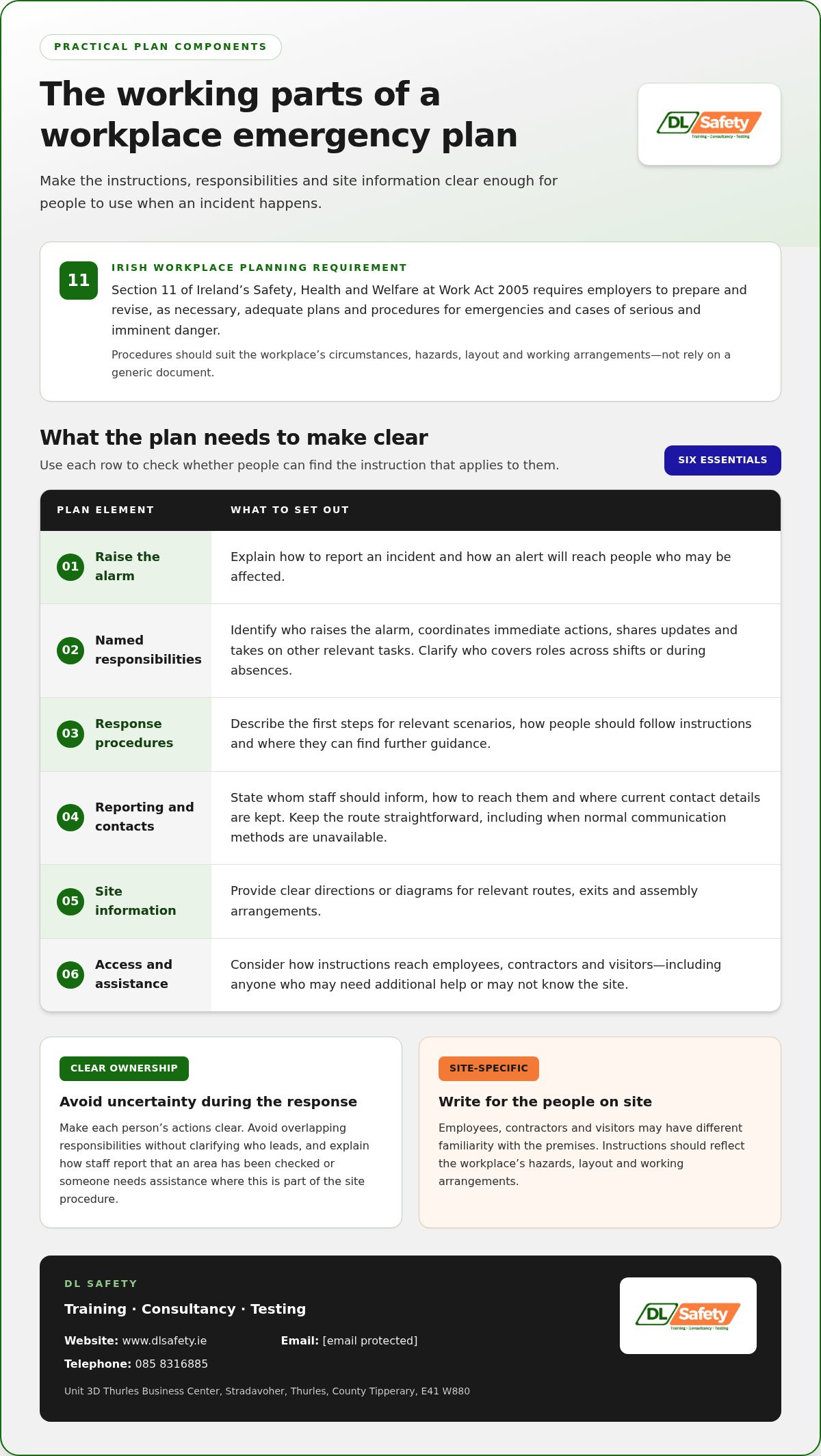
Section 11 of Ireland’s Safety, Health and Welfare at Work Act 2005 requires employers to prepare and revise, as necessary, adequate plans and procedures to be followed in emergencies and in cases of serious and imminent danger. The key word is adequate: procedures should suit the workplace’s circumstances rather than rely on a generic document that may not reflect its hazards, layout or working arrangements.
This section focuses on that stated planning requirement. It doesn’t treat the suggestions in this guide as a complete legal checklist; practical arrangements need to be considered in the context of the workplace. For wider context on Irish workplace obligations, readers can also consult the existing Health and Safety Compliance Ireland guide.
How is a workplace plan different from household preparedness advice?
Household preparedness guidance generally helps people think about personal awareness, communication and supplies. A workplace plan has a different job: it must translate site-specific risks into procedures people can follow at work, with clear responsibilities and reporting routes. The relevant details may include how to raise an alarm, which way to leave an area or where people should go next.
Workplaces also need to consider the people who may be present or affected, including employees, contractors and visitors. A visitor may not know the site or recognise an alarm, whilst a contractor may be working away from the main team. For organisations exploring a personal safety app no hardware solution, smartphone-based monitoring can help lone or mobile workers stay protected without needing separate equipment. Planning for these differences helps make instructions understandable and usable, rather than assuming everyone has the same familiarity with the premises.
Which roles, information and procedures make an emergency plan usable?
A plan is useful only if people can quickly find the instructions that apply to them and understand what to do. An operational emergency plan is a set of roles, decisions and actions people can follow when an incident occurs. For a workplace emergency plan Ireland employers can adapt to their site, make the guidance specific and easy to use, rather than relying on a document full of general statements.
The points below are practical planning guidance, not a legal checklist. Choose and tailor them to the workplace’s hazards, layout and working arrangements:
- How to raise the alarm: Set out how to report an incident and how an alert is communicated to people who may be affected.
- Named responsibilities: Identify who coordinates immediate actions, shares updates and takes on other relevant tasks.
- Response procedures: Explain the first steps for relevant scenarios, including how people should follow instructions and where to find further guidance.
- Reporting and contact arrangements: State who staff should inform, how to reach them and where current contact details are kept.
- Site information: Provide clear directions or diagrams for relevant routes, exits and assembly arrangements.
- Access and assistance: Consider how instructions reach employees, contractors and visitors, including anyone who may need additional help.
How should responsibilities and communication be set out?
Name roles by function and make each person’s actions clear. For example, explain who raises the alarm, who coordinates the immediate response and who communicates updates to staff. Tell employees how to report an incident and where they should get instructions, so they aren’t left guessing or relying on informal messages. Where responsibilities depend on a particular person being present, set out who covers the role across shifts or during absences.
Keep the communication route straightforward. Staff should be able to identify whom to notify and how updates will reach them, including if normal communication methods aren’t available. Explain how people should report that an area has been checked or that someone needs assistance, where this is part of the site procedure. Avoid assigning overlapping responsibilities without clarifying who leads.
What workplace details should staff be able to find quickly?
Put essential information in a format people can understand under pressure. Depending on the site, this may include routes and exits, assembly arrangements, alarm or reporting instructions, relevant contact details and where the current plan is available. Use plain language, clear headings and legible diagrams where they help people orient themselves. Make the information accessible to the staff who need it, including those who may not work at a desk or use a shared computer.
Consider how contractors and visitors will receive relevant instructions, rather than assuming they know the premises. Also plan for people who may need assistance, and make responsibilities for providing that help understandable to those involved. DL Safety’s ongoing health and safety support, including site audits and training, can help connect planning with wider workplace safety management. Find out more through DL Safety’s health and safety support, or contact info@dlsafety.ie or 085 8316885. The address is Unit 3D Thurles Business Center, Stradavoher, Thurles, County Tipperary, E41 W880.
How should a workplace plan account for different emergency scenarios?
Different incidents call for different first steps. A fire may require people to leave an affected area, while a medical incident may need someone to raise the alarm and get help without disrupting access to the casualty. A useful workplace emergency plan Ireland employers develop should connect each relevant hazard with clear, practical instructions for that site.
Response steps should reflect the hazard and the workplace conditions, not rely on one instruction for every emergency. The examples below are prompts for site-specific consideration, not a complete legal list or a substitute for procedures tailored to your workplace.
| Scenario | Immediate priorities to consider |
|---|---|
| Fire | Raise the alarm, communicate the evacuation instructions and direct people towards the appropriate route and assembly arrangements. |
| Medical incident | Report the incident promptly, arrange appropriate assistance and keep access to the person clear. Make sure others receive instructions about the affected area. |
| Severe weather | Share clear instructions about whether people should remain in a safe location, avoid particular areas or follow another site-specific procedure. |
| Loss of essential services | Explain how staff should report the disruption, communicate without relying on an unavailable service and follow arrangements for affected work areas. |
How do response priorities change between emergencies?
The sequence and emphasis depend on what is happening. With a fire, people may need an immediate warning and clear directions away from danger. For a medical incident, the priority may be to report what has happened, arrange assistance and give responders a clear route to the person. If essential services are lost, staff need to know how to receive instructions when the usual communication method or facility is unavailable.
One generic instruction, such as “leave the building”, may not suit every incident or layout. It could direct people towards an affected area or fail to explain what to do if normal routes or communications can’t be used. Procedures should state how to raise concerns, follow instructions and involve emergency services where appropriate to the incident, without relying on staff to improvise decisions beyond their role.
How can employers account for people and changing work conditions?
Think about who may be on site at different times, including employees, visitors and contractors, and how each group will receive instructions. Shift patterns can mean that the people familiar with a procedure aren’t present, so arrangements should make clear who takes on key tasks and how others are kept informed.
Work areas and access conditions can also change. For example, a route used during normal operations may be affected by temporary work, or a team may be working away from the main building. Connect identified hazards and site conditions to the relevant scenario procedures, then make sure the instructions remain understandable for the people expected to use them. This keeps the response grounded in the work as it is actually carried out.
How do you create, communicate, rehearse and review the plan?
A reliable plan takes more than writing down instructions. It needs to reflect the work being done, make responsibilities clear and give staff a chance to practise how they’ll use it. Treat development as a practical sequence: understand what could affect your workplace, prepare procedures, communicate them and learn from rehearsals or real incidents.
What are the practical steps for developing the plan?
- Identify the workplace context. Consider the activities taking place, relevant hazards, people who may be on site and conditions that could affect a response. Include changes in work areas or access arrangements that might alter how people receive instructions or move to safety.
- Decide what each procedure needs to achieve. For each relevant emergency, define the immediate actions, how to report the situation and how instructions will be shared. Keep these steps connected to the scenario rather than relying on one broad instruction for every event.
- Assign responsibilities. Identify who leads key actions and how cover is arranged when that person is unavailable. Make sure staff understand their own role, who they report to and where they should receive updates.
- Write for use, not just reference. Use plain language, clear headings and site information that helps people find the right instructions quickly. Make the current version accessible to relevant staff, and consider how contractors and visitors will receive the information they need.
- Communicate and rehearse. Explain the procedures to the people expected to use them, then carry out a proportionate rehearsal suited to the workplace. A discussion-based exercise or practical run-through can reveal whether responsibilities are understood, information is easy to locate and communication routes work as intended.
Writing the procedure and making it usable are separate tasks. A document may describe the correct action, yet staff may not know where to find it or how to apply it. Use questions and rehearsal feedback to spot unclear wording, missing information or assumptions that don’t match the way work is organised.
When should the plan be reviewed or updated?
Revisit the plan when relevant workplace arrangements change. A new layout, altered work activity, different access conditions or changes to how teams communicate may affect whether existing instructions still make sense. A rehearsal or incident can also expose gaps: perhaps a role wasn’t covered, instructions were difficult to locate or a procedure proved impractical.
Record what needs to change, update the relevant procedure and make sure staff can access the current information. Keep emergency arrangements connected to wider safety management and the workplace Safety Statement, rather than treating the plan as a document that stands alone. DL Safety’s Monthly Safety Support Packages provide ongoing health and safety management and compliance support that can help keep this work connected to day-to-day safety arrangements. Explore Monthly Safety Support Packages.
How can ongoing safety support keep an Irish workplace plan active?
An emergency plan can become outdated if nobody owns it after it’s written. Assign responsibility for keeping it current, make sure staff know where the latest version is held and build opportunities to review it into normal safety management. A workplace emergency plan Ireland businesses can rely on should keep pace with how work is actually organised, rather than remain a document that is only revisited after an incident.
Ongoing attention doesn’t have to mean starting again each time. A responsible person can keep track of changes that may affect the plan, such as new work activities, altered premises or revised communication arrangements. Set a suitable review routine for your workplace, and bring a review forward if a rehearsal, audit or incident reveals that instructions are unclear or difficult to follow. Record what needs attention and who is responsible for following it up.
How can a safety plan connect with wider workplace management?
Emergency arrangements work best as part of the wider safety system. Keep them aligned with the workplace Safety Statement and relevant Method Statements, so the documented approach to managing work reflects the procedures people may need to follow in an emergency. Training can help staff understand their part, whilst a health and safety site audit can help identify whether safety arrangements and information remain relevant to the workplace.
DL Safety’s Monthly Safety Support Packages provide ongoing health and safety management and compliance support. This broader support can help employers keep safety planning connected to their wider management arrangements, alongside relevant audits and training. It’s a practical way to give workplace safety continued attention, rather than treating emergency planning as a one-off task.
What should an employer do next?
Start by deciding who will own the plan and how changes, staff feedback and learning from rehearsals or incidents will reach them. Then consider whether your current safety arrangements, training and review processes work together. If procedures have changed but staff awareness hasn’t kept pace, that’s a useful prompt to address the gap through your wider safety management approach.
For background on how ongoing support can fit your organisation, explore the Monthly Safety Support in Ireland buying guide. To discuss your workplace safety-support needs with DL Safety, visit www.dlsafety.ie, email info@dlsafety.ie or call 085 8316885. The address is Unit 3D Thurles Business Center, Stradavoher, Thurles, County Tipperary, E41 W880.
Make emergency readiness part of everyday safety
A workplace emergency plan Ireland staff can use should keep pace with the business, not be treated as a document finished once it’s written. A useful next step is to make plan ownership part of your wider safety-management routine, so changes in how work is organised prompt a fresh look at whether the arrangements still make sense.
Consider what would help your team keep that work moving: clear ownership, time to review procedures and support that fits your workplace. DL Safety’s Monthly Safety Support Packages can help connect emergency planning with wider health and safety management, whilst site audits and safety training can contribute to workplace awareness and readiness.
If you’re ready to strengthen how safety support fits your organisation, discuss ongoing workplace safety support with DL Safety. A clear plan and steady attention to keeping it relevant can help your people approach their roles with greater confidence. Take the next step at a pace that works for your workplace.
Frequently Asked Questions
Does every employer in Ireland need a workplace emergency plan?
HSA guidance says employers, including self-employed persons, must prepare and revise adequate plans and procedures for emergencies or cases of serious and imminent danger. What is adequate depends on the workplace’s circumstances, so a workplace emergency plan in Ireland should be considered in light of the actual work and setting. Check current HSA guidance and consider how it applies to your workplace, rather than relying on a generic template.
Is a workplace emergency plan the same as a fire evacuation plan?
No. A fire evacuation procedure may form part of a workplace’s emergency arrangements, but it may not address other relevant situations, such as a medical incident or a loss of essential services. Think about what instructions apply to each hazard and whether the same route or action would be suitable in every case. The right scope depends on the workplace’s activities, people and conditions, not just the presence of fire precautions.
Can one emergency plan cover multiple work locations?
A shared framework can help make responsibilities and terminology consistent across sites, but it shouldn’t be assumed to suit every location unchanged. For example, sites may have different layouts, access points, hazards or ways of communicating with staff. Identify which core arrangements can be shared, then add location-specific instructions where needed. Keep the relevant site information easy to distinguish, so someone working at one location doesn’t rely on details meant for another.
What should a workplace emergency plan say about visitors and contractors?
Consider how visitors and contractors will learn what to do if an incident occurs, especially if they’re unfamiliar with the premises. Instructions might be provided verbally, in accessible written information or through another method suited to the site. Decide who will communicate with them and whether anyone may need assistance to follow the procedure. Tailor these arrangements to the workplace and the people who may be present, rather than assuming one visitor process suits every setting.
How should an emergency plan account for employees who work different shifts?
Make sure relevant instructions and responsibilities are clear to every shift, not just the team usually present during the day. A handover can identify changes to work areas or temporary arrangements that affect the response. Set out who covers a role if its usual holder is absent, and how new or occasional workers will become familiar with procedures. These practical steps help avoid relying on knowledge held by one person or one team.
Can a small business use a simple emergency plan?
Yes. A plan can be straightforward, provided it’s adequate for the workplace’s circumstances and people can understand and use it. A small team may have fewer roles to allocate, but should still be clear about who communicates instructions, how incidents are reported and what procedures apply. Keep the document concise enough to use, then compare it with actual workplace needs and current Irish guidance to identify any missing arrangements.