In the high-stakes world of heavy lifting, the line between a productive day and a catastrophic equipment failure is often measured in less than three millimetres of steel. Knowing exactly when to discard a lifting chain isn’t a matter of intuition or visual guesswork; it’s a rigorous technical requirement defined by statutory safety standards. We understand the underlying anxiety that comes with equipment inspections, particularly the fear of missing a minute defect that could lead to a site accident or a failed HSA audit. It is a heavy responsibility to manage, but you don’t have to navigate these complex regulations alone.
This guide empowers you to master the technical and statutory criteria for retiring lifting chains, ensuring your site remains 100% compliant and your team stays safe. We’ll provide clear, quantifiable rejection limits, including the critical 10% wear threshold and 5% elongation maximum, whilst demystifying the thorough examination process. At DL Safety, based at Unit 3D Thurles Business Center, Stradavoher, Thurles, County Tipperary, E41 W880, we’re dedicated to your success. Whether you need GA1 testing or expert advice, reach out to us at www.dlsafety.ie, email info@dlsafety.ie, or call 085 8316885 to ensure your lifting operations are beyond reproach.
Key Takeaways
- Distinguish between routine pre-use checks and statutory GA1 thorough examinations to ensure your lifting operations remain fully compliant with Irish safety regulations.
- Apply precise technical measurements, including the 10% interlink wear limit and the 5% elongation rule, to remove subjectivity from your safety inspections.
- Recognise immediate visual deal-breakers, such as nicks, cracks, and physical deformities, that necessitate an instant withdrawal of equipment from service.
- Identify exactly when to discard a lifting chain due to environmental degradation, including chemical corrosion, pitting, or heat-related strength loss.
- Establish a professional equipment registry and quarantine protocol with the support of DL Safety, Unit 3D Thurles Business Center, Stradavoher, Thurles, County Tipperary (085 8316885).
Understanding the Statutory Requirements for Chain Retirement
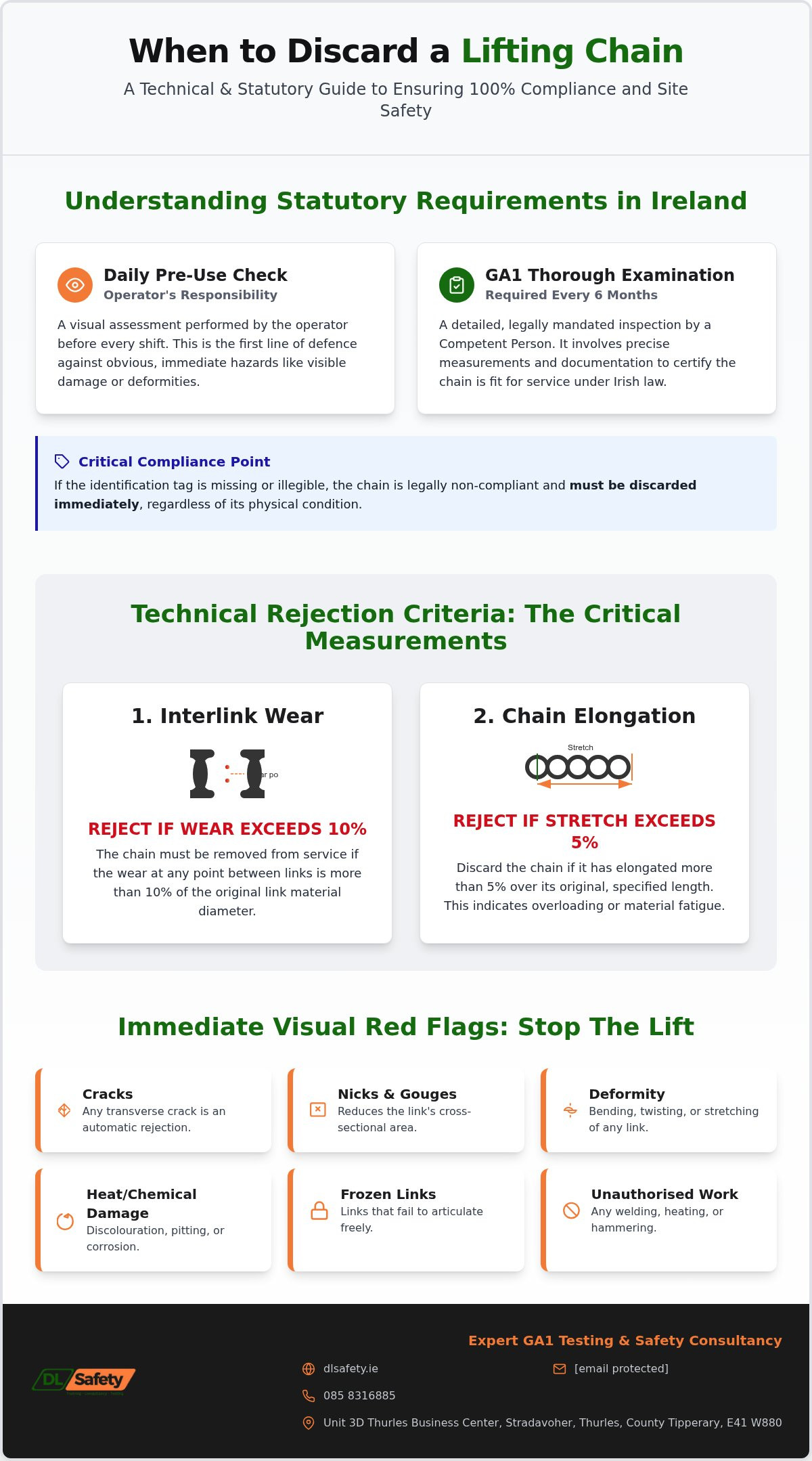
In the Irish lifting industry, safety isn’t a suggestion; it’s a legal mandate. The Safety, Health and Welfare at Work (General Application) Regulations 2007 provide the rigid framework that governs how we use, maintain, and eventually retire lifting equipment. Under these rules, lifting chains are classified as ‘lifting accessories’. This distinction is vital because accessories face more frequent statutory scrutiny than the cranes or hoists they’re attached to. Whilst a crane might only require a thorough examination once a year, your chain slings must undergo a GA1 thorough examination every six months to remain compliant.
Determining when to discard a lifting chain starts with recognising the difference between a daily pre-use check and a statutory inspection. A pre-use check is a visual assessment performed by the operator before every shift. It’s the first line of defence against obvious damage. However, the six-monthly GA1 is a much deeper dive performed by a professional. If a single link in a four-leg assembly shows signs of excessive wear or deformation, the entire chain assembly must be withdrawn from service immediately. You cannot simply ‘patch’ a lifting chain; the integrity of the whole system is only as strong as its weakest point.
The Legal Framework for Lifting Accessories in Ireland
Failing to produce a valid GA1 certificate during a HSA inspection can lead to immediate site closures or heavy fines. Employers hold the ultimate responsibility for ensuring that all rigging equipment and safety protocols are strictly followed. This includes maintaining an up-to-date equipment registry and ensuring that every chain in use has a legible identification tag. If the tag is missing or the serial number is worn away, the chain is legally non-compliant and must be discarded, regardless of its physical condition.
The Competent Person: Who Has the Authority to Discard?
A “Competent Person” isn’t just someone with a lot of experience; they must possess the specific practical and theoretical knowledge to detect defects and assess their importance in relation to safety. Impartiality is key. The person inspecting the chain shouldn’t be the same person responsible for its daily maintenance to avoid potential conflicts of interest. DL Safety supports businesses across Ireland by providing expert GA1 testing services. Our team acts as your trusted advisor, making the hard calls on when to discard a lifting chain so you can focus on the job at hand with total peace of mind. You can reach our experts at www.dlsafety.ie or visit us at Unit 3D Thurles Business Center, Stradavoher, Thurles, County Tipperary.
Immediate Visual Red Flags: When to Stop the Lift
Visual inspection is the most immediate way to determine when to discard a lifting chain. Whilst some degradation requires specialist tools to detect, many defects are glaring indicators that an assembly is no longer fit for purpose. If you spot a deep nick or a gouge during a pre-shift walk-around, it’s never just a cosmetic blemish. These imperfections act as “stress raisers” that can trigger a sudden, catastrophic failure when the chain is under tension. Identifying these issues early is a fundamental part of maintaining a safe site environment.
Surface Damage and Mechanical Abuse
Any transverse crack, regardless of its size, is an automatic reason for immediate rejection. These cracks usually run across the width of the link and often signal that the metal has reached its fatigue limit or has been compromised by chemical exposure. Nicks and gouges are equally problematic because they physically reduce the link’s cross-sectional area. If a link has become “frozen” and fails to articulate freely with its neighbour, the internal friction or deformity has likely caused hidden damage. Mechanical abuse is another common red flag. We occasionally encounter chains that have been hammered or even subjected to unauthorised welding. Such modifications are strictly forbidden by international safety benchmarks, including OSHA regulations for chain slings, as they destroy the chain’s heat-treated integrity and unpredictable load-bearing capacity.
Deformity, Bending, and Twisting
Physical deformity is a silent witness to past overloading. You should examine the chain whilst it’s relaxed to identify twisted links that no longer sit in a uniform plane. Bent links are frequently the result of a shock loading event, such as a load shifting suddenly or being dropped. These high-energy events often leave their mark on the rest of the assembly. If a master link appears elongated or a hook’s throat has visibly spread, the chain has almost certainly exceeded its Working Load Limit (WLL). Identifying these deformities early prevents a minor equipment issue from becoming a major site accident. If you’re struggling to decide when to discard a lifting chain based on visual cues alone, our experts at DL Safety can help you establish a clear rejection protocol. You can find our team at Unit 3D Thurles Business Center, Stradavoher, Thurles, County Tipperary, or reach us directly at 085 8316885 to discuss your equipment inspection needs.
Technical Rejection Criteria: Measuring Wear and Elongation
Whilst visual cues are your first line of defence, the final decision on when to discard a lifting chain usually relies on quantifiable data. You can’t rely on the naked eye to detect a five per cent change in length or a fraction of a millimetre in wear. These minute shifts are where the real danger lies. Precision measurement is the only way to ensure your equipment aligns with the ASME B30.9 sling safety standard and local statutory requirements. Using professional tools rather than visual estimation removes the guesswork from your safety protocols.
Measuring Internal Wear at the Interlink
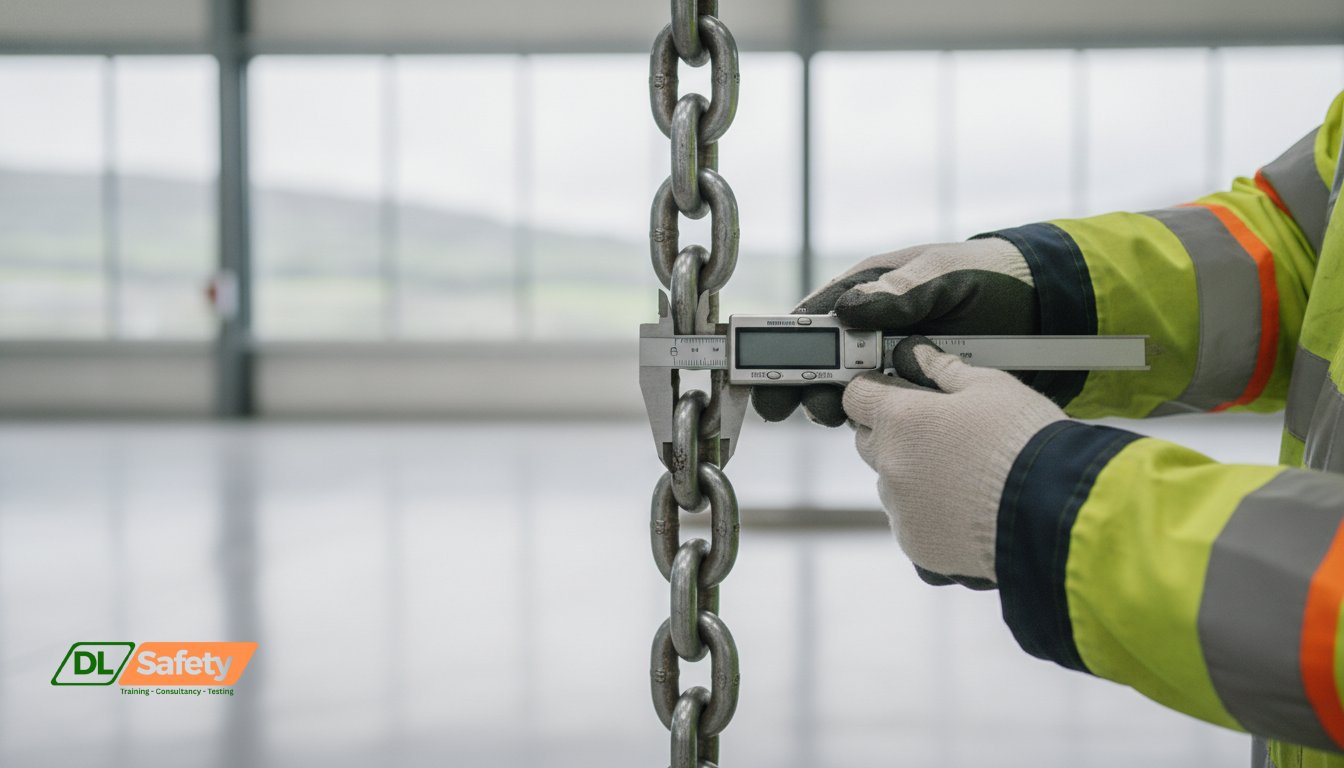
Interlink wear occurs at the bearing points where links rub against each other under load. This is the most common cause of hidden failure because the damage is often tucked away inside the link assembly. To measure this accurately, you need high-quality vernier calipers. Don’t just take one measurement; you must measure the diameter at the point of highest wear in two directions, 90 degrees apart. If the average of these two diameters has decreased by 10% or more compared to the original nominal diameter, the chain is no longer safe. This 10% rule is the industry standard for retirement across Ireland.
Detecting Permanent Elongation
Permanent elongation is a sign that the chain has been physically stretched beyond its elastic limit. This isn’t the same as ‘seating’ elongation, which happens when a new chain is first loaded and the links settle into place. Permanent stretch is a warning that the material’s molecular structure has been compromised. For Grade 80 and Grade 100 alloy chains, the maximum allowable elongation is 5% over the original length. For leaf chains used in lifting, this limit is even stricter at 3%. We recommend measuring a section of 5 to 10 links to get an accurate ‘pitch’ reading against the manufacturer’s original specifications.
Accurately measuring these limits requires both the right tools and a disciplined approach. If you’re unsure about your measurements or need a professional second opinion, DL Safety provides expert GA1 testing and specialised lifting equipment inspection training. Our team at Unit 3D Thurles Business Center, Stradavoher, Thurles, County Tipperary, E41 W880, can help you establish a fail-safe inspection routine. You can reach us at www.dlsafety.ie, email info@dlsafety.ie, or call 085 8316885 to ensure your team stays safe and your site remains compliant.
Environmental Hazards and Operational Limits
Even the most robust Grade 100 alloy chain can be compromised by the environment in which it operates. Whilst mechanical wear is a slow process, environmental damage often acts as a silent catalyst for sudden failure. Understanding when to discard a lifting chain due to environmental factors requires a keen eye for subtle changes in the steel’s surface and a deep respect for the physical limits of the material. Exposure to harsh chemicals or extreme heat doesn’t just damage the surface; it fundamentally alters the chain’s molecular integrity, making it brittle and unpredictable under load.
Extreme Temperature Exposure and WLL Reductions
High-tensile steel is exceptionally sensitive to heat. When a chain is used in foundries or near high-heat industrial processes, its Working Load Limit (WLL) must be derated to account for the loss of strength. If you notice “blueing” or significant discolouration on the links, the chain has likely been exposed to temperatures that have permanently altered its heat treatment. Any chain exposed to temperatures exceeding 400°C must be withdrawn from service immediately and discarded, as its safety factor is effectively destroyed. As of 2026, safety standards demand strict adherence to these thermal limits to prevent catastrophic failure.
| Chain Temperature | Reduction in WLL |
|---|---|
| -40°C to 200°C | None |
| 200°C to 300°C | 10% Reduction |
| 300°C to 400°C | 25% Reduction |
| Over 400°C | Discard Immediately |
Chemical Corrosion and Pitting
Chemical environments, particularly those involved in galvanising or pickling, are hazardous for lifting chains. Acids and alkalis can lead to hydrogen embrittlement, a condition where high-tensile steel becomes brittle and prone to cracking without any visible stretch. Unlike surface rust, which is often cosmetic, “pitting” creates small, deep holes that act as concentrated stress points within the link. If pitting is visible or if the chain has been used in a highly corrosive atmosphere without specialist protection, it is time to retire the assembly. We provide comprehensive GA1 testing and safety audits to help you identify these hidden risks before they lead to an accident.
Maintaining a safe working environment means looking beyond the obvious. If your equipment is regularly exposed to these hazards, our team at DL Safety can help you manage your inspection registry and ensure 100% compliance. Visit us at Unit 3D Thurles Business Center, Stradavoher, Thurles, County Tipperary, E41 W880, or call 085 8316885 to speak with a dedicated safety professional. You can also email info@dlsafety.ie for expert guidance on when to discard a lifting chain that has reached its environmental limit.
Implementing a Robust Inspection and Quarantine System
Knowing when to discard a lifting chain is only half the battle; the other half is ensuring that rejected equipment never finds its way back into service. A robust management system bridges the gap between identifying a fault and eliminating the risk. Without a formal quarantine and disposal process, there’s always a danger that a compromised chain might be ‘borrowed’ for a quick, unofficial task. This is how preventable accidents happen. Establishing a disciplined workflow ensures that once a chain is deemed unsafe, it stays unsafe until it’s physically destroyed.
The GA1 Thorough Examination Process
A professional inspection by DL Safety is a comprehensive health check for your entire rigging inventory. During a thorough examination, our competent persons scrutinise every link, hook, and coupling for the technical defects we’ve discussed, such as interlink wear and permanent elongation. We provide the formal documentation required for your site safety files, ensuring you’re always ready for a HSA inspection. For a detailed breakdown of these legal obligations, explore our guide on GA1 Testing Ireland. Our team, based at Unit 3D Thurles Business Center, Stradavoher, Thurles, County Tipperary, brings the impartial expertise needed to make definitive discard decisions.
Secure Disposal and Record Keeping
Simply throwing a failed chain into a general waste skip is a safety gamble you shouldn’t take. Discarded equipment is frequently scavenged by individuals who may not recognise the hidden dangers of hydrogen embrittlement or heat damage. To prevent unauthorised re-use, you must physically disable the assembly. We recommend using an angle grinder to cut through the master link and several links along the chain’s length. This makes the equipment visibly and functionally useless. Once the physical destruction is complete, your internal lifting equipment register must be updated to reflect the ‘Discarded’ status.
Maintaining this level of administrative rigour can be challenging for busy sites. This is why many of our clients opt for a monthly safety support package. This service ensures your equipment registry is always current and that your quarantine protocols are followed to the letter. By integrating these processes, you move from a reactive safety culture to a proactive one where the question of when to discard a lifting chain is handled with absolute certainty.
If you’re ready to professionalise your equipment inspection routine, DL Safety is here to help. You can reach us at www.dlsafety.ie, email info@dlsafety.ie, or call 085 8316885 to discuss your site’s specific needs. Our office at Unit 3D Thurles Business Center, Stradavoher, Thurles, County Tipperary, E41 W880, serves as a hub for safety excellence across the region, providing the tools and expertise your team needs to stay safe.
Securing Your Site with Data-Driven Safety Protocols
Maintaining a safe lifting environment requires a transition from subjective visual guesswork to rigorous, quantifiable standards. By mastering the 10% wear rule and the 5% elongation limit, you replace uncertainty with technical precision. Understanding when to discard a lifting chain is not merely about avoiding equipment failure; it’s about fostering a culture of accountability and ensuring your site remains fully compliant with HSA regulations. Whether you’re managing environmental hazards or implementing a strict quarantine system, your commitment to these standards protects your team’s welfare and your business’s reputation.
Our expert GA1 inspectors across Ireland are ready to support your operations with thorough examinations and professional safety audits. To move forward with confidence, Ensure your lifting equipment is compliant: Book a GA1 Inspection with DL Safety. You can visit us at Unit 3D Thurles Business Center, Stradavoher, Thurles, County Tipperary, E41 W880, or reach out directly via 085 8316885 or info@dlsafety.ie. We’re here to help you demystify compliance and build a safer, more efficient workplace for your entire team.
Frequently Asked Questions
How often should lifting chains be inspected in Ireland?
Under Irish law, lifting accessories like chain slings must undergo a documented thorough examination by a competent person every six months. This is known as the GA1 thorough examination. In addition to this statutory requirement, operators must perform a visual pre-use check before every shift. If the equipment is used in severe environments, such as chemical plants or quarries, you might need to increase the frequency of these professional inspections to ensure ongoing safety.
Can a lifting chain be repaired if a link is damaged?
No, you cannot repair a lifting chain by welding or replacing individual links. Once a single link is compromised by a crack, gouge, or deformity, the entire assembly’s integrity is lost. Unauthorised repairs are strictly prohibited under safety standards because they destroy the material’s heat-treated strength. When you identify damage, the safest and only compliant course of action is to follow the protocol for when to discard a lifting chain and replace the assembly.
What is the maximum allowable wear on a lifting chain link?
The maximum allowable wear at any point on a lifting chain link is 10% of its original nominal diameter. This wear is most commonly found at the interlink bearing points where friction is highest. You should use precision vernier calipers to measure the diameter in two directions at the thinnest section. If the average measurement falls below 90% of the original specification, the chain must be permanently removed from service to prevent a catastrophic failure on site.
How do I know if my lifting chain has been shock-loaded?
Shock-loading often leaves behind permanent physical deformities such as stretched links, bent components, or a lack of free articulation between links. You can detect this by measuring for cumulative elongation; a stretch of 5% or more indicates the material has exceeded its elastic limit. If the chain links no longer sit flat or “frozen” links are present, it’s a clear sign of mechanical abuse that requires the immediate retirement and destruction of the equipment.
Is surface rust a reason to discard a lifting chain?
Light surface rust is generally acceptable if it can be wiped away and hasn’t caused “pitting” or a reduction in the link’s diameter. However, deep corrosion that penetrates the metal surface is a major safety risk. If the rust has led to a measurable loss of material or if you suspect hydrogen embrittlement from chemical exposure, you must discard the chain. Regular cleaning and proper storage help prevent this type of environmental degradation over time.
What should I do if the WLL tag is missing from the chain?
You must immediately remove any lifting chain from service if the identification tag or Working Load Limit (WLL) marking is missing or illegible. Without a valid tag, a competent person cannot verify the chain’s capacity or its inspection history. This makes the equipment legally non-compliant during a HSA audit. At DL Safety, we recommend that any untagged accessory be quarantined and destroyed to prevent accidental use in any high-risk lifting operations across your site.
Can I use a lifting chain if it has been exposed to fire?
No, any lifting chain exposed to extreme heat or fire must be discarded immediately. High temperatures, specifically those exceeding 400°C, fundamentally alter the molecular structure and heat treatment of alloy steel. This damage is often invisible to the naked eye, though “blueing” or discolouration can sometimes be a clue. Because the chain’s load-bearing capacity is no longer predictable, it’s never worth the risk of continued use after any significant thermal exposure.
Who is responsible for the daily pre-use check of lifting equipment?
The equipment operator or the person carrying out the lift is responsible for performing the daily pre-use check. Whilst the employer has a legal duty to provide training and ensure these checks happen, the user is the final line of defence. This visual assessment focuses on obvious defects like nicks, gouges, or missing tags. It complements the six-monthly GA1 examination, ensuring that you know exactly when to discard a lifting chain before a lift begins.