
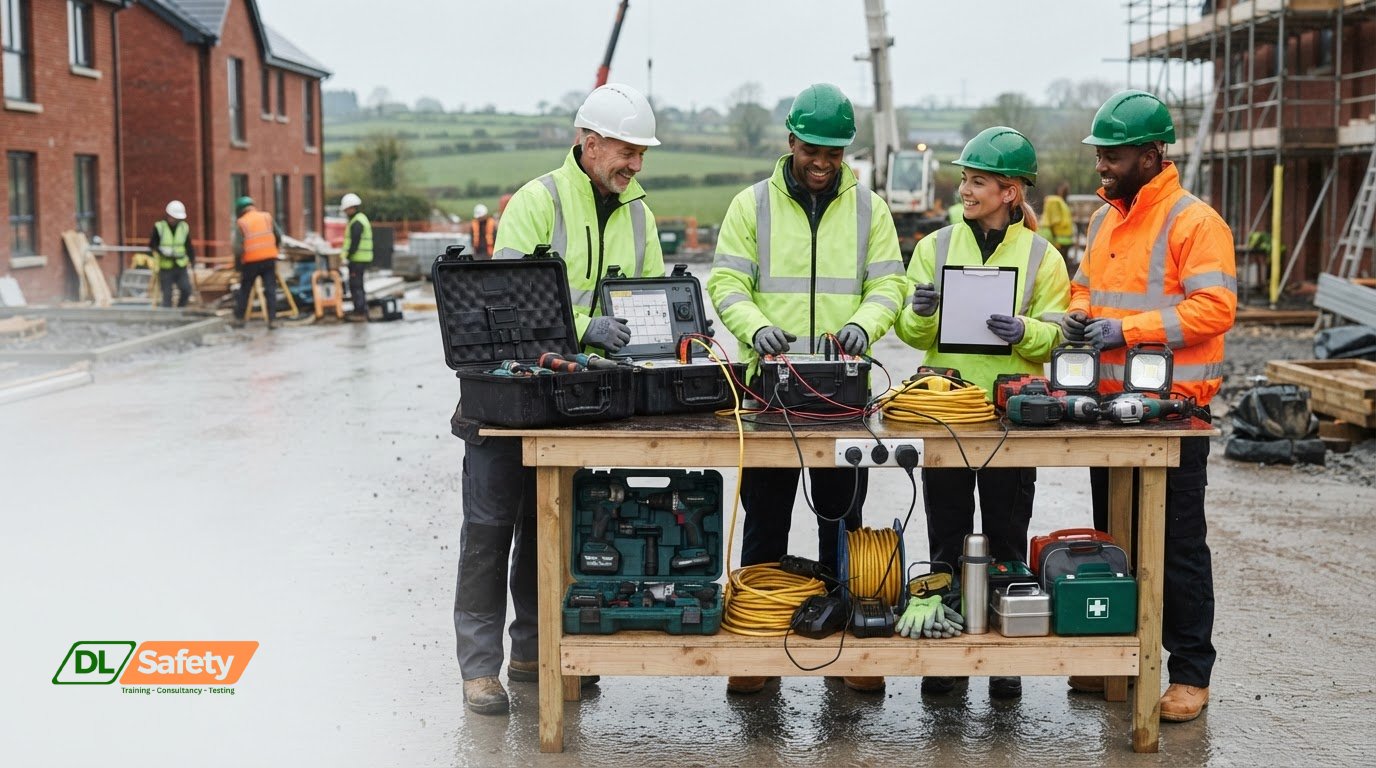
A construction-site PAT checklist should cover more than power tools. Leads, chargers, portable lighting and welfare equipment may all need to be considered, depending on what is used on site. Knowing what needs to be PAT tested on a construction site starts with recording the equipment in use, where it is used and the conditions it faces, such as dust, knocks or damp.
Not every appliance needs the same approach, and annual testing is not a universal requirement. In Ireland, there is no single statutory testing interval for every item: inspection and testing should be prioritised according to the equipment, its use and its environment. This checklist explains how to build a site-specific inventory, set priorities and distinguish user checks from competent testing and record-keeping.
DL Safety provides PAT testing support for construction and industrial workplaces. For information or to discuss your site’s needs, visit www.dlsafety.ie, email info@dlsafety.ie or call 085 8316885.
Key Takeaways
- To decide what needs to be PAT tested on a construction site, list the portable equipment actually in use and consider its condition and working environment.
- Organise the inventory by task and location so tools, leads and welfare equipment are easier to track.
- Keep portable appliances and accessories distinct from fixed electrical installations, which need a separate approach.
- Use visual checks to identify visible damage and instrument-based testing to assess electrical safety. Neither replaces the other.
- Prioritise equipment, arrange competent testing and record results and follow-up actions in a clear workflow.
What needs to be PAT tested on a construction site? Start with the equipment in use
Include portable electrical equipment used on site in your risk-based inspection and testing plan. To work out what needs to be PAT tested on a construction site, make an inventory of equipment workers move, transport or connect for their tasks. Then consider its condition, how it is used and the environment it faces. This gives you a practical basis for prioritising checks instead of relying on a generic list that may not match your site.
Start by recording equipment by work activity or location, such as:
- Tools and other equipment used by tradespeople during site work.
- Leads, cable reels and portable distribution equipment used to supply power.
- Chargers and portable lighting moved between work areas.
- Appliances used in site offices, canteens or other welfare spaces.
These examples are prompts, not a complete register. Add equipment actually used on your site, including items brought in for a specific task. The next section breaks the checklist down by category so you can compare it with your own inventory.
What counts as portable electrical equipment on site?
Portable electrical equipment is an appliance or item that can be moved as part of the work, whether it is carried between areas, transported to site or connected for a task. A plug alone does not determine whether an item belongs in your inventory. Record the equipment workers use and move, along with where it is normally used. Fixed electrical installations are a separate category, not simply portable items that happen to stay in one place.
For general background on the purpose and approach to PAT, see Portable appliance testing (PAT) on Wikipedia. Base your site record on the equipment and conditions you actually have, rather than copying another workplace’s inventory.
Why construction conditions change the priority
Construction equipment may be moved frequently, handled roughly or exposed to dust, moisture and impact. Those conditions can affect its condition over time, so equipment used in demanding areas may warrant closer attention than an item kept in a relatively protected space. Consider the task, frequency of use and visible condition together when deciding which items to prioritise for inspection and testing. Do not assume every appliance needs an identical approach.
A practical equipment inventory reflects what is used, where it is used and the condition it is in. It does not assume every item needs identical testing. Workers’ visual checks can help identify visible damage, but they are not a substitute for appropriate testing. If an item appears damaged, take it out of use and have it assessed appropriately before it is used again. This keeps the inventory connected to everyday site conditions rather than treating it as a one-off paperwork exercise.
Construction-site PAT testing checklist: tools, leads and welfare equipment
Use the categories below as prompts for your site inventory, then compare them with your equipment register. Organising items by task and location can help reveal gaps, such as a lead used by a subcontractor in a temporary work area or a portable appliance kept in a site cabin. Add equipment that is actually present or used on the project.
Tools and temporary power accessories
Start with the electrical tools used for the work, then include the accessories supplying power to each task area. The right inventory depends on the project, so do not assume every site will use the same equipment. Record items individually or with a clear asset identifier so test outcomes and follow-up actions can be matched to the correct item.
- Drills, grinders, saws and other electrical tools used by tradespeople.
- Extension leads and adaptors used to connect equipment.
- Cable reels supplying temporary work areas.
- Portable distribution equipment, where present.
Record where each item is used, such as a particular work area, task station or site cabin. Note its condition and any action needed rather than treating a whole category as one item. A voltage or equipment type alone does not determine the inspection approach; set priorities according to the equipment, its use and its condition.
Welfare, office and portable site equipment
Include appliances used in welfare and office spaces, not just equipment taken onto the workface. For example, record canteen kettles, portable heaters, chargers and office equipment where they are present. Add task lighting and other portable equipment used in cabins or work areas, noting the location so each item can be found for checks and testing.
A simple checklist can make the inventory easier to maintain. Include fields such as:
Equipment: Item name or asset identifier, for example a kettle, charger or task light.
Location: The work area, cabin, office or welfare space where it is used.
Condition: Observations from a visual check, including visible damage or other concerns.
Follow-up: Action needed, such as taking a damaged item out of use or arranging further assessment.
Review the list as work areas and tasks change. A charger kept in an office and a tool moved around active work areas may face different conditions, so their records should make that distinction clear. These are inventory prompts, not a claim that every item needs identical testing. DL Safety provides PAT testing support to help construction businesses organise equipment checks around their site’s needs.
What may fall outside PAT testing? Separate portable items from fixed installations
A site inventory needs clear boundaries. Some electrical items are portable appliances, some are accessories used with them, and others belong to the building’s fixed electrical installation. Distinguishing between them helps prevent a portable appliance test being mistaken for a check of the entire electrical system. It also helps keep equipment supplied by a subcontractor or introduced part-way through a project visible in the site process.
Portable equipment versus fixed electrical installations
Portable equipment is moved, carried or connected as part of a task. Fixed installations, by contrast, are built into or attached to the premises. A portable test result relates to the item tested, not every part of the electrical system it connects to. This distinction is about scope, not a conclusion on Irish legal duties; base applicable requirements on current authoritative Irish guidance.
| Category | Examples | How to treat it in the inventory |
|---|---|---|
| Portable appliances | Tools or appliances moved between tasks or locations | Record the individual item, its usual location and condition. |
| Accessories | Leads, adaptors or cable reels used with equipment | List separately where they can be identified and checked as equipment in use. |
| Fixed electrical installations | Wiring and other electrical components that form part of the premises | Keep these distinct from portable items; a PAT result is not evidence that fixed wiring is safe. |
Some items may be less obvious at first glance. A cable reel moved between work areas is an accessory in use, while wiring installed as part of a site cabin belongs to the fixed installation. If an item’s category is unclear, describe what it does and how it is connected in the register, and keep its scope clear when arranging checks.
Hired, subcontractor-owned and newly arrived equipment
Ownership does not make equipment irrelevant to the site inventory. Include hired items, subcontractor equipment and newly arrived appliances in the process so they are not overlooked simply because they are not company-owned or were absent when the register was first prepared. Their inclusion does not mean they are automatically exempt or automatically due for testing.
For each item, note who uses it, where it is used and any available information about its condition or previous checks. When equipment changes hands or moves to another work area, update its record so the location and follow-up remain useful. A brief visual check can help identify obvious damage, but it does not establish the status of fixed wiring or replace other appropriate assessment.
PAT testing is one element of electrical equipment maintenance, not a substitute for every other check. Identify portable appliances and accessories for the relevant process, and treat fixed installations separately. This keeps the inventory practical without implying that one test covers equipment or systems beyond its scope.
How to organise PAT testing on a construction site
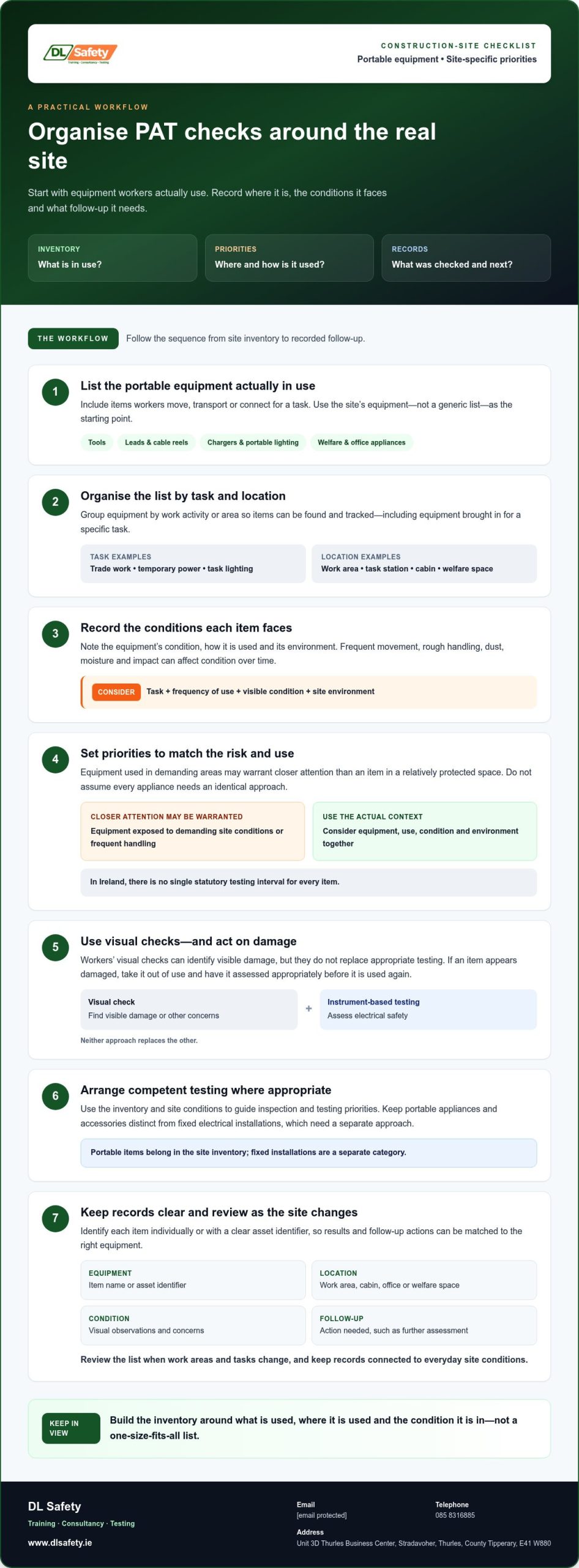
A clear process turns a site equipment list into a manageable testing programme. Start with the equipment identified, then use its condition, use and environment to plan proportionate checks. There is no universal annual interval that fits every item; set priorities and review them in line with equipment changes and applicable Irish guidance. For wider context, see the PAT testing for construction sites guide.
- List the equipment. Create a register of portable appliances and accessories used on site. Give each item a clear identifier and record its type and location so it can be found and matched to its checks.
- Assess condition and use. Note how often an item is used, whether it is frequently moved and the conditions it faces. Record visible concerns and take damaged equipment out of use for appropriate assessment.
- Prioritise attention. Use the information to identify items that may need earlier inspection or testing, such as equipment subject to heavy use or frequent movement. Do not assign an identical approach simply because items share a category.
- Arrange competent testing. Plan instrument-based testing for the selected equipment, with timing shaped by the risks, use and condition of items and applicable Irish guidance. A calendar reminder can keep planned checks visible, but it should not replace a site-specific decision about priority.
- Record outcomes and follow-up. Update the register with the result, date and any corrective action. Make clear which items need further attention and who is responsible for following up.
Visual checks and instrument-based testing have different purposes. A visual check can identify obvious problems, such as damage to a casing or cable. Instrument-based testing uses test equipment to assess electrical safety in ways a visual check cannot. Neither replaces the other, and a visual check should not be recorded as an instrument test.
Keep records useful and current
A useful record lets a site manager trace each result back to the item and decide what happens next. Capture an item identifier or description, its location, the check or test date, the outcome and any corrective action. Where practical, note who is responsible for the item or follow-up. If equipment moves, is replaced or arrives for a new task, update the register rather than relying on an outdated list.
Consistent records make patterns and outstanding actions easier to see, helping managers focus attention where it is needed. They also connect equipment checks with broader site safety arrangements. For more on that wider context, read the Irish health and safety compliance guide. DL Safety provides PAT testing support to help construction businesses organise checks as part of a practical equipment maintenance process. Arrange construction-site PAT testing.
How DL Safety supports construction-site PAT testing in Ireland
A clear equipment register is a useful starting point, but arranging checks across an active project takes coordination. DL Safety provides PAT testing for construction and industrial workplaces in Ireland, helping businesses organise checks around the equipment they use and the conditions it faces. Knowing what needs to be PAT tested on a construction site makes the process specific to the project rather than reliant on a generic list.
A practical testing service for site equipment
DL Safety’s PAT testing can form part of a wider approach to equipment maintenance and site safety. The focus is on portable equipment in use, its condition and where it operates. This helps site managers consider testing alongside everyday checks and follow-up actions. For example, equipment moved between work areas may need different attention from items used in a site office, so a site-specific register provides useful context for planning.
Testing is one part of the picture. DL Safety also provides health and safety site audits and monthly safety support packages, which can complement technical testing within broader safety management. PAT testing focuses on portable electrical equipment, while audits and ongoing support can help businesses consider wider site arrangements. No single check guarantees overall site safety; clear responsibilities and appropriate follow-up remain important.
Before arranging a project’s checks, site managers can bring together the equipment register, locations, known condition concerns and outstanding follow-up. This gives the testing process a practical starting point and keeps attention on equipment actually used on site. DL Safety supports construction and industrial businesses with PAT testing as part of this organised approach.
Discuss your site PAT testing needs
If you are responsible for a construction site or workplace, discuss your PAT testing requirements with DL Safety. Sharing the type of work taking place, the equipment in use and the site conditions provides a practical starting point. For construction-site PAT testing, contact DL Safety through the website, by email or by telephone.
Website: www.dlsafety.ie
Email: info@dlsafety.ie
Telephone: 085 8316885
Make equipment checks part of your next site review
As a project moves through different phases, equipment and work areas can change too. Review the equipment register when tasks shift, new work areas open or equipment is brought onto the project. This keeps your approach to what needs to be PAT tested on a construction site connected to the work taking place, rather than relying on a list that no longer reflects the site.
Start by reviewing your current records, noting any gaps and deciding how testing support can fit into your equipment maintenance arrangements. DL Safety’s PAT testing can sit alongside its wider health and safety support, helping you take a considered approach without treating one check as the whole safety plan.
Ready to discuss your site’s needs? Discuss construction-site PAT testing with DL Safety and take the next step towards a more organised process.
Frequently Asked Questions
What needs to be PAT tested on a construction site?
Include portable electrical equipment used on site in your inspection and testing plan, such as tools, leads, portable lighting and welfare appliances. To decide what needs to be PAT tested on a construction site, check what is actually used for each task, including equipment brought in as work progresses. Keep fixed installations separate in your records. The scope should reflect the site’s equipment and use, not assume every item needs the same test or interval.
Do power tools and extension leads need PAT testing on a construction site?
Power tools and extension leads are common items to include in a construction-site equipment inventory. Give particular attention to equipment that is moved frequently, used heavily or exposed to demanding conditions, and record concerns such as visible wear for follow-up. The appropriate inspection and testing approach depends on the item and its use. Do not assume a universal legal interval; check current Irish guidance when setting the site’s schedule.
Does every electrical item on a construction site need PAT testing?
Not every item should automatically be treated in the same way. Build a register of actual site equipment, then distinguish portable appliances from accessories and fixed installations before deciding what checks are appropriate. A movable tool and the fixed wiring in a site cabin, for example, are different categories. Assess the equipment in use and refer to applicable Irish requirements rather than assuming an exemption or applying one identical test to everything.
Is annual PAT testing a legal requirement in Ireland?
Do not assume that annual PAT testing is either universally required or never required in Ireland. The appropriate schedule depends on the equipment, how it is used and the risks involved. Check legal requirements against current Irish legislation and authoritative Irish guidance. Document why the chosen schedule suits the equipment and conditions, then review that reasoning if work activities or equipment change.
Do new or hired tools need to be PAT tested before use on site?
Include new and hired tools in the site’s equipment-management process, but do not treat either category as automatically exempt or automatically due for testing. Record when an item arrives, who will use it, its intended work area and its visible condition. Keep relevant inspection information with the equipment record so site managers can make an informed decision about appropriate checks and verify any specific requirement against Irish guidance.
Is a visual inspection enough, or is electrical testing also needed?
A visual inspection and electrical testing serve different purposes, so one should not be treated as a complete substitute for the other. A visual check may reveal visible damage, while an instrument-based test assesses electrical characteristics. UK HSE material supports this general distinction, but it is not Irish legal guidance. Consider the equipment, its condition and environment, and check current Irish requirements when deciding on the appropriate approach.
Who can carry out PAT testing on a construction site?
PAT testing should be carried out by a competent person with suitable knowledge and experience for the equipment and work involved. A worker’s pre-use visual check is useful, but it is not the same as formal inspection and instrument-based testing. Do not assume a particular certificate is required without checking applicable Irish requirements. DL Safety provides PAT testing support for construction and industrial workplaces.