What if the biggest safety challenge isn’t knowing the rules, but turning them into clear, consistent routines? For employers in Ireland, understanding the health and safety obligations employer Ireland law sets for a workplace is only the starting point. The practical questions are just as important: which risks need attention, what records should be kept, and what steps follow an incident?
It’s understandable if these duties feel difficult to manage alongside the demands of running a business. The main framework is the Safety, Health and Welfare at Work Act 2005, and its requirements need to be applied to the risks and work activities in your organisation. This guide explains where key duties come from, how risk assessments and a Safety Statement support day-to-day safety, and what to consider when recording and reporting incidents.
You’ll also learn how training, audits and ongoing guidance can help make safety management more practical, while responsibility remains with the employer. DL Safety is an Irish-owned consultancy serving Ireland nationwide, offering affordable online training & expert consultancy. Contact details: www.dlsafety.ie, info@dlsafety.ie, 085 8316885.
Key Takeaways
- Get clarity on health and safety obligations employer Ireland requirements, and how they apply to your workplace.
- Match safety controls to the hazards, tasks and people involved in your organisation’s day-to-day work.
- Understand why a small workforce doesn’t remove the need to manage workplace risks.
- Use risk assessments and a Safety Statement to organise your approach and keep responsibilities clear.
- See how ongoing expert support can help maintain practical safety arrangements, while the employer remains responsible.
What health and safety obligations apply to employers in Ireland?
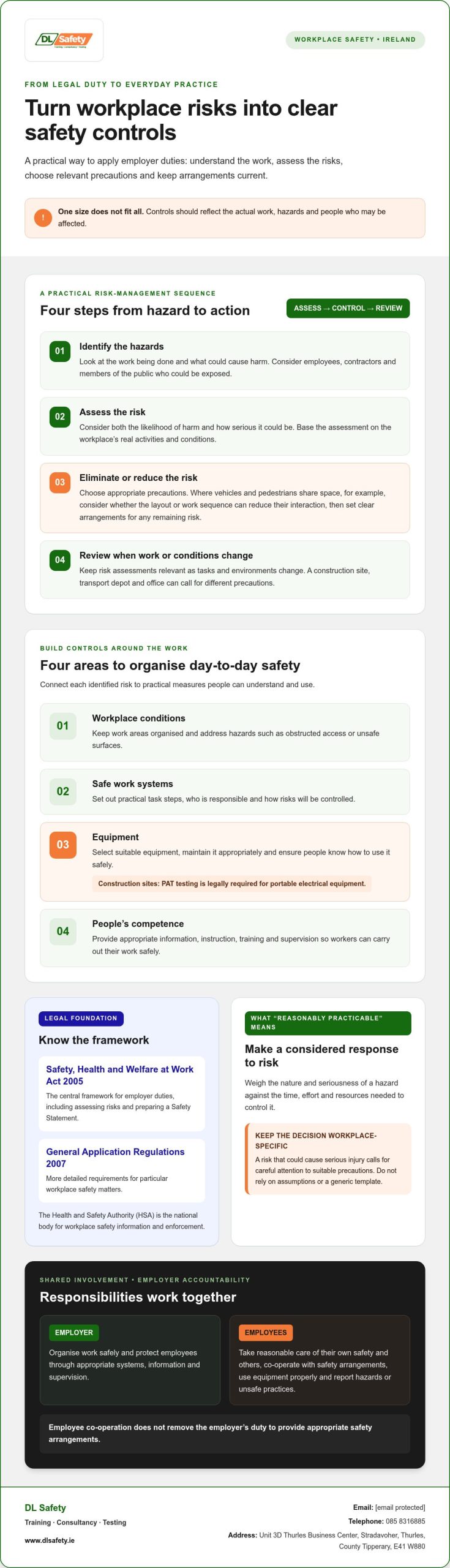
Employers in Ireland must manage workplace safety, health and welfare so far as is reasonably practicable. In practice, this means identifying foreseeable risks and taking appropriate steps to prevent harm, with controls that reflect the work being done and the people who may be affected. The health and safety obligations employer Ireland law sets out are not one-size-fits-all: a construction site, a transport depot and an office will each have different hazards to address.
The central legislative framework is the Safety, Health and Welfare at Work Act 2005. It establishes the broad responsibilities employers must meet, while more detailed rules for particular topics are set out in regulations, including the Safety, Health and Welfare at Work (General Application) Regulations 2007. Together, these provide the legal foundation for managing safety, but the specific arrangements need to be shaped around the workplace itself.
Which Irish laws set out employer health and safety duties?
The 2005 Act sets out the general duty to protect employees’ safety, health and welfare, alongside requirements such as assessing risks and preparing a Safety Statement. It provides the overall framework rather than a ready-made set of controls for every task. The General Application Regulations 2007 address more specific workplace safety matters, so employers should consider both the broad duties and any detailed requirements relevant to their activities.
The Health and Safety Authority (HSA) is the national body responsible for workplace safety information and enforcement. Its website is a useful source for current guidance and practical explanations of requirements. For general background on the Health and Safety Authority (HSA) in Ireland, employers can also consult this overview, then use HSA guidance and relevant legislation when making decisions about their own workplace.
“Reasonably practicable” calls for a considered response to risk, rather than a promise that every possible danger can be removed. Employers should weigh the nature and seriousness of a hazard against the time, effort and resources needed to control it. A risk that could cause serious injury, for example, calls for careful attention to suitable precautions; the controls should be based on the actual circumstances, not assumptions or a generic template.
Who has workplace health and safety responsibilities?
Employers carry the primary responsibility for organising work safely and protecting employees. Employees also have duties: they must take reasonable care of their own safety and that of others, co-operate with safety arrangements, use equipment properly and report hazards or unsafe practices. These responsibilities work together, but employee co-operation doesn’t remove the employer’s duty to provide appropriate systems, information and supervision.
Health and safety law also addresses self-employed people, whose responsibilities depend on the work they undertake and its potential effects on themselves and others. Where a workplace involves employees, contractors or members of the public, employers need to consider who could be exposed to each risk. A broad legal summary can orient you, but it can’t replace a workplace-specific assessment of activities, hazards and suitable controls.
How do Irish employer duties translate into everyday safety controls?
Legal duties become meaningful through the arrangements people follow each day. A practical approach starts with the hazards created by the work, then connects each risk to suitable measures across workplace conditions, work systems, equipment and people’s competence. This helps employers turn the health and safety obligations employer Ireland law establishes into controls that are relevant, understood and usable.
Controls should reflect the work actually undertaken, not simply repeat a generic policy. A transport workplace may need to consider how vehicles and pedestrians move through shared areas, whilst a construction task may involve changing site conditions and work at height. These examples call for different precautions. The right response depends on what could cause harm, who may be exposed and how the work is organised.
How should employers manage workplace risks?
Identify hazards first, then assess the likelihood and potential seriousness of harm. Use those findings to decide how risks can be eliminated or reduced, and whether further precautions are needed. For example, if a task involves moving vehicles near people on foot, consider whether the layout or work sequence can reduce interaction, then set clear arrangements for the remaining risk. Risk assessments should be reviewed when work or conditions change. The existing guide, Risk Assessments: A Guide to Dynamic Site Safety, can help employers think through how assessments relate to changing tasks and environments.
It can help to group day-to-day controls into four areas:
- Workplace conditions: Keep the work area organised and address hazards such as obstructed access or unsafe surfaces.
- Safe work systems: Set out practical steps for completing tasks, including who is responsible and how risks are controlled.
- Equipment: Select suitable equipment, maintain it appropriately and make sure people know how to use it safely. PAT testing is legally required for portable electrical equipment on construction sites.
- People’s competence: Give workers appropriate information, instruction, training and supervision so they understand the hazards and procedures relevant to their work.
What do safe systems, equipment and training involve?
A safe system is a workable method for carrying out a task with risks controlled. It should make the safe approach clear in practice, rather than existing only in a written document. Briefings, instructions and supervision can help ensure workers understand their responsibilities, know how to use equipment and can raise concerns if conditions change.
Personal protective equipment (PPE) is one part of risk control, not a substitute for addressing hazards at source or organising work safely. Where PPE is needed, employers should provide the necessary equipment free of charge and explain its correct use, care and limitations. Regularly checking whether controls still match actual work helps keep them useful as tasks, equipment or workplace conditions evolve.
For practical help connecting risk assessments, workplace controls and staff understanding, DL Safety’s health and safety support can assist employers in developing a clearer approach.
Do small businesses have the same health and safety obligations?
Yes. A small workforce doesn’t, by itself, remove an employer’s health and safety duties in Ireland. The scale of the arrangements can be proportionate, but the risks still need to be managed. The health and safety obligations employer Ireland law sets out should be applied to the work being done, the conditions in which it takes place and the people who could be affected.
Proportionate doesn’t mean doing nothing, nor does it mean downloading a generic policy and treating the job as complete. A small office and a business carrying out work on active sites may have different hazards, even if both employ only a few people. Focus on relevant risks and workable controls, rather than the size of the paperwork.
How can a smaller employer make safety management proportionate?
Start with real tasks and working conditions. Consider routine and occasional work, the equipment used, where activities take place and whether employees, contractors or visitors could be exposed to harm. Then decide what precautions are appropriate and who will put them into practice. This keeps arrangements grounded in the actual business, rather than copied from an organisation with different work and risks.
Records should support those arrangements. Keep the risk assessment and Safety Statement relevant to the work, and make changes when tasks, equipment or conditions change. For a small employer, a clear record of the hazards considered, controls selected and responsibilities agreed can be more useful than a lengthy document that staff don’t recognise or follow. Keep the process manageable, but make sure it reflects the risks that matter.
Can an employer outsource health and safety responsibilities?
External advice can help employers understand requirements, plan controls and review whether arrangements fit the work. It can also support practical implementation, such as preparing safety documentation, carrying out site audits or helping staff build relevant knowledge. This support can be particularly useful where an organisation needs specialist input or an independent view of its existing approach.
But advice and accountability aren’t the same thing. An employer remains responsible for managing workplace safety; appointing a consultant doesn’t automatically transfer that responsibility or guarantee compliance. The employer still needs to understand the arrangements, make decisions about the work and ensure agreed controls are put into practice. Employees also need clear instruction and a way to raise concerns, so safety measures don’t remain only on paper.
A sensible approach is collaborative: use external expertise to strengthen planning and reviews, then keep ownership of the decisions and day-to-day arrangements within the business. DL Safety’s Monthly Safety Support Packages and health and safety consultancy can provide practical assistance with safety management, while the employer retains responsibility for the workplace. The aim is a system that suits the organisation’s risks and can be maintained as its work changes.
What practical steps help employers manage and evidence compliance?
A repeatable process makes safety management easier to act on and review. It also helps show how decisions were made when work changes or an incident occurs. The health and safety obligations employer Ireland rules establish are best managed through controls that reflect the actual work, rather than paperwork kept separate from day-to-day operations.
Use this sequence as a practical starting point:
- Identify work risks. Consider the tasks people carry out, the conditions they work in, the equipment they use and who could be affected.
- Set suitable controls. Decide how to eliminate or reduce identified risks, and record who is responsible for putting each measure in place.
- Communicate arrangements. Give employees relevant information, instruction and training so they understand safe procedures and their responsibilities.
- Review and update. Revisit assessments and controls when work, equipment or conditions change, and after incidents or concerns reveal that an arrangement may need attention.
What records help show that safety is being managed?
Keep records that reflect the decisions and actions taken, such as risk assessments, safety instructions, relevant training records and reviews of controls. The Safety Statement brings the main arrangements together: it should reflect the risks identified and how the organisation intends to manage them. For more detail on preparing and maintaining one, see the existing guide to Safety Statements for Monthly Support Packages. Records are useful evidence, but paperwork alone doesn’t make work safe; controls also need to be understood and followed in practice.
What should an employer do after a workplace incident?
Respond promptly, make the area safe where needed and gather a clear account of what happened. Investigate the circumstances, speak with relevant people and document the findings, including any factors that may have contributed. The purpose is to understand the causes and decide whether controls, instructions or work arrangements need to change, rather than simply to complete a form.
Under S.I. No. 370 of 2016, reportable incidents must be notified to the Health and Safety Authority (HSA) using the relevant form. Reporting is mandatory when an employee cannot work for three consecutive days after an incident. Use the IR1 Form for reportable injury incidents and the IR3 Form for reportable dangerous occurrences, following the current criteria and instructions on the HSA website. Not every incident meets the reporting threshold, so check the applicable guidance and record the decision and any action taken.
Keep the incident record with the investigation and any follow-up actions, so it’s clear what was learned and whether the changes were completed. If you’d value practical help reviewing your safety documents and arrangements, explore DL Safety’s health and safety support. Expert input can help organise the work, while responsibility for managing safety remains with the employer.
How can ongoing safety support help employers meet their obligations?
Keeping safety arrangements relevant takes time, especially as work, equipment and teams change. Ongoing support can help an employer organise this work, review documentation and turn identified risks into practical actions. It complements the employer’s own management of workplace safety; it doesn’t transfer legal responsibility or guarantee compliance.
DL Safety’s Monthly Safety Support Packages are intended to provide ongoing safety management and compliance support. The right focus depends on the organisation’s work and current needs. Support may help bring safety documents into a clearer structure, identify areas that need attention and keep follow-up actions visible, so safety management is connected to day-to-day operations rather than treated as a once-a-year paperwork task.
What can ongoing consultancy support with?
Consultancy can help employers plan safety management work, review arrangements and make sense of what needs attention. A site audit is a distinct activity: it provides an opportunity to examine workplace conditions and how controls are being applied. Practical advice can then help the employer consider suitable next steps. Training can support employees’ understanding, while accident investigation can help identify lessons and actions after an incident.
These activities are most useful when they support a clear, documented approach that the organisation can maintain. Employers retain ownership of decisions and must ensure appropriate controls are put into practice. For a closer look at ongoing support, the existing Monthly Safety Support in Ireland: The Complete Buying Guide for 2026 explores what employers may consider when assessing this type of arrangement.
How does DL Safety support organisations across Ireland?
DL Safety is an Irish-owned health and safety consultancy serving organisations across Ireland nationwide, with over 25 years of industry expertise. Its practical support includes consultancy, site audits, training and accident investigation. This can help employers bring different parts of their safety management together, while keeping responsibility for workplace decisions with the employer.
Training is available through the Direct Learning E-Academy, which is approved by RoSPA, IIRSM and CPD. DL Safety’s core offering is Affordable online training & expert consultancy, connecting accessible learning with practical professional support.
If you’d like to discuss support for organising your workplace safety arrangements, you’re welcome to get in touch. Visit DL Safety’s health and safety consultancy, email info@dlsafety.ie or call 085 8316885.
Make your next safety step deliberate
Choose one practical improvement to take forward, then make it part of how work is planned and reviewed. It could be clarifying who checks a control, improving how a procedure is shared with staff, or setting a point to revisit arrangements after a change in work. A focused next step can help turn the health and safety obligations employer Ireland businesses face into a more manageable part of everyday operations.
Keep the decision connected to the real work: agree who will act, what needs to happen and how you’ll know the change has been put into practice. If an outside perspective would help you decide where to focus, DL Safety can help you consider practical support for your organisation. The employer remains responsible, but expert input can make the work clearer and easier to organise.
Explore practical health and safety support with DL Safety, and take your next step with greater confidence.
Frequently Asked Questions
Does the Safety, Health and Welfare at Work Act 2005 apply to self-employed people?
Yes, the Act applies to self-employed people as well as employers and employees. A self-employed person must consider risks arising from their own work and how their activities could affect others. For example, someone working alone at a client’s premises should consider hazards created by their task and any risks their work may create for people at the site. The specific measures depend on the work and circumstances.
What is an IR1 Form used for in Ireland?
An IR1 Form is used to report a qualifying work-related injury to the Health and Safety Authority (HSA). Under S.I. No. 370 of 2016, reporting is mandatory when an employee cannot work for three consecutive days after an incident. Employers should use the current form and HSA guidance to check the reporting criteria and provide accurate incident details, rather than treating every injury as automatically reportable.
What is an IR3 Form used for?
An IR3 Form is used to notify the HSA of a specified dangerous occurrence, even where nobody has been injured. These are particular events listed in the relevant regulations, not every near miss or unsafe condition. If an event may fit a listed category, consult the current HSA guidance and S.I. No. 370 of 2016 to establish whether it must be reported and what information the form requires.
Do employers have to report every workplace accident to the HSA?
No. An employer doesn’t have to report every accident, but should record and review incidents and check whether the legal reporting criteria apply. A qualifying employee injury is reported using an IR1 Form; a specified dangerous occurrence is reported using an IR3 Form. The relevant rules are set out in S.I. No. 370 of 2016. Check the HSA website for current criteria, and keep a record of the decision and any follow-up.
What are employees’ health and safety responsibilities in Ireland?
Employees must take reasonable care to protect their own safety and that of others who could be affected by their actions. They should co-operate with their employer’s safety arrangements, use equipment as instructed, follow relevant procedures and report hazards or defects. For the health and safety obligations employer Ireland workplaces manage, employee co-operation is important, but it doesn’t replace the employer’s responsibility to organise and maintain suitable safety measures.
What should an employer keep after investigating a workplace accident?
Keep a clear record of what happened, when and where it occurred, who was involved, relevant witness accounts, the investigation findings and any corrective actions. Retain copies of any IR1 Form or IR3 Form submitted to the HSA, along with supporting information and follow-up records. These details can help explain why decisions were made and show whether lessons led to changes in work arrangements. HSA guidance states that records of reportable incidents must be kept for 10 years.