
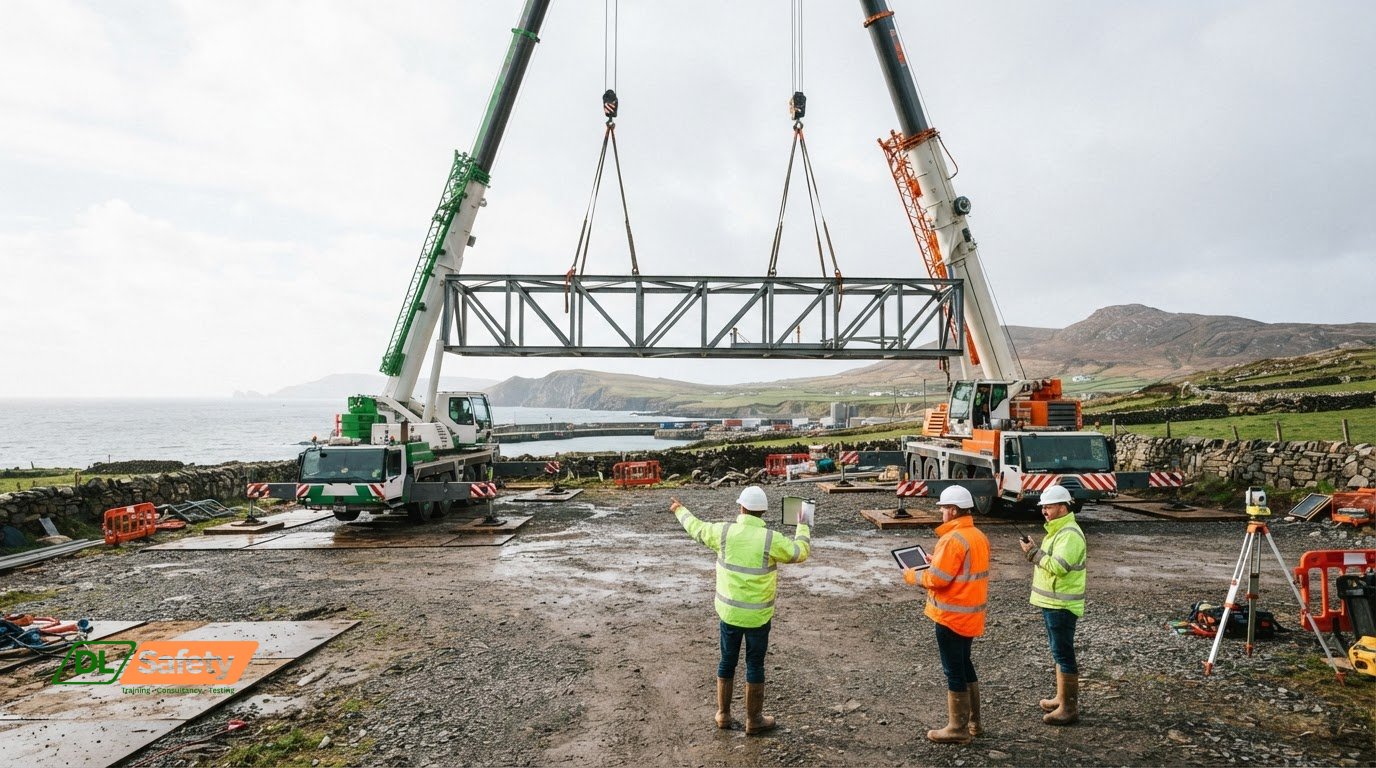
What if one crane’s movement changes how much of the load the other is carrying? In a tandem lift, the two cranes need to be planned as one system. These tandem lift planning considerations bring the key questions into focus: how the load will be shared, whether each crane is suitable for its part of the lift, and how movements and communication will be coordinated.
A practical plan turns site details and equipment information into a clear sequence. It sets out roles, communication methods and movement steps before the lift begins, and helps identify when the proposed arrangement needs further technical assessment.
This checklist covers the load, cranes and lifting equipment, ground and site conditions, and the coordination needed to carry out the lift. DL Safety develops lift plans for construction and industrial projects across Ireland, helping make complex lifting operations easier to plan and document. To discuss a project, visit www.dlsafety.ie, email info@dlsafety.ie or call 085 8316885.
Key Takeaways
- Gather verified load details, including weight, centre of gravity, dimensions and approved lifting points, before settling the crane arrangement.
- Record each crane’s configuration, capacity information, working radius and planned position to support a project-specific assessment.
- Map each movement stage and consider how the load share may change, so operators and the lift team have a clear sequence to follow.
- Use these tandem lift planning considerations to organise document review, site checks, briefing and pre-lift readiness. Remember, a checklist does not replace technical assessment.
- For a complex arrangement, a professionally developed lift plan can bring load data, ground conditions, crane positions and coordination together in clear site documentation.
Tandem lift planning considerations: when does a two-crane lift need extra planning?
A tandem lift is an operation in which two cranes work together to handle one load, with their movements coordinated to keep it controlled. Unlike a single-crane lift, it involves two crane systems acting on the same load. Each crane’s position, configuration and movement can affect how the load is supported. Planning must therefore consider the operation as a whole, rather than treating it as two separate capacity checks.
If you’re unfamiliar with the equipment, this overview of cranes offers a useful starting point. A general guide can explain planning considerations, but it can’t verify a particular crane arrangement or replace project-specific assessment. Suitability depends on accurate load information, each crane’s capacity for its planned configuration, site conditions and the full movement sequence. These tandem lift planning considerations help identify what needs assessment before decisions are made.
What makes a tandem lift different from a single-crane lift?
Two cranes support one load through separate lifting points and systems. If the load shifts, a crane moves or the geometry changes, the forces carried by each crane can change too. Never assume the cranes will share the load equally. The distribution depends on the load and the planned arrangement, and needs to be assessed for the lift.
When should the lift plan receive additional scrutiny?
Some arrangements leave less room for uncertainty. Complex load geometry, restricted access or limited visibility can make positioning and coordinated movement harder to manage. Simultaneous crane movements and changing working radii also need careful consideration because they may affect load sharing and the sequence.
Review the documented plan if an assumption changes, site conditions differ from those assessed, or the equipment arrangement is altered. Even a seemingly minor change can affect how the lift is carried out. Record what has changed and whether the revised arrangement has been assessed before work proceeds.
A useful review connects the load data, crane capacities and positions, ground and site conditions, and intended movements in one practical plan. Where the arrangement is complex or key information is uncertain, project-specific lift planning is a sound next step. DL Safety prepares project-specific lift plans to bring those details together in clear, usable site documentation.
Assess the load, cranes and ground before finalising a tandem lift plan
Verified load data and the correct crane configuration are the foundation of a workable tandem lift plan. If either is uncertain, the proposed arrangement can’t be assessed reliably. A competent planner needs to consider how the load is shared at each stage, using project information rather than assumptions or a default split between cranes.
What load information belongs in the plan?
Start with confirmed details of the load and how it will be connected. The plan should record:
- Verified weight and dimensions, including the load’s shape and any features that affect how it hangs.
- The centre of gravity, so the planner can assess how the load is likely to balance.
- Approved lifting points and the intended rigging arrangement, including where attachments connect to the load.
Attachment positions and rigging can influence how forces are distributed between the cranes. If the weight, centre of gravity or lifting-point information is uncertain, resolve the assumptions before relying on capacity calculations. A drawing or estimate should not be treated as verified data without assessment.
How should crane capacity and ground conditions be considered?
Record each crane’s configuration, relevant capacity information, planned operating position and working radius. Assess each crane against the conditions it will actually work in, not just a general capacity figure. The planner also needs to consider how each crane’s contribution may change as the load is raised, moved or positioned.
Ground conditions matter at both set-up locations. Include the site’s ground-bearing assessment, specified support arrangements, access routes and any restrictions affecting crane positioning or set-up. Make these assumptions visible in the plan, so the site team can confirm the actual conditions match the assessed arrangement.
Keep the lifting-equipment examination records relevant to the equipment being used. DL Safety provides GA1 Testing, which should be considered alongside the project-specific assessment of the load, rigging and cranes. For context, the linked OSHA rule for multiple-crane lifts is a United States regulation, not Irish law, so it should not be treated as the governing requirement for an Irish project.
DL Safety’s lift planning support brings project information together in usable site documentation. To discuss your requirements, visit www.dlsafety.ie, email info@dlsafety.ie or call 085 8316885.
Compare the lift sequence, load sharing and communication arrangements
A coordinated lift needs a clear sequence, not just a start and finish point. The plan should show what each crane is expected to do at every stage, how the load share has been assessed, and where the team must pause before continuing. These tandem lift planning considerations turn calculations and site information into instructions that operators and the lifting team can use.
How should planners document load sharing and movement?
Record the assumptions used to assess how the load is shared between cranes, along with the technical basis for those assumptions. Then consider how planned movements, including changes in crane radius or load position, could affect each crane’s share and operating limits. Mark any stage that requires a hold or reassessment, so the lift doesn’t continue on an assumption that no longer applies.
A stage-by-stage table makes the sequence easier to review. The details below are prompts for a project-specific plan, not instructions for a particular lift.
| Stage | Lead action | Monitor | Hold point |
|---|---|---|---|
| Take-up | Coordinate gradual tensioning as set out in the plan. | Load response, rigging and crane behaviour. | Pause if the load does not respond as assessed. |
| Test lift | Raise only as specified in the plan, then pause. | Balance, attachment positions and load sharing. | Proceed only when the planned checks are satisfactory. |
| Travel, if required | Direct the agreed movement sequence. | Crane positions, changing radii and load movement. | Stop for unexpected movement or changed conditions. |
| Landing | Coordinate the final approach and placement. | Load stability, landing area and rigging response. | Pause if the load or landing conditions differ from plan. |
Who communicates and controls the coordinated lift?
Name one appointed lead in the plan to coordinate instructions and the sequence. Define the project-specific roles of crane operators, slingers and signallers, including who gives directions and how each operator receives them. Agree the communication method, signals and visibility arrangements before the lift begins. If communication is lost, unclear or conflicting, everyone should know the stop instruction and understand that work must pause until coordination is restored.
Brief the team on the sequence, hold points and stop instruction before starting. Clear, consistent communication gives everyone a shared picture of the next movement and when to wait.
Pre-lift checklist to confirm readiness and manage change
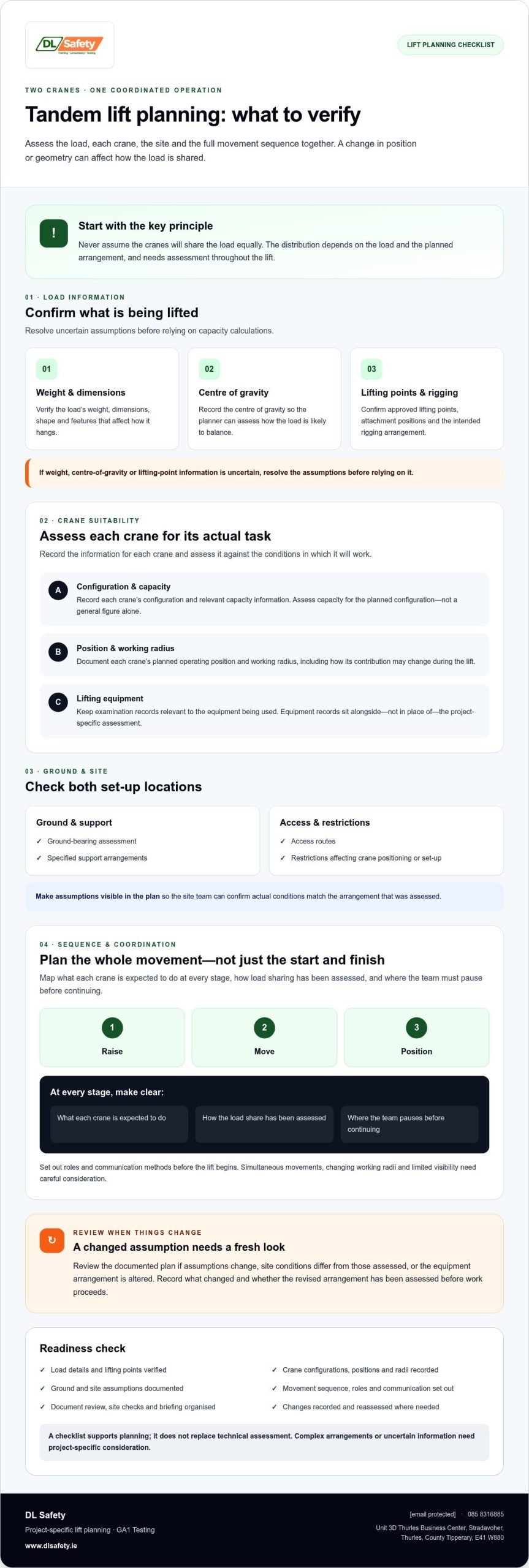
A pre-lift checklist helps the team confirm that the planned arrangement is ready to proceed, but it is a planning aid, not a substitute for site-specific assessment. Use it in order: review the documents, verify the set-up, brief the team, then complete the agreed pre-lift checks. These tandem lift planning considerations help confirm the plan still matches conditions on the day.
What should the team verify before the lift begins?
- Review the documents: make sure the current approved lift plan, load information and equipment arrangements are available to the people carrying out the lift.
- Check the site set-up: compare crane positions and ground support with the plan, and confirm exclusion arrangements are in place.
- Confirm access and movement controls: check that access routes and crane movements align with the site’s relevant traffic management arrangements.
- Brief the team: cover roles, the agreed sequence, hold points, communications and the stop-work instruction so everyone knows when to pause.
- Complete pre-lift checks: confirm the planned arrangements are in place and that the team can communicate as agreed before starting.
A clear briefing gives operators, slingers, signallers and the appointed lead a shared understanding of the sequence. If a check cannot be completed or a planned control isn’t in place, resolve the issue before proceeding.
When should the lift pause for reassessment?
Pause if actual conditions differ from the plan or the assumptions it relies on. Triggers can include changed load information, rigging or crane configuration, weather or ground conditions, reduced visibility, or a movement sequence that can’t be followed as planned. A change to access or nearby activity may also affect site controls and crane movements.
Material changes require review before the lift proceeds. Record what has changed, reassess the plan and communicate revised controls to everyone involved. Restart only when the updated arrangements are understood and the team is ready to follow them. Don’t rely on an informal adjustment if it could affect the assessed lift or how the cranes are coordinated.
For a project-specific lift plan that sets out the sequence, checks and change controls clearly, explore DL Safety lift planning.
Bring tandem lift planning together with a clear, project-specific lift plan
A tandem lift plan brings the job’s key information into one coordinated document. Load data, lifting points, crane configurations, ground conditions and the movement sequence need to work together, so the team understands how the lift is intended to proceed and what controls apply at each stage. Reviewing these tandem lift planning considerations as a whole helps identify gaps before they become on-site uncertainties.
Project-specific planning is particularly valuable where the load is difficult to handle, crane positions are constrained, access is restricted or movements may affect how the load is shared. It’s also a sensible next step when the lift relies on assumptions that need technical assessment. A clear plan can set out the assessed arrangement, communication structure, hold points and change process in usable site documentation.
What information helps develop a project-specific lift plan?
Gather information about both the load and the actual working environment. Drawings and site details help connect the proposed crane arrangement to the lift sequence, rather than leaving important decisions to be made at set-up.
- Load details, lifting points, relevant drawings and the intended movement sequence.
- Each crane’s configuration, proposed position and available capacity information.
- Site layout, access constraints, ground information and any known conditions that could affect set-up or movement.
- Relevant operating arrangements, team roles and planned communication methods.
Identify uncertain information early. The plan can then show what needs resolving or assessing before the lift proceeds, rather than presenting an unverified assumption as settled fact.
How can DL Safety support the planning process?
DL Safety provides lift plans for construction and industrial work, bringing project information together in coordinated, practical documentation. The plan is shaped around the project details and the requirements of the lift. Where crane access interacts with vehicle or pedestrian routes, include the relevant site traffic management arrangements in the planning information so these interfaces are considered alongside crane movements.
To discuss a project-specific lift plan, prepare the available load and site information, then contact DL Safety through lift planning support, email info@dlsafety.ie or telephone 085 8316885.
Make your next tandem lift easier to plan
A coordinated tandem lift starts with reliable load information, crane and ground assessments, and a movement sequence the team understands. Clear communication and agreed hold points help everyone know what to do, while a documented review keeps the plan aligned with changing conditions. These tandem lift planning considerations are a practical starting point, but complex arrangements benefit from project-specific assessment.
DL Safety provides lift plans for construction and industrial work across Ireland, helping turn project details into clear, usable documentation. To discuss your requirements, discuss a project-specific lift plan with DL Safety, email info@dlsafety.ie or call 085 8316885. Visit www.dlsafety.ie to get in touch.
With reliable information and a well-coordinated plan, your team can approach the lift with greater clarity and confidence.
Frequently Asked Questions
What should a tandem lift plan include?
A tandem lift plan should bring together verified load details, crane arrangements, site conditions and the coordinated movement sequence. Include the load’s weight, centre of gravity, dimensions and lifting points, plus each crane’s configuration, capacity information, working radius and position. The plan should also set out rigging, load-sharing assumptions, roles, communications, hold points and stop-work instructions. Keep the information project-specific so the team can follow a clear, agreed approach.
How is the load shared between two cranes during a tandem lift?
Load sharing is assessed for the particular load, lifting points, rigging and crane positions. It shouldn’t be assumed that each crane carries an equal share. As the load is raised, moved or lowered, changes in its position or the cranes’ working radii can alter the forces on each crane. The plan should explain the basis for the assessment and consider how load distribution may change at each stage of the lift.
Can two cranes lift one load at the same time?
Yes, two cranes can work together to lift one load when the operation has been assessed and planned for that arrangement. The plan should consider the load, both cranes’ operating configurations, ground and site conditions, rigging, movement sequence and communication method. Operators need clear instructions and a shared understanding of when to move or pause. The suitability of a particular lift depends on its project-specific assessment, not simply on having two cranes available.
Who is responsible for coordinating a tandem lift?
The lift plan should identify a competent lead to coordinate the operation and provide clear instructions. It should also define the project-specific roles of crane operators, slingers and signallers, including who communicates with each operator. Agree the communication method, signals, visibility arrangements and stop instruction in advance. Everyone involved should understand the sequence and know to pause if directions are unclear or communication is lost.
What happens if site conditions change during a tandem lift?
Pause the lift if conditions no longer match the plan or the assumptions used to assess it. Changes to the load, rigging, crane configuration, ground conditions, weather, visibility or access may affect the planned operation. Record the change and review its effect on the lift before continuing. Communicate any revised controls and instructions to the team, then proceed only when the updated arrangements are understood and the lift can be carried out as planned.
Do tandem lifts require a lift plan in Ireland?
In Ireland, lifting operations must be planned by a competent person and carried out safely. A tandem lift involves two cranes supporting one load, so it calls for careful, project-specific planning. A documented lift plan helps set out the load and crane arrangements, site conditions, movement sequence and coordination controls. The exact planning requirements depend on the operation, and applicable Irish requirements should be considered for the project.
When should a tandem lift be reassessed?
Reassess the lift before proceeding if the load, rigging, crane set-up, site conditions, visibility or planned movements change, or if the operation doesn’t respond as expected. Document the review and brief the team on any revised controls. DL Safety provides lift plans for construction and industrial work. For planning support, visit www.dlsafety.ie, email info@dlsafety.ie or call 085 8316885.