Did you know that whilst traditional classroom lectures result in a measly 5% to 10% knowledge retention rate, immersive simulation training boasts a staggering 75%? It is a frustrating reality for many site managers across Ireland who are tired of “death by PowerPoint” and the high stakes of training new operators on live, expensive machinery. You likely want your team to be truly competent rather than just technically compliant, but proving that readiness during a rigorous site audit often feels like an uphill battle.
This article explores how simulation safety training construction technology bridges the gap between theoretical knowledge and high-risk reality, helping you reduce accidents by up to 43% whilst ensuring total site compliance. We will examine the measurable ROI of digital training, the potential for lower insurance premiums, and how these virtual tools integrate seamlessly into your existing Safety Management Systems to create a safer, more engaged workforce for 2026.
Key Takeaways
- Learn how “consequence-free failure” boosts knowledge retention to 75%, allowing workers to build instinctive muscle memory for high-risk procedures without the danger of a live site.
- Understand the different tiers of simulation safety training construction, from Virtual Reality (VR) headsets to machinery-specific simulators, and how to choose the right fit for your project.
- Discover how to link simulation performance data directly to individual competency records for seamless integration with your Safety Management System and site audits.
- Compare the long-term cost-benefit of digital simulation against traditional methods, including the potential for reduced insurance premiums and lower equipment hire costs.
- See how combining advanced technology with expert strategy ensures your training is a proactive tool for reducing site accidents rather than a simple box-ticking exercise.
Defining Simulation Safety Training for the Modern Construction Sector
For years, site safety was a matter of reading manuals and sitting through lengthy presentations. Today, simulation safety training construction has redefined what it means to be site-ready. It is no longer just a digital add-on; it’s a fully immersive, interactive experience that replicates real-world site hazards with startling accuracy. By 2026, this technology has become the gold standard for proving high-risk competency across Ireland. It allows workers to step into a digital twin of a live site, where they can make mistakes, witness the consequences, and refine their skills without a single person being put in harm’s way.
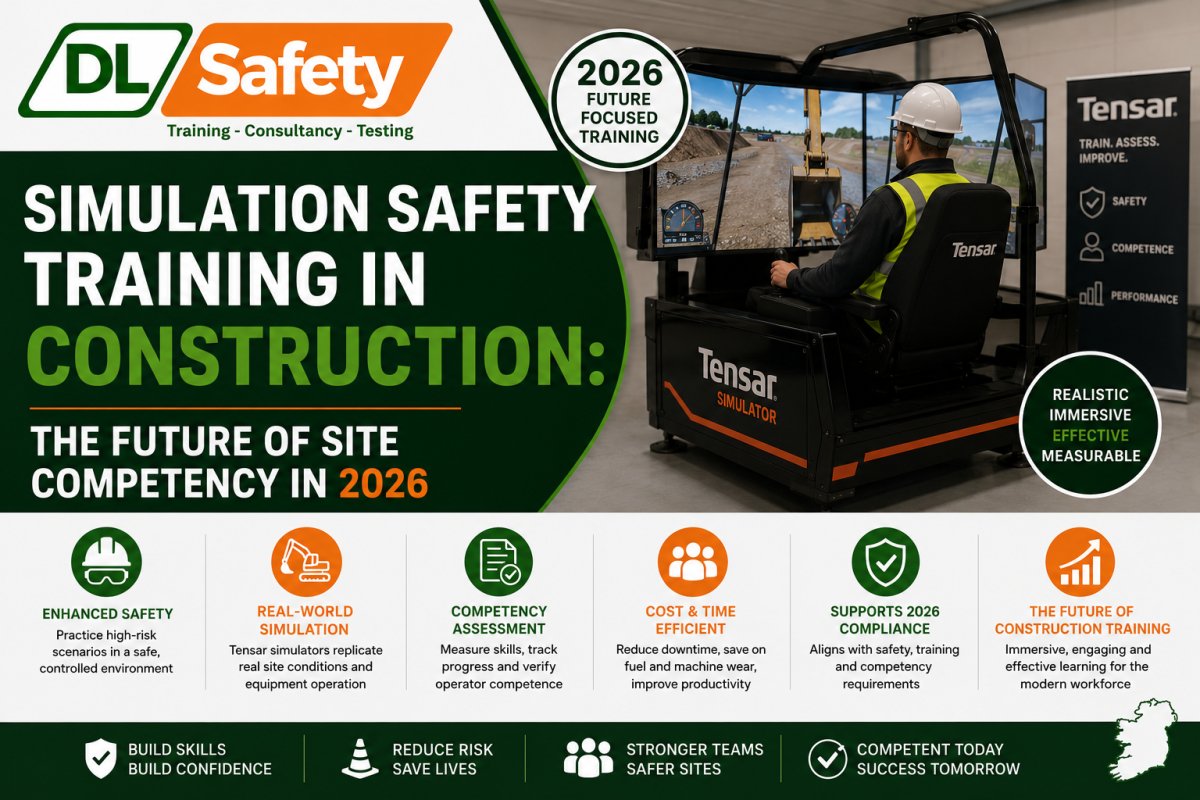
Modern simulation-based training typically falls into three categories. Virtual Reality (VR) uses headsets like the Meta Quest 3 to place workers directly inside a 3D environment. Desktop-based simulations offer interactive, 360-degree scenarios on a standard computer, which is ideal for remote learning. Finally, machinery-specific simulators use physical controls to mimic the exact “feel” of operating heavy plant equipment. This shift represents a move away from passive online safety courses Ireland workers are accustomed to towards active, experiential learning where the trainee is the protagonist of their own safety story.
The Evolution from Classroom to Digital Reality
Traditional “talk and chalk” methods are failing modern construction sites because they don’t account for the psychological reality of high-pressure environments. You can’t learn how to react to a sudden structural failure by looking at a slide deck. Digital twins and 3D environments now create realistic site conditions that mirror the complexities of an Irish building project. In these spaces, learning becomes active. Instead of being told what to do, workers must navigate the site, identify risks, and take action. This hands-on approach is why retention rates jump from 10% for reading to 75% for “doing” in a simulated environment.
Core Components of an Effective Construction Simulator
A truly effective simulation safety training construction module isn’t just a game; it’s a precise educational tool. It focuses on three core pillars:
- Hazard identification modules: These train the eyes to spot “unseen” dangers, such as subtle ground instability or poorly secured overhead loads, before they become fatal.
- Scenario-based decision making: This uses a “what happens if” approach, forcing workers to choose between different actions and seeing the immediate, often visceral, results of those choices.
- Instant feedback loops: Unlike a real-world accident, a simulator provides immediate data. It corrects dangerous behaviour in real-time, explaining why a choice was risky and how to rectify it.
This methodical approach ensures that by the time a worker steps onto a live site, their safety habits are already instinctive. They aren’t just remembering a rule; they’re relying on experience they’ve already gained in a safe, controlled environment.
The Psychology of Risk: How Simulators Transform Safety Behaviour
Most construction workers in Ireland are highly skilled, but years of incident-free work can often lead to “optimism bias”, a dangerous psychological state where individuals believe accidents only happen to others. This mental barrier is exactly what simulation safety training construction aims to dismantle. By creating an environment where risk feels visceral rather than theoretical, we can shift a worker’s perspective from passive compliance to active self-preservation. It isn’t just about knowing the rules; it’s about feeling the consequences of breaking them.
Emotional engagement is the secret to lasting behavioural change. When a trainee sees a virtual crane collapse or experiences the sudden shock of a simulated fall from height, the brain processes the stress as if it were real. This “consequence-free failure” creates a powerful memory anchor that stays with the worker long after they’ve removed the headset. Unlike a textbook, which only engages the logical mind, a simulator engages the senses, making the lessons stick because they are experienced rather than just read.
Building Instinctive Competency through Repetition
Executing a complex lift plan requires more than just understanding the physics; it requires the physical ability to react under pressure. Simulators bridge the gap between knowing a procedure and executing it by allowing for endless repetition, which strengthens the neural pathways responsible for physical action. By using a specialised hazard-identification training tool, workers can practice their response to site dangers until the correct action becomes second nature. Repeated virtual exposure to high-stress scenarios ensures that when a real emergency occurs, the brain bypasses panic and moves straight into trained, decisive action.
The Value of “Safe Failure” in High-Stakes Environments
In the real world, a mistake on a high-stakes site often leads to injury or costly equipment damage. In a simulator, however, failure is a valuable teaching moment that provides instant clarity on risk assessment. Allowing trainees to witness the catastrophic results of a missed safety check fosters a deeper level of site awareness. They don’t just know the safety rule; they understand the “why” behind it. This approach to simulation safety training construction also promotes a culture of transparency amongst teams. When workers can discuss their virtual mistakes openly, it leads to proactive problem-solving and a shared commitment to site integrity that benefits everyone.
Comparing Training Methods: Simulation vs. Traditional Classroom Learning
The gap between reading a safety manual and managing a live site is vast. Traditional classroom models, often dubbed “death by PowerPoint,” are increasingly seen as a relic in a high-stakes industry where passive listening rarely translates to active site safety. By adopting simulation safety training construction, Irish firms are moving away from static instruction towards a model where retention rates soar. Research shows that whilst lecture-based learning yields a retention rate of just 5% to 10%, immersive simulation hits 75%. This isn’t just a minor improvement; it’s a fundamental shift in how workers process and recall life-saving information.
Logistically, the comparison is equally stark. Training on live machinery requires hiring expensive plant, burning significant amounts of fuel, and pulling experienced supervisors away from their primary duties. Digital simulations eliminate these overheads. They provide a consistent, repeatable training standard that doesn’t fluctuate based on the instructor’s mood or the weather. Citing research into How Training Technology Prevents Hazards, it’s clear that simulators offer a risk-free space to develop skills that are directly transferable to the field without the environmental or financial cost of heavy machinery idling.
Safety, Speed, and Scalability
Simulation allows for training to continue regardless of external factors. In Ireland, where extreme weather can frequently halt on-site activities, virtual modules ensure that competency development stays on schedule. It reduces machinery downtime and allows for the scalability of training across national workforces. You can train ten workers in different counties simultaneously using the same virtual scenario, ensuring every team member receives the exact same high standard of instruction. Because VR learners complete their training four times faster than classroom students, your team spends less time in a chair and more time being productive on-site.
The ROI of Modern Safety Training
Investing in simulation safety training construction offers a measurable return on investment that goes beyond simple compliance. Firms investing in digital training report an average ROI of 250% through reduced accident rates and improved efficiency. There is also a significant impact on your professional reputation and bottom line; 60% of contractors report lower insurance premiums when they can demonstrate a robust, data-driven safety record. When you consider that a single serious site accident can result in fines exceeding €150,000, the cost of the technology becomes a sensible, proactive investment in your business’s future stability. To understand the full compliance landscape your business must navigate, our guide to online safety courses Ireland firms rely on covers the latest HSA standards for 2026 in detail.

Integrating Simulation into Your National Safety Management System
Adopting simulation safety training construction technology is most effective when it is not treated as a standalone activity but as a core component of your broader Safety Management System (SMS). To truly bridge the gap between theory and reality, you should map specific simulation modules directly to the risks identified in your recent Health & Safety Site Audits. For example, if an audit highlights recurring issues with plant-pedestrian interfaces, your training focus should shift immediately to vehicle exclusion zone simulations. This creates a proactive feedback loop where real-world data informs virtual practice, ensuring your safety strategy is always reactive to the actual conditions on your Irish sites.
The Health and Safety Authority (HSA) places a heavy emphasis on the “competent person” standard. Simulation provides a quantifiable, data-backed method to prove this competency. Instead of relying on a simple signature on an attendance sheet, you can now show a digital performance record of a worker successfully navigating a complex hazard. This level of detail is invaluable during modern site inductions and “toolbox talks”, where short, targeted simulation exercises can be used to keep high-risk procedures fresh in the minds of the workforce. It moves the conversation from “we told them” to “we proved they can”. For a broader perspective on how different training methods compare for meeting these standards, our guide to workplace safety training Ireland businesses rely on for 2026 compliance provides a comprehensive breakdown of online, face-to-face, and simulation approaches.
Compliance and Record Keeping in 2026
During a site inspection, being able to produce a digital trail of worker performance simplifies the entire compliance process. By linking simulation performance data to individual competency records, you provide a robust level of “proof of competency” that traditional logs simply cannot match. Integrating these digital training logs with our Monthly Safety Support Packages ensures that your compliance documentation remains current, centralised, and ready for any audit. Under Irish safety law, the provision of verifiable and up to date training records is a non-negotiable legal necessity for any employer overseeing high-risk activities.
Customising Scenarios for Specific Site Challenges
Every construction project in Ireland carries its own unique set of challenges, from tight urban builds in city centres to expansive quarry operations. Simulation allows you to adapt training scenarios for these specific environments, ensuring that your Traffic Management Design and complex Lift Plans are rehearsed virtually before any physical work begins. This “digital rehearsal” identifies potential pinch points or clearance issues in a risk-free space, significantly reducing the likelihood of on-site errors. Furthermore, using simulation to investigate “near misses” allows teams to recreate a close call and analyse the root cause collectively, preventing future occurrences and building a culture of shared responsibility. To see how these digital tools can be tailored to your specific site risks, explore our Simulation Training solutions today.
Elevating Workforce Standards with DL Safety’s Training Solutions
At DL Safety, we believe that technology is only as effective as the strategy behind it. Whilst many providers treat simulation safety training construction as a standalone software product, we view it as a critical piece of a much larger puzzle. Our approach is that of a “Personable Expert”; we don’t just hand you a headset and leave you to it. Instead, we work alongside you to ensure that the virtual scenarios your team experiences are directly aligned with the technical realities of your site, from the integrity of your lifting equipment to the accuracy of your traffic management layouts.
This holistic view allows us to integrate simulation data with our other core services, such as GA1 Testing and comprehensive Health & Safety Site Audits. By combining physical inspections with digital training performance, we provide a 360-degree view of site competency. If a simulation reveals a recurring error in how a team handles Lifting Chains or Lifting Shackles, we can address that specific gap through targeted on-site support or updated Lift Plans. This level of cohesion ensures that your safety standards aren’t just high on paper, but are lived and breathed by every member of the workforce.
Beyond the Screen: A Holistic Safety Partnership
Our simulations are designed to complement our on-site technical testing and strategic planning. Having a dedicated safety advisor to interpret simulation data means you aren’t just looking at scores; you’re looking at actionable insights into your team’s behaviour. We support Irish firms in building a culture of excellence and integrity, where safety is seen as a shared value rather than a regulatory burden. Managing modern training is complex, but our Monthly Safety Support Packages provide the steady, reliable oversight needed to keep your projects moving safely.
Getting Started with Modern Safety Training
Transitioning to digital-first safety learning doesn’t have to be overwhelming. The first step is assessing your current training gaps to identify where simulation can provide the most immediate impact. Whether it’s high-risk plant operation or complex hazard perception, we help you map out a transition that feels natural for your team. By moving towards interactive modules, you’ll see a measurable reduction in accidents and a significant boost in workforce engagement. It is about building a future where every worker returns home safely every day.
Contact DL Safety today to discuss our simulation and safety support packages. We’re here to help you navigate the future of site competency with confidence and clarity.
Building a Resilient Safety Culture for the Future
The shift towards immersive site safety is no longer a futuristic concept; it’s a present-day necessity for any firm looking to lead in 2026. By adopting simulation safety training construction, you aren’t just ticking a box for compliance. You’re giving your workforce the tools to build muscle memory and react instinctively to hazards that a traditional slide deck simply cannot replicate. This proactive approach turns potential site failures into valuable, risk-free learning moments that protect both your people and your bottom line.
DL Safety, led by David, an experienced Irish H&S professional, provides the pragmatic, solution-oriented support you need to navigate this transition. We specialise in integrating these digital tools with our core services, such as GA1 and technical testing, to offer a truly 360-degree safety view. Our monthly support packages ensure your strategy remains as dynamic as the projects you manage. Explore our Online Safety Courses and Simulation Training to see how we can help you protect your team and your reputation. Let’s work together to make your site the safest it’s ever been.
Frequently Asked Questions
Is simulation safety training as effective as on-site training?
Simulation training is highly effective because it allows for “consequence-free failure” which is impossible on a live site. While on-site training is valuable for physical orientation, simulation boasts a 75% retention rate compared to just 10% for traditional reading. It builds the necessary muscle memory for high-risk tasks without the physical danger or the cost of hiring heavy plant machinery.
How does simulation training help with Irish safety compliance?
This technology provides a verifiable, data-backed record of a worker’s competency, directly supporting the “competent person” requirements set by the Health and Safety Authority (HSA). By integrating simulation safety training construction into your Safety Management System, you move beyond simple attendance sheets. You gain a detailed performance log that proves a worker can identify hazards and make safe decisions under pressure.
Can simulation training reduce my business insurance premiums?
Yes, many Irish insurers recognise the value of robust, data-driven safety programmes. Statistics indicate that 60% of contractors report lower insurance premiums when they can demonstrate a superior safety record through digital training logs. By reducing your accident rate by up to 43% through simulation, you present a much lower risk profile to your insurance provider, which often leads to significant cost savings.
What equipment is needed for construction safety simulations?
The equipment depends on the level of immersion you require, ranging from simple desktop setups to full Virtual Reality (VR). For the most immersive experience, a VR headset like the Meta Quest 3 is commonly used to place workers inside a 3D environment. Alternatively, machinery-specific simulators use physical joysticks and pedals to mimic the controls of plant equipment, while standard desktop simulations only require a modern computer and an internet connection.
How long does a typical safety simulation training module take?
Most simulation modules are designed to be concise and targeted, typically taking between 15 and 30 minutes to complete. Because VR learners complete their training four times faster than those in a classroom environment, you can cover complex high-risk scenarios in a fraction of the time. This efficiency reduces site downtime and allows workers to return to their primary duties with improved safety awareness.
Is simulation training suitable for experienced site workers or just beginners?
It is highly beneficial for both groups, though the focus of the training often differs. Beginners use simulators to learn foundational safety protocols and machinery controls in a stress-free environment. Experienced workers, on the other hand, use simulation to rehearse rare emergency procedures or complex manoeuvres that are too dangerous to practice on a live site, ensuring their instincts remain sharp for high-pressure situations.
How do I track the progress of my team in an online safety course?
Progress is tracked through an integrated digital dashboard that provides real-time data on every worker’s performance. When your team completes an Online Safety Course or simulation module, the system logs their completion time, assessment scores, and specific areas where they may have struggled. This data allows you to identify site-wide knowledge gaps and tailor your safety support strategy accordingly.
What happens if a worker fails a simulation scenario?
Failure in a simulator is treated as a valuable learning opportunity rather than a setback. If a worker makes a dangerous choice, the simulation provides an instant feedback loop, showing the catastrophic result and explaining the correct procedure. The worker can then immediately retry the scenario until they demonstrate the required level of competency. This ensures that mistakes are made virtually, where they are safe, rather than on a live construction site.