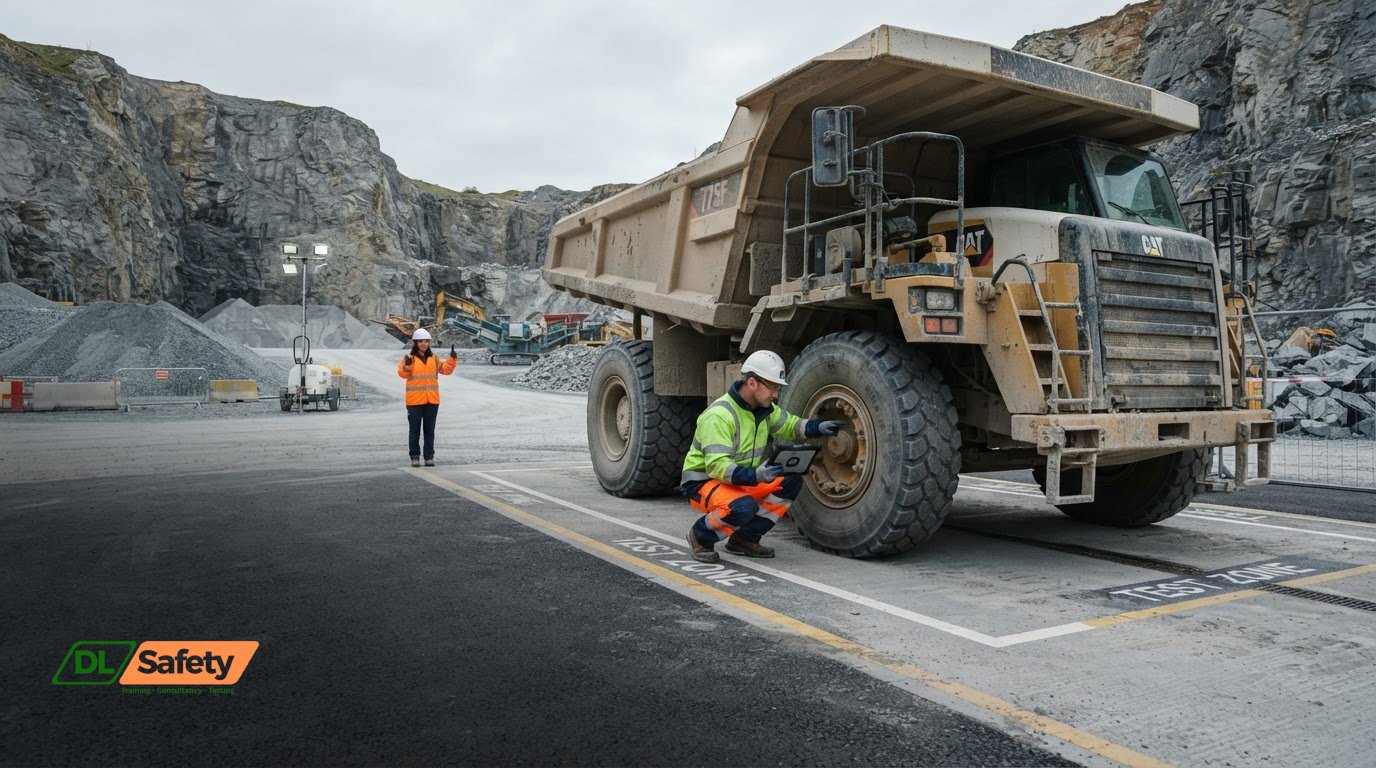
Planning quarry vehicle brake testing Ireland-wide means more than booking a test. A clear plan for vehicle movements, work schedules and site access helps the team organise testing around daily operations and avoid preventable delays.
Before arranging an on-site visit, site managers often want to know what the test covers, how to organise the vehicles and what to do with the results. This guide explains how to prepare, what to clarify about the testing scope and how to compare on-site and off-site arrangements. Test records can help you understand braking results, but they are only one part of wider safety management. DL Safety provides on-site quarry vehicle brake testing across Ireland. Led by David, a health and safety professional with extensive Irish construction-sector experience, the team takes a practical approach to discussing the work and site arrangements.
Key Takeaways
- For quarry vehicle brake testing Ireland-wide, choose an arrangement that fits site access, vehicle movements and the work schedule.
- List the vehicles in scope and coordinate their availability before testing begins.
- Clarify what the test covers and what records will be provided, then keep relevant results with your site documentation.
- Compare on-site and off-site arrangements by considering access, travel and the coordination each requires.
- DL Safety provides on-site quarry vehicle brake testing across Ireland and can discuss the scope and practical site arrangements with your team.
Why quarry vehicle brake testing in Ireland needs a site-specific plan
Quarry vehicle brake testing assesses how effectively a vehicle’s braking system works under the conditions of the test. It provides a focused result on braking performance, not a complete assessment of the vehicle’s condition or a replacement for routine maintenance.
Quarry vehicles operate in busy environments where vehicle types, loads, routes and other site activity all affect how work is carried out. A site-specific plan helps fit testing into those conditions, rather than treating it as separate from daily operations. For general background on quarry settings and their activities, see Quarry operations and safety.
What does quarry vehicle brake testing assess?
The test focuses on braking. Routine driver checks and broader maintenance have different purposes: driver checks can help identify concerns during normal use, while maintenance addresses the vehicle’s general condition and required work. A brake test records the outcome of the test, but it should not be taken as confirmation that every part of the vehicle is in good order. The method and information recorded depend on the service arranged.
Why do quarry operations need a planned approach?
Testing has to account for which vehicles are available and how they move around the site. A vehicle may be needed for scheduled work, or its route to the testing area may cross other site activity. Coordinating the visit with the site team helps organise those movements and reduce avoidable disruption.
The practical plan will depend on the fleet and site layout. A site with several vehicle types, restricted access or a tightly scheduled working day may need different arrangements from one with more flexibility. Agreeing the scope and considering access, vehicle movements and timing in advance gives the team a clear basis for organising the day.
There is no single testing frequency set out here. Consider quarry vehicle brake testing in the context of your operating conditions and relevant guidance rather than relying on an assumed interval. A clear site plan keeps the test focused on the vehicles in scope and the practical needs of the operation.
How on-site quarry vehicle brake testing works, from planning to records
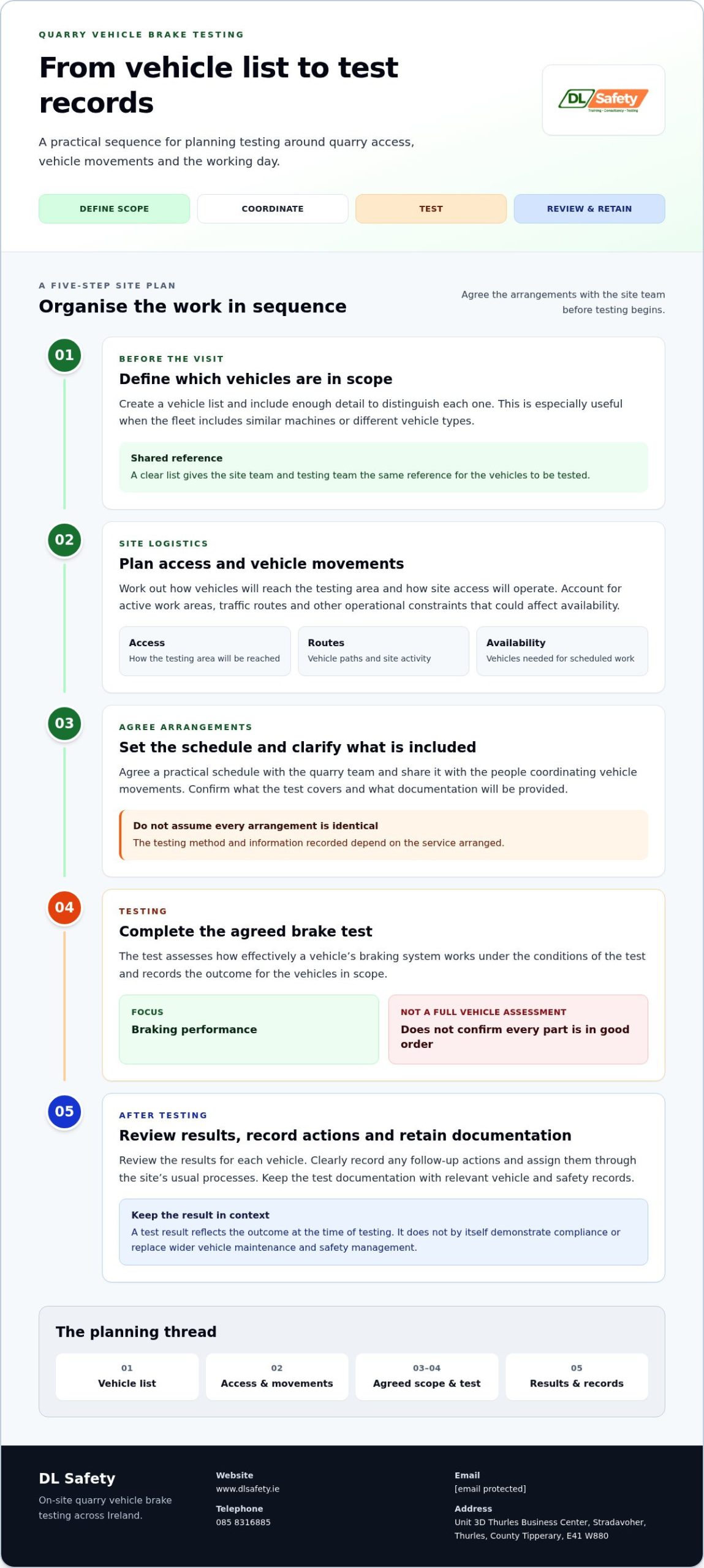
A clear process helps the site team understand what is included and fit the work around quarry operations. For quarry vehicle brake testing, a useful sequence is to agree the scope, coordinate access and vehicle movements, complete the testing, then review and retain the relevant records.
What should the site team organise before testing?
Start with a vehicle list and identify which vehicles are in scope. Include enough detail to distinguish each one, especially if the fleet includes several similar machines or different vehicle types. This gives the site team and testing team a shared reference and reduces the chance of confusion on the day.
Next, plan how vehicles will reach the testing area and how site access will work. Consider active work areas, traffic routes and operational constraints that could affect vehicle availability. Agree a practical schedule with the quarry team in advance and share it with the people coordinating vehicle movements. Clear communication helps avoid unnecessary waiting and makes it easier to adjust if site activity changes.
Clarify what the agreed test covers and what documentation will be provided. The method and outputs can vary with the service, so do not assume every test follows the same process or produces identical records.
What should happen after the test?
Review the results for each vehicle in scope. Record any follow-up actions clearly and assign them through the site’s usual processes. A test result is evidence of the outcome at the time of testing, but it does not by itself demonstrate compliance or replace wider vehicle maintenance and safety management.
Keep the test documentation with relevant vehicle and safety records so it can be retrieved and considered alongside other fleet information. If a result raises questions about action or legal obligations, refer to current Irish guidance relevant to the situation. Do not rely on an old document or assumed testing interval without checking that it remains relevant.
Good preparation makes testing easier to manage: define the scope, organise vehicle availability, plan access and keep communication clear before and during the visit. DL Safety provides on-site quarry vehicle brake testing across Ireland, with a practical approach to agreeing the scope and site arrangements.
On-site or off-site brake testing: compare the practical options
The choice between on-site and off-site testing comes down to how each arrangement fits the quarry’s vehicles, access and work schedule. Consider how vehicles will reach the testing location, who will coordinate their movements and how the arrangement fits with normal activity. The right option depends on the site and agreed scope, not on an assumed difference in cost or performance.
When might on-site testing suit a quarry?
Testing at the operating site may be practical when moving vehicles elsewhere would require careful coordination or when fleet availability is closely tied to the work schedule. The number and type of vehicles, access routes and site layout all influence the plan. These factors help the team compare arrangements realistically; they do not automatically make on-site testing the best fit for every situation. DL Safety provides on-site quarry vehicle brake testing across Ireland.
What should a fair comparison include?
Compare the practical arrangements separately from the technical or regulatory position. Changing the testing location does not, on its own, establish that a different test method, result or legal standard applies. Clarify the agreed scope and check applicable requirements against current authoritative guidance.
| Practical consideration | On-site arrangement | Off-site arrangement | Technical or regulatory position |
|---|---|---|---|
| Vehicle movements | Plan access and movements within the quarry. | Plan the journey to and from the testing location. | Location alone doesn’t establish a different test requirement. |
| Scheduling | Coordinate vehicle availability with site activity. | Coordinate vehicle availability with travel and the appointment. | Any applicable intervals or requirements need to be verified separately. |
| Access and communication | Agree site access, the testing area and who will coordinate movements. | Agree arrangements for getting vehicles to the external location. | Confirm the scope, method and outputs for the service arranged. |
For example, a vehicle needed for scheduled quarry work may require a carefully chosen time slot under either arrangement. A clear construction site traffic management plan can help teams think through routes and movements, alongside the quarry’s own operating arrangements. Compare the coordination required and the effect on normal work instead of assuming one option will always cause less disruption.
With the scope and practical arrangements clear, the team can make an informed decision about the testing location. DL Safety’s on-site quarry vehicle brake testing service can be discussed in relation to site logistics and vehicle coordination.
How to prepare a quarry site and vehicle fleet for testing
A short planning conversation helps fit the testing day around the site instead of leaving vehicle access and availability to chance. Gather the practical details first, then agree who will coordinate arrangements with the testing team. These preparation steps do not replace checking the legal or technical requirements that apply to your operation.
What information should the quarry team gather?
Prepare a list of vehicles being considered for testing and clarify which ones are within the agreed scope. Vehicle identifiers and relevant records can help the team discuss the fleet. Keep useful information available, but do not assume every record will be needed.
Choose a named site contact to coordinate arrangements and share updates with relevant team members. Before the visit, discuss:
- Vehicle availability: which vehicles can be presented and when they are needed for site work.
- Access: the proposed entry route, testing area and any site-specific access constraints.
- Operating conditions: work schedules, active areas or other activity that may affect vehicle movements.
- Communication: who will brief drivers and site staff, and how changes to the agreed schedule will be shared.
A named contact gives everyone a clear point of coordination if a vehicle becomes unavailable or site activity changes. Agreeing a scheduling window in advance also helps the quarry plan around normal work.
How can testing fit around site traffic?
Plan vehicle movements alongside the site’s existing traffic-management arrangements. The site team can identify a suitable access route and working area, then communicate these arrangements to the people involved. Consider current activity and access conditions before settling on a testing location or route.
For broader background, read the quarry vehicle testing guide. Check mandatory requirements against current authoritative guidance for the vehicles and operation in question. A preparation checklist alone does not establish compliance.
In brief: agree the vehicles in scope, nominate a site contact, share access and scheduling constraints, and coordinate movements with the quarry’s existing arrangements.
For quarry vehicle brake testing, Ireland-wide sites can use DL Safety’s on-site service. Discuss the testing scope and practical arrangements with the team, then arrange on-site quarry vehicle brake testing as your next step.
Arrange on-site quarry vehicle brake testing with DL Safety
DL Safety provides on-site quarry vehicle brake testing across Ireland, helping quarry teams plan the service around their fleet and site operations. Led by David, a health and safety professional with extensive Irish construction-sector experience, the team takes a practical approach to discussing the scope, access arrangements and coordination needed for a visit.
To make the first conversation useful, share a clear picture of the vehicles involved and how they are used. Information about vehicle availability and site activity helps the team discuss arrangements that fit the operation.
What to include when making an enquiry
You do not need to prepare a lengthy brief. A few details can help establish what the site needs and which practical arrangements to discuss:
- Quarry location: where in Ireland the testing would take place.
- Vehicle types: a broad description of the fleet and the vehicles you would like included.
- Testing needs: the scope your team has in mind and any questions about the service.
- Site arrangements: access information, operating constraints and how vehicle movements are coordinated.
- Preferred timing: scheduling windows that may suit the site’s work programme.
Identify a site contact who can discuss access and coordinate with relevant team members. If vehicle availability changes or work plans affect the proposed arrangements, that contact can keep communication clear. The method and outputs depend on the service agreed, so discuss what the testing covers and what records will be provided.
Contact DL Safety
Quarry teams can discuss the scope and site arrangements for quarry vehicle brake testing with DL Safety. Email info@dlsafety.ie or call 085 8316885. Visit www.dlsafety.ie for more information.
If your quarry team is planning on-site testing, get in touch with the vehicle details, location and coordination needs to discuss a practical next step with DL Safety.
Discuss on-site quarry vehicle brake testing
Plan your next brake test with confidence
A workable plan is central to quarry vehicle brake testing Ireland-wide: define which vehicles are in scope, coordinate access and availability, and fit the arrangements around site movements. On-site and off-site options each have practical considerations, so base your decision on the fleet, site layout and operating schedule. Keep test records with relevant vehicle information, while treating them as one part of wider safety management.
Led by David, a health and safety professional with extensive Irish construction-sector experience, the team can discuss your requirements and practical site arrangements.
To start the conversation, email DL Safety at info@dlsafety.ie or call 085 8316885. Discuss on-site quarry vehicle brake testing with DL Safety.
With clear communication and a considered plan, your team can take the next step with confidence.
Frequently Asked Questions
What is quarry vehicle brake testing?
Quarry vehicle brake testing is a focused assessment of a vehicle’s braking performance in a quarry setting. The agreed testing scope determines what is assessed and recorded. It is distinct from routine driver checks, which help identify concerns during normal use, and general vehicle maintenance, which covers broader vehicle condition. A test result does not describe the overall condition of the vehicle or replace other relevant checks.
Can quarry vehicle brake testing be carried out on-site in Ireland?
Yes. Practical arrangements depend on the vehicles involved, site access and the quarry’s operating schedule. For example, the team may need to consider when vehicles are available and how they can reach the testing area. Sharing these details when arranging the service helps the site team and DL Safety discuss a workable scope and plan.
How often should quarry vehicles have their brakes tested?
There is no universal testing interval to apply without considering the vehicle and operation. Identify the current legal, manufacturer and site requirements relevant to your fleet, and use them to inform an appropriate inspection and maintenance programme. A specialist brake test can support the assessment of braking performance, but it does not replace other applicable checks or maintenance. If you are unsure which interval applies, consult current authoritative Irish guidance relevant to your circumstances.
What happens during an on-site quarry vehicle brake test?
The testing scope and method are agreed for the vehicles being assessed, so the process can vary with the service arranged. The site team coordinates vehicle access and operational arrangements, then the testing is completed on-site. Results and records depend on the agreed service. Before the visit, clarify which vehicles are in scope and what information will be provided after testing.
What should a quarry prepare before brake testing?
Prepare a list of vehicles in scope, nominate a site contact and share relevant access, traffic and scheduling constraints. For example, note when vehicles are available and any site activity that could affect their movements. This practical preparation helps organise the work around quarry operations, but it is not a statutory checklist. Confirm any required documents, vehicle condition criteria or site controls against the agreed service scope and current requirements for your operation.
Does on-site quarry vehicle brake testing mean vehicles do not need other inspections?
No. A brake test has a defined purpose and should not be treated as a replacement for all other applicable inspections, maintenance or checks. What else is relevant depends on the vehicle, workplace and requirements that apply to the operation. Continue to follow your established vehicle maintenance arrangements and use current authoritative Irish guidance when determining what is required. Test records can support your understanding of braking results, but they do not prove on their own that every wider safety obligation has been met.
How can I arrange quarry vehicle brake testing with DL Safety?
Contact DL Safety by phone on 085 8316885 or email info@dlsafety.ie to discuss on-site testing. Share the quarry location, vehicle types, approximate scope and any access or scheduling constraints so the conversation can focus on your site’s practical needs. Visit www.dlsafety.ie to learn more and take the next step.