
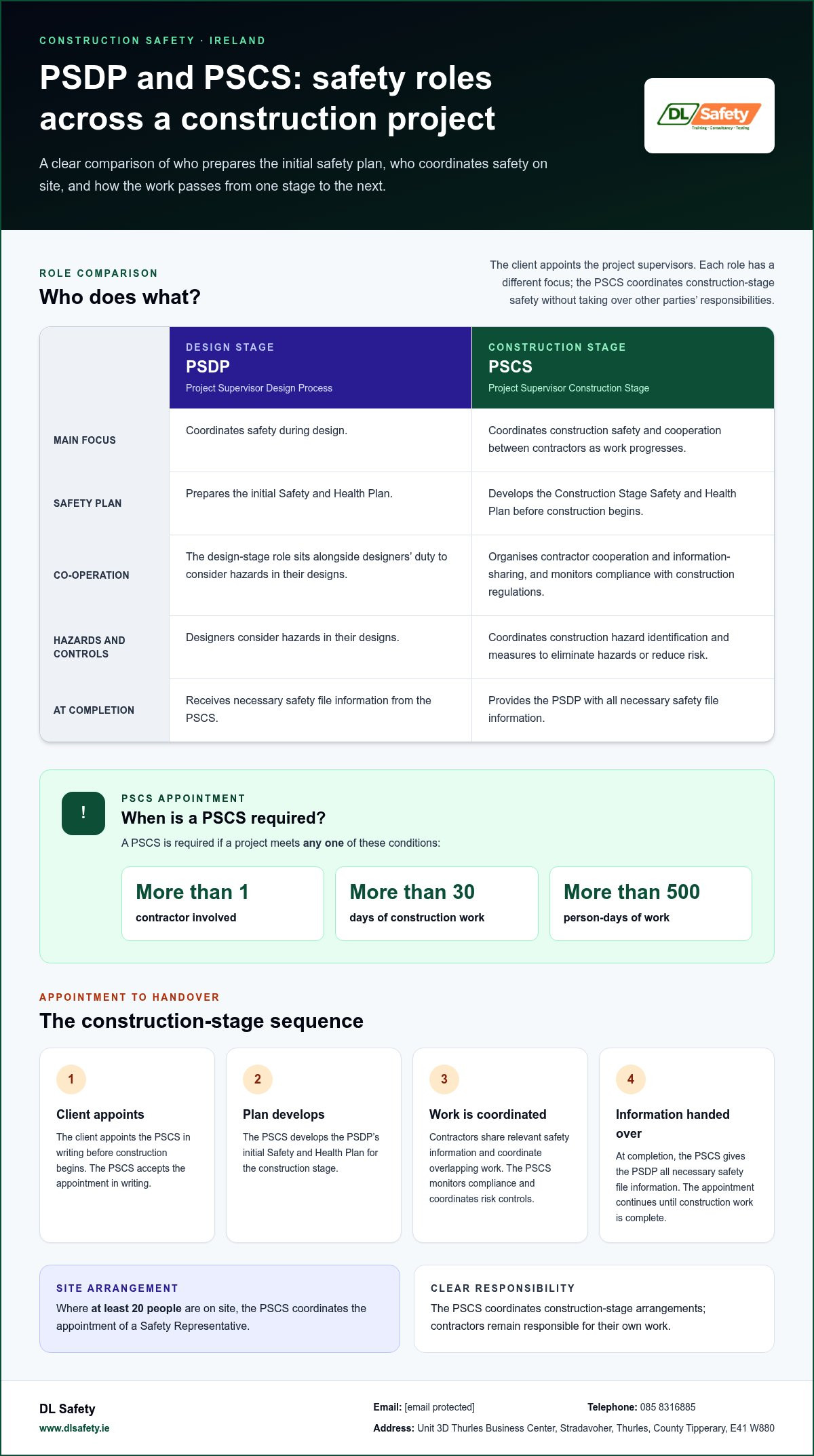
In Ireland, the role of a project supervisor construction stage (PSCS) is to coordinate construction safety and the work of contractors. A PSCS is required where a project involves more than one contractor, construction work lasts more than 30 days, or it involves more than 500 person days. The client appoints the PSCS in writing before construction begins, and the appointment continues until the construction work is complete.
It can be difficult to distinguish the PSCS’s responsibilities from those of the Project Supervisor Design Process (PSDP), especially when both roles relate to the same project. Knowing who coordinates safety on site, how risks are managed and what the appointment involves helps clarify each role.
This article explains the PSCS role, including contractor coordination, hazard identification and risk reduction, and how the role relates to the PSDP. It also covers legal entity requirements and key construction-stage duties, helping you understand how the PSCS supports safe project delivery.
Key Takeaways
- Understand when a PSCS appointment is required, including the project size and contractor conditions that trigger it.
- Know why the client must make the appointment in writing before construction begins, and when the role ends.
- See how the PSCS coordinates contractors, monitors safety arrangements and helps address construction hazards.
- Understand how the PSCS and PSDP duties connect, including the requirement to appoint each role to a legal entity.
- Find out how DL Safety’s Monthly Safety Support Packages can support businesses managing ongoing health and safety responsibilities.
What is the role of the Project Supervisor Construction Stage?
The PSCS coordinates construction safety and cooperation between contractors. Understanding the role of a project supervisor construction stage (PSCS) clarifies who coordinates these arrangements as work progresses.
In Ireland, a PSCS is required when a project involves more than one contractor, construction work lasts more than 30 days, or it exceeds 500 person days. The client appoints the PSCS in writing before construction begins, and the PSCS accepts the appointment in writing. The appointment continues until all construction work is complete.
Duties across the project team
The client appoints the project supervisors. The PSDP coordinates safety during design and prepares the initial safety and health plan. Designers consider hazards in their designs, while contractors organise safe work and cooperate with the supervisors. During construction, the PSCS coordinates safety and helps each party understand how its decisions and activities affect others on the project.
The PSCS does not take over the other parties’ responsibilities. Clear appointments and communication help clients, designers and contractors understand their own duties and the PSCS’s coordination role.
Contractor cooperation and compliance
Contractors cooperate by sharing relevant safety information, coordinating overlapping work and following agreed site arrangements. The PSCS organises that cooperation and information exchange, then monitors compliance with construction regulations. Where necessary, the PSCS takes corrective action and may issue directions to designers or contractors.
For example, one contractor’s work may affect another crew’s access or safe working procedures. Coordinating activities helps teams address these interactions, while each contractor remains responsible for its own work.
Risk assessments and controls
The PSCS coordinates the identification of construction hazards and the measures taken to eliminate them or reduce their risks. Contractors provide information about their activities, helping the project team identify where separate tasks could interact or create shared hazards.
Controls need to reflect changing work. If planned activities overlap in one area, for example, the PSCS can coordinate a response between the affected teams and help adjust arrangements. The aim is to keep risk controls relevant to the work underway.
PSCS legal duties
The PSCS coordinates contractors’ implementation of construction regulations, cooperation and information-sharing. The role also includes coordinating arrangements for craft, general construction and security workers to hold a SOLAS Safe Pass card and, where required, a SOLAS Construction Skills card. While Irish projects rely on domestic certification schemes to verify site competence, tradespeople moving between jurisdictions or seeking Australian trade equivalents can turn to rightpathway.com.au for recognition of prior learning support.
Understanding the role of a project supervisor construction stage (PSCS) also means knowing what information must pass between project supervisors. At completion, the PSCS provides the PSDP with all necessary safety file information, linking construction-stage records with the project safety file.
Health and safety coordination during construction
The PSCS brings contractors’ safety arrangements together during construction, connecting the project plan with the work taking place on site.
Coordinating contractors and site safety
The PSCS coordinates contractors’ implementation of construction regulations, cooperation and information-sharing. This helps separate teams understand how their work and safety arrangements connect.
Coordination includes giving information to the site safety representative and arranging checks of safe working procedures. Where at least 20 people are on site, the PSCS coordinates the appointment of a Safety Representative.
Contractors share relevant information about their activities and cooperate with one another. The PSCS uses that information to coordinate arrangements and monitor compliance with the regulations.
For example, one contractor’s work may affect another crew’s safe working procedures. Coordinated checks can identify arrangements that need attention, while clear information helps those involved understand the relevant precautions.
The PSCS may appoint an individual Health and Safety Coordinator to assist with PSCS duties, but this is not required. The PSCS remains responsible for coordinating construction-stage arrangements.
Construction-stage safety plans
The Construction Stage Safety and Health Plan sets out the project’s safety and health arrangements for construction. The PSDP prepares it initially, and the PSCS develops it before construction begins.
This process links planning before construction with coordination on site. The PSDP’s preliminary safety and health plan provides the starting point, and the PSCS develops it for the construction stage.
The plan gives the project team a shared reference for safety and health arrangements. Contractors use it alongside information about their work, while the PSCS coordinates implementation and cooperation across the site.
Where contractors’ procedures affect one another, for instance, the PSCS can coordinate checks against the plan and share relevant information. This helps keep the project arrangements aligned with the work being carried out.
The PSCS also provides information to the site safety representative and coordinates checks of safe working procedures. These duties connect the plan with practical site coordination, rather than leaving it as a preliminary document prepared before construction.
A clear handover from the PSDP’s initial plan to the PSCS’s construction-stage development clarifies which arrangements apply during the work. Contractor cooperation then supports consistent implementation across the project.
A clear handover from the preliminary plan to the construction-stage plan gives the PSCS a basis for coordinating arrangements. The plan connects information about contractors’ activities with cooperation, checks and relevant precautions. As work proceeds, sharing information helps identify where one contractor’s arrangements may affect another’s and where safe working procedures need attention. The PSCS remains responsible for construction-stage arrangements, whether or not an individual Health and Safety Coordinator assists.
Ireland’s Safety, Health & Welfare at Work (Construction) Regulations introduced the PSCS role in 2006. The role links the initial planning prepared by the PSDP with the PSCS’s development of the plan before construction and coordination during construction. Keeping those responsibilities clear supports cooperation among contractors and helps ensure the site safety representative receives relevant information.
Hazard identification and risk reduction
The PSCS coordinates how construction hazards are identified and how their risks are eliminated or reduced. This depends on information from contractors, designers and people working on site. A hazard may arise from one task or from two planned activities taking place in the same area.
Start with the work itself: what is happening, where, and which activities could interact? A delivery route crossing an area where workers are operating, for example, creates a coordination issue. Contractors explain their planned work, while the PSCS brings relevant information together and identifies possible conflicts.
Some hazards can be addressed before construction starts. A designer may remove a hazardous feature from the design, while a contractor may change how a task is organised. The PSCS coordinates hazard identification and the response across the project, rather than assessing each contractor’s work in isolation.
If a hazard cannot be eliminated, the project team can consider ways to reduce its risk. Contractors might coordinate work schedules so incompatible activities do not take place together. Clearly defined work areas can also show teams where each activity is planned and what other work could affect it.
Safety information needs to be practical. A contractor describing a task should explain the activity, its location and how it may interact with other work. The PSCS can use those details to coordinate discussion between affected teams and identify whether arrangements need to change. If work changes, new information may reveal hazards that were not in the original plan.
Risk controls must relate to the work on site. If deliveries, lifting operations and pedestrian access share an area, for example, coordination can bring the relevant contractors together to discuss sequencing, access and separation. On infrastructure and highway schemes where public routes interact with construction activities, specialist consultancies such as Corehard Ltd assist with street works and traffic management advisory support. The aim is to identify possible conflicts and eliminate or reduce the risks they create.
Design decisions and construction methods can affect the same hazard in different ways. A designer may alter a feature, while a contractor may need to organise work around what remains. The PSCS coordinates the construction-stage response and cooperation, helping the project team consider how each decision affects other activities.
Monitoring matters as conditions change. If a work area, delivery arrangement or planned activity changes, contractors’ earlier information may no longer describe the situation accurately. The PSCS coordinates hazard identification and risk reduction with the project team, considering changing work alongside existing hazards and controls.
PSCS and PSDP responsibilities
The PSDP and PSCS oversee different stages, but their work must connect. Clear appointments and information transfer help align design decisions, construction arrangements and safety records.
In Ireland, the cost of appointing a PSCS depends on the project’s scope, duration, complexity and coordination requirements. The cost is set after a quote request.
In Ireland, the requirements for appointing a PSCS are the same as those for appointing a PSDP. Both roles must be appointed as a legal entity, either an individual or a corporate body such as a limited company.
How the responsibilities differ
The PSDP coordinates safety and health during design and prepares the initial safety and health plan. The PSCS coordinates the construction stage, develops that plan before construction begins and coordinates contractors’ implementation of the construction regulations.
These roles cover distinct stages and are not interchangeable. A design-stage hazard identified by the PSDP, for example, may require construction-stage coordination. The PSCS needs relevant design and safety information to manage that transition and coordinate the contractors doing the work.
Competence matters for both appointments. Ireland’s construction regulations require competent persons to be appointed as project supervisors for the design and construction stages. The client should make the appointments deliberately, ensuring that the people or organisations accepting them understand their responsibilities.
Can one person or organisation hold both roles?
The same person or organisation may be appointed as both PSDP and PSCS. If one organisation fulfils both roles, using different people for each set of responsibilities is good practice.
Separate individuals can help distinguish design-stage coordination from construction-stage coordination within one organisation. For example, the design contact can pass relevant hazard and safety information to the construction contact before work starts. The organisation holds both appointments, while each individual focuses on their respective duties.
Whether appointments are separate or combined, each role needs a clear scope. The client’s written appointments establish who is responsible for each stage, and written acceptance records that the appointee has accepted the role.
Information transfer and the safety file
The PSCS provides the PSDP with all necessary safety file information. This handover connects construction-stage information with the safety file, ensuring relevant details gathered during the work reach the person coordinating the file.
Information should reflect how the project was actually built, not just its original design. If construction work changes relevant project details, for example, that information can be passed to the PSDP. A clear transfer preserves the connection between design decisions and completed work.
The practical distinction is straightforward: the PSDP coordinates safety during design, and the PSCS coordinates safety during construction. The client’s appointments, competence arrangements and information handover connect these responsibilities across the project.
What are the PSCS’s legal duties under Irish construction safety regulations?
The PSCS coordinates construction-stage safety duties across contractors and other project participants. These responsibilities include compliance monitoring, worker arrangements, accident reporting and safety information handover.
In Ireland, the Safety, Health and Welfare at Work (Construction) Regulations, 2013 provide the regulatory framework referenced by the HSA guidance on procurement, design and management duties, according to the Irish Statute Book. The PSCS’s role sits within that framework and focuses on coordinating how construction regulations are implemented on the project.
In practice, coordination connects contractors’ work with the required site arrangements. The PSCS monitors compliance by contractors and others, takes corrective action where necessary, and may issue directions to designers or contractors. This allows the PSCS to address problems affecting project-wide coordination rather than treating every activity in isolation.
Worker arrangements form another part of the role. The PSCS coordinates arrangements for craft, general construction and security workers to hold a SOLAS Safe Pass card and, where required, a SOLAS Construction Skills card. The PSCS must also appoint a Safety Advisor when there are 100 or more people on site, according to the Health and Safety Authority.
The PSCS also coordinates accident reporting to the Authority, linking information about an accident with the relevant reporting process. Clear communication between contractors and the PSCS helps keep incidents connected with wider construction-stage coordination arrangements.
Several responsibilities work together during project delivery:
- Coordinate implementation: organise contractors’ application of the construction regulations.
- Monitor compliance: identify where contractors’ or others’ arrangements need corrective action.
- Support worker requirements: coordinate the relevant SOLAS card arrangements.
- Report accidents: coordinate reporting to the Authority.
- Transfer safety information: provide the PSDP with all necessary safety file information.
These duties depend on information moving between the site and project supervisors. A contractor’s compliance issue may require corrective action, while an accident may trigger reporting coordination. The PSCS connects the relevant parties and arrangements without replacing each contractor’s own responsibilities.
The safety file handover remains important at project completion. The PSCS provides the PSDP with all necessary safety file information, ensuring construction-stage details reach the person responsible for the file. Together, coordination, monitoring, corrective action and reporting define the PSCS’s practical legal responsibilities in Ireland.
DL Safety: Monthly Safety Support Packages
DL Safety offers Monthly Safety Support Packages for businesses that need ongoing health and safety support alongside their project arrangements. This can help organise safety tasks as site activities and project needs evolve, while the appointed PSCS retains their responsibilities.
DL Safety also offers Lift Plans, GA1 Testing and Accident Investigation for specific workplace and project needs.
Contact DL Safety at info@dlsafety.ie or 085 8316885, visit www.dlsafety.ie, or write to Unit 3D Thurles Business Center, Stradavoher, Thurles, County Tipperary, E41 W880.
Put your project’s safety arrangements into practice
Understanding the role of a project supervisor construction stage (PSCS) is a starting point. Next, consider what practical safety support your organisation needs around its projects, while keeping the appointed supervisors’ responsibilities clear.
DL Safety offers Monthly Safety Support Packages for ongoing safety needs, e-learning programmes for training, and Lift Plans for lifting activities. Each addresses a different requirement, so consider which best fits your planned work and the support your team needs.
If you’d like to discuss safety support for your organisation, contact DL Safety. Taking a clear, considered next step can help your team approach its project responsibilities with greater confidence.
Frequently Asked Questions
What does a Project Supervisor Construction Stage (PSCS) do in Ireland?
A PSCS coordinates contractors’ safety work during construction and monitors project-wide arrangements. If deliveries overlap with another contractor’s activity, for example, the PSCS coordinates information and cooperation so the teams can address the interaction. The role also includes coordinating required worker card arrangements, taking corrective action where necessary, and passing necessary safety file information to the PSDP at construction completion.
What safety and health plan must the PSCS prepare and coordinate?
Before construction begins, the PSCS develops the construction-stage safety and health plan initially prepared by the PSDP. The plan provides a shared reference for coordinating work; it does not replace preliminary planning. Contractor information helps the PSCS consider how the plan applies where activities interact. The PSCS also coordinates checks of safe working procedures, linking the plan with site arrangements.
What are the PSCS’s duties for risk assessments, method statements and site inspections?
The PSCS coordinates construction hazard identification, elimination or risk reduction, and monitors compliance with safety arrangements. Contractors’ work information can reveal possible clashes between activities. Method statements and site inspection findings can inform discussion, but the PSCS’s coordination role does not mean they personally author every contractor document or carry out every inspection. The focus is on how work and controls connect across the project.
What is the difference between the PSCS and Project Supervisor Design Process (PSDP)?
The PSDP coordinates safety and health during design, while the PSCS coordinates these matters during construction. Information about a design hazard, for example, may inform construction-stage planning and coordination. The same person or organisation may hold both appointments, although using different people for each responsibility within one organisation is good practice. This distinction clarifies who coordinates each stage and how information passes between them.