
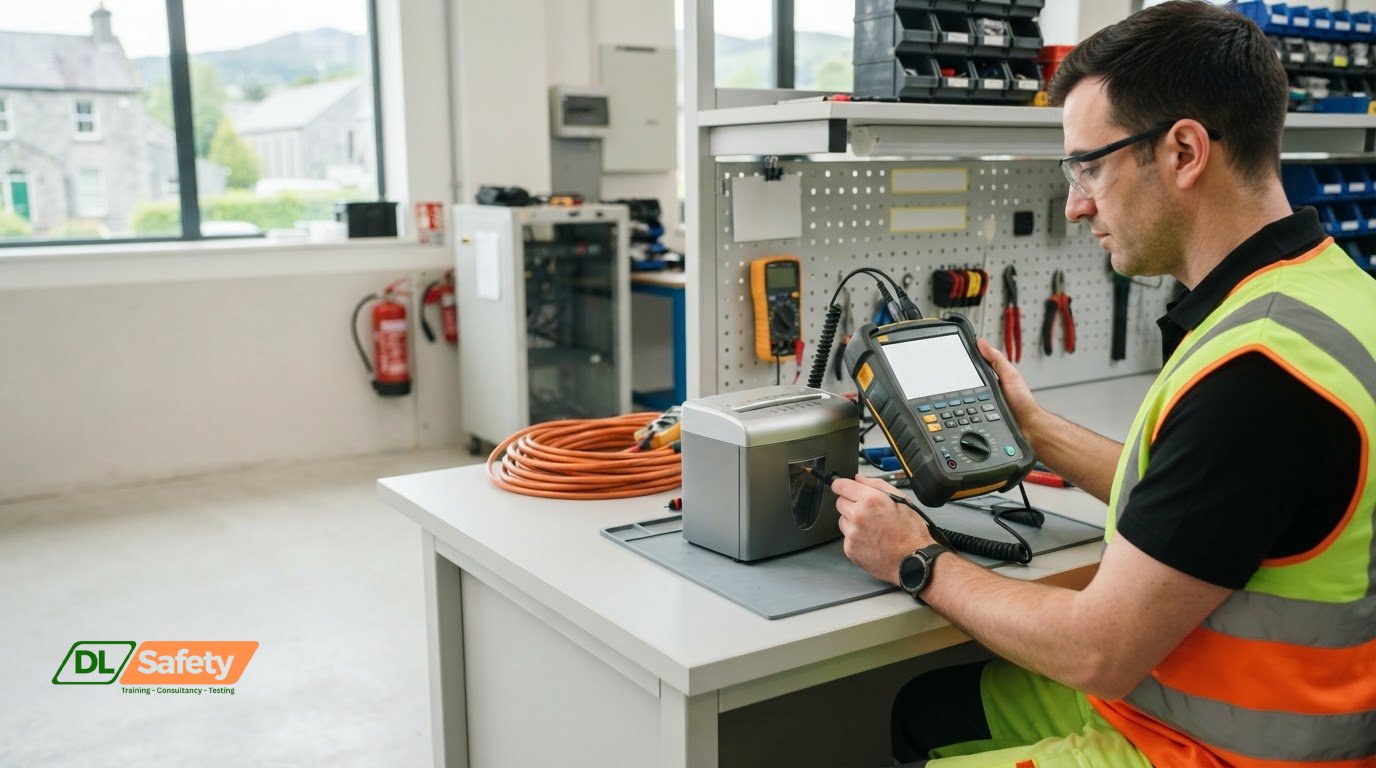
PAT testing regulations in Ireland require employers to keep work equipment safe, with portable equipment periodically inspected and tested by a competent person where conditions could cause deterioration and create a safety risk. The Safety, Health and Welfare at Work Act 2005 places a duty on employers to maintain work equipment safely, according to the Irish Statute Book. Irish law doesn’t set one exact testing frequency, so checks should reflect the equipment and the risks involved.
It’s natural to want a clear testing interval and a straightforward list of appliances to check. The practical answer is that the right approach depends on how equipment is used, where it operates and how likely it is to become damaged or unsafe.
This article explains which workplace appliances may need testing, how to set a risk-based schedule and what records to keep. It also outlines what a PAT inspection involves, so you can plan checks and keep compliance evidence organised.
Key Takeaways
- Employers must keep work equipment, including portable electrical appliances, in a safe condition under the Safety, Health and Welfare at Work Act 2005, according to the Irish Statute Book.
- Choose appliances for testing by considering how they’re used, their condition and the environment they operate in.
- Set inspection intervals according to risk rather than relying on one schedule for every workplace.
- Keep PAT inspection and test records available for 5 years from the inspection date, according to the Irish Statute Book.
- Understand how installation-testing duties differ from checks on portable appliances when organising workplace compliance.
Is PAT Testing a Legal Requirement in Ireland?
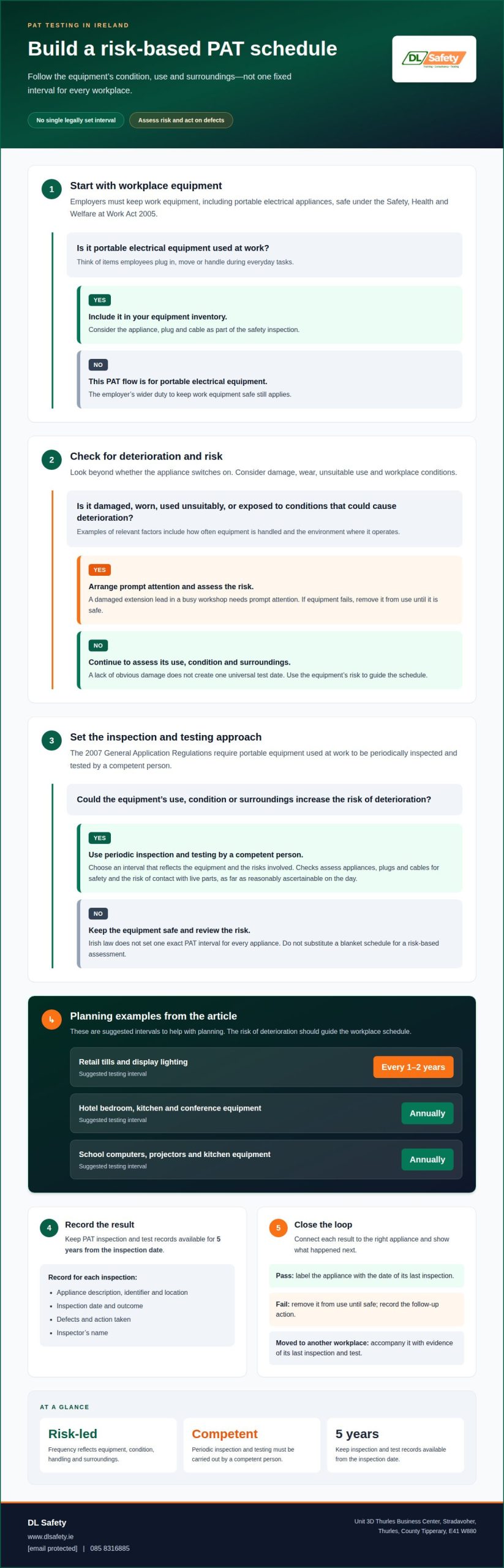
Irish law requires work equipment, including portable electrical appliances, to be safe. The practical duty is to inspect and test equipment in line with its condition, use and associated risks.
Employer Duties for Electrical Equipment
Employers in Ireland are legally required to ensure work equipment, including portable electrical appliances, is maintained in a safe condition under the Safety, Health and Welfare at Work Act 2005, according to the Irish Statute Book. That duty means looking beyond whether an appliance switches on. Check for damage, wear, unsuitable use and workplace conditions that could cause deterioration. A damaged extension lead in a busy workshop needs prompt attention, not simply a future test date.
Inspection and Testing Requirements
The Safety, Health and Welfare at Work (General Application) Regulations, SI 299, 2007, require portable equipment used at work to be periodically inspected and tested by a competent person. Irish PAT testing assesses appliances, plugs and cables for safety and the risk of contact with live parts, as far as reasonably ascertainable on the day of the test. The person carrying out checks needs the competence to inspect and test the equipment safely. A pass label should identify the appliance’s last inspection, helping staff recognise its status. If equipment fails, remove it from use until it is safe.
Testing Frequency by Workplace and Equipment
Irish law does not set one exact PAT testing interval for every appliance. Use a risk-based schedule that reflects the equipment, its condition, how often it is handled and its surroundings. Suggested intervals include testing retail tills and display lighting every 1-2 years, and hotel bedroom, kitchen and conference equipment annually. School computers, projectors and kitchen equipment are also recommended for annual testing. These examples help with planning, but the risk of deterioration should guide the workplace schedule.
Comparing Irish and UK Requirements
Irish employers should follow Irish legislation rather than assume UK guidance sets their obligations. The Irish duty rests on the Safety, Health and Welfare at Work Act 2005 and the 2007 General Application Regulations; testing frequency is risk-based, not one fixed interval. UK rules and guidance belong to a separate jurisdiction, so don’t transfer a UK schedule or interpretation automatically to an Irish workplace. If equipment moves between workplaces, keep evidence of its last inspection and test with it.
Poorly maintained equipment can remain in use despite damage, increasing the risk of electric shock, fire or injury. To meet your safety responsibilities, identify signs of deterioration, arrange competent inspection and testing, and act on defects. Keep PAT records accessible so employers can show which checks were completed and what follow-up was needed.
PAT test records and compliance certificates
Clear records link each appliance to its inspection result and any follow-up action. In Ireland, records should be accurate, accessible and clearly identify the equipment.
PAT Test Records
According to the Irish Statute Book, records of PAT inspections and tests must be kept available for 5 years from the date of inspection. Organise entries so staff can find the right appliance and its latest result without confusion. A simple register can link each record to an equipment label or asset identifier.
For each inspection, record practical details such as:
- The appliance’s description, identifier and workplace location.
- The inspection date and the recorded outcome.
- Any visible defect, action taken and return-to-use decision.
- The name of the person who carried out the inspection and test.
These details help managers trace an issue, such as a damaged kettle moved between rooms. Keep records accessible to an inspector, and make them available to equipment users upon request. A consistent format also makes missing results and overdue follow-up easier to spot.
Compliance Certificates and Reports
A PAT report should show the outcome for each appliance, not merely note that a workplace visit took place. Match the report to the equipment register, using the same identifier and location where possible. This helps managers connect each result to the right item, even when similar appliances are used in different areas.
Keep reports with related inspection records, and note what happened to equipment that failed. For example, record when a defective appliance was removed from use and whether it was repaired or replaced. This creates a clear trail from inspection to corrective action, rather than leaving a pass-or-fail result without context.
Label appliances that pass testing to show the date of their last inspection. Check that each label is legible and attached to the correct item. The label helps identify the appliance quickly, while the detailed report records the result and any relevant notes.
When work equipment is taken to another workplace, it must be accompanied by evidence of its last inspection and test. Keep that evidence easy to retrieve during transport and on arrival. This is particularly useful when equipment moves between sites and the main workplace’s register is not with it.
For help organising workplace checks and their records, see the PAT testing service.
What Appliances Need to Be PAT Tested?
Include portable electrical equipment used at work in your workplace inventory. The appliance, cable and plug may all need to be included in the safety inspection.
Start with items employees plug in, move or handle during everyday tasks. Examples include office computers, monitors and desk lamps; school projectors; hotel bedroom equipment; and workplace kitchen appliances. Other examples include retail tills, display lighting, conference equipment and healthcare devices. Consider whether an item is portable and whether its use or surroundings could expose it to damage or deterioration.
Don’t overlook accessories. Extension leads and detachable cables may be exposed to repeated movement, tight bends, crushing or sharp edges. Add them to the equipment inventory alongside the appliances they serve. For example, record a portable power tool and its extension lead as separate identifiable items, so a damaged lead is not overlooked because the tool itself appears intact.
A PAT check assesses equipment for safety, including risks to people who could come into direct or indirect contact with a live part, as far as reasonably ascertainable on the day of the test. The inspection should consider the appliance, plug and cable. The result describes the equipment’s condition at that time, so later damage or changes in use still need attention.
Record a pass against the correct appliance, and label the item to show its last inspection. Check that the label is readable and belongs to that device. Do not leave a failed appliance in normal use: identify it clearly, prevent staff from using it and record the issue. If it cannot be repaired on site, keep it in a designated quarantine area until it is safe to use again.
Set a clear return-to-use process for repairs. Once work is complete, ensure the equipment is safe before putting it back into service, and update its record. For example, a kettle with a damaged plug should remain out of use until the fault is resolved. Keeping failed items separate from working equipment reduces the risk of someone reconnecting them by mistake.
Allow enough time for access and assessment. A qualified technician may take about two minutes per device, while testing can take up to five minutes depending on the item and its accessibility. Blocked sockets, crowded desks and the need to move equipment can affect access. Group appliances by room and make them reachable to help the inspection proceed efficiently without missing items.
Risk-based PAT testing frequency
Irish law does not set one exact testing interval for every portable appliance. The Health and Safety Authority recommends a risk-based approach, with frequency reflecting the equipment and its working conditions.
Start by grouping equipment according to how it is used, its exposure to damage and its likely deterioration. A desk lamp in a controlled office is different from a power tool used on a construction site. Consider how often staff handle an item, whether it moves between locations, and whether its cable or plug is exposed to knocks, dust or strain. These factors help you set an inspection schedule suited to actual workplace risks.
Suggested intervals illustrate how those differences can affect planning:
- Office computers, monitors and desk lamps: every 2-4 years.
- Construction and other high-risk power tools and extension leads: every 3 months.
- Care-home and healthcare portable electrical equipment: annually or in line with HSE requirements.
- Retail till equipment and display lighting: every 1-2 years.
Use these intervals as planning examples, not as a substitute for assessing your workplace. A construction lead moved across rough surfaces may need closer attention than equipment kept in a clean, fixed position. Similarly, consider how a care-home appliance is handled and where it is used, especially if staff or residents use it frequently.
Build the schedule around an equipment register. Record each appliance’s location, use, condition and next planned check. Group similar items, such as fixed office equipment or frequently moved tools, while making higher-risk items easy to identify. A clear register helps prevent a portable tool from being given the same interval as low-use equipment simply because both belong to one department.
Review the schedule if equipment changes location, its use increases, damage appears or inspection findings show recurring wear. For example, repeated cable damage on a workshop tool is a reason to reassess its inspection interval and how it is stored or handled. Record the reason for scheduling decisions alongside the register so managers can explain how they considered the risks.
Visual checks between formal tests can help staff spot obvious damage early. Ask users to report cracked plugs, frayed cables or loose connections, and remove suspect equipment from use. These checks do not replace periodic testing, but they can prompt action before the next planned inspection. A risk-based programme works best when intervals respond to actual conditions, rather than staying fixed as equipment and work practices change.
PAT testing as a legal requirement in Ireland
Irish employers must keep work equipment safe, but the law does not prescribe one fixed testing interval for every portable appliance. Understanding PAT testing regulations in Ireland helps employers distinguish the general safety duty from decisions about inspection schedules. The key is to assess workplace equipment and act when its condition or use creates a risk.
Under the Safety, Health and Welfare at Work Act 2005, employers are legally required to ensure work equipment, including portable electrical appliances, is maintained in a safe condition, according to the Irish Statute Book. The duty applies to equipment used for work, including items brought into the workplace for a particular task. A portable heater in an office or a drill used during maintenance should be considered as part of workplace equipment management.
The Safety, Health and Welfare at Work (General Application) Regulations 2007 also form part of Ireland’s legal framework. Regulation 89 of the Safety Health & Welfare at Work (General-Application-Regulations) 2007 sets out general duties for testing new and existing installations, according to the Irish Statute Book. Installation testing and portable appliance testing concern different equipment, so Regulation 89 should not be read as setting an interval for every portable appliance.
For portable equipment, employers should arrange periodic inspection and testing by a competent person where conditions could cause deterioration and create danger. The assessment should consider the item’s condition and the risks associated with its use. A PAT result reflects the equipment’s state on the test day. It does not replace action if staff later notice damage or working conditions change.
Irish law does not set an exact PAT testing frequency. The Health and Safety Authority recommends a risk-based approach that considers equipment type, use, condition and surroundings. A lamp that stays in a low-traffic office differs from equipment regularly moved around a demanding work area. Applying PAT testing regulations in Ireland means considering these factors in real workplace conditions, rather than using one calendar interval for every item.
Put the duty into practice by identifying portable equipment, assessing likely deterioration and setting proportionate inspection intervals. Record your reasoning, keep evidence of checks and take defective items out of use. Review the approach when equipment is relocated, its use changes or damage appears. This connects employers’ legal responsibilities with day-to-day decisions and changing workplace risks.
For support with workplace electrical checks, arrange PAT testing for your workplace.
DL Safety: Monthly Safety Support Packages
DL Safety’s Monthly Safety Support Packages provide ongoing health and safety management and compliance support for businesses. If you need help organising electrical equipment risks, inspection records and wider compliance tasks, ongoing safety support can help keep these responsibilities on track. The right level of support depends on your business needs.
DL Safety also provides Lift Plans, GA1 Testing and Accident Investigation. These services address distinct safety needs, so choose the one that matches the task rather than treating them as substitutes for electrical equipment checks.
Contact DL Safety at info@dlsafety.ie or 085 8316885, or visit the DL Safety website. The address is Unit 3D Thurles Business Center, Stradavoher, Thurles, County Tipperary, E41 W880.
Make your next compliance step practical
Turn your inspection approach into a routine by assigning responsibility for equipment lists, defect reporting and record updates. A designated person or team can help capture changes when appliances move, work practices shift or damage is reported. This makes the approach easier to maintain as the workplace changes, rather than treating testing as a one-off task.
Understanding how PAT testing regulations in Ireland apply is a useful starting point. The next step is putting suitable checks into practice at your workplace. For PAT testing support, contact DL Safety to discuss your requirements and agree on the appropriate next step.
Contact DL Safety about PAT testing, and take a clear, considered step towards managing workplace equipment safely.
Frequently Asked Questions
What is PAT Testing?
PAT testing involves inspecting and testing portable electrical equipment used at work. It assesses the appliance, plug and cable for safety, including risks of contact with live parts that can be ascertained on the test day. For example, a workplace check might cover a portable fan and its lead. The process helps employers identify defects, document results and decide whether equipment can remain in use.
How Long Does a PAT Test Last?
Testing one workplace appliance may take about two minutes, or up to five minutes depending on the item and how accessible it is. An easy-to-reach portable kettle may take less time than equipment tucked behind a fixed workstation. The time for a whole workplace visit depends on the number of appliances and how readily each can be accessed. Having equipment ready helps the inspection proceed efficiently.
What are the legal requirements for PAT testing in Ireland?
Employers in Ireland must keep work equipment, including portable electrical appliances, in a safe condition under the Safety, Health and Welfare at Work Act 2005. Portable equipment used at work should be periodically inspected and tested by a competent person where conditions could cause deterioration and create danger. Employers should also organise a risk-based schedule, act on defects and retain records of inspections and tests.
Is PAT testing legally mandatory for employers in Ireland, and how often is it required?
Employers have a legal duty to keep work equipment safe, but Irish law does not set one exact PAT testing frequency for every appliance. The Health and Safety Authority recommends a risk-based approach. Consider how equipment is used, its condition and its surroundings. A frequently moved appliance exposed to knocks may need closer attention than equipment kept in a controlled area. Review intervals if use or conditions change.
How often should different types of portable appliances be inspected and tested in Ireland?
Suggested intervals vary with workplace and equipment type. Office computers, monitors and desk lamps are recommended for testing every 2-4 years; construction and other high-risk power tools and extension leads every 3 months. Retail till equipment and display lighting are suggested every 1-2 years. Hospitality and school equipment are recommended annually. These are planning examples, so assess actual use, exposure to damage and the working environment.
What visual inspections and electrical tests are included in Irish PAT testing?
A PAT assessment considers the appliance, plug and cable, checking for visible damage such as a cracked plug casing or frayed insulation. It also assesses electrical safety and the risk of contact with live parts, as far as reasonably ascertainable on the test day. The precise checks depend on the equipment. The result records its condition at that time, so any later damage still needs attention.
What records must employers keep after PAT testing in Ireland?
Keep records identifying the appliance, its inspection date and result, along with defects and actions taken. Link each entry to a label or asset identifier so similar devices aren’t confused. According to the Irish Statute Book, records of PAT inspections and tests must be kept available for 5 years from the date of inspection. Make them available for an inspector, and allow equipment users access upon request.
What are the steps for arranging compliant PAT testing in Ireland?
Start by listing portable electrical equipment and recording where each item is used. Group appliances by type and working conditions, then arrange periodic inspection and testing by a competent person. Make equipment accessible on the day, and take failed items out of use until they are safe. Match results to appliance identifiers, update labels and records, and set review dates that reflect each item’s risks.