When budgeting for the cost of PAT testing per item Ireland businesses need to consider, the lowest-looking figure may not tell the whole story. The total depends on the appliance numbers and types, the work covered during a site visit and the records provided afterwards.
It’s understandable to want one clear figure, but quotes can describe different scopes, making headline rates difficult to compare fairly. PAT testing is a legal requirement for portable electrical equipment on construction sites, so it’s important to understand what is covered and plan the work around your workplace.
This article explains the main factors that shape a per-item quote, how an appliance inventory can help you compare proposals on a like-for-like basis, and what to prepare to minimise disruption. DL Safety provides PAT testing for Irish businesses. Contact the team at www.dlsafety.ie, info@dlsafety.ie or 085 8316885.
Key Takeaways
- The cost of PAT testing per item Ireland businesses are quoted is a pricing unit, not a complete description of the work covered.
- Compare quotes against the same appliance inventory, checking item scope, site attendance, stated extras and service boundaries.
- For construction-site testing, include power tools, leads, chargers, portable lighting and welfare equipment when identifying appliances.
- Record where appliances are kept and organise access before testing to support clear planning and reduce disruption.
What determines PAT testing costs per item in Ireland?
A per-item figure depends on the agreed scope and the circumstances of the site. The number of appliances, the range of equipment, how easily items can be reached and whether they’re ready for inspection all affect the work involved. A quote may also separate the item-testing rate from attendance or other charges, so the per-item figure alone may not show the full cost of the visit.
A headline per-item rate can mislead if the appliances, attendance and work covered aren’t comparable. To understand the cost of PAT testing per item Ireland-wide, compare quotes against the same inventory and scope rather than treating an advertised figure as a complete price. For general background on the purpose and practice of Portable Appliance Testing (PAT), see the overview from Wikipedia.
Which factors can change a per-item quote?
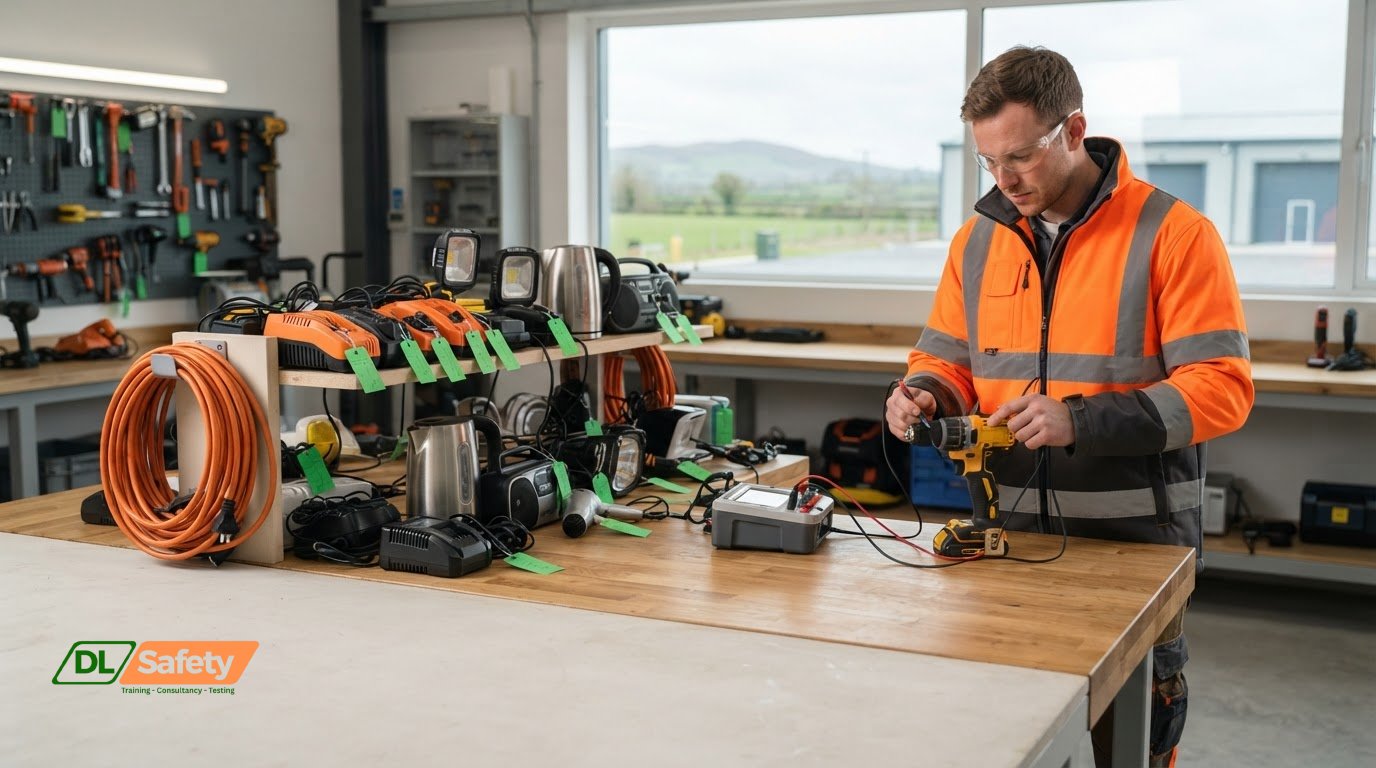
Appliance volume matters, but so does the equipment mix. A list of similar, readily accessible items presents a different job from one containing varied equipment across several work areas. On construction sites, the inventory can include power tools, leads, chargers, portable lighting and welfare equipment. These are all included in the portable appliances DL Safety tests for construction sites.
Site organisation also affects how efficiently the work proceeds. Items that are identified, grouped and accessible are easier to account for than equipment in use, stored in different places or difficult to locate. When comparing a quote, check that it identifies the appliances being presented for testing and sets out what the quoted charges cover.
Why one provider’s rate is not a national benchmark
Pricing can be structured in different ways. One quote may show an item rate alongside a separate attendance charge; another may use volume bands or a package for a defined number of appliances. These are different pricing approaches, not evidence of a single Irish market rate. Unless the inventory and any separate charges match, a lower-looking item figure may not mean a lower overall cost.
For a fair comparison, set out the same details for each proposal:
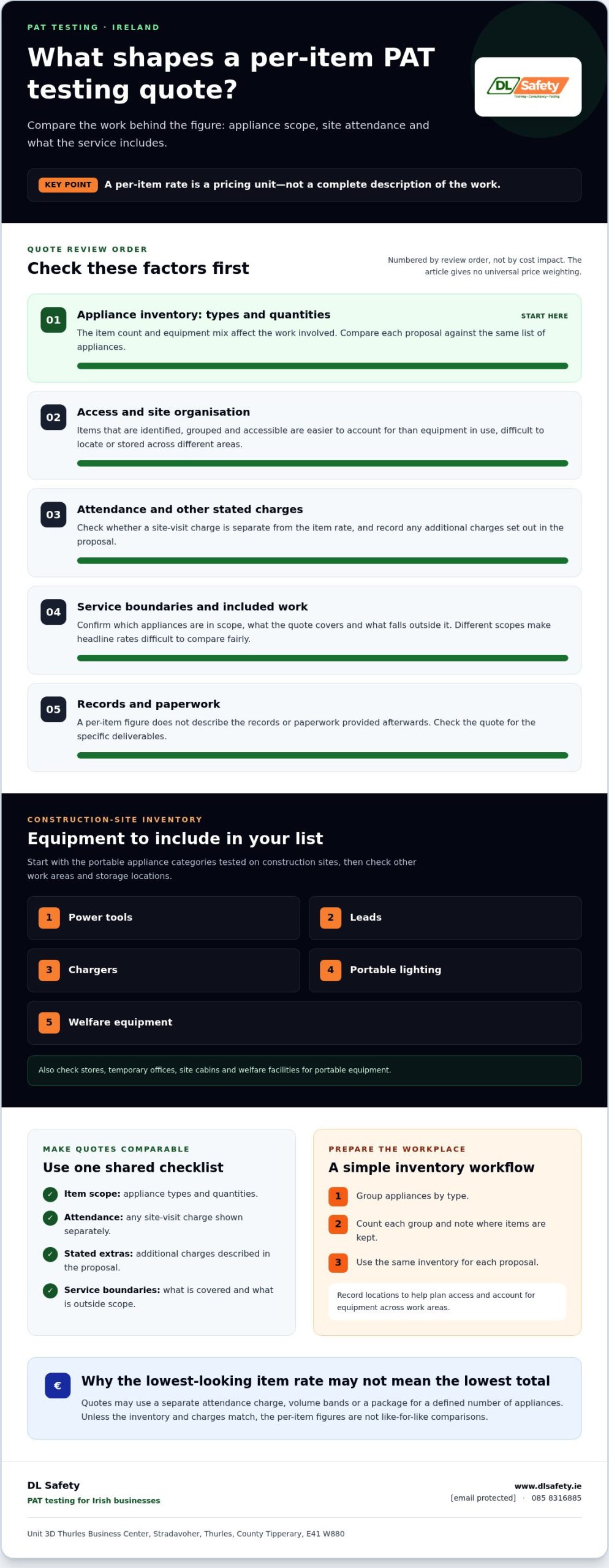
- Item scope: List the appliances to be tested, with their types and quantities.
- Attendance: Separate any site-visit charge from the per-item amount.
- Stated extras: Record any additional charges described in the proposal.
- Service boundaries: Note what the quote covers and what falls outside that scope.
This approach keeps the comparison grounded in your workplace rather than an advertised rate. DL Safety provides PAT testing for portable appliances on construction sites, including power tools, leads, chargers, portable lighting and welfare equipment. A clear inventory gives the discussion a practical starting point and helps define the items in scope.
What does a PAT testing per-item quote need to cover?
A per-item quote uses each appliance as a pricing unit; it doesn’t, by itself, explain which appliances are included or everything the service covers. To judge the cost of PAT testing per item Ireland businesses are quoted, look for a clear description of the inventory behind the figure, including equipment categories and quantities. A rate applied to a defined list is more meaningful than one attached to an unclear item count.
Scope matters in practice. A proposal might refer to a specific group of appliances, while your workplace has equipment across several buildings or functions. Before comparing totals, make sure you’re looking at the same types and quantities, and check that any separate charges or limits are clearly described.
Which workplace appliances should businesses include in the inventory?
For construction sites, DL Safety tests portable appliances including power tools, leads, chargers, portable lighting and welfare equipment. Use these categories to start your inventory, then check other work areas where portable equipment is used. Appliances may also be kept in stores, temporary offices, site cabins or welfare facilities.
List each category and quantity to show what needs to be considered. Keep the appliance scope distinct from any assumptions about labels, certificates or records: a per-item figure alone doesn’t describe those deliverables. Check the quote for the specific records and paperwork it includes.
How to make the quoted scope clear
A useful inventory gives everyone a practical reference. Record the equipment type, number of items and their locations. If the same kind of appliance appears in different areas, note each location so it’s easier to plan access and account for all the equipment.
- Group appliances by type, such as tools, leads or portable lighting.
- Count the items in each group and note where they’re kept.
- Use the same inventory when reviewing each proposal so you can compare like with like.
This preparation clarifies what the quoted item count represents. It also makes it easier to spot differences in scope, such as a category included in one proposal but not another. Keep the inventory focused on the equipment being presented for testing, and check separately what documentation or labelling the quote covers.
For wider context on construction-site responsibilities, read the sibling guide, PAT Testing for Construction Sites Ireland. If your inventory includes portable appliances used on site, DL Safety’s PAT testing service provides a practical option for Irish businesses.
How to compare PAT testing quotes beyond the per-item figure
A fair comparison requires matching the appliance scope and quote inclusions. A lower per-item figure may relate to a smaller inventory, different appliance categories or a different approach to attendance. To assess the cost of PAT testing per item Ireland-wide, put each proposal beside the same equipment list and record what each total covers.
Use a simple comparison table to make differences visible. Enter the details from each proposal rather than assuming similar wording means identical work.
| Comparison point | Proposal A | Proposal B | What to compare |
|---|---|---|---|
| Item scope | Categories and quantities stated | Categories and quantities stated | Are both based on the same inventory? |
| Attendance | Any separately stated charge | Any separately stated charge | Is attendance separate or included in the quoted total? |
| Stated extras | Any additional items or charges described | Any additional items or charges described | Are the same extras included in both proposals? |
| Service boundaries | Work expressly covered | Work expressly covered | Are any tasks or equipment excluded? |
A simple like-for-like quote comparison
Start with the appliance categories and quantities named in each proposal. Check whether the same groups are included, and note any differences in how items are defined. Record attendance charges or other separately stated costs as written. Don’t fold them into the per-item figure unless the proposal does so. If an element is unclear or defined differently, mark it as not directly comparable rather than treating it as equivalent.
This lets you compare the quoted total with the work you actually need, not just the headline rate. It also gives you a clear list of scope differences to resolve before making a decision.
How to assess value without assuming the cheapest is best
Price matters, but value also depends on whether the scope fits your workplace, whether the practical arrangements suit your site and whether the service is delivered with relevant safety experience. DL Safety takes a practical, expert-led approach to PAT testing and brings over 25 years of industry expertise. That experience supports informed work, but it isn’t a promise of a particular test outcome.
Repairs or replacement are separate considerations unless a proposal explicitly says they’re included. Don’t assume a failed appliance will be repaired, replaced or charged for in a particular way based solely on a per-item rate. Keep those possibilities distinct from the testing quote, and base your decision on the inventory, stated inclusions and needs of your workplace.
How to prepare your business for PAT testing
A little preparation makes the testing scope easier to define and the site visit more straightforward to organise. Start by identifying the portable appliances in use, note where they’re kept, plan how they can be accessed and agree which equipment is included in the work. A clear inventory also gives you a consistent basis for comparing proposals, particularly when your workplace uses a varied mix of appliances.
The setting matters. Construction, transport, quarry, agriculture, civil engineering, demolition, commercial and pharmaceutical workplaces can each have different work areas, equipment and access arrangements. A shared office and a site with active work zones may need different practical planning. Focus on how your own workplace is organised rather than relying on a generic equipment list.
Build a practical appliance inventory
Group equipment by type and work area so items are easier to count and locate. For example, record power tools, leads, chargers and portable lighting separately, and include welfare equipment. Note whether items are kept in a workshop, store, vehicle, site office or welfare area. The aim is to create a useful picture of what’s present and where.
For a mixed inventory, avoid relying on one overall item count. A count broken down by category can highlight areas that might otherwise be missed, such as equipment used away from the main work zone. It also helps ensure you use the same categories and quantities when reviewing proposals. The inventory describes the appliances to be considered; it isn’t a prediction of test results or a description of the documentation included.
Organise access and agree the work scope
Once the list is prepared, consider how each group of appliances can be reached. Gather items where practical, identify equipment that may remain in use and note any site constraints that could affect access. This helps plan the work around normal operations. Before the visit, use the inventory to set out which equipment is in scope and keep that description consistent in your quote comparisons.
- Identify appliances across all relevant work areas and facilities.
- Record each item type, quantity and location in a practical list.
- Organise access and flag operational constraints that affect when or where equipment can be reached.
- Agree the appliance scope so the planned work reflects the inventory.
DL Safety provides PAT testing as a technical safety service for Irish businesses. Connecting appliance testing with wider workplace arrangements can help keep safety planning joined up; for broader context, consider how it fits within Health and Safety Compliance Ireland.
Ready to plan testing around your workplace inventory? Arrange PAT testing with DL Safety.
Arrange PAT testing with DL Safety across Ireland
For businesses planning portable appliance testing, the first useful step is a clear view of the equipment and the workplace it serves. DL Safety provides PAT testing as part of its technical safety services for Irish businesses, with nationwide coverage. As an Irish-owned business with over 25 years of industry expertise, the team offers a practical, expert-led approach.
On construction sites, equipment in scope includes power tools, leads, chargers, portable lighting and welfare equipment. These categories can help you shape an inventory, but the most useful starting point is the equipment actually present at your workplace. A list grouped by type and location helps describe the job clearly, whether appliances are kept in a work area, store, vehicle, site office or welfare facility.
What businesses can expect from DL Safety
Clear preparation supports a focused discussion about the work. Share the types and quantities of appliances you have, where they’re located and any practical access considerations. This provides context for the testing scope and keeps the conversation relevant to your equipment and requirements.
DL Safety’s technical safety experience means PAT testing can be considered as part of a practical workplace safety approach. The priority is to understand the appliances and their setting, rather than rely on a headline per-item figure without context. For a varied inventory, identifying the different equipment groups helps describe your requirements accurately.
Take the next step with a clear inventory
Before getting in touch, gather what you know about the portable appliances you want tested. A simple list of equipment types, quantities and locations is a helpful starting point. Include relevant workplace context, such as how the areas are organised and any access constraints that could affect planning. This information helps frame a useful discussion of the scope.
Contact DL Safety through www.dlsafety.ie, email info@dlsafety.ie or call 085 8316885.
If you’re assessing the cost of PAT testing per item Ireland businesses need to budget for, a clear inventory is a sound basis for discussing scope and site circumstances. Discuss your PAT testing requirements with DL Safety and share your workplace inventory.
Make your next PAT testing step straightforward
As your workplace changes, keep its appliance inventory useful by updating it when equipment is added, moved or taken out of use. That gives future planning a clearer starting point and helps you describe the job accurately when reviewing the cost of PAT testing per item Ireland businesses need to budget for.
A considered decision is about more than the smallest figure on a page. Focus on a proposal that reflects your workplace and the equipment you need tested, with the scope and charges clearly set out. This makes it easier to plan the work with confidence and keep safety arrangements connected to the way your business operates.
DL Safety is an Irish-owned business with nationwide coverage, bringing over 25 years of industry expertise to its technical safety services, including PAT testing. Take the next step and share your workplace inventory with the team.
Discuss your PAT testing requirements, and move forward with a clear, practical plan for your business.
Frequently Asked Questions
How much does PAT testing cost per item in Ireland?
There isn’t one national cost of PAT testing per item Ireland businesses can use as a guaranteed rate. The quote depends on the appliances and quantities in scope, their mix and the site arrangements. Some proposals show attendance separately from the item charge, while others present charges differently. Prepare an inventory and compare proposals based on the same equipment and stated inclusions.
What factors affect the cost of PAT testing?
Appliance quantity, equipment types, access and how clearly the work is organised can all shape the scope of a quotation. Equipment kept across separate work areas may take more planning to present than items gathered in one accessible location. Attendance and item charges can also be structured differently. Prepare one inventory and use it for each proposal, comparing scopes that describe a similar set of appliances and work.
Does a PAT testing quote include a site visit?
Proposals can describe attendance and item testing in different ways. Check the full wording to see whether site attendance is included in the stated total or identified separately, and note any other distinct charge. Don’t infer the arrangement from a per-item rate alone. DL Safety’s PAT testing service is planned around the workplace inventory and testing requirements.
Which items should a construction business include for PAT testing?
DL Safety tests portable appliances on construction sites, including power tools, leads, chargers, portable lighting and welfare equipment. Use these categories as prompts, then consider appliances in areas such as stores, site offices and welfare facilities so your inventory reflects the workplace. Keep categories and quantities consistent when reviewing quotes. For broader context on PAT testing in that setting, see DL Safety’s construction PAT testing guide.
Is PAT testing required by law in Ireland?
PAT testing is a legal requirement for portable electrical equipment on construction sites. This answer is limited to that stated construction-site scope and doesn’t set out testing intervals or interpret other legal requirements. If you’re planning testing for a construction workplace, an equipment inventory helps define what needs to be considered. The construction PAT testing guide provides further context for that setting.
Can PAT testing be charged at a different rate for different appliances?
Equipment types can affect the work involved, and quotes may define appliance categories or scope differently. That doesn’t mean one tariff structure applies everywhere. For instance, a proposal may describe equipment by category, while another may use a broader item count. List the appliance types and quantities you want tested, then compare how each proposal treats those same categories. Repairs shouldn’t be assumed to form part of the testing charge.
How can a business prepare for a PAT testing quote?
Prepare a list showing portable appliance types, quantities and work areas. For a construction business, include power tools, leads, chargers, portable lighting and welfare equipment, then note where these are kept and any access constraints. Use the same inventory when reviewing proposals so the requested scope is consistent. This gives you a clearer basis for discussing the work and distinguishing appliance coverage from other arrangements described in a quote.