
Did you know that manual handling activities remain the single largest trigger for non-fatal workplace injuries in Ireland, accounting for a staggering one-third of all reported accidents? It is a sobering statistic that highlights why the Health and Safety Authority remains so vigilant regarding training standards. You likely already recognise that keeping your team safe is about more than just ticking a box, yet the confusion between online-only modules and blended learning often makes compliance feel like a moving target.
Securing a valid manual handling certificate Ireland is actually a straightforward process when you have the right partner to demystify the Safety, Health and Welfare at Work Act 2005. At DL Safety, we believe in a pragmatic approach that prioritises both legal rigour and human safety. This 2026 guide will walk you through the essential steps to achieve full compliance, from understanding QQI Level 6 instructor requirements to navigating the mandatory practical assessment. Whether you are arranging public courses nationwide or coordinating bespoke on-site training for your staff, we’ll ensure you move from a state of uncertainty to total confidence in your workplace safety protocols.
Key Takeaways
- Master the legal requirements of the Safety, Health and Welfare at Work Act 2005 to ensure your business stays ahead of HSA inspections.
- Recognise why a valid manual handling certificate Ireland must include a practical assessment to be considered legally robust and compliant.
- Understand the three-year renewal period and how to keep your staff training records organised and up to date to avoid gaps in safety.
- Learn how to select a QQI Level 6 qualified instructor who can provide bespoke training specific to your industrial or construction environment.
- Discover the benefits of bundling manual handling into a Monthly Safety Support Package for seamless, long-term compliance management.
Understanding Manual Handling Legislation in Ireland
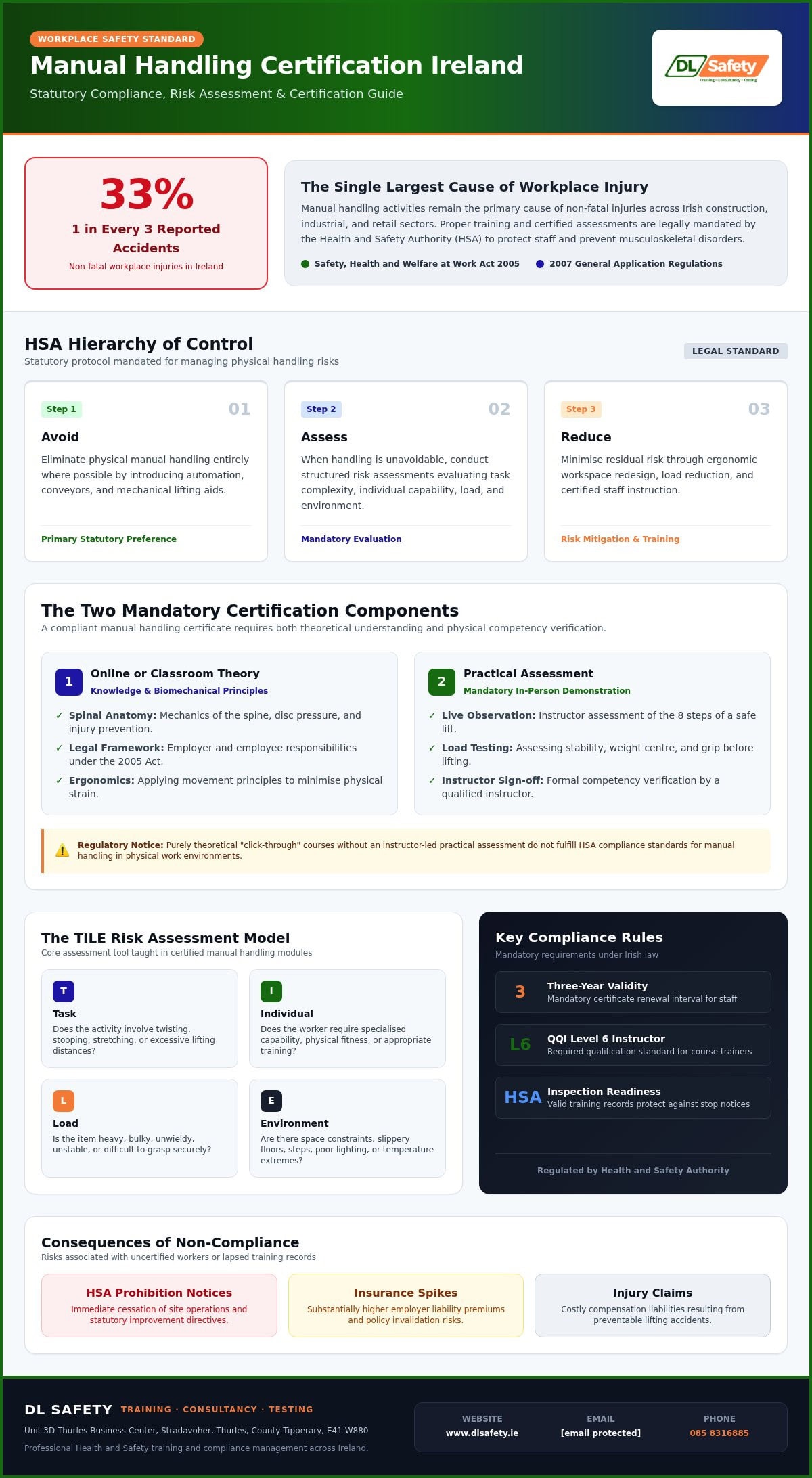
Safety in the workplace isn’t just a recommendation; it’s a legal cornerstone. The primary legislation governing these standards is the Safety, Health and Welfare at Work Act 2005, which sets out a clear framework for protecting everyone on-site. Under this Act, and the subsequent 2007 General Application Regulations, the Health and Safety Authority (HSA) requires that every employee who engages in physical lifting receives proper instruction. This is why securing a manual handling certificate Ireland is a non-negotiable requirement for businesses across the construction, industrial, and retail sectors.
The 2005 Act and General Application Regulations
The law is quite specific regarding the movement of goods and materials. Manual handling is any activity involving the lifting, putting down, pushing, pulling, or carrying of a load. To manage these risks, the HSA enforces a strict hierarchy of control known as “Avoid, Assess, Reduce.” Employers must first try to avoid manual handling altogether through automation or mechanical aids. If handling is unavoidable, they must assess the risks and reduce them through training and better workspace design. Understanding foundational manual handling principles and lifting techniques is essential for this process, as it helps workers recognise the biomechanical limits of the human body.
Employers hold the primary responsibility to provide a safe system of work, which includes providing the necessary training and equipment. In high-risk environments such as healthcare, introducing specialised engineering solutions like transfer systems and powered bed movers can drastically reduce physical strain—find out more about dedicated handling equipment. However, safety is a two-way street. Employees have a legal duty to follow the safe systems taught during their training and to use any provided mechanical aids correctly. Failure to do so doesn’t just risk injury; it compromises the entire safety culture of the organisation and can lead to long-term health complications.
Consequences of Non-Compliance
Ignoring these regulations carries heavy penalties. During a routine inspection, the HSA can issue improvement or prohibition notices that may halt your operations entirely. Beyond legal fines, businesses face the threat of soaring insurance premiums and costly personal injury claims if an accident occurs due to a lack of training. For a deeper look at how these rules fit into your broader obligations, you can read our guide on Health and Safety Compliance Ireland. At DL Safety, based at Unit 3D Thurles Business Center, Stradavoher, Thurles, County Tipperary, E41 W880, we help you avoid these pitfalls by ensuring your team holds a valid manual handling certificate Ireland. You can reach David and the team at info@dlsafety.ie, call 085 8316885, or visit www.dlsafety.ie to book your training. Keeping your staff safe ensures your business remains productive and legally protected.
Theory vs Practical: The Two Essential Components of Certification
A recurring issue in the safety industry is the proliferation of “click-through” certificates. These purely theoretical courses often leave workers ill-equipped for the physical demands of their roles. To secure a valid manual handling certificate Ireland, you must bridge the gap between knowing and doing. The Safety, Health and Welfare at Work (General Application) Regulations 2007 mandate that training must be appropriate to the risks involved. If your staff are lifting heavy pallets or awkward machinery, an automated quiz simply cannot verify their physical ability to do so safely. A legally robust certificate requires an instructor to observe and sign off on your technique.
Online Theory: What You Will Learn
The Practical Assessment: Demonstrating Competency
Theory only gets you so far. During a face-to-face session, an instructor observes your ability to execute the 8 steps of a safe lift in real-time. This includes everything from testing the load’s weight and stability to ensuring a firm grip and using the legs rather than the back. We don’t just focus on standard boxes; we assess how your team handles unusual loads, including pushing, pulling, and team lifting. The instructor provides immediate feedback, correcting posture and foot placement until the movement becomes second nature. This hands-on verification is what truly satisfies HSA inspectors during a site audit.
We’ve found that generic training often fails because it doesn’t reflect the worker’s actual environment. Our bespoke manual handling training is designed to meet your specific operational needs nationwide. We bring the training to your site, using your actual equipment, to ensure the skills learned are immediately applicable. If you’d like to arrange a session at our centre at Unit 3D Thurles Business Center, Stradavoher, Thurles, County Tipperary, E41 W880, or at your own facility, contact David at info@dlsafety.ie or call 085 8316885 to get started. Visit www.dlsafety.ie for more information.
Choosing the Right Manual Handling Course in Ireland
Finding a training provider is easy, but finding one whose certification stands up to scrutiny is where the challenge lies. When you’re looking to secure a manual handling certificate Ireland, it’s vital to look beyond the price tag. Cheap, automated courses often lack the rigour required by site managers and HSA inspectors, making them a false economy if your staff are turned away from a site for having inadequate training. High-quality instruction must align with European Directive 90/269/EEC requirements, which set the baseline for load risk assessment across the EU. At DL Safety, we ensure our training isn’t just a box-ticking exercise but a practical tool for reducing workplace injury.
Accreditation Standards: QQI vs CPD
Understanding the National Framework of Qualifications (NFQ) helps you make an informed choice. For most general workers, a certificate issued by a QQI Level 6 qualified instructor is the gold standard. While CPD (Continuing Professional Development) certificates are appropriate for low-risk environments or annual refreshers, high-risk sectors often demand the formal validation that only a QQI-aligned trainer can provide. You should always verify that your instructor holds the relevant Level 6 Manual Handling Instructor award to ensure the training is legally recognised during a site audit.
Industry-Specific Training Requirements
Generic training often misses the mark in industrial settings. Construction workers, for instance, need instruction that complements their Safe Pass and addresses the specific hazards of a live site, such as uneven terrain or bulky building materials. Similarly, warehouse staff require focus on high-frequency lifting and pallet management. For those looking to expand their skills further, we offer Online Safety Courses Ireland that cover a range of compliance needs. For advanced roles moving into lifting equipment inspection, understanding LEEA standards alongside your manual handling training provides a comprehensive safety foundation.
DL Safety, located at Unit 3D Thurles Business Center, Stradavoher, Thurles, County Tipperary, E41 W880, specialises in this high-level industrial focus. We don’t believe in one-size-fits-all solutions; instead, we tailor our approach to the actual loads your team handles daily. You can contact David at info@dlsafety.ie or call 085 8316885 to discuss bespoke training that fits your specific industry. Visit www.dlsafety.ie to see how we can support your long-term compliance goals and keep your team working safely.
Steps to Obtain Your Manual Handling Certificate
Getting your manual handling certificate Ireland doesn’t have to be a bureaucratic headache. It starts with booking a session with a provider that understands the industrial landscape. Once you’ve secured your spot, you’ll work through the theory modules, which cover the legalities and the TILE framework we discussed earlier. The most critical step is the practical assessment; this is where you demonstrate your technique under the watchful eye of a QQI Level 6 instructor. After successfully completing both parts, you’ll receive your certificate, which should be immediately filed within your company’s safety statement to ensure you’re ready for any surprise inspections.
Preparing for Your Training Session
Preparation is simple but essential for a smooth experience. For the practical portion, you’ll need to wear flexible clothing that allows for a full range of movement; workwear or comfortable trousers and steel-toed boots are usually best. Ensure you have your PPS number and employer details ready for the registration process. It’s also a good idea to refresh your memory on the basic TILE principles before you arrive, as this helps you engage more effectively with the instructor’s demonstrations and questions.
Post-Certification: Keeping Records
Your manual handling certificate Ireland is typically valid for three years, though you might need a refresher sooner if your job role changes or a workplace accident occurs. We recommend storing a digital copy on your phone or a cloud-based folder. This ensures you can provide instant proof of training to site managers or HSA inspectors without having to hunt for paperwork. If you are an employer, keeping a digital training matrix is the most efficient way to track expiry dates across your team. You can learn more about how to verify a safety training certificate to ensure your records are always audit-ready.
Our team at DL Safety is here to support you at every stage of the process. We are based at Unit 3D Thurles Business Center, Stradavoher, Thurles, County Tipperary, E41 W880. You can reach us at info@dlsafety.ie or call 085 8316885 to arrange your session. For more information on our full range of services, visit www.dlsafety.ie and book your manual handling course to stay compliant and safe.
Integrating Training into Your Monthly Safety Support
A manual handling certificate Ireland should never be viewed as a standalone document tucked away in a drawer. Instead, it serves as a vital component of your company’s Safety Statement, acting as a live record of your commitment to worker welfare. When safety training is isolated from daily operations, it often becomes a reactive task rather than a proactive shield. By weaving manual handling into a broader safety culture, you create a workplace where safe lifting is the standard behaviour, not just a rule followed during an inspection.
Retained safety services offer a pragmatic solution for businesses that want to move beyond basic compliance. At DL Safety, we position training as a strategic tool to reduce workplace accidents and subsequent insurance claims. Our approach ensures that your safety protocols evolve alongside your business, rather than becoming stagnant or outdated.
Managing Training Matrices for Large Teams
Managing safety for a team of 50 or more staff presents significant administrative challenges. It is easy for renewal dates to slip through the cracks, leaving you exposed during a surprise HSA audit. Our Monthly Safety Support Packages are designed to remove this stress by automating the reminder process. We maintain a detailed training matrix for our clients, tracking every manual handling certificate Ireland to ensure no one is working with expired credentials.
This systematic oversight is particularly crucial for new starters. We ensure that every new recruit receives the necessary instruction and practical assessment before they hit the site. This proactive management prevents the common bottleneck of having skilled workers sidelined because their paperwork isn’t in order.
The ROI of Professional Safety Training
The financial impact of musculoskeletal disorders (MSDs) on Irish businesses is substantial. These injuries are a leading cause of long-term absenteeism, resulting in lost productivity and increased operational costs. Investing in high-quality, face-to-face training provides a clear return on investment by keeping your most valuable assets, your people, healthy and on the job. A generic online video cannot correct a worker’s posture, but a dedicated instructor can prevent a life-altering injury.
We believe that professional safety support should be accessible and straightforward. If you want to streamline your compliance and protect your team, we are ready to help. You can reach David and the team at info@dlsafety.ie or call 085 8316885 to discuss how our Monthly Safety Support Packages can work for you. Visit our centre at Unit 3D Thurles Business Center, Stradavoher, Thurles, County Tipperary, E41 W880, or explore www.dlsafety.ie to organise your next training session and secure your long-term workplace safety.
Secure Your Workplace Safety Standards
Maintaining a safe work environment requires more than a casual awareness of lifting techniques. By prioritising a blended approach that combines rigorous theory with hands-on practical assessment, you ensure your team is truly protected from injury. A valid manual handling certificate Ireland is a core requirement for HSA compliance. It must be renewed every three years to keep your safety statement audit-ready and your insurance premiums stable.
Our expertise in industrial safety compliance provides the peace of mind you need to focus on your core operations. We invite you to visit us at Unit 3D Thurles Business Center, Stradavoher, Thurles, County Tipperary, E41 W880, or reach out to David directly at 085 8316885 or info@dlsafety.ie. Let’s work together to build a proactive safety culture that reduces risk and supports your business growth. Book your Manual Handling Training with DL Safety today and take the first step toward a safer, more compliant future.
Frequently Asked Questions
Is an online-only manual handling certificate valid in Ireland?
No, a 100% online course without a practical assessment is generally not considered sufficient by the HSA. While the theory can be completed via e-learning, a qualified QQI Level 6 instructor must observe your physical lifting technique. This can be done in person or via a live video link to ensure you can safely apply the principles in a real-world setting. Purely theoretical certificates often fail to meet site audit standards.
How long does a manual handling certificate last before it expires?
A manual handling certificate Ireland is typically valid for three years. Although there is no specific expiry date in the primary legislation, the Health and Safety Authority (HSA) and industry best practices mandate refresher training every 36 months. You should renew your certification sooner if your job tasks change significantly, if new machinery is introduced, or if an employee returns to work following a back-related injury.
Do I need a manual handling certificate if I already have a Safe Pass?
Yes, you still need a dedicated manual handling certificate even if you hold a valid Safe Pass. While the Safe Pass course covers general site safety and mentions lifting hazards, it doesn’t provide the in-depth practical assessment or the 8-step lifting technique required by the 2007 General Application Regulations. Site managers across Ireland will check for both individual certifications before allowing workers to commence physical tasks on a live construction site.
What is the cost of a manual handling course for a small business?
Costs for manual handling training are influenced by the size of your group and whether you require on-site instruction or a public course. While prices vary across the industry, choosing a reputable provider ensures the training is recognised by site managers and inspectors. It’s often more cost-effective for small businesses to book a private session for their entire team to ensure everyone is certified simultaneously, reducing the administrative burden of tracking multiple expiry dates.
Can an employer be fined if staff do not have manual handling certificates?
Yes, employers can face significant penalties, including fines and prohibition notices, if their staff lack valid training records. During a Health and Safety Authority (HSA) inspection, you must be able to produce a current manual handling certificate Ireland for every worker involved in lifting or moving loads. Non-compliance doesn’t just lead to legal fees; it also increases your exposure to personal injury claims and can result in higher insurance premiums.
What happens during the practical part of the manual handling assessment?
During the practical assessment, a QQI Level 6 instructor will ask you to demonstrate a safe lift using the 8-step technique. You’ll be evaluated on your ability to assess the load, maintain a stable base, and use your leg muscles rather than your back. The session also covers more complex movements like pushing, pulling, and team lifting. This hands-on verification ensures you can apply theoretical knowledge to the actual materials you handle daily.
Is manual handling training mandatory for office workers?
Training is mandatory for any employee who is required to lift, move, or support loads as part of their job. While office workers might lift less frequently than warehouse staff, activities like moving heavy boxes of files or restocking printer paper fall under the 2005 Act. Employers should conduct a risk assessment to determine the level of training required, but providing basic certification is the most effective way to prevent musculoskeletal injuries in an office environment.
How do I check if my manual handling certificate is QQI accredited?
You can verify your certification by checking the credentials of the training provider and the instructor. A valid certificate should state that the training was delivered by an instructor holding a QQI Level 6 Manual Handling Instructor Award. You can also contact the training centre directly to confirm the certificate’s authenticity. At DL Safety, we ensure all our training meets these high standards, providing you with a recognised and audit-ready document for your records.
